Question # 4
Scenario:
Please read this scenario prior to answering the Question
You are serving as the Lead Enterprise Architect at a major supplier in the automotive industry. The company is headquartered in Cleveland, Ohio with manufacturing plants across the United States, Brazil, Germany, Japan and South Korea. Each of these plants has been operating its own planning and production scheduling systems, as well as custom developed applications that drive the automated production equipment at each plant.
The company is implementing lean manufacturing principles to minimize waste and improve the efficiency of all of its production operations. During a recent exercise held for internal quality improvement, it was determined that a significant reduction in process waste could be achieved by replacing the current planning and scheduling systems with a common Enterprise Resource Planning (ERP) system located in the Cleveland data center. This central system would provide support to each of the plants replacing the functionality in the existing systems. It would also eliminate the need for full data centers at each of the plant facilities. A reduced number of IT staff could support the remaining applications. In some cases, a third-party contractor could provide those staff.
The Enterprise Architecture department has been operating for several years and has mature, well-developed architecture governance and development processes that are strongly based on TOGAF 9.
At a recent meeting, the Architecture Board approved a Request for Architecture Work sponsored by the Chief Engineer of Global Manufacturing Operations. The request covered the initial architectural investigations and the development of a comprehensive architecture to plan the transformation.
The Common ERP Deployment architecture project team has now been formed, and the project team has been asked to develop an Architecture Vision that will achieve the desired outcomes and benefits. Some of the plant managers have expressed concern about the security and reliability of diving their planning and production scheduling from a remote centralized system. The Chief Engineer wants to know how these concerns can be addressed.
Refer to the Scenario
During the initial meeting of the Common ERP Deployment architecture project team, a number of alternative recommendations for how to proceed are put forward by members of the team.
You have been asked to select the most appropriate recommendation to ensure that the team evaluates different approaches to the problem and clarifies the requirements for the architecture.
Based on TOGAF 9, which of the following is the best answer?
Question # 5
Scenario:
Please read this scenario prior to answering the question
The ABC company is an international agricultural company exporting bulbs, flowers and seeds worldwide. It is headquartered in Rotterdam in the Netherlands, and has sales and distribution centers in over 60 countries worldwide. Several of these centers include administrative, manufacturing, and research facilities.
To achieve full integration of their research capabilities with their development centers located in various climate zones, the company wants to develop strong self-directed teams in each location. It also wants to define new business models that are profitable while reducing their impact on the environment. The management is deeply committed to ensuring that the company is a world leader in socially responsible seed development with a business strategy that focuses on profitability through environmentally friendly operating processes.
The company international operations are subject to various legal and regulatory requirements. In areas such as genetically modified seeds, governmental controls are strictly enforced and compliance is critical. Recently a competitor was heavily fined for violating the regulations in a country where it was developing pest-resistant seeds.
The Governing Board is concerned, and as a result has approved the expenditure of resources to establish an Enterprise Architecture program. They have requested information about the status of projects that could impact regulatory compliance. They also want to enable the corporate legal staff and auditors to analyze proposed architectures to ensure that they are within the legal guidelines for a given location. In addition, the research organization should be able to see that the architecture is appropriate for its needs. TOGAF 9 has been mandated as the guiding framework for the development and evolution of the Enterprise Architecture practice.
Refer to the Scenario
You have been appointed as the Lead Consultant.
You have been asked to recommend an approach that would enable the development of an architecture that addresses the needs of all these parties.
Based on TOGAF 9, which of the following is the best answer?
Question # 6
Which of the following best describes an architectural change categorized as a re-architecting change?
Question # 7
You are an Enterprise Architect at a food production and distribution company. The primary goal of the company is to maximize profit while satisfying the needs of consumers for its products. Its customers are demanding food that is produced sustainably, safely, and transparently while reducing environmental impact.
The business is highly mechanized, and this mechanization has caused a decrease in the number of workers needed, together with a focus on agricultural engineering to improve the efficiency of its farms, its processing facilities, and the overall enterprise. As part of this, the company has established an Enterprise Architecture (EA) practice based on the TOGAF standard, using it as the method and guiding framework. The Chief Information Officer (CIO) is the sponsor of EA practice. The introduction of EA has enabled the decision-makers to have valuable insights into the different aspects of the business.
Global warming has caused a lot of poor harvests, and the company is producing fewer crops than before. This combined with an increase in costs for energy, feed, fuel, and fertilizer has led to a significant decrease in profits. The rising costs and reduced profits mean that the company is unable to take as much planned action on climate measures as it would like, such as reducing its carbon footprint. In response to the situation, the Chief Executive Officer (CEO) has decided that big changes are needed that will lead both to improved crop production and profitability. They must look to all aspects of the business. This includes looking at the mix of crops to mitigate for the change in climate.
The company will also cease to process its own crops and will sell off its processing facilities. Thus, the target market will change, and the end-products will be different and more varied. A formal request for architecture change has been approved. At this stage, there is no fixed scope, shared vision, or objectives.
Refer to the scenario:
You have been asked to propose the best approach for architecture development to realize the CEO ' s change in direction for the company.
Question # 8
Which of the following statements best describes the Requirements Management process?
Question # 9
Complete the sentence. The Architecture Landscape is divided into levels, Strategic Architectures, _____________
Question # 10
In Phase D of the ADM cycle, if you are following the order of the steps defined and the current step is to perform gap analysis, what is the next step?
Question # 11
Please read this scenario prior to answering the question
Your role is an Enterprise Architect for a chain of convenience stores. Many of the stores
remain open 24 hours a day. Each store has a standardized retail solution using cloud-
based point-of-sale (POS) technology to manage sales and inventory. The cloud-based
systems collect real-time data to support ordering and product selection decisions
including the tailoring of product assortment based on sales history, customer
demographics as well as the short-term weather forecast.
The company has acquired a smaller competitor, that has similar product lines and
operates in a different geographic region. The CEO believes that a merger will enable
growth through combined offerings and cost savings. This growth includes market share,
geographic expansion, as well as product diversification. The decision has been taken to
quickly integrate the two organizations, including merging retail operations and systems.
The merger will replace duplicated systems with the standardized cloud-based point-of-
sale technology. One innovation that the competitor has deployed is the use of hand-
held tablets within stores, together with a suite of store management applications, and
this is to be adopted across the whole of the merged organization. It has been observed
that this has increased employee satisfaction due to the time savings this has brought
compared to the previous fixed screens used for data entry.
The company has a mature Enterprise Architecture practice based on the TOGAF
Standard, with the CEO and CIO as joint sponsors. A project is underway to manage the
merger of the operations and systems.
The CIO anticipates significant cost savings will be made by moving to the standardized
retail solution across the merged organization. The CIO has also stated that the staff
training for the hand-held tablets should be kept to a minimum due to the large number
of employees, which include a large proportion of part-time employees.
Refer to the Scenario
[Note: You should assume that the company has adopted the example set of principles
that are listed and defined in the TOGAF standard, Architecture Principles chapter. You
may need to refer to the Architecture Principles chapter, section 20.6 (located in Part III)
within the reference text in order to answer this question.]
You have been asked to identify the most relevant architecture principles for the current
situation.
Based on the TOGAF Standard, Version 9.2, which of the following is the best answer?
[Note: The ordering of the principles listed in each answer is not significant.]
Question # 12
What does the TOGAF standard describe as a structure which can be used for developing a broad range of architectures?
Question # 13
Scenario
Please read this scenario prior to answering the Question
You are serving as the Lead Architect for an Enterprise Architecture project team within a multinational oil and gas corporation. It is organized into two major business groupings:
-Upstream operations which include exploration for crude oil and natural gas and operating the infrastructure necessary to deliver oil and gas to the market.
-Downstream operations which include the manufacturing, distribution and marketing activities for oil products and chemicals
Safety is a priority for the company, with the aim to ensure id causes zero harm to people and the environment. The company has to satisfy the regulatory requirements of each of the countries it operates in.
The downstream business generates a third of the company’s profits worldwide and includes more than 30,000 petrol stations and various oil refineries. In some countries it also includes oil refining, a retail station network, lubricants manufacture and marketing, industrial fuel and lubricants sales. The practice for the downstream business has been to operate locally managed by local “operating companiesâ€.
The Governing Board is concerned about the risk posed by operating in this complex global environment with a large part of the downstream business represented by local operating companies. As a result, the Chief Executive Officer (CEO) has appointed a Chief Compliance Officer (CEO) to be responsible for overseeing and managing compliance issues for the corporation. The CCO reports directly to the CEO.
The CCO has approved the expenditure of resources to establish an Enterprise Architecture program, and has mandated the use of the TOGAF standard as the framework. He has requested to be informed about the status of downstream operations that could impact regulatory compliance. He also wants the corporate legal staff and auditors to analyze all proposed new downstream operations to ensure that they are within the legal guidelines for each country. In addition, the local operating companies should be able to see that the architecture is appropriate for their needs.
The architecture project team has worked within the sponsor to complete a detailed Request for Architecture Work providing the high level project description. As the project commences the next phase, the necessary approvals from corporate and line management have been …..
Refer to the Scenario
You have been asked to recommend an approach that would enable the development of an architecture that addresses the needs of the Chief Compliance Officer, legal staff, auditors and the local operating companies.
Based on the TOGAF standard, which of the following is the best answer?
Question # 14
Which of the following does the TOGAF ADM recommend for use in developing an Architecture Vision document?
Question # 15
Complete the sentence. Two of the four architecture domains that are subsets of an overall Enterprise Architecture are Business and Technology, the other two are Application and _________
Question # 16
Which of the following best describes the TOGAF Architecture Development Method?
Question # 17
Scenario
Please read this scenario prior to answering the question
You are serving as the Lead Enterprise Architect for a chain of convenience stores. The stores operate 24 hours a day and 7 days a week and use cloud-based point-of-sale (POS) technology to manage their sales and inventory. Cloud-based POS systems store all user data, including sales and inventory in a remote server.
The cloud-based systems collect real-time data to support ordering and product selection decisions including the tailoring of product assortment based on sales history, customer demographics as well as the next day ' s weather forecast. In many cases, several stores are located in neighboring areas. This strategy makes distribution to each store cheaper, as well as making multiple deliveries per day possible. The stores also act as self-service delivery locations for a large online retailer which further increases the number of potential customers entering the stores.
An Enterprise Architecture practice exists within the company, with the CEO and CIO as joint sponsors. They have decided to adopt TOGAF standard within the practice and the first project is to restructure the Enterprise Architecture so that it can better support the existing environment and accommodate future changes of strategy within the company.
The CIO has stated that the following issues need to be addressed in the restructuring:
They need to address problems with data quality and inconsistent data in order to support better decision making and analysis.
The architecture should focus on the needs of the business, not technology
To remain competitive, new products and promotions must undergo market trials before deployment across the retail chain. Information systems must be able to manage changes and updates without undue delays.
[Note: You should assume that the company has adopted the example set of principles that are listed and defined in TOGAF standard, Architecture Principles chapter. You may need to refer to the Architecture Principles chapter, section 20.6 (located in Part III) within the reference text in order to answer this question.]
You have been asked to identify the most relevant architecture principles for the current situation.
Based on the TOGAF standard, which of the following is the best answer? [Note: The ordering of the principles listed in each answer is not significant.]
Question # 18
Complete the sentence.
A good set of architecture principles that cover every situation perceived throughput the enterprise meet the recommended criteria of____
Question # 19
Scenario:
Please read this scenario prior to answering the Question
You are the Lead Architect for a firm that manufactures ball bearings used in industrial equipment applications. They have manufacturing operations in several cities in the United States, Germany, and the United Kingdom.
The firm has traditionally allowed each manufacturing plant to drive its own production planning systems. Each plant has its own custom Materials Requirements Planning, Master Production Scheduling, Bill of Materials, and Shop Floor Control systems.
" Just In Time " manufacturing techniques are used to minimize wastes caused by excessive inventory and work in process. The increasingly competitive business environment has compelled the firm to improve its business capability to be more responsive to the needs of industrial customers. To support this capability, the firm has decided to implement an Enterprise Resource Planning (ERP) solution that will enable it to better coordinate its manufacturing capacity to match the demands for its products across all plants. In addition, there are also new European regulations coming into force to which their manufacturing processes must conform in the next six months.
As part of the implementation process, the Enterprise Architecture (EA) department has begun to implement an architecture process based on TOGAF 9. The CIO is the sponsor of the activity. The Chief Architect has directed that the program should include formal modeling using the Architecture Content Framework and the TOGAF Content Metamodel. This will enable support for the architecture tooling that the firm uses for its EA program.
The Chief Architect has stated that in order to model the complex manufacturing process it will be necessary to model processes that are event-driven. Also, in order to consolidate applications across several data centers it will be necessary to model the location of IT assets. In particular, the end goal is to have the single ERP application running in a single data center.
Currently the project is in the Preliminary Phase, and the architects are tailoring the Architecture Development Method (ADM) and Architecture Content Framework to fit into the corporate environment.
Refer to the Scenario
You have been asked to recommend a response to the Chief Architect ' s request to tailor the TOGAF Content Metamodel.
Based on TOGAF 9, which of the following is the best answer?
Question # 20
Complete the sentence. Actions arising from the Business Transformation Readiness Assessment technique should be incorporated in the ___________
Question # 21
In which ADM phase is the Implementation and Migration Plan coordinated with other activities in the enterprise?
Question # 22
Scenario:
Please read this scenario prior to answering the question
The ABC company is a major supplier in the automotive industry, headquartered in Cleveland, Ohio with manufacturing plants in Chicago, Sao Paulo, Stuttgart, Yokohama, and Seoul. Each of these plants has been operating its own planning and production scheduling systems, as well as custom developed applications that drive the automated production equipment at each plant.
The company is implementing lean manufacturing principles to minimize waste and improve the efficiency of all of its production operations. During a recent exercise held for internal quality improvement, it was determined that a significant reduction in process waste could be achieved by replacing the current planning and scheduling systems with a common Enterprise Resource Planning (ERP) system located in the Cleveland data center. This central system would provide support to each of the plants replacing the functionality in the existing systems. It would also eliminate the need for full data centers at each of the plant facilities. A reduced number of IT staff could support the remaining applications. In some cases, a third-party contractor could provide those staff.
The company Enterprise Architecture department has been operating for several years and has mature, well-developed architecture governance and development processes that are strongly based on TOGAF 9. At a recent meeting, the Architecture Review Board approved a Request for Architecture Work from the Chief Engineer of Global Manufacturing Operations who is the project sponsor. The request covered the initial architectural investigations and the development of a comprehensive architecture to plan the transformation.
The Common ERP Deployment architecture project team has now been formed, and the project team has been asked to develop an Architecture Vision that will achieve the desired outcomes and benefits. Some of the plant managers have expressed concern about the security and reliability of driving their planning and production scheduling from a central system located in Cleveland. The Chief Engineer wants to know how these concerns can be addressed.
Refer to the Scenario
You are serving as the Lead Enterprise Architect of the newly-formed Common ERP Deployment architecture project team.
As the Common ERP Deployment architecture project team assembles for its initial meeting, many of the participants have voiced concerns about the sweeping scope of the initiative. Others are confident that they know a solution that will work. During the meeting, a number of alternative recommendations for how to proceed are put forward by members of the team.
You have been asked to select the most appropriate recommendation to ensure that the team evaluates different approaches to the problem and clarifies the requirements for the architecture.
Based on TOGAF 9, which of the following is the best answer?
Question # 23
Scenario:
Please read this scenario prior to answering the question
ABC LLC is a vacation property management firm that is growing through acquisition. It manages over 200 resort properties across North America. Many of the resort properties use the same internal IT systems that they used before they were acquired. Until recently, the only requirement that has been placed in each property is that they use a standard financial reporting system to report their financials ID the headquarters on a weekly basis.
The CEO has stated his concerns about the inefficiencies of the current approach and identified the need to change. He has defined a new strategic vision that will enhance the LLC property business by standardizing its operations across the network to provide consolidated financial, human resources, logistics, sales and marketing, and yield management. He has also stated that he expects results by the end of the current fiscal year.
These changes will provide the company with improved utilization of its capacity and more efficient operations. The addition of a corporate-wide data warehouse will provide analytics that will enable the marketing group to improve its ability to target advertising into key markets to improve yields.
The LLC has a mature enterprise architecture (EA) practice and uses TOGAF 9 as the method and guiding framework. The CIO is the sponsor of the activity.
In planning this change, the Chief Architect engaged the services of a well-known consulting firm that specializes in business strategy. An initial study has been conducted to identify the strategic changes needed to implement the CEO ' s vision. This recently completed with approval of a strategic architecture encompassing the entire firm, including detailed requirements and recommendations.
Based on the recommendations from the initial engagement, the company has embraced an Architecture Vision to adopt an enterprise application that is tailored to the needs of the hospitality industry.
Refer to the scenario
Your role is that of Chief Architect. You have been asked to recommend the best approach to take in this architecture engagement to realize the CEO ' s vision.
Based on TOGAF 9, which of the following is the best answer?
Question # 24
Scenario
Please read this scenario prior to answering the Question
You are serving as an Enterprise Architect at a large aerospace company. It designs, manufactures and sells civil and military aviation products worldwide and manufactures in multiple countries both inside and outside of the European Union. The company has grown rapidly by acquisition and has inherited numerous different procurement processes and related IT systems.
Recently, several procurement processes, within the civil aviation business, have has problems related to the timing of purchases, which has led to excess inventory. The Vice President in charge of Supply Chain Management has made the decision to consolidate and reduce redundant procurement processes and systems. He has committed to the CEO that the business will move to a " Just-in-time " procurement system so as to keep inventory costs low.
The TOGAF standard is used for internal Enterprise Architecture activities. At present, there are no architectural assets in the Architecture Repository related to this initiative. All assets will need to be acquired, customized, or created from scratch. The company prefers to implement commercial off the shelf package applications with little customization. The CIO, who is the project sponsor, has stated that she is not concerned about preserving the existing procurement processes or systems.
This project is using an iterative approach for executing the Architecture Development Method (ADM). The architecture development project has completed the Architecture Vision Phase and has started a number of iteration cycles to develop the Architecture. As a packaged application is being considered, the next iteration will include both the Business and Application Architectures.
Stakeholders concerns that should be addressed by these architectures include:
1. What groups of people should be involved in procurement-related business processes?
2. What applications will these groups use once the architecture development is complete?
3. What non-procurement applications will need to be integrated with the new procurement applications?
4. What are the dependences between the non-procurement and the new procurement applications?
Refer to the Scenario
[Note: You may need to refer to the Architectural Artifacts chapter, section 31.6 (located in Part IV) within the reference text in order to answer this question.]
You have been asked to identify the most appropriate catalogs, matrices, and diagrams to support the next iteration of Architecture development.
Based on the TOGAF standard, which of the following is the best answer?
Question # 25
During a TOGAF ADM cycle, an architecture is denoted as Version 10. What does this indicate?
Question # 27
Which one of the following does TOGAF state is an objective for Phase A: Architecture Vision?
Question # 28
Scenario:
Please read this scenario prior to answering the question
Your role is that of Lead Enterprise Architect working at the headquarters of a fast food chain. The chain manages over 7500 restaurants across 33 countries. Each restaurant in the chain is an independently owned and operated franchise.
Many of the restaurants still use the first generation IT systems deployed over 10 years ago. The Chief Operating Officer (COO) of the chain has stated his concerns about the inefficiencies of the current systems and identified the need to change. He has defined a new strategic vision that will enhance the business including providing its franchisees new support services to help them address the increasing competition from coffee shops. This is part of the long-term commitment to enhance the brand image and increase revenue for the chain. He has also stated that he expects improved financial results by the end of the current fiscal year.
The changes will help provide the chain with improved products, including healthier alternatives in the menu, and more efficient operations. The addition of a corporate-wide data warehouse will provide analytics that will enable the marketing group to improve its ability to target advertising and new products to specific regions.
The chain has a mature Enterprise Architecture practice based in its headquarters and uses the TOGAF standard as the method and guiding framework. The CIO is the sponsor of the activity.
In planning this change the Chief Architect engaged the services of a well-known consulting firm that specializes in business strategy. An initial study has been conducted to identify the strategic changes needed to implement the COO’s vision. This recently completed with approval of a strategic architecture encompassing the entire chain, including detailed requirements and recommendations.
Based on the recommendation from the initial study, the decision has been taken for the chain to adopt a packaged suite of integrated application that is tailored to the needs of the franchise.
Refer to the scenario.
You have been asked by the Chief Architect to propose the best approach for architecture development to realize the COO’s vision.
Based on the TOGAF standard, which of the following is the best answer?
Question # 29
Which of the following does the TOGAF standard classify as catalogs, matrices and diagrams?
Question # 30
You are working as an Enterprise Architect at a large company. The company runs many retail stores, as well as an online marketplace. The online marketplace allows hundreds of brands to partner with the company.
The company has a mature Enterprise Architecture (EA) practice and uses the TOGAF standard for its architecture development method. The EA practice is involved in all aspects of the business, with oversight provided by an Architecture Board with representatives from different parts of the business. The EA program is sponsored by the Chief Information Officer (CIO).
Many of the stores remain open all day and night. Each store uses a standard method to track sales and inventory. This involves sending accurate, timely sales data to a central AI-based inventory management system that can predict demand, adjust stock levels, and automate reordering. The central inventory management system is housed at the company ' s central data center.
The company has bought a major rival. The Chief Executive Officer believes that a merger will enable growth through combined offerings and cost savings. The decision has been taken to fully integrate the two organizations, including merging retail operations and systems. This means that duplicated systems will be replaced with one standard retail management system. Also, the company will reduce the number of applications that are used. The CIO expects significant savings will be achieved by implementing these changes across the newly merged company.
One improvement that the rival has successfully implemented is the use of hand-held devices within stores, for both customers and staff. This has increased both customer and staff employee satisfaction due to the time savings this has brought. The CIO has given the go-ahead to roll out the devices in all stores but has stated that training on how to use the hand-held devices should be brief because there are a lot of employees, many of whom are part-time.
The Request for Architecture Work to oversee the merger has been approved. The project has been scoped and you have been assigned to work on it. Your role includes managing the architecture for the retail stores.
Refer to the scenario:
You have been asked to confirm the most relevant architecture principles for the transformation.
Question # 31
Consider the following ADM phases objectives.
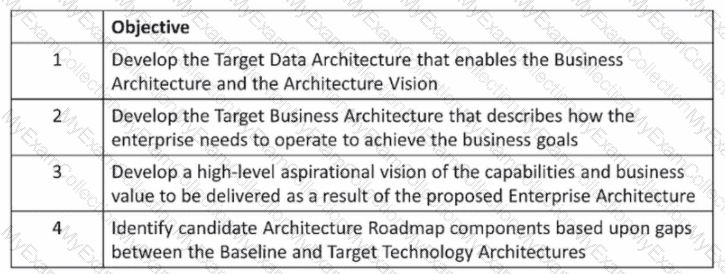
Which phase does each objective match?
Question # 32
The TOGAF ADM uses a version numbering convention to illustrate the evolution of Baseline and Target Architecture Definitions. What does Version 1.0 indicate according to this convention?
Question # 33
In which part of the ADM cycle are building blocks evolved using a common platform of steps?
Question # 35
In which ADM phase does the value and change management process determine the circumstances under which the Enterprise Architecture is permitted to change after deployment?
Question # 36
According to TOGAF, where should architecture governance artifacts be stored?
Question # 37
When considering the gap analysis technique, which of the following is an example of a business domain gap?
Question # 39
Complete the sentence. When considering agile development. Architecture to Support Portfolio will identity what products the Enterprise needs, the boundary of the products, and what constraints a product owner has: this defines the Enterprise ' s____________,
Question # 40
Which of the following best describes the TOGAF Architecture Governance Framework?
Question # 41
Which of the following best describes the purpose of the Business Scenarios technique?
Question # 42
According to TOGAF, which of the following activities is described as part of the approach in the Preliminary Phase of the ADM?
Question # 43
Which of the following describes a key objective of the Technology Architecture Phase?
Question # 44
Complete the sentence. All of the following are sections of the recommended template for defining Architecture Principles, except ___________
Question # 45
Complete the sentence. A gap analysis will enable the architect to do all of the following except _____.
Question # 46
What are the following activities part of?
• Risk classification
• Risk identification
• Initial risk assessment
Question # 47
Which section of the TOGAF document describes the processes, skills and roles to establish and operate an architecture function within an enterprise?
Question # 48
Which phase of the TOGAF ADM is the first phase directly concerned with the planning for the implementation of the target architecture(s)?
Question # 49
Gap Analysis is a technique used in Phases B, C, D and E. Which one of the following statements best describes the gap analysis technique?
Question # 50
What document is sent from the sponsoring organization to the architecture organization to trigger the start of an ADM cycle?
Question # 51
Complete the sentence. The key purpose of Gap Analysis is to _____ ActualTests.com
Question # 52
What ADM phase defines the scope for the architecture development initiative and identifies the stakeholders?
Question # 53
Complete the sentence. The Business Transformation Readiness Assessment technique is
primarily focused on ___
Question # 54
In which ADM phase is the Implementation and Migration Plan coordinated with other frameworks?
Question # 55
An association of companies has defined a data model for sharing inventory and pricing information.
Which of the following best describes where this model would fit in the Architecture Continuum?
Question # 56
Which of the following is the ability to develop, use and sustain the architecture of a particular enterprise using architecture to govern change?
Question # 57
According to TOGAF, in which sequence should Application Architecture and Data Architecture be developed in Phase C?
Question # 58
Complete the sentence. The Architecture Development Method produces content to be stored in the Repository, which is classified according to the __________________.
Question # 59
Complete the sentence. A set of architecture principles that cover every situation perceived throughout the enterprise meet the recommended criteria of__________.
Question # 60
Which of the following identifies business units that possess capabilities, and which participate in value streams?
Question # 61
Which of the following does the TOGAF standard describe as a package of functionality defined to meet business needs across an organization?
Question # 62
Which of the following describes a purpose of an Architecture Compliance review?
Question # 63
Complete the sentence. The Architecture Landscape is divided into three levels, Strategic, Segment and ____________.
Question # 64
Which of the following is described by the TOGAF Architecture Content Framework as a type of artifact that shows lists of things?
Question # 65
Which of the following does TOGAF provide as a set of reference materials for establishing an architecture function within an organization?
Question # 67
Which of the following best completes the sentence? The Architecture Repository __________________.
Question # 68
Which of the following supports the need to govern Enterprise Architecture?
Question # 69
According to TOGAF, which of the following best describes Architecture Governance?
Question # 70
Complete the sentence. The TOGAF standard covers the development of four architecture domains, Application. Business. Data and__________.
Question # 71
Which of the following is a true statement about the TOGAF Technical Reference Model?
Question # 72
Which ADM Phase includes obtaining approval for the Statement of Architecture Work?
Question # 73
TOGAF uses a version numbering convention to illustrate the evolution of the Baseline and Target Architecture Definitions. Which version number in this convention indicates a formally reviewed, detailed architecture?
Question # 74
Which one of the following is an objective of the Preliminary Phase of the ADM?
Question # 75
Which Architecture domain is recommended to be the first architecture work undertaken in the ADM cycle?
Question # 76
Which of the following best describes a purpose of the Gap Analysis technique?
Question # 77
Complete the sentence. TOGAF covers the development of four architecture domains, Business, Data, Technology and ___________.
Question # 78
What part of the Architecture Repository holds specifications to which architectures must conform?
Question # 79
TOGAF uses a version numbering convention to illustrate the evolution of the Baseline and Target Architecture Definitions. Which version number in this convention indicates a high-level outline of the architecture?
Question # 81
Which one of the following is defined by TOGAF as: the fundamental organization of a system embodied in its components, their relationship to each other, and the principles guiding its design and evolution?
Question # 82
What information does the Architecture Requirements Repository within the Architecture Repository hold?
Question # 83
Consider the following ADM phases objectives.
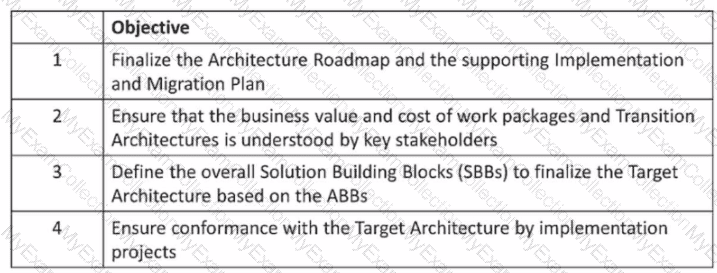
Which phase does each objective match?
Question # 84
In which ADM phase is the goal to ensure that the architecture achieves its original target business value?
Question # 86
What class of architectural information within the Architecture Repository defines processes that support governance of the Architecture Repository?
Question # 87
Which one of the following is recommended to define requirements and articulate the Architecture Vision created in Phase A?
Question # 89
Which one of the following is NOT an objective for Phase C, Data Architecture?
Question # 90
Which of the following best describes the purpose of the Statement of Architecture Work?
Question # 91
Which of the following best describes an approach for adapting the ADM in the situation where the business case for doing architecture is not well recognized?
Question # 92
Complete the sentence. The TOGAF risk categorization after the implementation of mitigating actions is known as the level of risk.
Question # 93
Which of the following are considered as generic Building Blocks in the Solutions Continuum?
Question # 94
Which component within the Architecture Repository holds best practice or template materials that can be used to construct architectures?
Question # 95
According to TOGAF, which of the following terms describes people who have key roles in, or concerns about, a system?
Question # 97
Complete the sentence. Capability-Based Planning is a technique that _______
Question # 98
Scenario:
Please read this scenario prior to answering the question
You are serving as the Lead Enterprise Architect at a major supplier in the automotive industry. The company is headquartered in Cleveland, Ohio with manufacturing plants across the United States, Brazil, Germany, Japan and South Korea. Each of these plants has been operating its own planning and production scheduling systems, as well as custom developed applications that drive the automated production equipment at each plant.
The company is implementing lean manufacturing principles to minimize waste and improve the efficiency of all of its production operations. During a recent exercise held for internal quality improvement, it was determined that a significant reduction in process waste could be achieved by replacing the current planning and scheduling systems with a common Enterprise Resource Planning (ERP) system located in the Cleveland data center. This central system would provide support to each of the plants replacing the functionality in the existing systems. It would also eliminate the need for full data centers at each of the plant facilities. A reduced number of IT staff could support the remaining applications. In some cases, a third-party contractor could provide those staff.
The Enterprise Architecture department has been operating for several years and has mature, well-developed architecture governance and development processes that are strongly based on TOGAF 9.
At a recent meeting, the Architecture Board approved a Request for Architecture Work sponsored by the Chief Engineer of Global Manufacturing Operations. The request covered the initial architectural investigations and the development of a comprehensive architecture to plan the transformation.
The Common ERP Deployment architecture project team has now been formed, and the project team has been asked to develop an Architecture Vision that will achieve the desired outcomes and benefits. Some of the plant managers have expressed concern about the security and reliability of diving their planning and production scheduling from a remote centralized system. The Chief Engineer wants to know how these concerns can be addressed.
Refer to the Scenario
[Note: You should assume that the company has adopted the example set of principles that are listed and defined in TOGAF 9, Section 23.6.]
One of the earliest initiatives in the Enterprise Architecture program was the definition of a set of architecture principles. These now need to be updated to address the concerns raised.
You have been asked to select a set of principles most appropriate for guiding the team to define a robust solution.
Based on TOGAF 9, which of the following is the best answer?
Question # 99
Which of the following best describes the purpose of an Architecture Definition Document?
Question # 100
Which of the following best describes the purpose of the Architecture Roadmap?