Question # 4
What is the number and structure of Prisma SD-WAN QoS queues supported per WAN interface?
Question # 5
An administrator wants to configure a Path Policy that routes all "Guest Wi-Fi" traffic directly to the internet using the local broadband interface, bypassing all VPN tunnels.
Which Service & DC Group setting should be selected in the policy rule to achieve this "Direct Internet Access" (DIA) behavior?
Question # 6
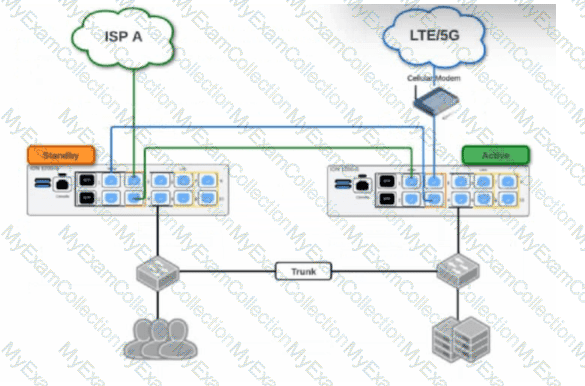
Based on the HA topology image below, which two statements describe the end-state when power is removed from the ION 1200-S labeled “Activeâ€, assuming that the ION labeled “Standby†becomes the active ION? (Choose two.)
Question # 7
An engineer at a managed services provider is updating an application that allows its customers to request firewall changes to also manage SD-WAN. The application will be able to make any approved changes directly to devices via API.
What is a requirement for the application to create SD-WAN interfaces?
Question # 8
In a data center (DC) with two ION devices, all of the remote branch Prisma SD-WAN VPNs are active only on DC ION-1.
Why are no VPNs active on DC ION-2?
Question # 9
When defining a Path Quality Profile (SLA) for a "Transactional" application group (e.g., Citrix, Oracle), the administrator sets the "Packet Loss" threshold to 1%.
What happens to the traffic for this application if all active paths currently exceed this 1% loss threshold?
Question # 10
A network administrator is viewing the Flow Browser to investigate a report that a specific user cannot access an internal web server. The flow entry for this traffic shows the "Flow State" as "INIT" and it remains in that state until it times out.
What does the "INIT" state indicate about the traffic flow?
Question # 11
A network engineer is able to ping and traceroute from SD-WAN branch IP 192.168.1.123 to servers in primary data center – DC1, but is unable to ping or traceroute to a server 10.2.2.22 in the newly configured secondary data center, DC2.
The DC2 ION device is advertising the branch IP subnet 192.168.1.0/24 to the DC2 core via eBGP Core Peer. The DC2 data center site has site prefix 10.2.2.0/23 configured.
Which configuration will resolve the issue in this scenario?
Question # 12
An administrator is configuring a High Availability (HA) pair of ION 3000 devices at a Data Center.
Which statement accurately describes the requirement for the HA Control Interface connection between the two devices?
Question # 13
A network installer is at a remote branch site to deploy a new ION 3000 device. The device has been racked, cabled to the internet, and powered on. The installer has the "Claim Code" displayed on the email sent by the administrator.
When the administrator enters this Claim Code into the Prisma SD-WAN portal, what is the immediate status of the device before the configuration is fully pushed?
Question # 14
When allocating Aggregate Bandwidth for a Prisma Access "Remote Network" deployment (connecting 50 branch sites), how is the bandwidth license enforced?
Question # 15
An ION 3000 device at a remote branch has suffered a critical hardware failure and must be replaced via the RMA process. The administrator has received the replacement unit.
What is the correct procedure to transfer the configuration and license from the defective unit to the replacement unit to ensure minimal downtime and retention of historical data?
Question # 16
Which troubleshooting step should be taken when users at a branch site are experiencing a maximum throughput of 200 Mbps for Direct Internet Access (DIA) traffic on a 1 Gbps internet connection?
Question # 17
1000 branches are to be deployed on Prisma SD-WAN with the following constraints:
Devices will be shipped in batches directly to the site
Configuration Management Database (CMDB) has all the necessary details for a site deployment
Field tech will be responsible for rack, stack, and cabling of the IONs at each site
Field tech will need to spend minimum amount of time at each branch site to reduce the cost
The NOC operates in shifts and is responsible for remote cutover support
Which method will achieve the mass deployment in shortest possible time?
Question # 18
When troubleshooting an issue at a site that is running on two cellular links from two carriers, the operations team shared some evidence shown in the graph below:
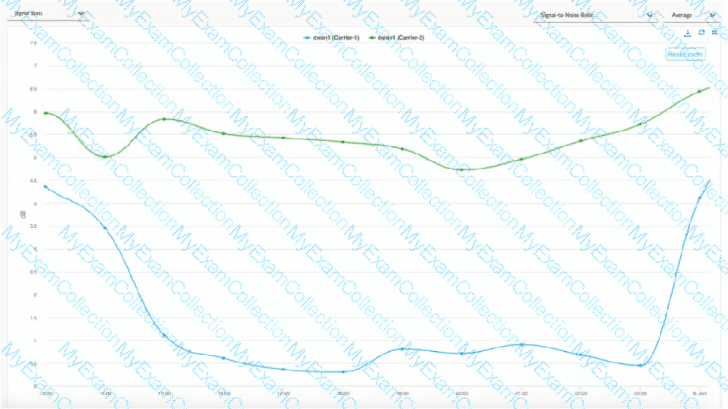
For the time duration shown in the graph, what are two inferences about the site’s traffic that can be made? (Choose two.)
Question # 19
A network administrator notices that a branch ION device is experiencing high CPU utilization due to a suspected TCP SYN Flood attack originating from a compromised host on the local LAN.
Which specific security feature should be configured and applied to the "LAN" zone to mitigate this Denial of Service (DoS) attack?
Question # 20
A network installer is attempting to claim a new ION device using the "Claim Code" method. The device is connected to the internet, but the status in the portal remains stuck at "Claimed" and does not transition to "Online". The installer connects a laptop to the LAN port of the ION and can successfully browse the internet, confirming the uplink is active.
What is the most likely cause of the device failing to reach the "Online" state?
Question # 21
What does Prisma SD-WAN use for monitoring and operations to deliver flow data and application visibility?
Question # 23
A network design mandates segmentation at the routing level and traffic isolation across various services, such as teller cash registers, ATM traffic, guest Wi-Fi, and corporate applications. Which command can be used to validate and display the Virtual Routing and Forwarding (VRF) route leak rules?
Question # 24
An organization has provided the following technical requirements and details:
High availability (HA) at all data center and branch locations
Two geographically separate main data center locations
One small data center location that contains local users and applications requiring policies
50 branch locations
ISP capacities for all branch locations but no accurate measurement of the actual bandwidth consumption
Based on Palo Alto Networks best practices and recommendations, which two licensing options will meet the customer objectives? (Choose two.)
Question # 25
When troubleshooting an issue at a site that is running on two cellular links from two carriers, the operations team shared some evidence shown in the graph below:
(SNR Graph showing Carrier-1 in blue dropping to near 0 dB and Carrier-2 in green staying relatively stable between 4.5 dB and 6.5 dB)
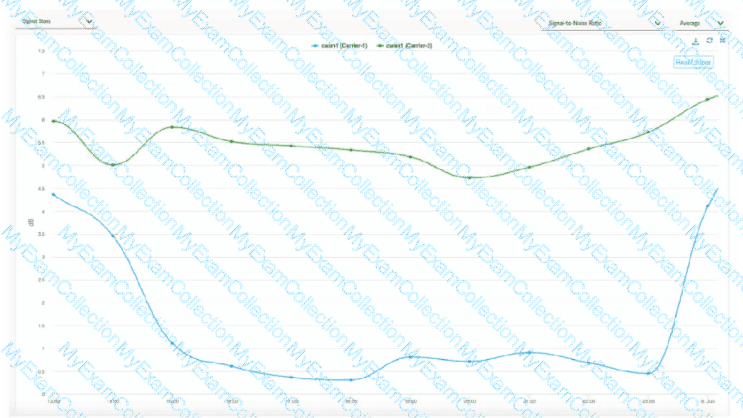
For the time duration shown in the graph, what are two inferences about the site’s traffic that can be made? (Choose two.)