Question # 4
Alimento Y Agricultura (AYA) is a food and agriculture conglomerate headquartered in Costa Rica with operations throughout Central America. AYA historically produced coffee, bananas, and sugar. Over the last decade, the company growing region experienced climate-related crop production challenges. The region suffered prolonged drought conditions and severe flooding events. AYA leadership may relocate existing coffee farm locations in response to these climate stressors.
Last year Costa Rica introduced mandatory climate risk reporting aligned with ISSB standards The government mandate compelled AYA to enhance its transition and physical risk assessment across the company. A newly formed sustainability governance team prioritizes the following objectives:
• Update TCFD reporting with new ISSB IFRS S2 requirements
• Initiate more comprehensive scenario analysis
• Conduct nature and water risk assessments
AYA previously reported climate risks aligned with all TCFD pillars, risk categories, and scenario analysis recommendations. Reporting includes all Scope 1 and Scope 2 emissions, reduction targets, and appointments of board officers responsible for climate risks. Scenario analysis is used to assess all banana, coffee, and sugar production climate risk exposure.
AYA uses 2°C and 4°C climate scenarios to assess company impacts from physical and transition risk. Under the 2°C scenario transition risk increases, while under the 4°C scenario water risk significantly increases.
AYA appoints an SCR certificate holder to the position of nature risk manager to advance nature-based assessments. The manager contracts with a nature risk consultancy to better understand and manage exposure to nature-related risks and impacts. The consultancy identifies crop production, water quality, and water quantity as the primary nature-based risks.
The consultancy produces the following graph to demonstrate coffee crop productivity:
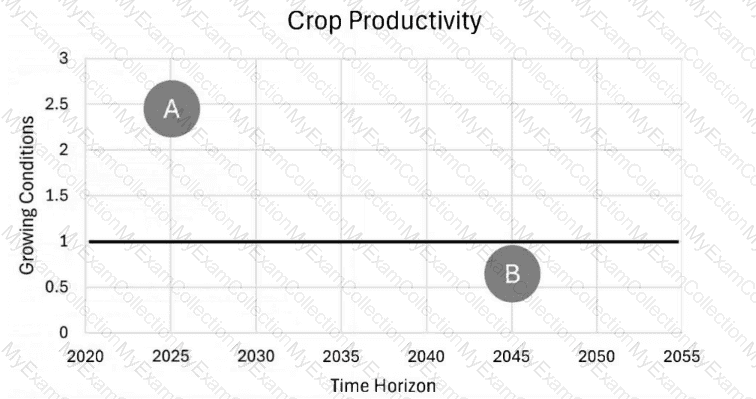
If growing conditions fall below 1, it is not economical for AYA to continue coffee production in the region. Point A indicates current growing conditions. Point B is a forecast of future conditions under a 4°C scenario, created by the consultancy model.
After identifying nature risks broadly, AYA performs a water risk assessment (WRA). The WRA assesses historical and future water withdrawal rates and identifies operational water dependencies.
Following the WRA, the company engages with existing stakeholders to adapt existing business strategy. AYA initiates a pilot project with upstream farmers to protect their land. AYA will either train or pay local farmers to plant shrubbery and buffer zones to reduce erosion and runoff of sediments, nutrients, and pathogens from local crop production and industry.
Which LEAP concept best describes Point A in the context of coffee growing conditions?
Question # 5
A global logistics company evaluates how climate change could disrupt its global distribution network. The CSO recommends a scenario analysis exercise to explore long-term risks and opportunities. Which of the following variables should the company include to effectively develop climate scenarios?
Question # 6
A telecommunications corporation issues a green bond to finance energy efficiency improvements for the company’s office space worldwide. The company’s risk management department commissions an independent advisory assessment of the bond to check bond alignment with components of the Green Bond Principles.
What action does the corporation take to align the bond with the “process for project evaluation and selection†component of the Green Bond Principles?
Question # 7
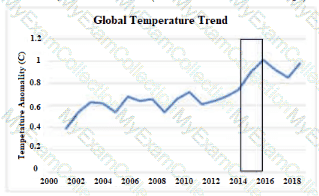
A scientist at a large agricultural company develops an internal presentation that explains weather variation and long-term climate change. The scientist presents global annual temperature anomalies (relative to a 1951-1980 average) throughout the last 20 years:
What natural forcing contributed to the temperature trend from 2014 to 2016?
Question # 8
The risk team for a multinational company, that operates and franchises hotel and timeshare properties, prepares talking points for an upcoming business continuity plan meeting. A key area for discussion are the risks that can impact the company’s financial and reputational stability. The team recommends the company conduct climate-related scenario analysis and provides examples of scenarios and their use.
Which of the following is correct for the team to include as part of the talking points?
Question # 9
As climate change poses new financial risks to a central bank’s monetary policy operations, the bank decides to adapt operations with NGFS guidelines. Because the central bank does not include climate change in supervision practices, the bank consults subject matter experts (SMEs) to develop a proposal for central bank action on climate change. After completing the risk assessment, SMEs recommend the bank incorporate microprudential and macroprudential measures to embed climate change into supervision practices.
Which action are SMEs likely to recommend?
Question # 10
In response to a survey showing consumers consider sustainability a key factor in purchasing decisions, a group of cosmetics companies announce a collaboration to develop an environmental impact assessment and sustainability framework for cosmetics products. The framework enables customers to evaluate the environmental impact of products they purchase. The framework draft includes definitions of climate, green, and sustainable finance.
Which of the following definitions is appropriate for the proposed framework?
Question # 11
A large insurance company in South America expands use of climate scenario analysis. The company used RCPs in previous scenario analyses but now hires an actuary with climate expertise to incorporate SSPs in this process.
How can the actuary advise the insurance company use SSPs going forward?
Question # 12
A risk manager at an investment bank works on a climate disclosure project for a bank portfolio. To understand the climate impacts on the investment portfolio, the risk manager evaluates different metrics to measure climate risk exposure. The manager selects a metric that can be easily applied across asset classes. While the metric is sensitive to outliers, calculating the metric is simple and easy to communicate to investors. Which metric did the manager most likely select to measure climate risk exposure?
Question # 13
A major hurricane extensively damages the electrical infrastructure of a utility company. To improve the utility’s risk management, the risk director prepares a strategy plan and incorporates climate risk considerations within the existing risk management framework.
Which recommendation should the director make to incorporate climate risk into the framework’s risk identification component?
Question # 14
After conducting a comprehensive climate risk assessment of company operations, a climate risk consultant hired by a large North American apparel manufacturer identifies climate change risks. The consultant highlights wildfires which are enhanced by occasional drought, as a high risk to company operations. What type of climate risk enhances wildfire risk?
Question # 15
A mid-size bank in Australia will implement scenario analysis as part of a risk assessment to measure climate risk. A risk manager in charge of this project reviews current practices among peers worldwide.
To align with common and well-established practices of financial firms, how will the risk manager implement scenario analysis to assess climate risk?
Question # 16
A climate analyst at a research institution analyzes climate risk for various companies. The analyst examines transmission channels of climate risk as part of the risk identification process.
Which of the following examples can the analyst use to describe an operational risk transmission channel?
Question # 17
A venture capital coalition integrates ESG considerations into an investment strategy for generative AI startups. An external consultant assesses sustainability risks to align coalition strategy with ESG benchmarks. Which of the following insights will most effectively inform the coalition investment strategy?
Question # 18
A global electronics manufacturer experiences severe flooding in one of its key locations. Company senior management will mitigate supply chain risk and adhere to environmental standards by issuing a bond. The bond proceeds will simultaneously address floodwater contaminated by industrial chemicals and assist communities experiencing deterioration of health conditions due to waterborne diseases.
Which bond is the company likely to issue?
Question # 19
Leaders of an energy company meet to address physical and transition risks to company operations. At the meeting, the CRO recommends a strategy to mitigate physical climate risk to the company. Which of the following strategies will the CRO most likely recommend?
Question # 20
An ESG scorecard for sovereign debt issuers has the following information:
Country 1No carbon policy and high corruption risk
Country 2High-level carbon policy and low corruption risk
Country 3Detailed carbon policy and low corruption risk
Based only on this information, the country with the lowest ESG risk is:
Question # 21
A European commercial bank recently became a signatory to the UNEP FI PRB. To fulfill PRB commitments, the bank CRO emphasizes the need to holistically integrate ESG considerations into lending decisions to reduce long-term risk exposure. Which of the following strategies will the bank most likely adopt going forward?
Question # 22
A European bank considers investing in an offshore wind farm project. A bank ESG analyst assists in the origination and execution of green and sustainable finance transactions to finance the project. The analyst recommends a loan to finance the project by gathering related materials on sustainability-linked loans (SLLs), green loans, and corresponding market trends.
Which of the following loans is the analyst likely to recommend?
Question # 23
A climate scientist is invited to a morning news program to discuss human influence on Earth’s climate. Prior to the program, a producer asserts climate change is a natural process, citing Earth’s historical climate shifts. What example does the scientist most likely provide to highlight human influence on climate?
Question # 24
T he sustainability team at a Central European agricultural firm identifies nature-related risks threatening agricultural productivity and supply chain resilience. Declining yields are linked to environmental degradation and biodiversity loss. To avoid biodiversity loss, which of the following actions will the team most likely recommend?
Question # 25
Which of the following technologies is most likely to be viewed by investors as a strategic solution to the decarbonization of high-temperature processes?
Question # 26
A city planning commissioner consults with climate scientists to assess the impact of sea level rise on strategic infrastructure projects. The scientists discuss several climate model projections and indicate sea level rise has a fundamental relationship to GHG emissions, regardless of a specific warming scenario.
How should the scientists describe this relationship?
Question # 27
A solar panel manufacturing company for renewable energy systems makes a 2040 net-zero commitment. The company sustainability director references the COSO ERM framework to inform the company’s long-term growth strategy. Which approach will the director most likely use to effectively assess the impact of transition risk on the business strategy?
Question # 28
Which of the following is an example of a just’ transition with regards to climate change?
Question # 29
A large European bank implements the PRB and hires an external auditor to assess implementation progress. After an initial assessment, the auditor prepares recommendations to improve governance and culture practices within the bank. Which of the following actions did the external auditor most likely recommend?
Question # 30
A fashion company raises an SLL to improve the company ESG score. The sustainability team identifies two sustainability KPIs for finalizing the loan with a financial institution. Which of the following KPIs did the team most likely recommend for the SLL?
Question # 31
A sustainability analyst at a global commercial bank researches trends surrounding the green loan market in China to develop a new business strategy. The analyst finds green loans are gaining popularity in various sectors due to environmental and financial benefits. If the analyst recommends the addition of green loans to the business strategy, what China market trend most likely supports this decision?
Question # 32
An investment management firm signs a net zero asset management initiative. An analyst engages with client companies to encourage adoption of targets that align with Paris Agreement goals. The analyst provides clients with a guide explaining the principles and protocols unique to the Paris Agreement.
How will the analyst most likely describe the feature that distinguishes the Paris Agreement?
Question # 33
The CRO for a large agriculture company reviews reference scenarios as part of an annual climate scenario analysis exercise. The CRO creates a transition risk matrix that compares four different scenarios - W, X, Y, Z. Scenarios are compared according to scale of emissions cuts and pace of emission cuts. Scale is depicted as business as usual (BAU) to net-zero. Pace is depicted as orderly to disorderly. The CRO uses this matrix to explain transition risk to the company’s executive members:

How should the CRO rank the reference scenarios from lowest level of transition risk to highest level of transition risk?
Question # 34
An investment analyst assesses climate-related stranded asset risk for a portfolio of energy companies. The analyst develops a list of companies potentially exhibiting stranded asset risk. After a more granular examination, the analyst summarizes corporate activity in the following table:
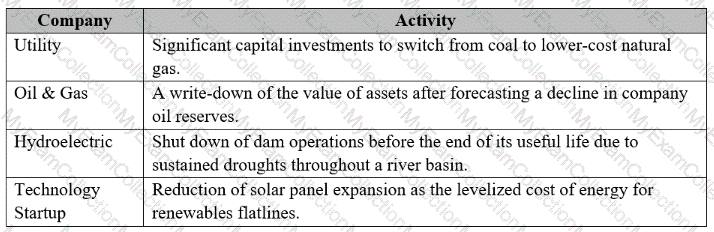
The analyst identifies the company with the highest stranded asset exposure for possible divestment. Which company does the analyst recommend for divestment?
Question # 35
A recent sustainability report revealed the pension fund of a small European nation is heavily invested in sectors with poor sustainability records. In response to pensioner and other stakeholder requests, the fund joins the PRI.
What strategy must the fund incorporate to comply with the PRI?