Question # 4
The BIG-IP Administrator disables all pool members in a pool. Users are still able to reach the pool members.
What is allowing users to continue to reach the disabled pool members?
Question # 5
A BIG-IP Administrator is informed that traffic on interface 1.1 is expected to increase beyond the maximum bandwidth capacity of the link. There is a single VLAN on the interface.
What should the BIG-IP Administrator do to increase the total available bandwidth? (Choose one answer)
Question # 6
Which three iRule events are likely to be seen in iRules designed to select a pool for load balancing? (Choose three.)
Question # 7
A BIG-IP Administrator configures remote authentication and needs to ensure that users can still log in even when the remote authentication server is unavailable . Which action should the BIG-IP Administrator take in the remote authentication configuration to meet this requirement? (Choose one answer)
Question # 8
What is required for a virtual server to support clients whose traffic arrives on the internal VLAN and pool members whose traffic arrives on the external VLAN?
Question # 9
A BIG-IP Administrator wants to add a new Self IP to the BIG-IP device. Which item should be assigned to the new Self IP being configured?
Question # 10
What type of virtual server will have a destination IP address of 0.0.0.0 and listen on a specific VLAN for requests?
Question # 11
A BIG-IP Administrator is making adjustments to an iRule and needs to identify which of the 235 Virtual Servers configured on the BIG-IP device will be affected. How should the administrator obtain this information in an efficient way?
Question # 12
A BIG-IP Administrator needs to apply a health monitor for a pool of database servers named DB_Pool that uses TCP port 1521. Where should the BIG-IP Administrator apply this monitor?
Question # 13
What should a BIG-IP Administrator configure to minimize impact during a failover ? (Choose one answer)
Question # 14
A BIG-IP is configured with a pool member located on a different subnet that is not local to the BIG-IP. To ensure that the return traffic from the pool member is sent to the client through the BIG-IP, a Source NAT (SNAT) is used and configured for SNAT Automap. The BIG-IP has a default gateway on the external VLAN, a floating and non-floating self-IP address on each VLAN, and a management address. Which IP address will the BIG-IP use as the source address for the traffic to the pool member when client traffic is sent through the virtual server?
Question # 15
What command will assist the BIG-IP Administrator in finding the tmm routes when in the TMSH CLI?
Question # 16
The network architecture for a BIG-IP consists of an external VLAN and an internal VLAN with two interfaces connected to the upstream switch . The design requires fault tolerance in the case that one of the interfaces is down. Which deployment architecture meets these requirements? (Choose one answer)
Question # 17
Refer to the exhibit.
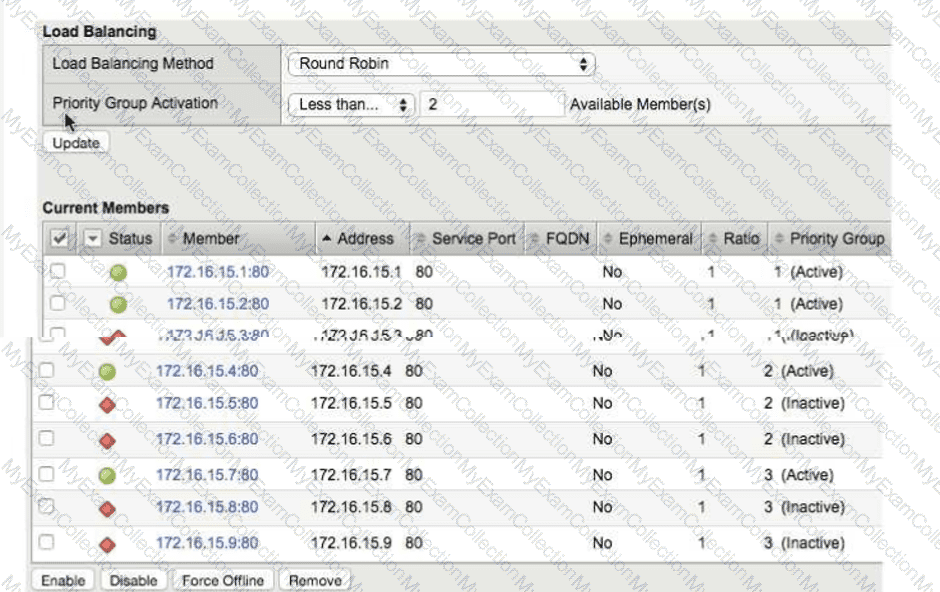
Load Balancing Method: Round Robin
Priority Group Activation: Less than 2 Available Members
Which two pool members should be chosen for a new connection? (Choose two.)
Question # 18
An application is configured so that the same pool member must be used for an entire session , and this behavior must persist across HTTP and FTP traffic . A user reports that a session terminates and must be restarted after the active BIG-IP device fails over to the standby device.
Which configuration settings should the BIG-IP Administrator verify to ensure proper behavior when BIG-IP failover occurs? (Choose one answer)
Question # 19
Refer to the exhibit.
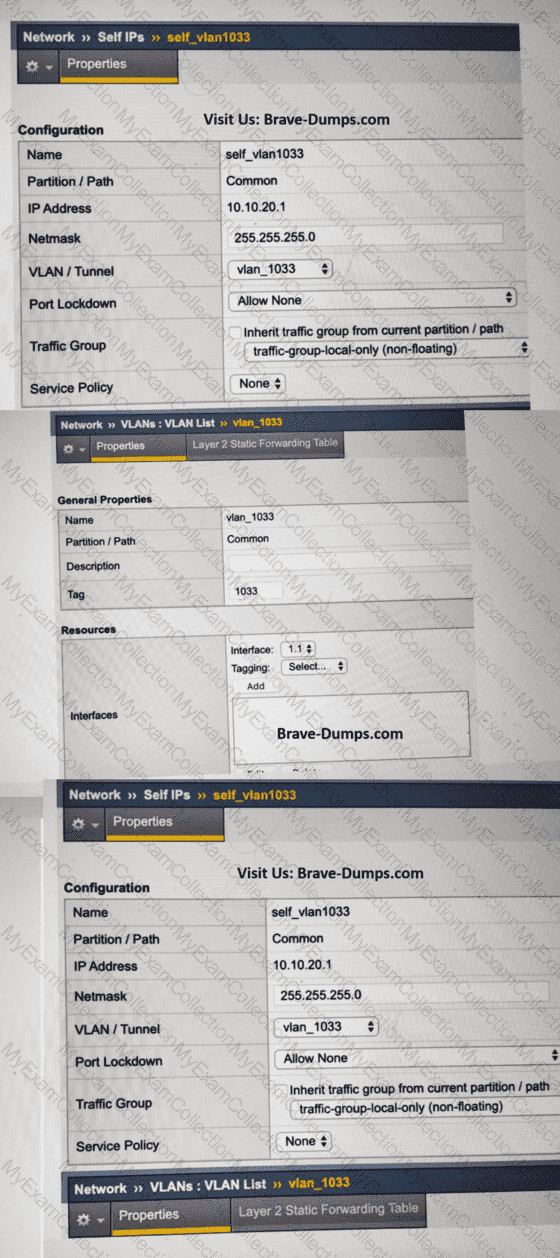
The network team creates a new VLAN on the switches. The BIG-IP Administrator creates a new VLAN and a Self IP on the BIG-IP device, but the servers on the new VLAN are NOT reachable from the BIG-IP device.
Which action should the BIG-IP Administrator take to resolve this issue? (Choose one answer)
Question # 20
What type of virtual server should be used to load balance UDP traffic without considering previous connections?
Question # 21
The BIG-IP Administrator wants to provide quick failover between the F5 LTM devices that are configured as an HA pair with a single-selfip using the MAC Masquerade feature for this quick failover and runs this command: tmsh modify /cm traffic-group traffic-group-1 mac 02:12:34:56:00:00 However, the Network Operations team has identified an issue with the use of the same MAC address being used within different VLANs. As a result, the administrator decides to implement the Per-VLAN Mac Masquerade in order to have a unique MAC address on each VLAN: tmsh modify /sys db tm.macmasqaddr_per_vlan value true. What would be the resulting MAC address on a tagged VLAN of 1501? (Choose one answer)