Question # 4
An administrator has been tasked with deploying a new VMware Cloud Foundation (VCF) environment that includes a Management Domain and two workload domains. Compliance regulations require that production and non-production workloads reside in separate failure domains, with the production workload environment using low-latency block storage and the non-production environment relying on high-capacity file-based storage.
Which combination of supported non-vSAN storage solutions should the administrator recommend to meet these requirements?
Question # 5
An architect is presented with the following requirements for the storage solution in a VMware Cloud Foundation (VCF) Workload Domain.
The solution must:
• Allow for rapid recovery in case of an availability zone failure.
• Provide an extremely high amount of IOPS to all applications.
• Allow for additional storage to be added as application needs grow.
• Provide the lowest latency possible for configured applications.
• Provide recovery in case of datastore failure.
• Encrypt data in transit and at rest.
What two vSAN advanced technologies must be deployed to meet these requirements? (Choose two.)
Question # 6
An administrator is deploying a vSphere Supervisor Cluster on a VMware Cloud Foundation (VCF) Workload Domain that uses NFS storage. As part of the configuration, the administrator must define separate storage policies for container images, ephemeral volumes, and persistent volumes within the vSphere Namespace.
The solution must align with vSphere Storage Policy Based Management (SPBM) and Broadcom TechDocs recommendations for supported Supervisor configurations.
Which configuration meets these requirements?
Question # 7
An architect is designing a vSAN storage solution for a remote site. The following requirements have been given:
• There is enough rack space for two hosts, each with 36 CPU cores and 256 GB of RAM.
• The physical network at the remote site supports 10 Gb maximum.
• The network connecting the remote site to corporate has 10 Gb of bandwidth with an average RTT of 25 ms.
• High availability is expected for all the Virtual Machines running at the remote site.
• The solution must provide additional storage to 16 graphic design Windows based workstations.
• Active Directory is configured and available at the remote site.
• The graphic design application requires native NTFS permissions.
What vSAN advanced technology is required for configuring this remote site?
Question # 8
A storage architect is designing a vSAN solution that enforces quotas and Access Based Enumeration (ABE) on all file shares.
What should the architect highlight as a design decision implication?
Question # 9
A multinational corporation is deploying a VMware Cloud Foundation (VCF) Workload Domain cluster to host tier-1 business applications with the following requirements:
• Deliver high performance to all workloads.
• Integration with automated VM placement.
• Reuse of existing infrastructure including multiple Fibre Channel (FC) arrays partitioned by business unit.
• The storage architecture must avoid vSAN.
• Meet organizational separation requirements.
Which two deployment approaches meet these requirements? (Choose two.)
Question # 10
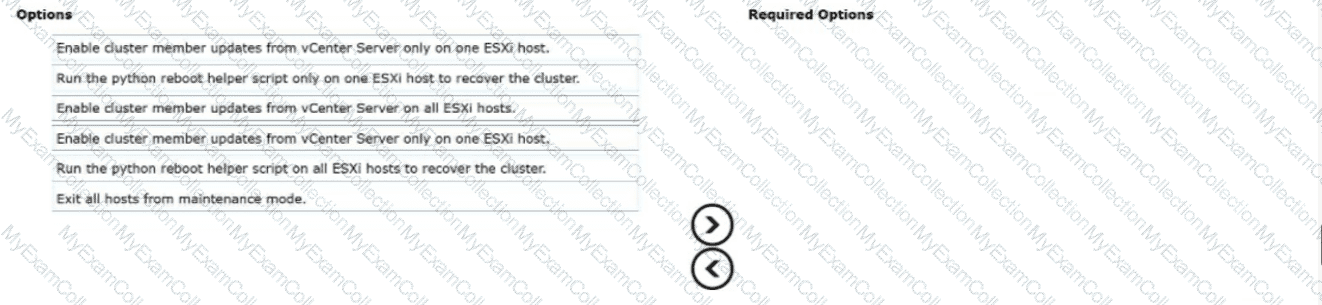
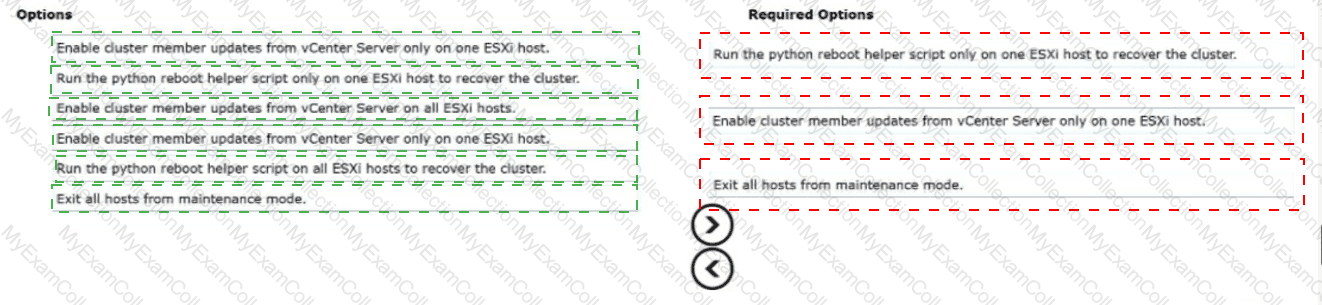
After a planned power outage, an administrator decided to restart the vSAN cluster manually.
Drag and drop the three correct options from the Options list on the left and place them into the Required Options on the right in any order. (Choose three.)
Question # 11
The security team has notified the VMware Cloud Foundation (VCF) Storage Administrator of a new security vulnerability that must be patched immediately. The vSAN Cluster uses vSphere Lifecycle Manager images.
After updating the image with the patch, what method should the administrator use to apply this patch with the least amount of disruption to the cluster?
Question # 12
An administrator is tasked with attaching an FC-based VMFS datastore to an existing Workload Domain cluster.
Which option reflects the correct process?
Question # 13
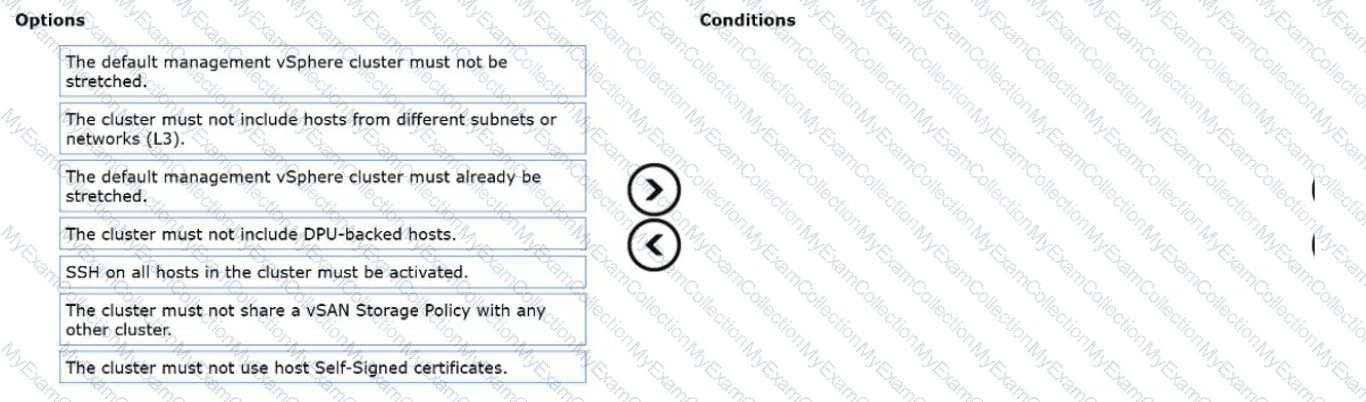
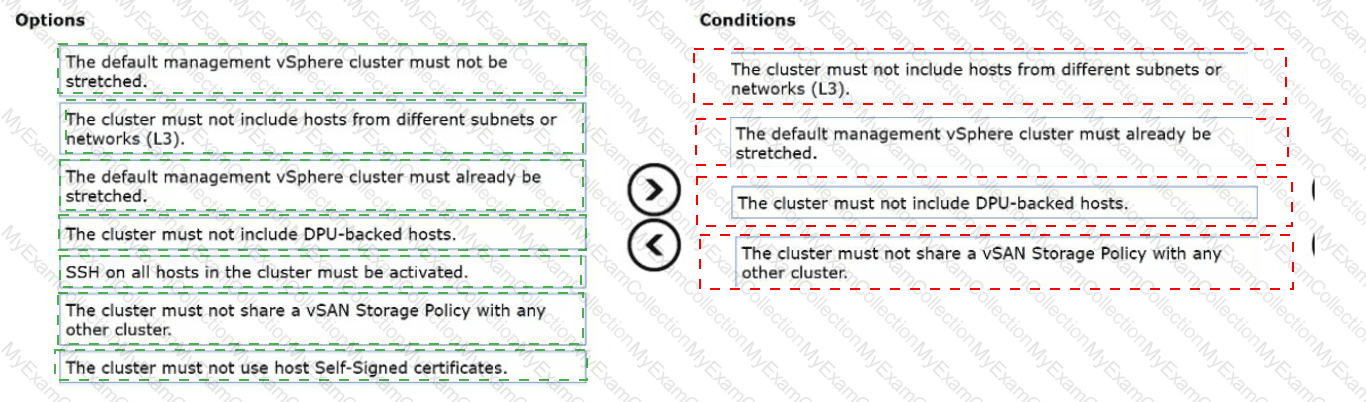
An administrator is tasked with stretching a vSAN cluster in a VMware Cloud Foundation (VCF) Workload Domain across two availability zones within a region. Both availability zones contain an equal number of hosts.
What four Conditions must also be met in order to stretch the cluster?
Drag and drop the four correct options from the Options list on the left and place them into the Conditions on the right in any order. (Choose four.)
Question # 14
An administrator is presented with the following scenario:
• 20 TB of additional storage is being requested by a VM application owner.
• The application has high CPU/Memory requirements that can only be satisfied by the current cluster the application runs in.
• The application has high IOPS and bandwidth requirements to run properly.
• The existing vSAN cluster only has 10 TB of unused capacity.
• The hosts in the cluster have no additional NVMe slots left.
• The administrator does not have permission to purchase additional hosts or re-assign hosts from other vSAN clusters.
• Other vSAN clusters exist in the environment that can satisfy the requirement.
Which vSAN feature should be used to fulfill this scenario?
Question # 15
An administrator is tasked with deploying a VMware Cloud Foundation (VCF) Workload Domain that meets the following requirements:
• vSAN ESA as principal storage
• RAID-6 with FTT=2
• Support for Storage Traffic Separation
The administrator is provided the following hardware to perform the task:
• Four ESX hosts, each host contains:
24 CPU cores
96 GB memory
Two 25GbE network NICs
12 NVMe devices 4 TB each, connected to a single SATA/SAS/NVMe Tri-mode controller What four changes must the administrator make to the hardware before deploying the new Workload Domain? (Choose four.)
Question # 16
An administrator attempts to enable vSAN Data-at-Rest Encryption on a cluster but receives the following error message:
“Key provider < vSphere Native Key Provider > is not available on host.â€
The administrator configured the vSphere Native Key Provider (NKP) using the default settings.
What should the administrator validate before enabling vSAN Data-at-Rest Encryption?
Question # 17
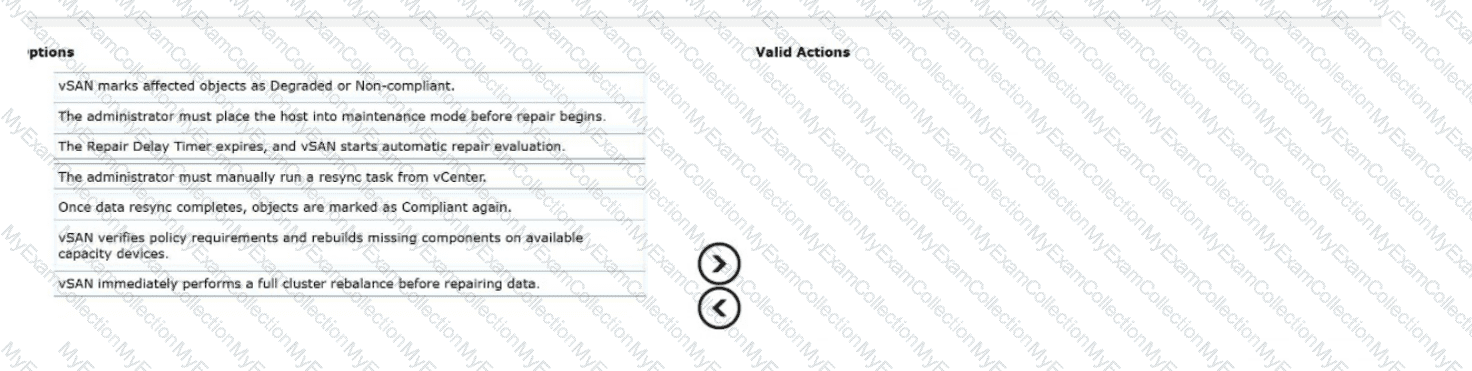
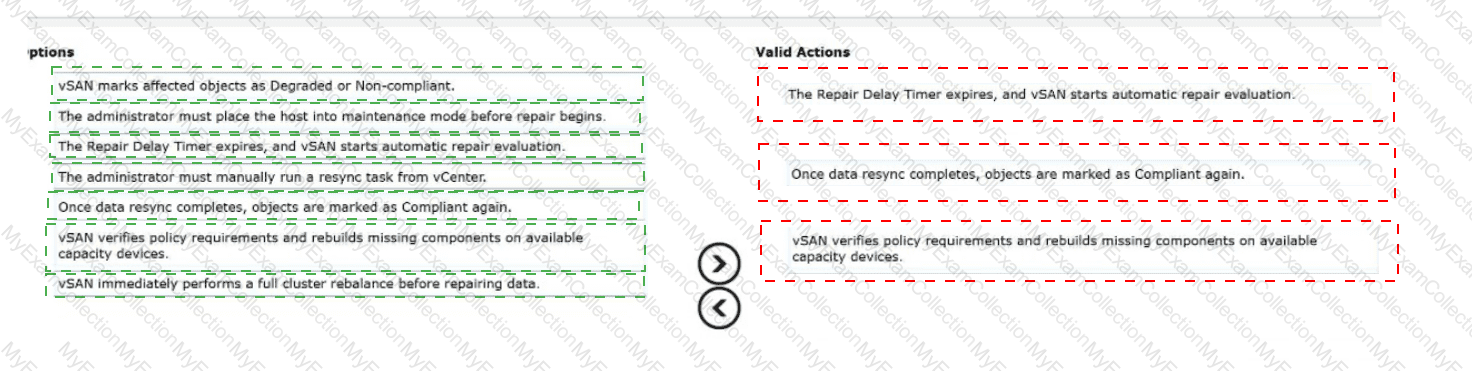
In a vSAN ESA cluster, one host goes offline unexpectedly for more than an hour.
When it returns online, vSAN needs to rebuild and restore compliance for several objects that became degraded during the outage.
Drag and drop the three correct options for the automatic recovery process from the Options list on the left and place them into the Valid Actions on the right in any order. (Choose three.)
Question # 18
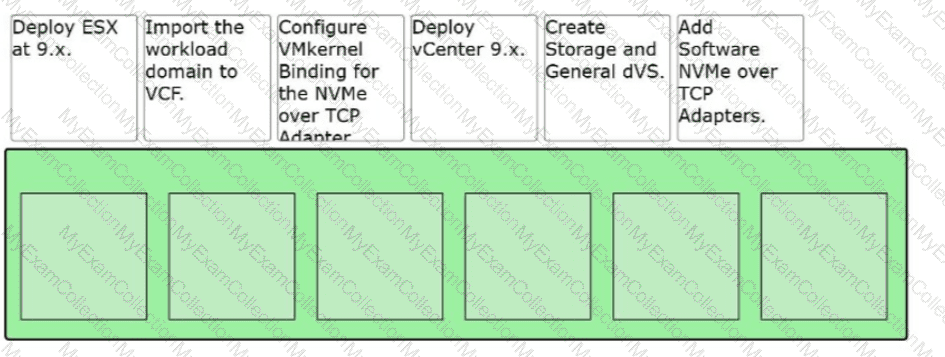
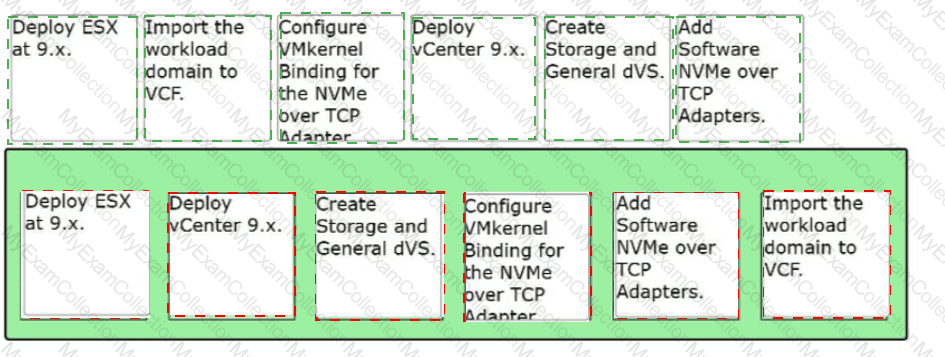
A VMware Cloud Foundation (VCF) Workload Domain is requested to be deployed with the following information:
. 6 blade style hosts with no local storage beyond the operating system.
. 4 25 Gb networking cards installed in each host.
. A 30 TB external array configured to support NVMe/TCP only.
. 2 dVS switches, one configured for storage isolation and one for all other traffic.
. NVMe/TCP multi-path configuration required.
. Existing Management Domain is deployed with VCF.
Place the steps for importing VCF on to this configuration.
Question # 19
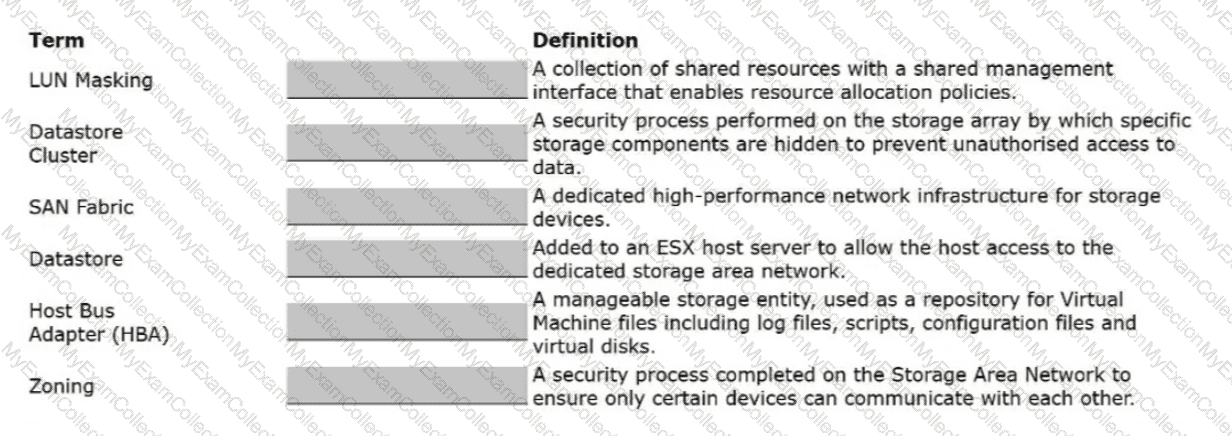
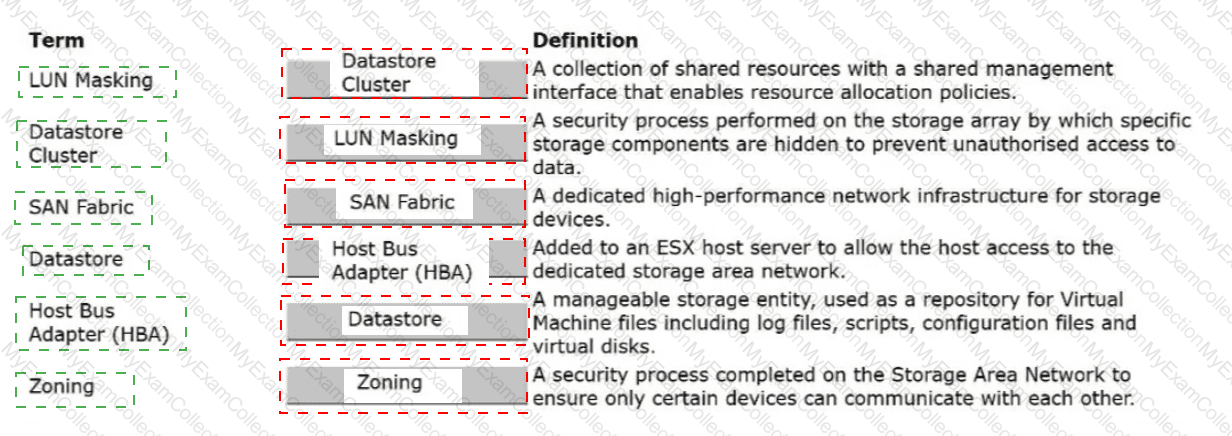
An administrator is responsible for a VMware Cloud Foundation (VCF) Private Cloud and has been tasked with identifying and explaining the different Fibre Channel (FC) Storage Area Network (SAN) components within a VCF Workload Domain cluster.
Drag and drop the correct Term onto its matching Definition.
Question # 20
An administrator is responsible for managing a VMware Cloud Foundation (VCF) Private Cloud.
The following information has been provided about the environment:
• There are 3 customer datacenters, Site A, Site B and Site C.
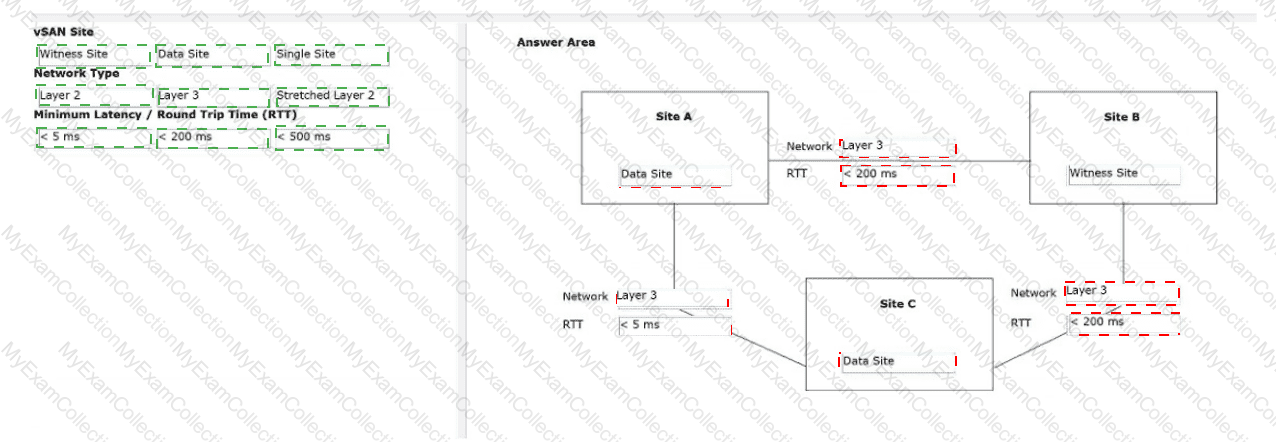
• The datacenter at Site A runs all Production Services.
• The datacenter at Site B has reached capacity and there is no space for additional physical hardware.
• The datacenter at Site C has been commissioned to replace Site B, because there is more rack space and power capacity to cater for future demand.
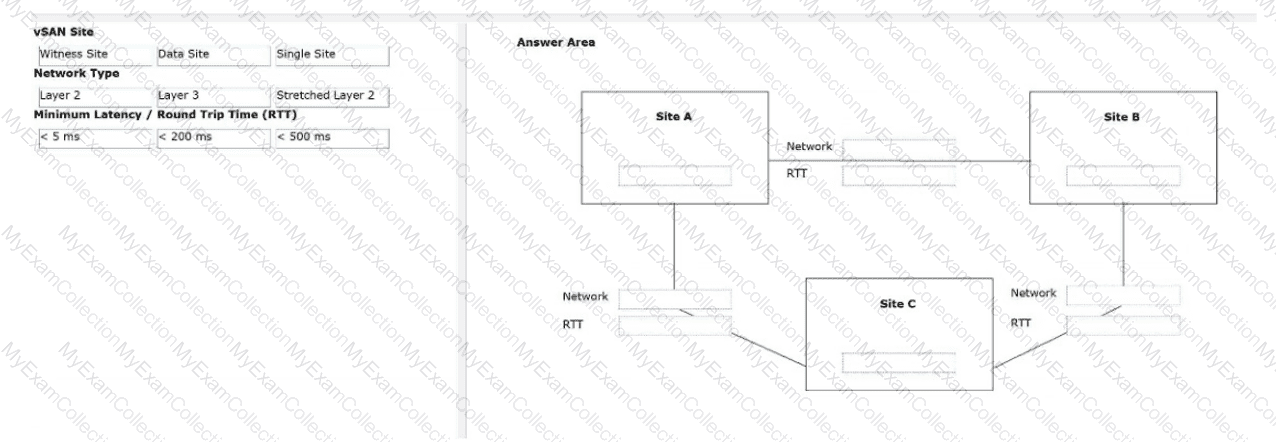
The administrator has been tasked with identifying the networking requirements for a new VMware vSAN Stretched Cluster with the following requirements:
• The solution will deploy a total of 10 new ESX host servers to create a VMware vSAN Stretched Cluster.
• The solution must deploy appropriate networking to ensure minimal disruption from issues with Spanning Tree Protocol (STP).
Drag and drop the correct vSAN Site Type, Networking Type and Round Trip Latency (RTT) within the boxes provided to complete the high-level diagram.
Question # 21
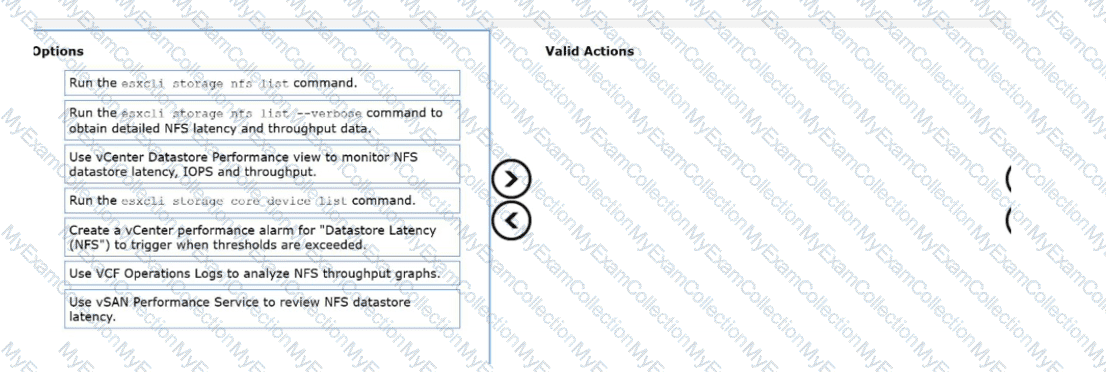
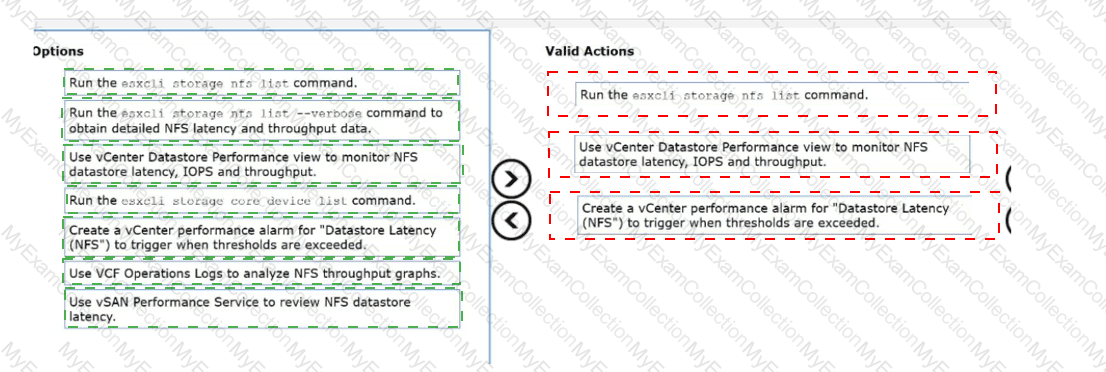
An administrator needs to monitor an external NFS datastore attached to a VMware Cloud Foundation (VCF) cluster to confirm that it meets latency and throughput targets.
Drag and drop the three correct options to monitor NFS performance from the Options list on the left and place them into the Valid Actions on the right in any order. (Choose three.)
Question # 22
An administrator is managing a stretched vSAN ESA cluster where each site has three hosts.
The following parameters apply to the storage policy being configured at the datastore level:
• The policy is configured at the datastore level
• Site disaster tolerance = Site mirroring - stretched cluster
• Failures to tolerate = 1 failure - RAID-1 (mirroring)
• Number of disk stripes = 1
When inspecting some of the Virtual Machines (VMs), why do objects have 3 disk stripes?
Question # 23
An administrator is managing a local vSAN 3-node cluster running the Express Storage Architecture (ESA) as part of a VMware
Cloud Foundation (VCF) Workload Domain.
The following parameters apply at the cluster level:
• HA is enabled
• Reserved Failover Capacity = 25% for both CPU and Memory
The administrator is tasked with configuring the VSAN storage policy so it will tolerate the maximum number of failures.
What two protection levels can the administrator configure? (Choose two.)