Question # 4
Which pension plan requires the services of an actuary to study and forecast future needs of the plan to ensure the plan remains sufficiently funded to provide employees with their retirement benefits?
Question # 5
PF1 Exam – Net Pay Calculation (Template Worksheet)
Scenario
Diane Lemay works for Monarch Construction in Alberta and earns an annual salary of $49,500.00, paid on a semi-monthly basis.
The company provides its employees with group term life insurance coverage of two times annual salary and pays a monthly premium of $0.62 per $1,000.00 of coverage.
Diane uses her car to meet with clients on company business and receives a taxable car allowance of $50.00 per pay.
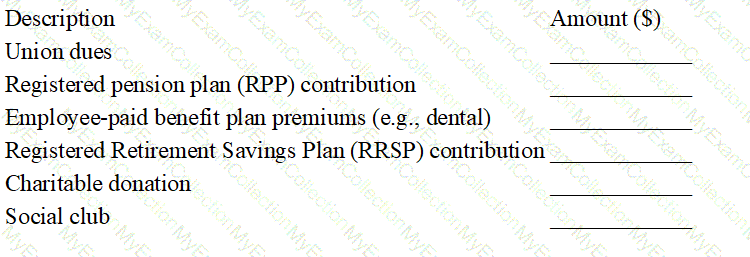
The company has a defined contribution pension plan to which Diane contributes 5% of her salary each pay.
Diane also contributes $20.00 to United Way and has $5.00 deducted for her social club membership each pay. She belongs to a union and pays 2% of her salary in union dues per pay period.
Diane’s federal and provincial TD1 claim codes are 1. She will not reach the first Canada Pension Plan or Employment Insurance annual maximums this pay period.
Required: Calculate the employee’s net pay, following the order of the steps in the net pay template.
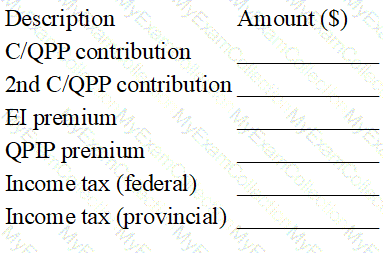
EXHIBIT A — Net Pay Template (Fill in all blanks)
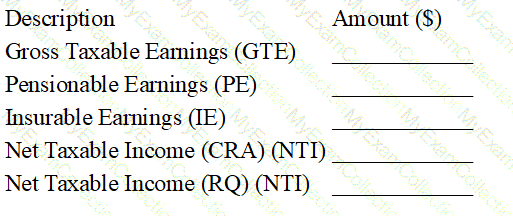
STATUTORY DEDUCTIONS
OTHER DEDUCTIONS
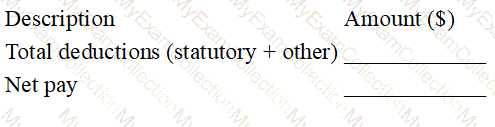
Given Data (Reference)
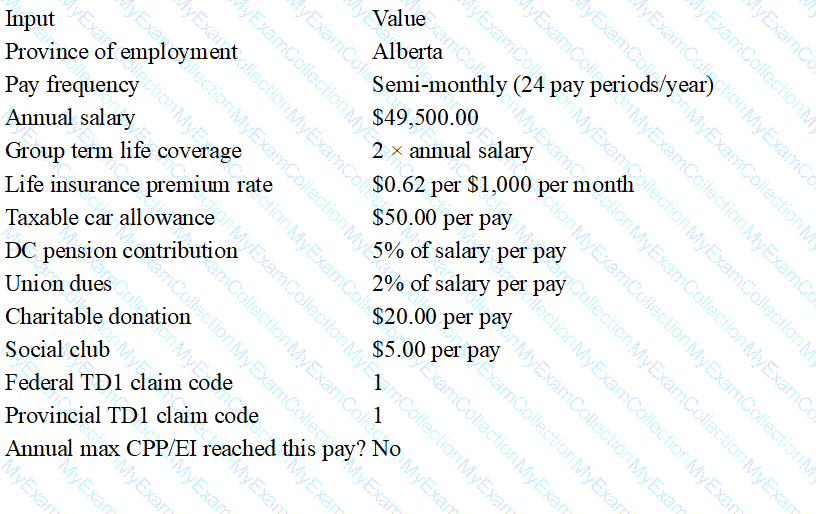
Step 1 — Calculate the employee’s gross taxable earnings (GTE) for this pay.
[ _________________________________ ]
Step 2 — Calculate the pensionable earnings (PE).
[ _________________________________ ]
Step 3 — Calculate the insurable earnings (IE).
[ _________________________________ ]
Step 4 — Calculate the net taxable income (CRA) (NTI).
[ _________________________________ ]
Step 5 — Calculate the net taxable income (RQ) (NTI).
[ _________________________________ ]
Step 6 — Calculate Diane’s Canada Pension Plan contribution.
[ _________________________________ ]
Step 7 — Calculate Diane’s Employment Insurance premium.
[ _________________________________ ]
Step 8 — Calculate Diane’s Quebec Parental Insurance Plan premium.
[ _________________________________ ]
Step 9 — Determine Diane’s federal income tax.
[ _________________________________ ]
Step 10 — Determine Diane’s provincial income tax.
[ _________________________________ ]
Step 11 — Calculate Diane’s total deductions (statutory + other).
[ _________________________________ ]
Step 12 — Calculate Diane’s net pay.
[ _________________________________ ]
Question # 6
Dollar amounts that are paid to an employee to cover expenses that they incurred while performing their job, but are not considered in the calculation of an employee’s earnings are:
Question # 10
The Canada Revenue Agency form that is completed to allow a commissioned employee to claim non-reimbursed expenses at source is a:
Question # 11
An employee has the use of a company-leased vehicle for both business and personal use. This is an example of:
Question # 12
Feraz Dalia is due $12,523.00 in legislated wages in lieu of notice that will be added to his last weekly pay of $1,080.00. Calculate Feraz’s Employment Insurance (EI) premium, if his employer is situated in Saskatchewan and the yearly maximum contribution will not be exceeded.
Question # 13
When would a Record of Employment be issued for an employee paid mainly by commission?
Question # 14
The authorization for hiring form should contain a checklist to ensure the organization obtains all required information. What is an example of an item that could be on that checklist?
Question # 15
Anthony earns $750.00 per week. He has a cash taxable benefit of $25.00 per week. Anthony is exempt from CPP contributions. Calculate the net taxable income for the week.
Question # 17
Matt earns $10.10 per hour and works 37.5 hours per week. Calculate Matt’s regular bi-weekly earnings.
Question # 18
Raminder was hired in January 1997. He was fully vested in the organization’s pension plan at the time he received the retiring allowance. His employment was terminated on May 1, 2006 and he was paid a $10,000.00 retiring allowance. Calculate the eligible portion of the retiring allowance.