Question # 4
MyCo, a telecom company, wants to send promotional SMSs with data plan offers to their qualified customers. The business intends to use the same action flow template with their target flow pattern for all the data plan actions.
What do you configure to implement this requirement?
Question # 5
What does a dotted line from a "Group By" component to a "Filter" component mean?
Question # 6
U+Bank presents various credit card offers to Its customers on Its website. The bank uses AI to prioritize the offers according to customer behavior. After the introduction of the Gold credit card offer, the offer click-through propensity decreased to 0.42.
What does the decrease in the propensity value most likely indicate?
Question # 7
A decisioning architect wants to use the customer properties income and age in a Filter component. Which decision component is required to enable access to these properties?
Question # 8
U+ Bank is designing a customer journey to increase credit card usage among new customers. The journey includes several stages with specific actions triggered by customer behavior. The bank wants to ensure that customers receive the most relevant actions based on their engagement.
Which stage arbitration option should the NBA Specialist select to ensure that customers always progress in the journey without reverting to previous stages?
Question # 9
The U+ Bank marketing department currently promotes various home loan offers to qualified customers. Now, the bank does not want customers to receive more than four promotional emails per quarter, regardless of past responses to that action by the customer.
Which option allows you to implement the business requirement?
Question # 10
GlobalRetail operates in a fast-changing digital marketplace where customer preferences and competitor offers change weekly. Their marketing team struggles with lengthy approval processes that prevent quick responses to market trends, often causing them to miss critical engagement opportunities.
What does agility represent in the context of customer engagement projects?
Question # 11
A volume constraint uses the Return any action that does not exceed
constraint mode. The following tables show the configuration of the volume constraints and the list of customers in the outbound segment:
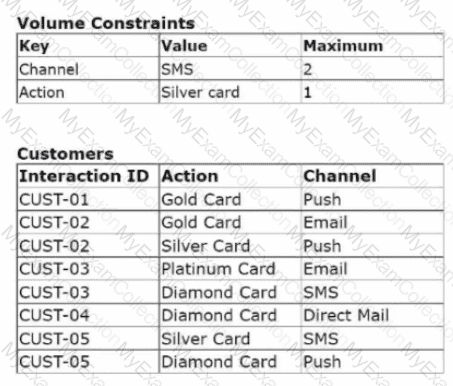
The outbound run selects customers in the following order to apply the volume constraints: CUST-01, CUST-02, CUST-03, and CUST-05.
Based on the configuration of the volume constraints for each channel, which offer does CUST-05 receive?
Question # 12
U+ Bank presents various credit card offers to its customers on its website. The bank uses AI to prioritize the offers according to customer behavior. With the introduction of the Gold credit card offer, the offer click-through propensity decreased to 0.42.
What does the decrease in the propensity value most likely indicate?
Question # 13
A financial institution's NBA team discovers that they need to modify their risk assessment strategy and edit a scorecard used for loan approvals. The team lead reviews the available options in 1:1 Operations Manager to determine the most appropriate approach to implementing these changes.
Which approach should the team lead use to implement these strategy and scorecard modifications?
Question # 14
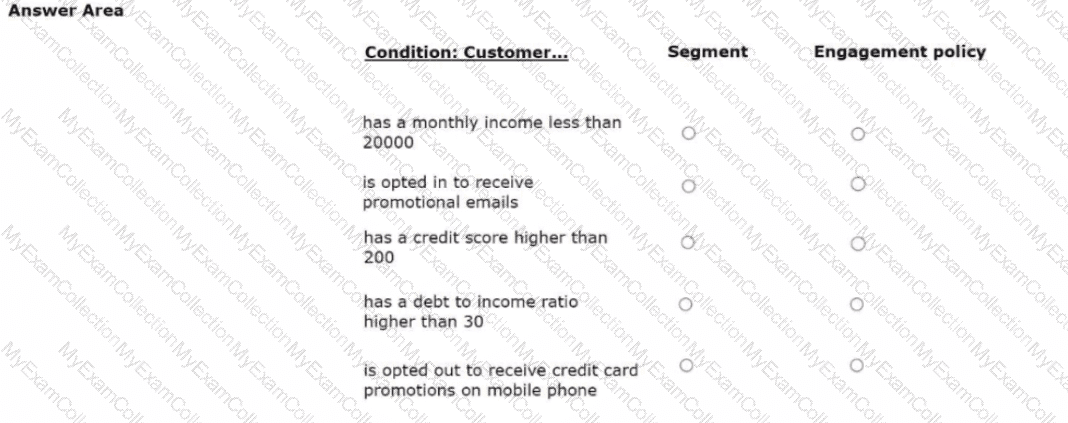
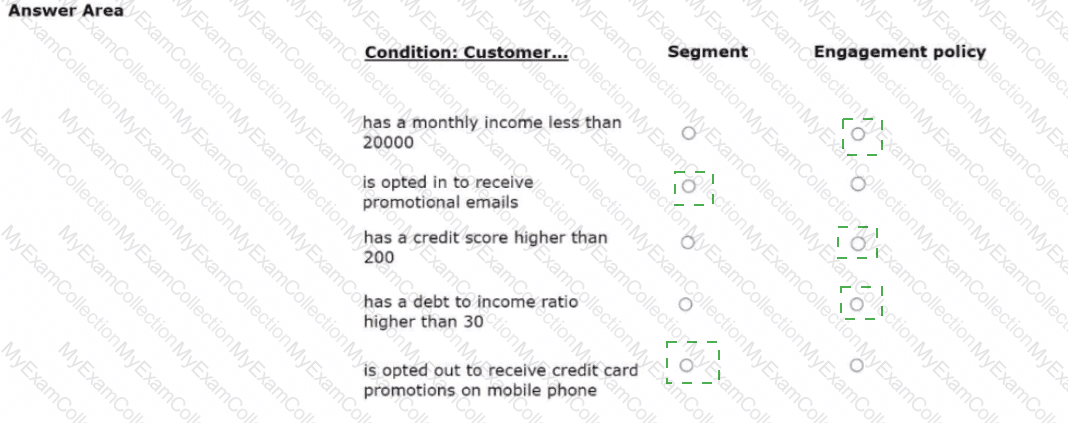
U+ Bank's marketing department wants to use the always-on outbound approach to send promotional emails about credit card offers to qualified customers. As a part of this promotion, the bank wants to identify the starting population by defining a few high-level criteria in a segment.
For each condition below, select which two conditions should be defined in Segment and which three conditions should be defined in Engagement policy as best practice.
Question # 15
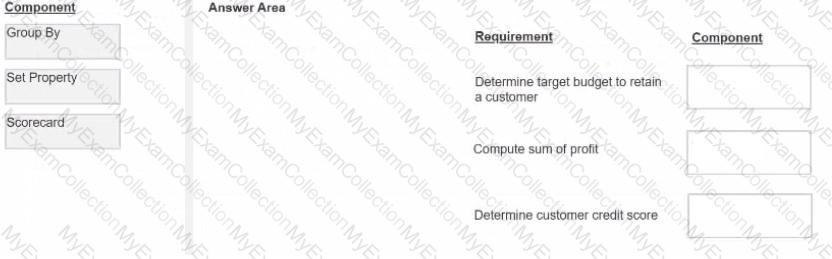
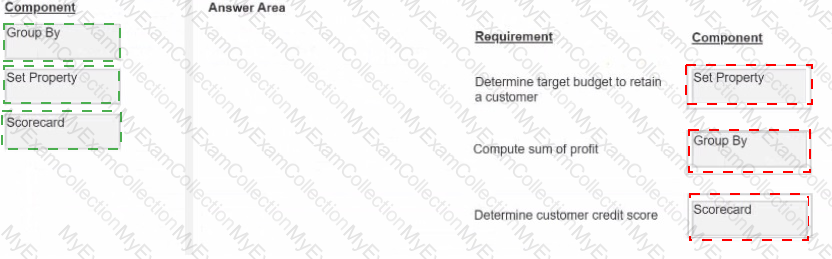
You are a decisioning architect on a next-best-action project and are responsible for designing and implementing decision strategies. Select each component on the leftand drag it to the correct requirement on the right.
Question # 16
As a Customer Service Representative, you present an offer to a customer who called to learn more about a new product. The customer rejects the offer. What is the next step that Pega Customer Decision Hub takes?
Question # 17
U+- Bank, a retail bank, has recently Implemented a project in which qualified customers see mortgage offers when they log in to the web self-service portal.
Currently, only the customers who satisfy the following engagement policy conditions receive the Fifteen-year fixed-rate mortgage offer:

The bank decides to make two changes:
1. Update the suitability condition for the Fifteen-year fixed-rate mortgage offer.
2. Introduce a new offer, Twenty-year fixed-rate mortgage.
The following table shows the new engagement policy conditions for both mortgage offers:

What is the best practice to fulfill this change management requirement in the business operations environment?
Question # 18
A financial institution has created a new policy that states the company will not send more than 500 emails per day. Which option allows you to implement the requirement?
Question # 19
A customer qualifies for Standard card (priority 60), Rewards card {priority 40), and Premium card {priority 30). Standard card volume is exhausted. Rewards card has remaining volume, and Premium card has remaining volume. The system uses "Return any action that does not exceed constraint" mode.
Which actions does the customer receive in this scenario?
Question # 20
MyCo, a telecom company, wants to use Pega Customer Decision Hubâ„¢ to send the MyFone Pro offer through email to qualified customers. In preparation, the marketing team created an action, a treatment, and an action flow. As a decisioning architect, you verify the settings in the Channel tab of Next-Best-Action Designer to enable email communication.
To implement this requirement, the completion of which two tasks do you verify in the Channel tab of Next-Best-Action Designer? (Choose Two)
Question # 21
A financial services company has implemented always-on outbound campaigns for three credit card offers: Standard card. Rewards card, and Rewards Plus card. The marketing team observes that customers who are qualified for multiple actions receive different numbers of offers, depending on the configuration of the volume constraint mode. To optimize customer engagement, the system administrator must choose between constraint modes.
Which volume constraint mode ensures that customers receive all actions for which they qualify, provided the actions do not reach volume limits?
Question # 22
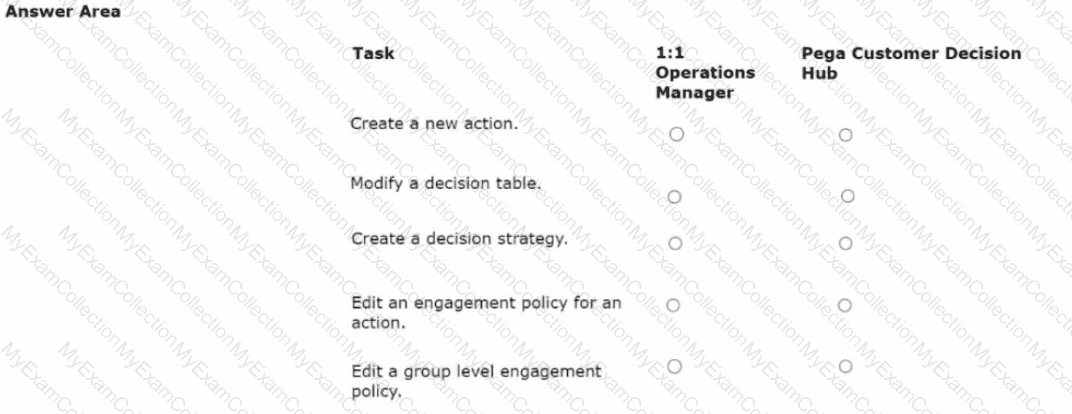
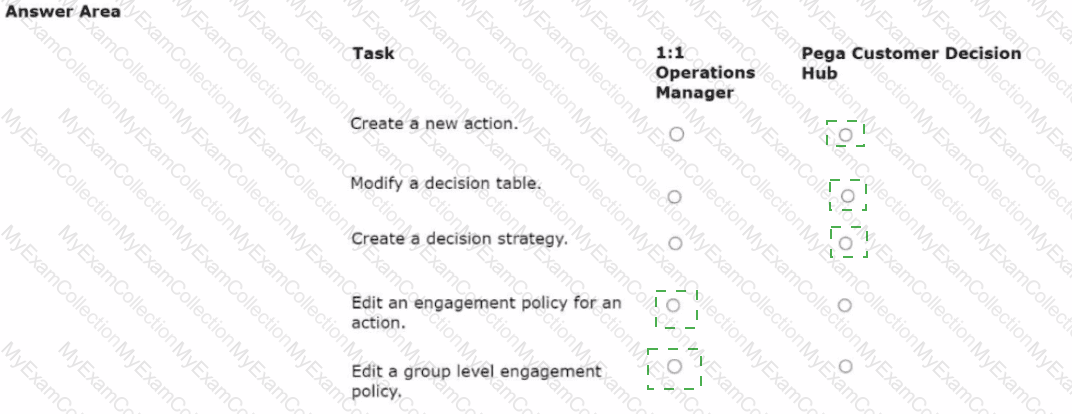
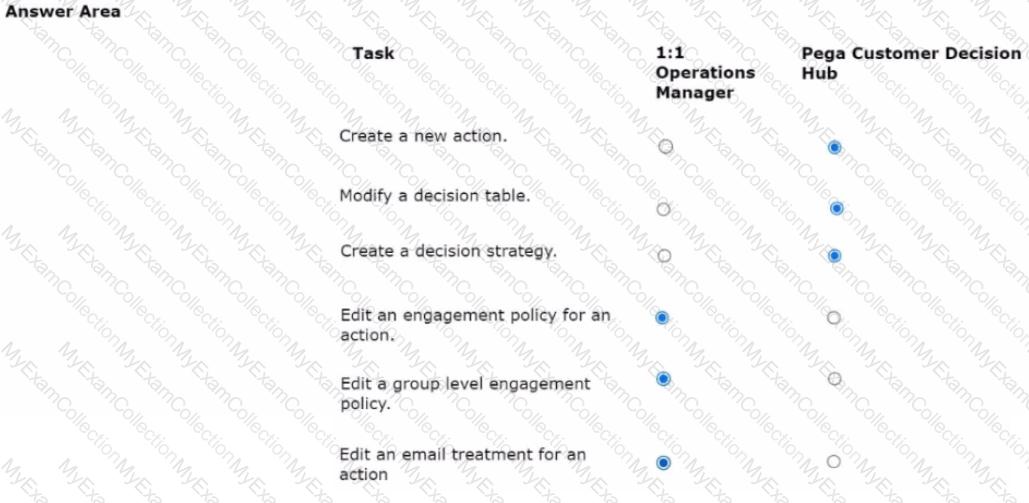
U+ Bank, a retail bank, uses the Business Operations Environment to perform its business changes. The bank carries out these changes in the Pega Customer Decision Hub portal by using revision management features or the 1:1 Operations Manager portal.
For each task, select the correct portal in which you initiate the change request based on best practices.
 C:\Users\Waqas Shahid\Desktop\Mudassir\Untitled.jpg
Question # 23
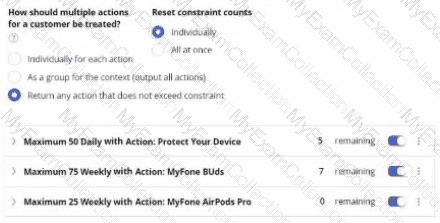
In the following figure, a volume constraint uses the Return any action that does not exceed constraint mode with the three following action type constraints that have remaining limits:
1.Maximum 50 Daily with Action: Protect Your Device, 5 remaining
2.Maximum 75 Daily with Action: MyFone Buds, 7 remaining
3.Maximum 25 Daily with Action: MyFone AirPods Pro, 0 remaining
A customer, CUST-01, qualifies for all the three actions. Given this scenario, how many actions does the system select for CUST-01 in the outbound run?
Question # 24
U+ Bank wants to use Pega Customer Decision Hub"* to display a credit card offer, the Standard Card, to every customer who logs in to the bank website.
What three of the following artifacts are mandatory to implement this requirement? (Choose Three)
Question # 25
U+ Bank implemented multiple customer journeys for Its customers. The goal of the bank Is to present the most relevant action for the customer to increase the chance of a positive outcome. U+ Bank is sure that customers see the next best action, regardless of the current journey that they are in.
Which statement is true about customer journeys in Pega Customer Decision Hub?
Question # 26
U+ Bank has recently defined two contact policies:
1. Suppress a group of credit card offers for 30 days if any credit card offer is rejected three times in any channel in the past 15 days.
2. Suppress the Reward card offer, part of the credit card group, for 7 days if it is rejected twice in any channel in the last 7 days. Paul, an existing U+ Bank customer, no longer sees the Reward card offer. What is the reason that Paul cannot see the offer?
Question # 27
MyCo, a mobile company, uses Pega Customer Decision Hubâ„¢ to display offers to customers on its website. The company wants to present more relevant offers to customers based on customer behavior. The following diagram is the action hierarchy in the Next-Best-Action Designer.
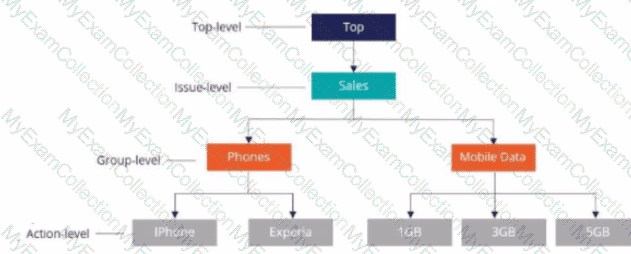
The company wants to present offers from both the groups and arbitrate across the two groups to select the best offer based on customer behavior.
As a decisioning architect, what must you do to present offers from the two groups?
Question # 28
U+ Bank, a retail bank, has recently implemented a project in which qualified customers see mortgage offers when they log in to the web self-service portal.
Currently, only the customers who satisfy the following engagement policy conditions receive the Fifteen-year fixed-rate mortgage offer:
The bank decides to make two changes:
1. Update the suitability condition for the Fifteen-year fixed-rate mortgage offer.
2. Introduce a new offer , Twenty-year fixed-rate mortgage.
The following table shows the new engagement policy conditions for both mortgage offers:

What is the best practice to fulfill this change management requirement in the Business Operations Environment?
Question # 29
Which of the following reasons explains why a customer might receive an action that they already accepted?
Question # 30
U+ Bank follows all engagement policy best practices to present credit card offers on their website. The bank has introduced a new credit card offer, the Rewards card. Anna, an existing customer, currently holds a higher value card, Premier Rewards, and does not see the new Rewards card offer.
What condition possibly prevents Anna from seeing the new Rewards card offer?
Question # 31
What is the name of the property that the system computes automatically when you use an Adaptive Model decision component?