Black Friday Sale Special - Limited Time 70% Discount Offer - Ends in 0d 00h 00m 00s - Coupon code: mxmas70

Home > OMG > OMG Certification > OMG-OCEB2-FUND100

OMG-OCEB2-FUND100 OMG-Certified Expert in BPM 2 - Fundamental Question and Answers

Question # 4

Choose the correct answer:

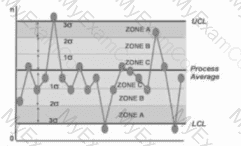
In Six Sigma analysis, the distinction between "common cause of variation" and "special cause of variation" is a key distinction.

In this diagram, which data points are characterized by common cause of variation?
A.

the data points within 1 sigma of the process average (within zone C)

B.

the data points inside the upper and lower control limits (UCL and LCL)

C.

the data points outside the upper and lower control limits (UCL and LCL)

D.

the data points within 2 sigma of the process average (within zones B and C)

E.

data points in the zone on the graph that contains the largest number of data points

Full Access
Question # 5

Choose the correct answer:

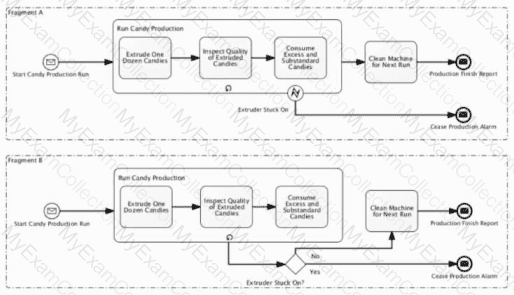
Which statement is true regarding the two diagram fragments?
A.

There is no difference between the two diagrams - Both are valid and imply the same execution semantics.

B.

Fragment A is invalid because a Boundary Error Event is always Interrupting and always is shown with a double-ring circle, while Fragment B is valid.

C.

In Fragment A, the machine is always cleaned while in Fragment B, the machine is only cleaned if the Run Candy Production Task ended without the Extruder Stuck On condition.

D.

In Fragment A, the Candy Production Task is interrupted by the first Extruder Stuck On event while in Fragment B, the Extruder Stuck On? condition is checked only at the end of the last Consume Excess and Substandard Candies Task.

Full Access
Question # 6

Choose the correct answer:

Which aspect is within the scope for BPMN?

A.

Strategy model

B.

Organization model

C.

Execution semantics

D.

Business rules model

Full Access
Question # 7

Choose the correct answer:

A winery notices that its younger consumers—those younger than 30—are buying more Chilean wine. You model this trend as the Business Motivation Model (BMM) element Younger customers buying more Chilean wine.

What is this model element?

A.

A Threat

B.

An Influencer

C.

An Assessment

D.

A Course of Action

Full Access
Question # 8

Choose the correct answer:

What is the key role of the Finance department in a company?

A.

to track the flow of money the company generates

B.

to ensure the company has the money it needs to operate

C.

to operate back-office functions in the service organization

D.

to ensure the company fulfills all applicable regulatory requirements

Full Access
Question # 9

Choose the correct answer:

Traditional (or functional) work management suffers from what?

A.

Clear definition of roles and responsibilities

B.

Functional excellence

C.

Bad vision and mission

D.

Lack of end-to-end focus

Full Access
Question # 10

Choose the correct answer:

Select the list of BPMN Activities:

A.

Task, Process

B.

Task, Sub-Process

C.

Task, Process, Action

D.

Task, Sub-Process, Action

E.

Task, Process, Sub-Process

Full Access
Question # 11

Choose the correct answer:

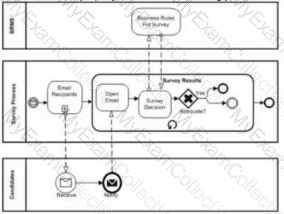
Which statement properly describes the following process?
A.

Conduct an email survey whose adequacy is defined by business rules.

B.

Survey recipients through email. Track the completion of the survey as the candidates return their responses.

C.

Conduct a survey of a number of recipients through email. Complete the survey when a predetermined number of responses have been received.

D.

Conduct a survey of a number of recipients through email. Complete the survey when all the responses have been filtered through the business rules.

E.

Send candidate recipients an email survey. Complete the survey when a predetermined number of answers, that satisfy business rules, have been received.

Full Access
Question # 12

Choose the correct answer:

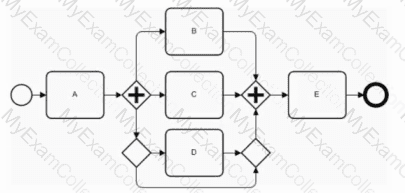
Given this process:
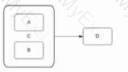
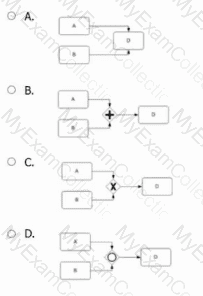
which alternative representation will execute identically?
A.

Option A

B.

Option B

C.

Option C

D.

Option D

Full Access
Question # 13

Choose the correct answer:

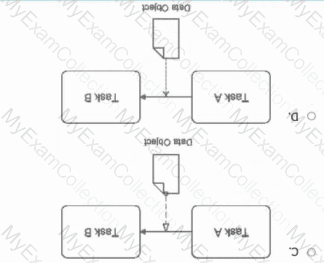
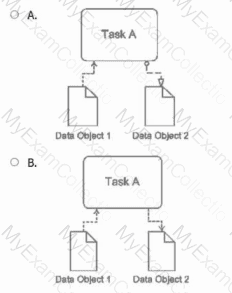
Which graphic about data objects in BPMN is correct?
A.

Option A

B.

Option B

C.

Option C

D.

Option D

Full Access
Question # 14

Choose the correct answer:

In the BMM, Directives govern which category?

A.

Goals

B.

Assessments

C.

Courses of Action

D.

Business Policies

Full Access
Question # 15

Choose the correct answer:

Which factor directly affects the complexity of a process?

A.

The number of steps

B.

The number of branches

C.

The number of instances

D.

The number of people using it

Full Access
Question # 16

Choose the correct answer:

Which process discovery technique obtains a detailed process topology definition?
A.

For each representative user, discover how that user is measured and controlled.

B.

For each representative user, discover the decisions that must be made by the participant.

C.

For each task performed, discover the previous and next tasks to be performed.

D.

For each task performed, discover the information that is required to complete the task.

Full Access
Question # 17

Choose the correct answer:

Which scenario fits this BPMN diagram?

A.

Choose a product, insert the delivery address, choose type of dispatch, pay for the product, confirm order.

B.

Choose a destination, choose a connection, pay for the ticket, optionally reserve a seat, print out the ticket.

C.

Enter one or several e-mail addresses for recipients, optionally add further addresses for cc-recipients, write some text, optionally add attachments, send e-mail.

D.

Get on the bike, drive the bike, pedal, optionally changing gears, get off the bike.

Full Access
Question # 18

Choose the correct answer:

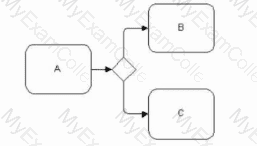
Which scenario is described by the diagram?

A.

First do A, then wait for an event before doing B and C.

B.

First do A, then B and C in any order.

C.

First do A, then B or C depending on a condition.

D.

First do A, then B or C or both B and C depending on a condition.

Full Access
Question # 19

Choose the correct answer:

Which description of text annotation in BPMN is true?

A.

The text annotation object affects the flow of the process.

B.

A text annotation object can be connected exclusively to pools, lanes, or groups.

C.

The text annotation object is connected to an object with an association.

D.

Text annotation can be represented as this graphic object.

Full Access
Question # 20

Choose the correct answer:

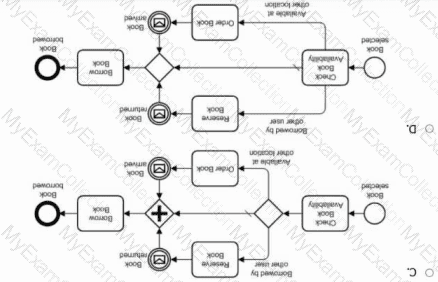
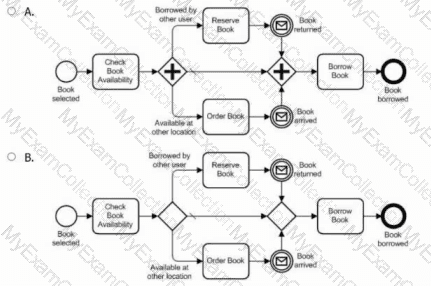
A user wants to borrow a book from her public library. At the library, she checks the avallability of the book. If it is available, she borrows it. If it is borrowed by an other user, she reserves the book and borrows it when it is returned by the other user. If the book is available at another location, she orders the book and borrows it when it arrives from the other location.

Which BPMN diagram depicts this process?
A.

Option A

B.

Option B

C.

Option C

D.

Option D

Full Access
Question # 21

Choose the correct answer:

Michael Porter created a strategic thinking framework called Porter's Five Forces.

Which is a set of those forces?

A.

adjust value creation, improve associated activities, segment customer base, analyze product performance, align business area to top two segments

B.

elements of barriers to entry, threats of substitute products or services, suppliers' bargaining power, customers' bargaining power, and competitive rivalry

C.

define organization's purpose, establish mission-consistent goals and objectives, develop resources to attain goals, set timeframe for the strategy, develop critical products and services

D.

determine where an organization is going over the next year or more, how it is going to get there, how it will know if it got there or not, the cost of the value chain, and the risk involved

Full Access
Question # 22

Choose the correct answer:

What is the meaning of an Expanded Sub-Process that lacks Sequence Flows between its Tasks?

A.

The Tasks are performed in Top to Bottom and Left to Right order, each Task executed once.

B.

The diagram is flawed: Tasks within a Sub-Process must be connected with Sequence Flows.

C.

The Tasks are performed in any order for any number of times including the possibility of skipping one or more of the Tasks entirely. These Tasks are performed until the Process arbitrarily decides to cease the execution.

D.

Each Task is performed once and only once, the order of execution is not specified, all the Tasks are simultaneously enabled for execution, and the execution of each Task can be contemporaneous with the others.

Full Access
Question # 23

Choose the correct answer:

What is straight-through-processing?

A.

It is where the BPMS application fully automates a process.

B.

It is a transactional approach to BPMS with large data volumes

C.

It is where the BPMS conducts high-speed, batch-oriented processing.

D.

It is a high-speed enterprise service broker approach to processing transactions.

Full Access
Question # 24

Choose the correct answer:

Which statement describes the concept of an End Event in BPMN?

A.

An End Event is a pointer to the last activity.

B.

An End Event marks the end of a path through a Process.

C.

An End Event is the last event that is generated by the Process.

D.

An End Event is the connection point between the Sub-Process and its parent Process.

Full Access
Question # 25

Choose the correct answer:

According to Chang in Business Process Management Systems, which is the key enabler of Business Process Re-engineering (BPR)?

A.

Incremental change

B.

Labor specialization

C.

Information technology

D.

Strong functional structure

Full Access
Question # 26

Choose the correct answer:

What is the function of a worklist handler in a BPMS?

A.

It is a report of the state of a process instance.

B.

It defines the responsibilities of the participants.

C.

It is where process participants are offered work items.

D.

It shows the current, actively worked tasks for participants.

Full Access
Question # 27

Choose the correct answer:

When connecting Flow Objects with Message Flows, which constraint is valid?

A.

Message Flows must be at a 90 degree angle from Sequence Flows.

B.

A Message Flow cannot connect a Pool with a Collapsed Sub-Process.

C.

Message Flows cannot connect to Flow Objects that are within the same Pool.

D.

A Message Flow cannot connect a Message End Event with a Catch-Message Intermediate Event.

Full Access