Question # 4
You are responsible for data security at a large hospital. You need to protect patient personal data including patient ID numbers, e-mail addresses, billing addresses, and credit card numbers that are stored in your database. You want to reduce false positives because you have limited resources for incident response. Which Netskope DLP capability would you use in this scenario?
Question # 5
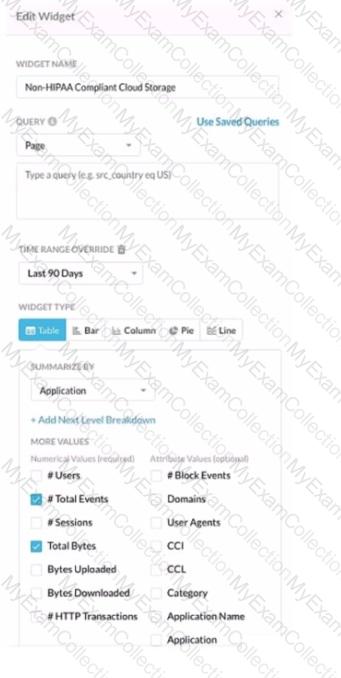
Review the exhibit.
You work for a medical insurance provider. You have Netskope Next Gen Secure Web Gateway deployed to all managed user devices with limited block policies. Your manager asks that you begin blocking Cloud Storage applications that are not HIPAA compliant Prior to implementing this policy, you want to verify that no business or departmental applications would be blocked by this policy.
Referring to the exhibit, which query would you use in the Edit Widget window to narrow down the results?
Question # 6
Review the exhibit.
MismatchCert (Hostname mismatch) Blocked by SSL_HOST_MISMATCH. The destination is not reachable. Contact your IT administrator with the following error.
A Netskope user reports receiving an error when trying to reach an application hosted by a trusted partner. Referring to the exhibit, what are two ways to solve this problem? (Choose two.)
Question # 7
You are using Netskope CSPM for security and compliance audits across your multi-cloud environments. To decrease the load on the security operations team, you are researching how to auto-re mediate some of the security violations found in low-risk environments.
Which statement is correct in this scenario?
Question # 8
You are deploying the Netskope Client to Windows devices. The following command line would be used to install the client MSI file:

In this scenario, what is < token > referring to in the command line?
Question # 9
Your Netskope Client tunnel has connected to Netskope; however, the user is not receiving any steering or client configuration updates What would cause this issue?
Question # 10
You want to enable the Netskope Client to automatically determine whether it is on-premises or off-premises. Which two options in the Netskope UI would you use to accomplish this task? (Choose two.)
Question # 11
You are asked to create a Quarantine repository in your Netskope tenant. Which statement is correct in this scenario?
Question # 12
You have an NG-SWG customer that currently steers all Web traffic to Netskope using the Netskope Client. They have identified one new native application on Windows devices that is a certificate-pinned application. Users are not able to access the application due to certificate pinning. The customer wants to configure the Netskope Client so that the traffic from the application is steered to Netskope and the application works as expected.
Which two methods would satisfy the requirements? (Choose two.)
Question # 14
You need to monitor the health of configured IPsec or GRE tunnels.
In this scenario, which two methods are supported by Netskope to accomplish this task? (Choose two.)
Question # 15
You want to verify that Google Drive is being tunneled to Netskope by looking in the nsdebuglog file. You are using Chrome and the Netskope Client to steer traffic. In this scenario, what would you expect to see in the log file?
A)

B)

C)

D)

Question # 16
Review the exhibit.
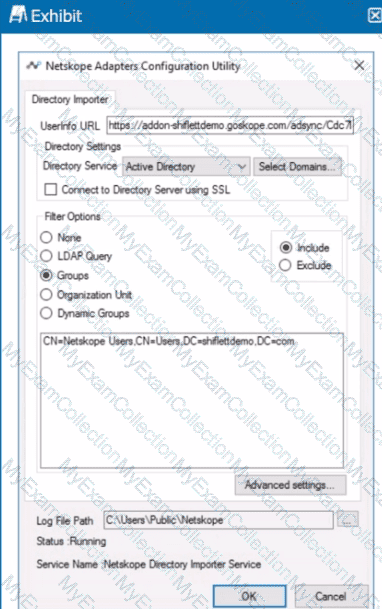
You installed Directory Importer and configured it to import specific groups ot users into your Netskope tenant as shown in the exhibit. One hour after a new user has been added to the domain, the user still has not been provisioned to Netskope.
What are three potential reasons for this failure? (Choose three.)
Question # 17
Your customer is currently using Directory Importer with Active Directory (AD) to provision users to Nelskope. They have recently acquired three new companies (A. B. and C) and want to onboard users from the companies onto the Netskope platform. Information about the companies is shown below.
- Company A uses Active Directory.
-- Company B uses Azure AD.
-- Company C uses Okta Universal Directory.
Which statement is correct in this scenario?
Question # 18
You want to integrate with a third-party DLP engine that requires ICAP. In this scenario, which Netskope platform component must be configured?
Question # 19
You built a number of DLP profiles for different sensitive data types. If a file contains any of this sensitive data, you want to take the most restrictive policy action but also create incident details for all matching profiles.
Which statement is correct in this scenario?
Question # 20
Users in your network are attempting to reach a website that has a self-signed certificate using a GRE tunnel to Netskope. They are currently being blocked by Netskope with an SSL error. How would you allow this traffic?
Question # 21
You receive a report from your endpoint team that a device may no longer be running the Netskope Client. You only know the hostname of the machine in question. You want to remotely verify whether the client is still installed and steering traffic and which user is assigned to the device. In this scenario, how would you accomplish this task?
Question # 22
A company wants to capture and maintain sensitive PII data in a relational database to help their customers. There are many employees and contractors that need access to sensitive customer data to perform their duties The company wants to prevent the exfiltration of sensitive customer data by their employees and contractors.
In this scenario. what would satisfy this requirement?
Question # 23
You are asked to create a customized restricted administrator role in your Netskope tenant for a newly hired employee. Which two statements are correct in this scenario? (Choose two.)
Question # 24
Review the exhibit.
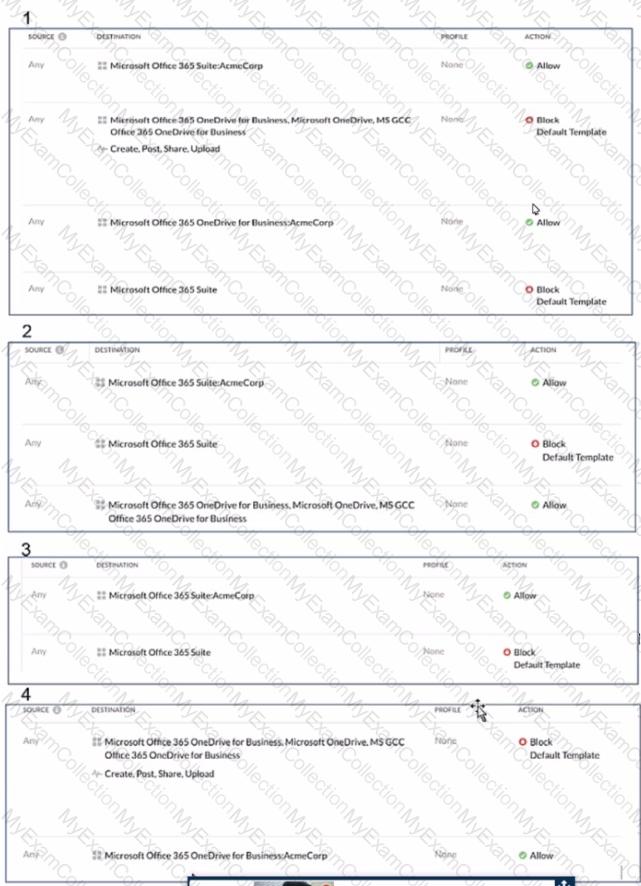
AcmeCorp has recently begun using Microsoft 365. The organization is concerned that employees will start using third-party non-AcmeCorp OneDrive instances to store company data. The CISO asks you to use Netskope to create a policy that ensures that no data is being uploaded to non-AcmeCorp instances of OneDrive.
Referring to the exhibit, which two policies would accomplish this posture? (Choose two.)