New Year Sale Special - Limited Time 70% Discount Offer - Ends in 0d 00h 00m 00s - Coupon code: mxmas70

Home > Fortinet > Fortinet Network Security Expert > NSE6_SDW_AD-7.6

NSE6_SDW_AD-7.6 Fortinet NSE 6 - SD-WAN 7.6 Enterprise Administrator Question and Answers

Question # 4

(You plan a large SD-WAN deployment for a global company. You want to divide the network architecture into five geographical regions and install two hubs in each region for increased redundancy. You expect a significant amount of traffic within each region and limited traffic flow between spokes in different regions. You plan to connect the small branch sites to only the closest hub in their regions and the large branch sites to the two hubs in the regions.

Which statement about your plan is true? Choose one answer.)

A.

It is possible. You should use eBGP as the routing protocol between the regions.

B.

It is not possible. FortiOS 7.6 supports multihub topologies with up to four hubs.

C.

It is possible. You should use FortiManager and the overlay orchestrator multihub topology to simplify the deployment.

D.

It is not possible. In a region, all spokes must have either single-hub or dual-hub connectivity.

Full Access
Question # 5

(When you deploy SD-WAN, you can choose from several common designs. Each design best applies to specific contexts.

Which two statements correctly associate a common SD-WAN design with its main indication or constraint? Choose two answers.)

A.

Use a cloud on-ramp topology to improve the performance of cloud applications.

B.

Use a standalone design for sites with only one WAN link to the cloud.

C.

Use remote breakout to centralize traffic inspection and limit local management requirements.

D.

Use a direct internet access (DIA) design to increase the traffic security and allow local devices with limited capabilities.

Full Access
Question # 6

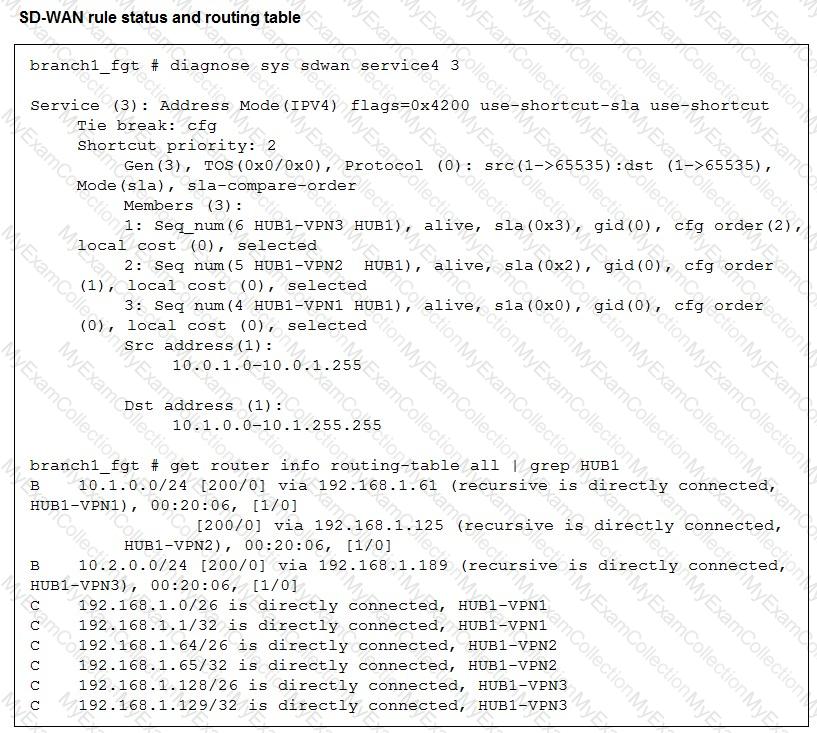
Refer to the exhibit.

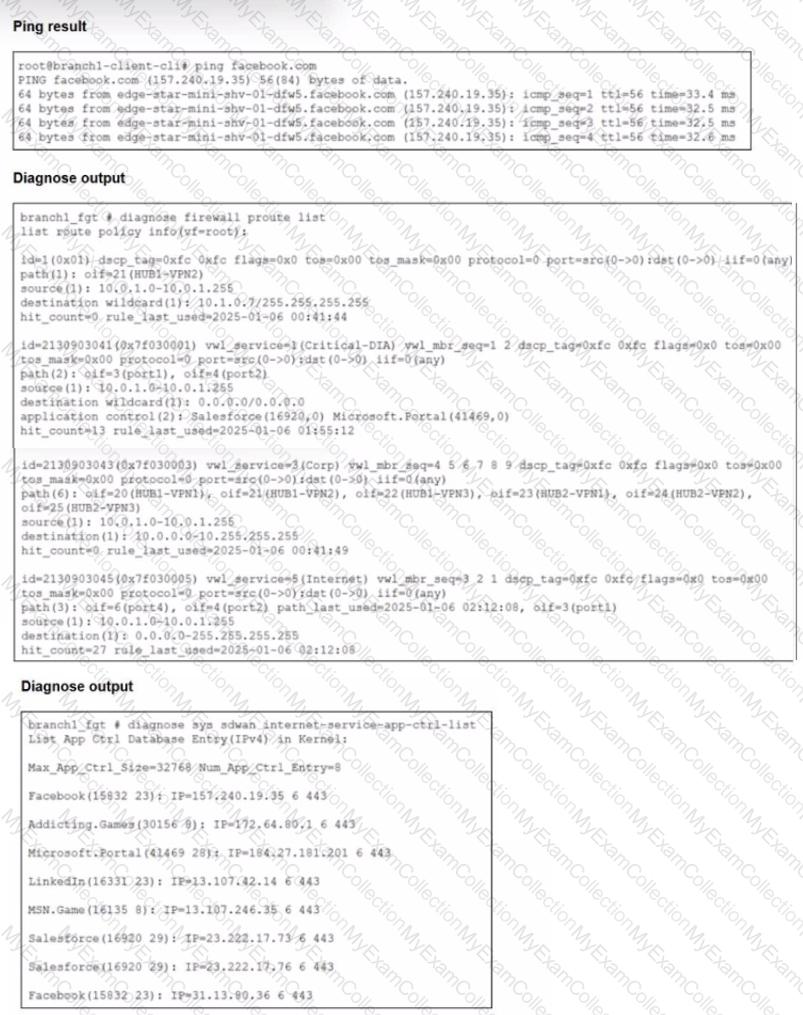
Which SD-WAN rule and interface uses FortiGate to steer the traffic from the LAN subnet 10.0.1.0/24 to the corporate server 10.2.5.254?

A.

SD-WAN service rule 3 and interface HUB1-VPN2.

B.

SD-WAN service rule 3 and interface HUB1-VPN3.

C.

SD-WAN service rule 4 and port1 or port2.

D.

SD-WAN service rule 4 and interface port2.

Full Access
Question # 7

The SD-WAN overlay template helps to prepare SD-WAN deployments. To complete the tasks performed by the SD-WAN overlay template, the administrator must perform some post-run tasks. What are two mandatory post-run tasks that must be performed? (Choose two.)

A.

Configure routing through the overlay tunnels created by the SD-WAN overlay template.

B.

Create policy packages and assign them to the branch devices.

C.

Assign a hub id metadata variable to each hub device.

D.

Configure SD-WAN rules

E.

Assign an sdwan_id metadata variable to each device (branch and hub)

Full Access
Question # 8

You manage an SD-WAN topology. You will soon deploy 50 new branches.

Which three tasks can you do in advance to simplify this deployment? (Choose three.)

A.

Update the DHCP server configuration.

B.

Create model devices.

C.

Create a ZTP template.

D.

Define metadata variables value for each device.

E.

Create policy blueprint.

Full Access
Question # 9

Refer to the exhibits.

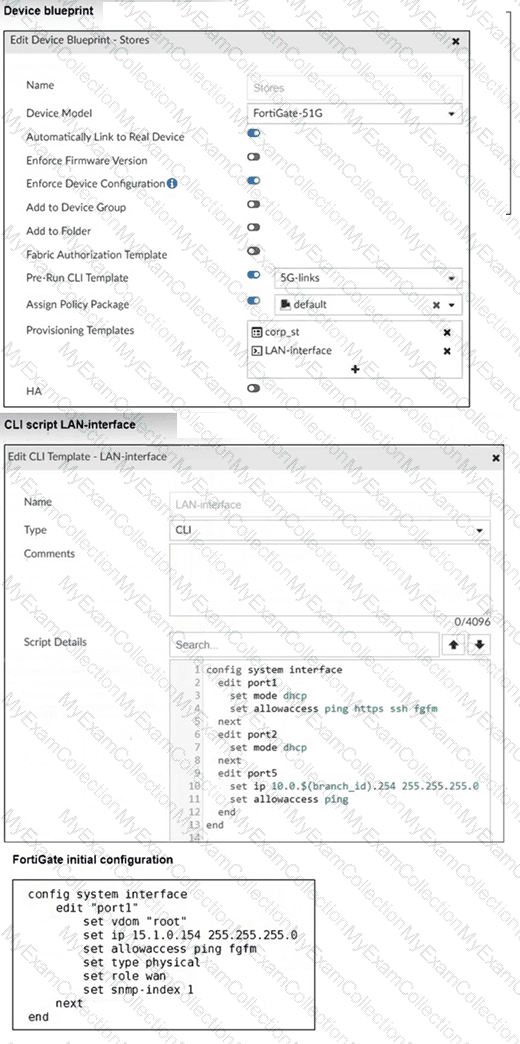
You use FortiManager to configure SD-WAN on three branch devices.

When you install the device settings. FortiManager prompts you with the error "Copy Failed" for the device branch1_fat When you click the log button. FortiManager displays the message shown in the exhibit.

A.

Based on the exhibits, which statement best describes the issue and how you can resolve it?

B.

Remove the installation target for the SD-WAN member port4. You cannot combine metadata variable and installation targets.

C.

Gateways for all members in a zone must be defined the same way. Specify the gateway of the SD-WAN member port! without metadata variables.

D.

Check the metadata variable definitions, and review the per-device mapping configuration.

E.

Check the connection between branch1_fgt and FortiManager

Full Access
Question # 10

Refer to the exhibit.

What conclusions can you draw about the traffic received by FortiGate originating from the source LAN device 10.0.1.133 and destined for the company’s SMTP mail server at 10.66.0.125?

A.

FortiGate steers the traffic from the LAN device 10.0.1.133 to the company SMTP mail server 10.66 0.125 through port3.

B.

ForliGate steers the traffic from the LAN device 10.0.1.133 to the company SMTP mail server 10.66.0.125 through port2.

C.

FortiGate steers the traffic from the LAN device 10.0.1.133 to the company SMTP mail server 10.66.0.125 through the SD-WAN member ID 4.

D.

FortiGate steers the traffic from the LAN device 10.0.1.133 to the SMTP mail server 10.66.0.125 through the SD-WAN member ID 1 or 2.

Full Access
Question # 11

An administrator is configuring SD-WAN to load balance their network traffic. Which two things should they consider when setting up SD-WAN? (Choose two.)

A.

You can select the outbandwidth hash mode with all strategies that allow load balancing.

B.

Only the manual and best-quality strategies allow SD-WAN load balancing.

C.

When applicable. FortiGate load balances the traffic through all members that meet the SLA target.

D.

SD-WAN load balancing is possible only using the best quality and lowest cost (SLA) strategies.

Full Access
Question # 12

Refer to the exhibits.

The exhibits show two IPsec templates to define Branch IPsec 1 and Branch_IPsec_2. Each template defines a VPN tunnel. The error message that FortiManager displayed when the administrator tried to assign the second template to the FortiGate device is also shown.

Which statement best describes the cause of the issue?

A.

You can assign only one template with a tunnel type of static to each FortiGate device.

B.

You can assign only one IPsec template to each FortiGate device.

C.

You should review the branch1_fgt configuration for configured tunnels in the rootVDOM.

D.

You should use the same outgoing interface of both templates.

Full Access
Question # 13

Refer to the exhibits.

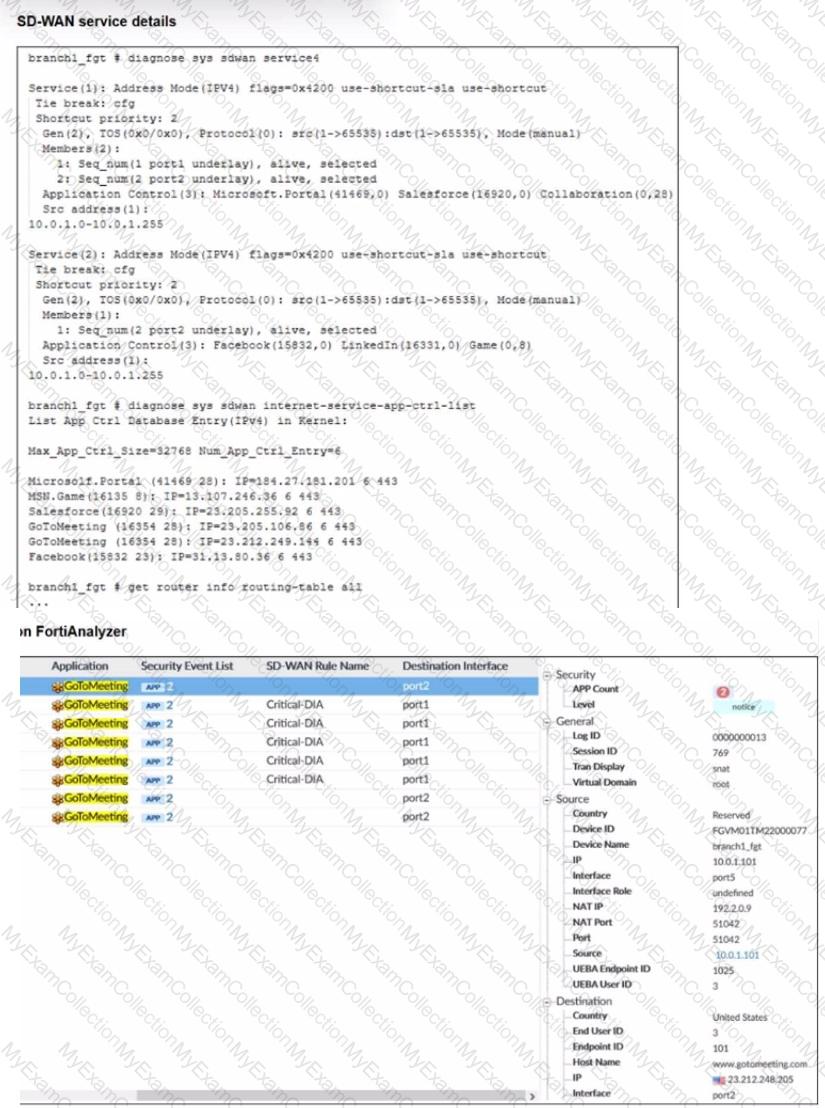
An administrator is testing application steering in SD-WAN. Before generating test traffic, the administrator collected the information shown in the first exhibit. After generating GoToMeeting test traffic, the administrator examined the corresponding traffic log on FortiAnalyzer, which is shown in the second exhibit.

The administrator noticed that the traffic matched the implicit SD-WAN rule, but they expected the traffic to match rule ID 1.

Which two reasons explain why some log messages show that the traffic matched the implicit SD-WAN rule? (Choose two.)

A.

Full SSL inspection is not enabled on the matching firewall policy.

B.

The session 3-tuple did not match any of the existing entries in the ISDB application cache.

C.

FortiGate could not refresh the routing information on the session after the application was detected.

D.

No configured SD-WAN rule matches the traffic related to the collaboration application GoToMeeting

Full Access
Question # 14

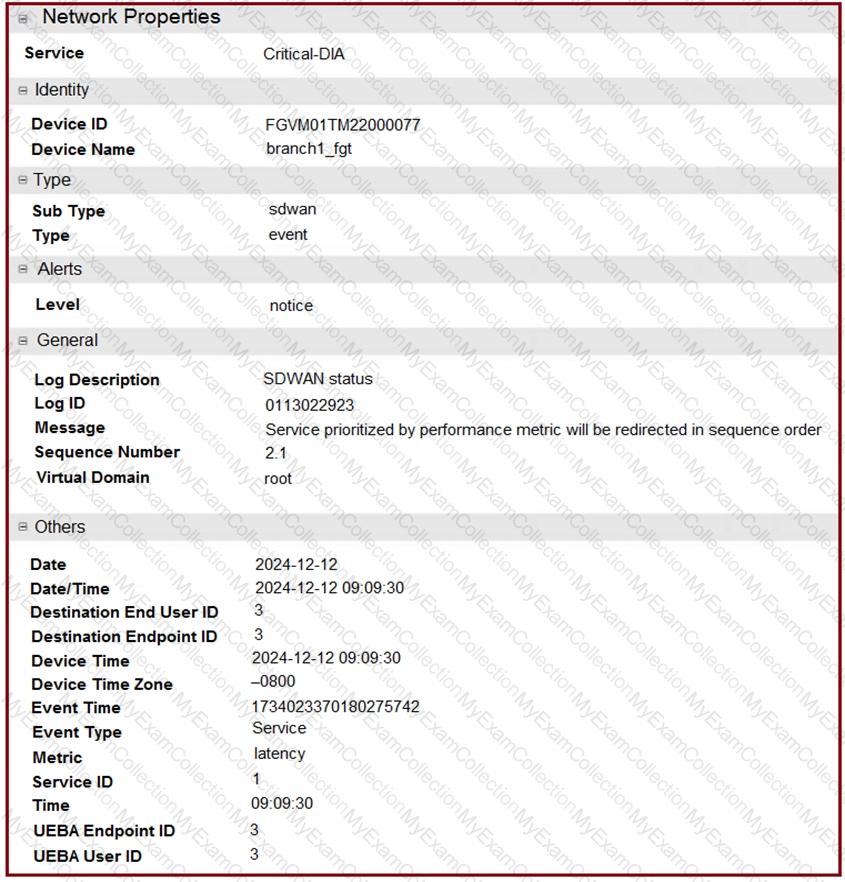
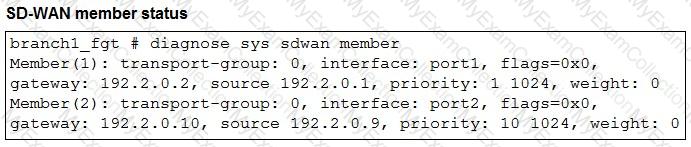
Refer to the exhibits.
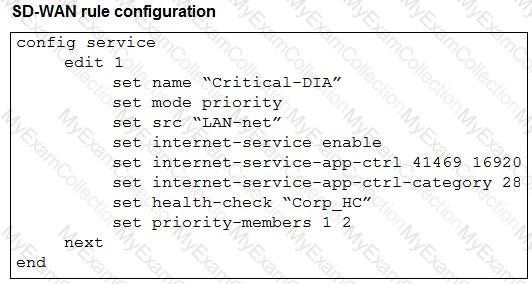
The exhibits show an SD-WAN event log, the member status, and the SD-WAN rule configuration.

Which two conclusions can you draw from the information shown? (Choose two.)

A.

The administrator configured the service ID 1 with the highest priority member for port2.

B.

Port2 has a lower latency than port1.

C.

FortiGate updated the outgoing interface list on the rule so it prefers port2.

D.

The administrator configured the SD-WAN rule ID 1 with the default strategy mode.

Full Access
Question # 15

Refer to the exhibit that shows a diagnose output on FortiGate.
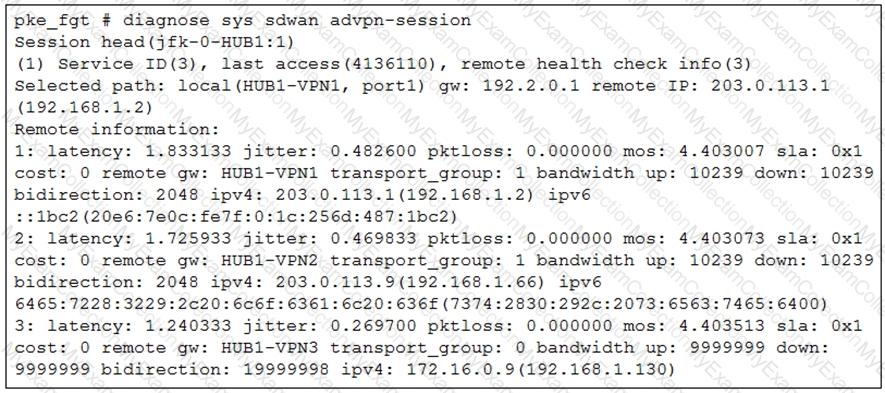
Based on the output shown in the exhibit, what can you say about the device role and how it handles health checks?

A.

The device is a spoke. It receives health-check measures for the tunnels of another spoke.

B.

The device is a hub. It receives embedded health-check measures for each tunnel from the spoke.

C.

The device is a spoke. It provides embedded health-check measures for each tunnel to the hub.

D.

The device is a hub. It receives health-check measures for the tunnels of a spoke.

Full Access
Question # 16

Refer to the exhibits.

The exhibits show the source NAT (SNAT) global setting. port2 interface settings, and the routing table on FortiGate.

The administrator increases the member priority on port2 to 20.

Upon configuration changes and the receipt of new packets, which two actions does FortiGate perform on existing sessions established over port2? (Choose two.)

A.

FortiGate continues routing all existing sessions over port2.

B.

FortiGate routes only new sessions over port2.

C.

FortiGate flags the SNAT session as dirty only if the administrator has assigned an IP pool to the firewall policies with NAT.

D.

FortiGate flags the sessions as dirty.

E.

FortiGate updates the gateway information of the sessions with SNAT so that they use port1 instead of port2.

Full Access
Question # 17

Your FortiGate is in production. To optimize WAN link use and improve redundancy, you enable and configure SD-WAN.

What must you do as part of this configuration update process?

A.

Replace references to interfaces used as SD-WAN members in the routing configuration.

B.

Purchase and install the SD-WAN license, and reboot the FortiGate device.

C.

Replace references to interfaces used as SD-WAN members in the firewall policies.

D.

Disable the interface that you want to use as an SD-WAN member.

Full Access
Question # 18

You are planning a large SD-WAN deployment with approximately 1000 spokes and want to allow ADVPN between the spokes. Some remote sites use FortiSASE to connect to the company's SD-WAN hub. Which overlay routing configuration should you use?

A.

BGP on loopback with dynamic BGP for ADVPN shortcut routing.

B.

BGP on loopback with IPsec phase2 selectors for ADVPN shortcut routing.

C.

BGP per overlay with dynamic BGP for ADVPN shortcut routing.

D.

BGP per overlay with BGP next-hop convergence for ADVPN shortcut routing.

Full Access
Question # 19

(You are configuring SD-WAN to load balance network traffic and you want to take into account the link quality.

Which two facts should you consider? Choose two answers.)

A.

When applicable, FortiGate load balances the traffic through all members that meet the SLA target.

B.

You can select the best quality strategy and allow SD-WAN load balancing.

C.

You can select the lowest cost service level agreement (SLA) strategy and allow SD-WAN load balancing.

D.

The best quality strategy supports only the round-robin hash mode.

Full Access
Question # 20

As an MSSP administrator, you are asked to configure ADVPN on an existing SD-WAN topology. FortiManager manages the customer devices in a dedicated ADOM. The previous administrator used the SD-WAN overlay topology.

Which two statements apply to this scenario? (Choose two.)

A.

You can activate auto-discovery VPN in the SD-WAN overlay template only if it is a single hub topology.

B.

When auto-discovery VPN is enabled, FortiManager updates the IPsec and BGP templates in the hub.

C.

After you enable auto-discovery VPN in the overlay template, you must select between ADVPN 2.0 and ADVPN 1.0.

D.

You can activate auto-discovery VPN in the SD-WAN overlay template for any type of topology, including a primary-primary dual-hub topology.

Full Access
Question # 21

(In the context of SD-WAN, the terms underlay and overlay are commonly used to categorize links.

Which two statements about underlay and overlay links are correct? Choose two answers.)

A.

A VLAN is a type of overlay link.

B.

Overlay links provide routing flexibility.

C.

FortiLink interface is considered an underlay link.

D.

Wireless connections can be used to build overlay links.

E.

Only wired connections can be used as underlay links.

Full Access
Question # 22

Which two statements correctly describe what happens when traffic matches the implicit SD-WAN rule? (Choose two.)

A.

The session information output displays no SD-WAN service id.

B.

Traffic is load balanced using the algorithm set for the v4-ecmp-mode setting.

C.

The traffic is distributed, regardless of weight, through all available static routes.

D.

Traffic does not match any of the entries in the policy route table.

E.

FortiGate flags the session with may_dirty and vwl_def ault.

Full Access
Question # 23

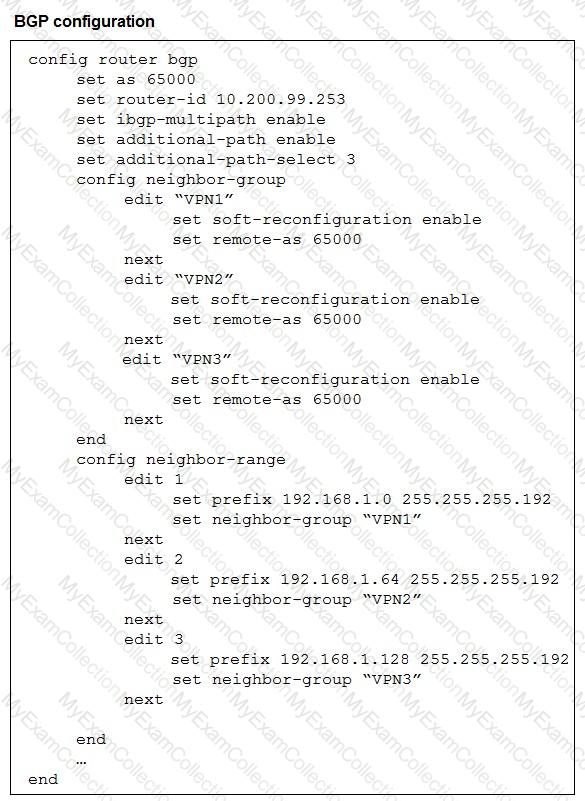
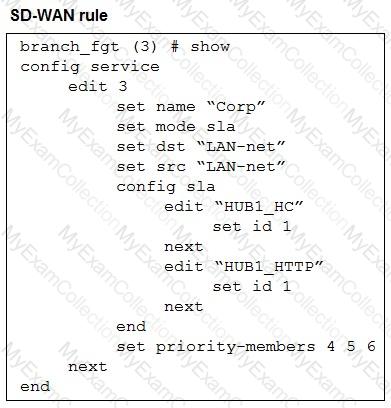
(Refer to the exhibits.

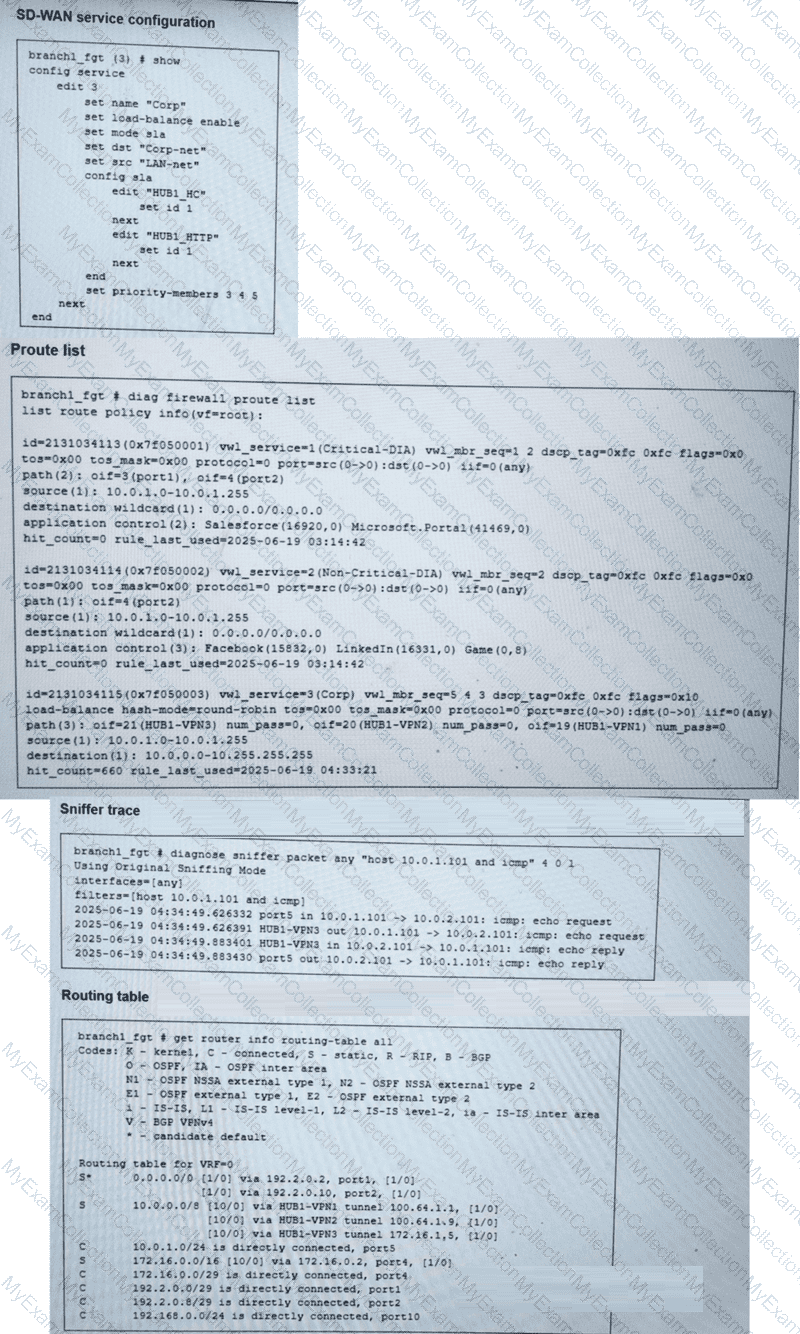
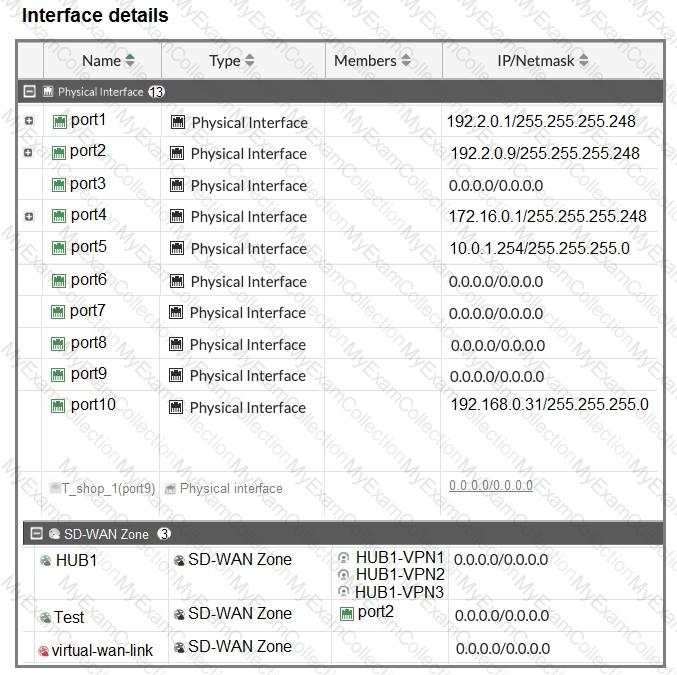
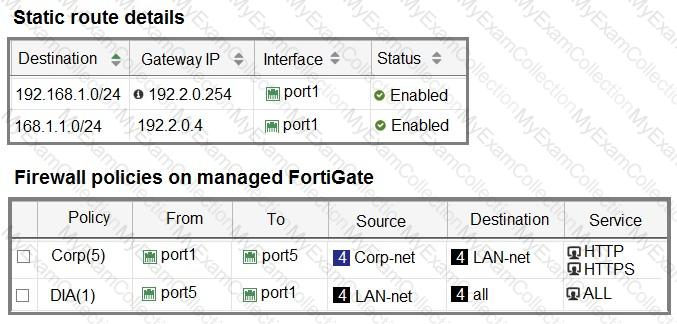
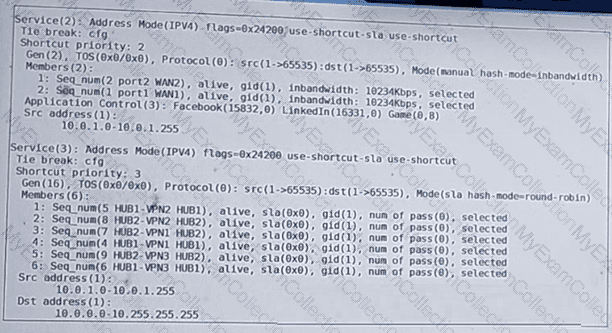
You collected the output shown in the exhibits and want to know which interface HTTP traffic will flow through from the user device 10.0.1.101 to the corporate web server 10.0.0.126. All SD-WAN links are stable.

Which interface will FortiGate use to steer the traffic? Choose one answer.)

A.

Only HUB1-VPN3

B.

Only HUB1-VPN2

C.

Either HUB1-VPN2 or HUB1-VPN3

D.

Either HUB1-VPN1, HUB1-VPN2, or HUB1-VPN3

Full Access
Question # 24

Exhibit.

Refer to the exhibit, which shows the SD-WAN rule status and configuration.

Based on the exhibit, which change in the measured packet loss will make HUB1-VPN3 the new preferred member?

A.

When HUB1-VPN1 has 4% packet loss

B.

When HUB1-VPN1 has 12% packet loss

C.

When HUB1-VPN3 has 4% packet loss

D.

When all three members have the same packet loss

Full Access
Question # 25

Refer to the exhibit.

The administrator analyzed the traffic between a branch FortiGate and the server located in the data center, and noticed the behavior shown in the diagram.

When the LAN clients located behind FGT1 establish a session to a server behind DC-1, the administrator observes that, on DC-1, the reply traffic is routed overT2. even though T1 is the preferred member in

the matching SD-WAN rule.

What can the administrator do to instruct DC-1 to route the reply traffic through the member with the best performance?

A.

Enable snat-route-change under config system global.

B.

Enable reply-session under config system sdwan.

C.

Enable auxiliary-session under config system settings.

D.

FortiGate route lookup for reply traffic only considers routes over the original ingress interface.

Full Access
Question # 26

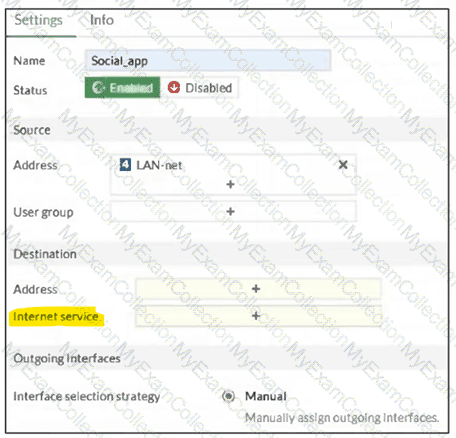
Refer to the exhibit.

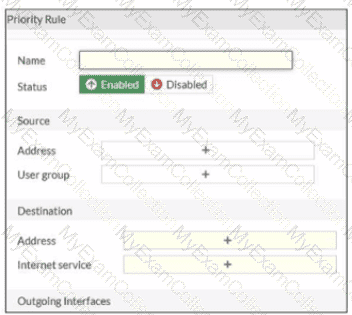
An administrator configures SD-WAN rules for a DIA setup using the FortiGate GUI. The page to configure the source and destination part of the rule looks as shown in the exhibit. The GUI page shows no option to configure an application as the destination of the SD-WAN rule Why?

A.

You cannot use applications as the destination when FortiGate is used for a DIA setup.

B.

FortiGate allows the configuration of applications as the destination of SD-WAN rules only on the CLI.

C.

You must enable the feature on the CLI.

D.

You must enable the feature first using the GUI menu System > Feature Visibility.

Full Access
Question # 27

SD-WAN interacts with many other FortiGate features. Some of them are required to allow SD-WAN to steer the traffic.

Which three configuration elements that you must configure before FortiGate can steer traffic according to SD-WAN rules? (Choose three.)

A.

Firewall policies

B.

Interfaces

C.

Security profiles

D.

Traffic shaping

E.

Routing

Full Access
Question # 28

Refer to the exhibit.

The administrator configured the SD-WAN rule ID 4 with two members (port1 and port2) and strategy lowest cost (SLA).

What are the two characteristics of the session shown in the exhibit? (Choose two.)

A.

FortiGate steered this flow according to an SD-WAN rule 4.

B.

FortiGate will never re-evaluate this session.

C.

FortiGate steered this flow according to the application detected and the outgoing interface is port3.

D.

FortiGate will re-evaluate this session if the outgoing interface goes down.

Full Access