Question # 4
Mule application A is deployed to CloudHub and is using Object Store v2. Mule application B is also deployed to CloudHub.
Which approach can Mule application B use to remove values from Mule application A's Object Store?
A.
CloudHub REST API
B.
CloudHub Connector
C.
Object Store v2 REST API
D.
Object Store Connector
Full Access
Answer:
C
Explanation:
Object Store Connector provides Mule operations for interacting with object stores associated with the application in which the connector executes. It is not the mechanism for one independently deployed CloudHub application to directly operate on another application's Object Store v2 data.
For cross-application administration and access, MuleSoft provides the Object Store v2 REST APIs. These APIs support listing object stores and keys, storing and retrieving key-value pairs, and explicitly deleting keys and their values. Calls are authenticated with an Anypoint Platform bearer token and address the required organization, environment, store, partition, and key. MuleSoft's documented DELETE operation removes a specified key-value pair from the targeted Object Store v2 partition.
The CloudHub REST API manages CloudHub resources and deployments rather than application Object Store entries. The CloudHub Connector likewise does not provide the direct cross-application Object Store v2 deletion capability described here.
Therefore, application B can invoke the Object Store v2 REST API, subject to appropriate authorization and identification of application A's relevant Object Store resources, to remove values from that store.
Reference topics: Object Store v2; Object Store v2 REST APIs; partitions and keys; DELETE operations; CloudHub persistence.
Official documentation: https://docs.mulesoft.com/object-store/osv2-apis
===============================================================
Question # 5
Which statement is true when using XML SDK for creating custom message processors?
A.
Operations can be reused in recursive calls
B.
An XML SDK provides both inbound and outbound operations
C.
Properties are fields defined by an end user of the XML SDK component and serve as a global configuration for the entire Mule project in which they are used
D.
All operations are public
Full Access
Answer:
C
Explanation:
Option C is directly supported by the MuleSoft XML SDK documentation. MuleSoft defines an XML SDK property as a field supplied by an end user of the component that operates at the module configuration level. Unlike an operation parameter, which applies to one operation invocation, properties configure the XML SDK component across the Mule project in which that configuration is used.
The other choices conflict with documented XML SDK behavior. XML SDK operations do not support recursive calls, so A is false. XML SDK provides outbound operations but does not provide inbound message sources such as schedulers, making B false.
Option D also requires correction. Current XML SDK versions support a visibility setting with values including PUBLIC and PRIVATE; the default is public, but operations are not universally required to remain public. MuleSoft's current XML SDK reference explicitly documents private operation visibility.
Therefore, C is the technically correct and directly documented statement. This is one question where the option selected in the supplied source should not be accepted without verification.
Reference topics: XML SDK Properties; Operations; module configuration; operation visibility; XML SDK limitations.
Official documentation: https://docs.mulesoft.com/mule-sdk/latest/xml-sdk
Official documentation: https://docs.mulesoft.com/mule-sdk/latest/
===============================================================
Question # 6
Refer to the exhibits.
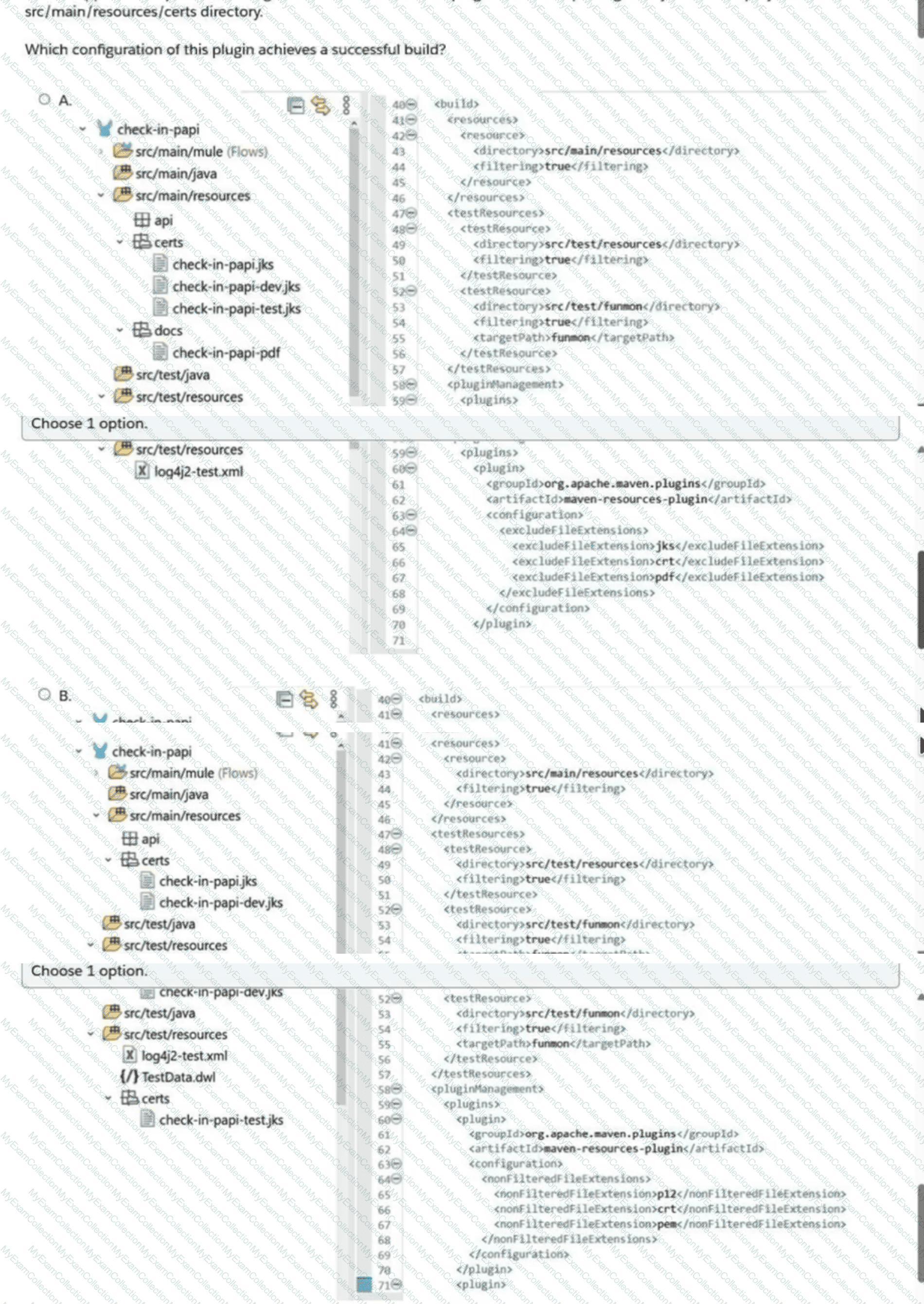
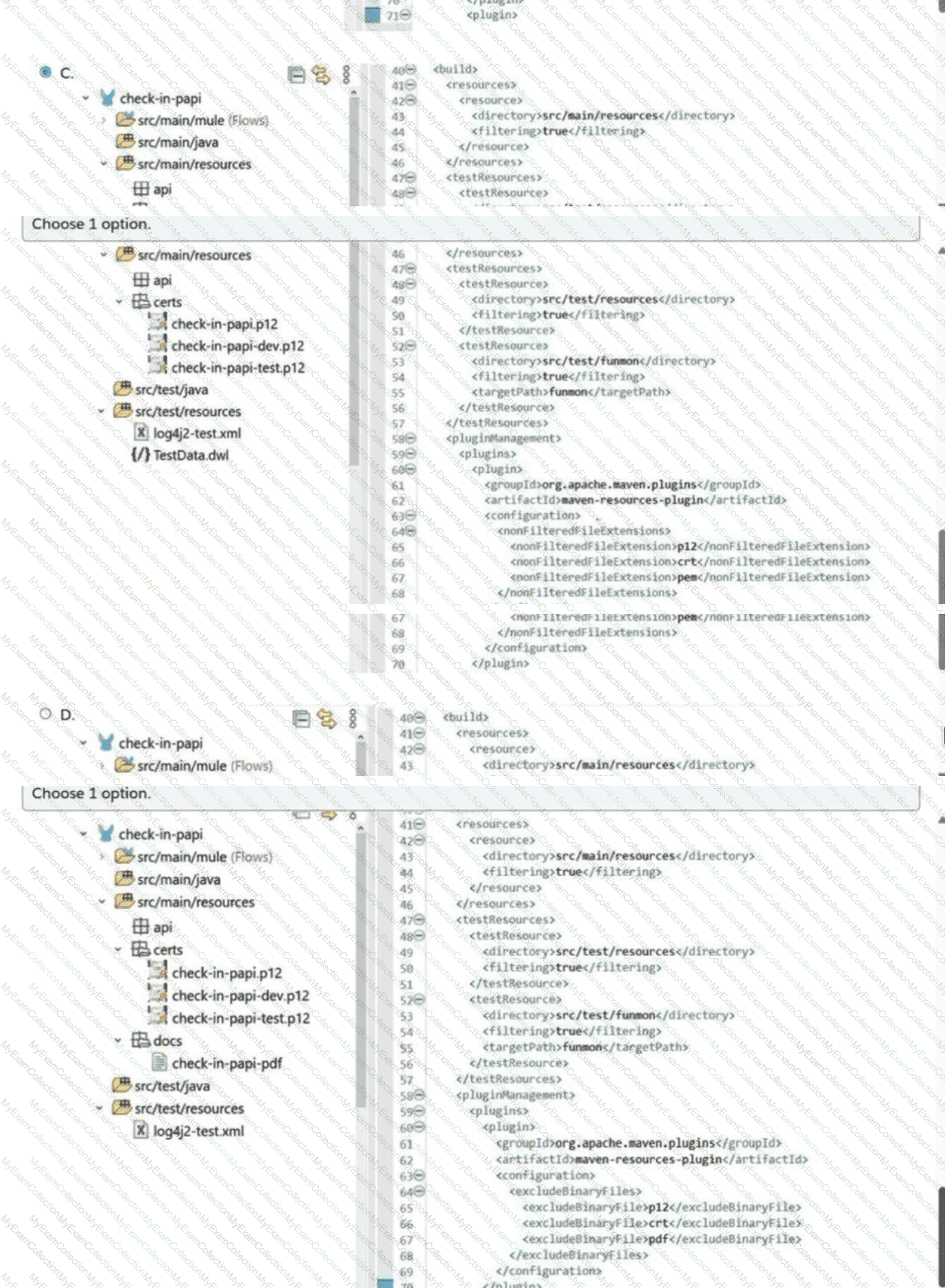
A Mule application's pom.xml configures the Maven Resources plugin to exclude parsing binary files in the project's src/main/resources/certs directory.
Which configuration of this plugin achieves a successful build?
Exhibits - Options A and B:
Exhibits - Options C and D:
A.
Configuration shown in Exhibit A
B.
Configuration shown in Exhibit B
C.
Configuration shown in Exhibit C
D.
Configuration shown in Exhibit D
Full Access
Answer:
C
Explanation:
Resource filtering is designed primarily for textual resources in which Maven substitutes property expressions. Binary files such as PKCS#12 keystores and certificate files must not be passed through text filtering because filtering can corrupt their binary representation.
The Maven Resources Plugin provides the dedicated configuration element nonFilteredFileExtensions. Each additional extension is declared using a nested nonFilteredFileExtension. The plugin documentation specifically defines this parameter as the list of additional file extensions to which filtering must not be applied.
Option C correctly uses the documented structure:
< nonFilteredFileExtensions >
< nonFilteredFileExtension > p12 < /nonFilteredFileExtension >
< nonFilteredFileExtension > crt < /nonFilteredFileExtension >
< nonFilteredFileExtension > pem < /nonFilteredFileExtension >
< /nonFilteredFileExtensions >
This is important because the application's normal resource configuration can still use < filtering > true < /filtering > for textual files while Maven leaves the listed certificate/keystore formats untouched.
The alternative constructs visible in the other exhibits, such as excludeFileExtensions or excludeBinaryFiles, are not the Maven Resources Plugin parameter used for this purpose.
Reference topics: Maven Resources Plugin; resource filtering; binary resources; nonFilteredFileExtensions; Mule Maven builds.
Official documentation: https://maven.apache.org/plugins/maven-resources-plugin/resources-mojo.html
===============================================================
Question # 7
What is the MuleSoft recommended method to encrypt sensitive property data?
A.
The encryption key and sensitive data should be the same for all environments
B.
The encryption key should be identical for all environments and the sensitive data should be different for each environment
C.
The encryption key should be different for each environment and the sensitive data should be the same for all environments
D.
The encryption key and sensitive data should be different for each environment
Full Access
Answer:
D
Explanation:
Secure property management should isolate development, test, staging, and production environments rather than allowing secrets from one environment to provide access to another. MuleSoft's Secure Configuration Properties model supports this by using environment-specific property files—for example dev.secure.yaml, sandbox.secure.yaml, and prod.secure.yaml—and resolving the appropriate file through an environment property.
Sensitive values such as passwords, API credentials, and private service configuration should therefore be environment-specific. Production credentials should not normally be reused in development or testing. The encryption key used to protect those values should likewise be independently managed rather than shared broadly across security boundaries. This limits the impact if a non-production key or properties file is exposed.
The Secure Properties Tool encrypts the sensitive values using a supplied key, while the Mule runtime receives the corresponding decryption key separately at deployment/runtime. MuleSoft also emphasizes protecting that key rather than embedding it directly in application configuration.
Accordingly, the Developer II security model represented by this question expects both different sensitive property values and different encryption keys across environments.
Reference topics: Secure Configuration Properties; environment-specific secure files; encryption keys; secret isolation; deployment security.
Official documentation: https://docs.mulesoft.com/anypoint-code-builder/int-create-secure-configs
===============================================================
Question # 8
An API has been developed and deployed to CloudHub. Among the policies applied to this API is an allowlist of IP addresses. A developer wants to run a test in Anypoint Studio and does not want any policies applied because their workstation is not included in the allowlist.
What must the developer do in order to run this test locally without the policies applied?
A.
Pass in the runtime parameter "-Danypoint.platform.gatekeeper=disabled"
B.
Deactivate the API in API Manager so the Autodiscovery element will not find the application when it runs in Studio
C.
Run the test as-is, with no changes, because the Studio runtime will not attempt to connect to API Manager
D.
Create a properties file specifically for local development and set the API instance ID to a value that is not used in API Manager
Full Access
Answer:
D
Explanation:
API Autodiscovery is what pairs a Mule application with a particular API Manager instance. The apiId in the Autodiscovery configuration identifies the managed API from which the runtime obtains API configuration and policies. Therefore, using an environment-specific configuration for local development prevents the locally running application from binding to the production API instance and consequently prevents those production policies from governing local test traffic.
This is different from setting anypoint.platform.gatekeeper=disabled. Gatekeeper controls whether a managed API is blocked while policy information is unavailable or being synchronized; disabling Gatekeeper is not equivalent to disabling API Manager policies. Policies can still be downloaded and applied when the application remains paired through Autodiscovery.
Running the application unchanged is also incorrect because a locally executed Mule runtime can connect to API Manager when Autodiscovery and platform credentials are configured. MuleSoft explicitly documents local Autodiscovery for policy testing. Deactivating the shared API is likewise inappropriate because it modifies centrally managed configuration rather than isolating the developer's local environment.
Reference topics: API Autodiscovery; API Instance ID; Environment-specific Configuration; Mule Gateway Gatekeeper.
Official documentation: https://docs.mulesoft.com/mule-gateway/mule-gateway-autodiscovery-overview
===============================================================
Question # 9
A Mule API receives a JSON payload and updates the target system with the payload. The developer uses JSON schemas to ensure the data is valid.
How can the data be validated before posting to the target system?
A.
Add the JSON module dependency and add the validate schema operation in the flow, configured to reference the schema
B.
Using the DataWeave If Else condition, test the values of the payload against the examples included in the schema
C.
Apply the JSON Schema policy in API Manager and reference the correct schema in the policy configuration
D.
Use a DataWeave 2.0 transform operation, and at the top of the DataWeave script, add: %dw 2.0 / import json-module
Full Access
Answer:
A
Explanation:
MuleSoft provides the JSON Module specifically for operations such as JSON validation. The application should include the JSON Module as a Mule dependency and place its Validate schema operation before the connector or operation that posts the data to the target system.
The Validate schema operation receives the JSON document and evaluates it against the configured JSON Schema. When validation succeeds, processing continues to the next processor. If the payload does not conform, Mule raises JSON:SCHEMA_NOT_HONOURED, allowing the flow's error-handling strategy to reject or transform the invalid request before the target system is modified.
MuleSoft also documents that modules/connectors added manually to an application are declared in pom.xml as dependencies with the mule-plugin classifier; the JSON Module follows this standard pattern.
DataWeave conditional validation would unnecessarily reimplement schema semantics and would not automatically interpret a JSON Schema. API Manager does not provide the application-level JSON Module operation described by this requirement, and import json-module is not a valid mechanism for invoking the Mule JSON Module from DataWeave.
Reference topics: JSON Module; Validate Schema; JSON Schema; JSON:SCHEMA_NOT_HONOURED; Maven module dependency.
Official documentation: https://docs.mulesoft.com/json-module/latest/json-schema-validation
Official documentation: https://docs.mulesoft.com/json-module/latest/json-xml-maven
===============================================================
Question # 10
A Mule application uses API autodiscovery to access and enforce policies for a RESTful implementation.
What needs to be configured for the flowRef attribute of the autodiscovery global element?
A.
The name of the flow that has APIkit Console to receive all incoming RESTful operation requests
B.
Nothing because flowRef is an optional attribute which can be passed during runtime
C.
The name of the flow that has HTTP Listener to receive all incoming RESTful operation requests
D.
Any of the APIkit generated implementation flows
Full Access
Answer:
C
Explanation:
API Autodiscovery pairs a Mule API implementation with an API instance managed in API Manager. The global autodiscovery element requires the API instance identifier and a flowRef that identifies the flow where API Gateway policy enforcement begins.
MuleSoft explicitly states that flowRef must reference a flow containing an HTTP Listener. The referenced flow represents the inbound API entry point receiving the requests against which API Manager policies are enforced. Connectors that merely use HTTP internally are not sufficient for this requirement.
In an APIkit-generated application, the appropriate flow is typically the main API flow that contains the HTTP Listener and APIkit Router. Individual generated resource/operation flows execute later after routing; they are not the primary inbound policy-enforcement point. Similarly, the APIkit Console flow is intended for interactive API documentation/testing and should not be used as the flowRef for production policy enforcement.
The attribute is not simply supplied dynamically at runtime. It is part of the Mule application's Autodiscovery configuration and identifies the exact listener-based flow paired to API Manager.
Therefore, flowRef must identify the flow containing the HTTP Listener that receives the REST API's incoming requests.
Reference topics: API Autodiscovery; api-gateway:autodiscovery; flowRef; HTTP Listener; API Manager policy enforcement.
Official documentation: https://docs.mulesoft.com/mule-gateway/mule-gateway-config-autodiscovery-mule4
===============================================================
Question # 11
Which pattern can a web API use to notify its client of state changes as soon as they occur?
A.
ETL data load
B.
Schedule Event Publisher
C.
HTTP Webhook
D.
Shared database trigger
Full Access
Answer:
C
Explanation:
An HTTP webhook provides event-driven notification from an API or service to a client-controlled HTTP endpoint. Instead of requiring the client to repeatedly poll the API for changes, the client registers or supplies a callback URL. When the relevant state transition occurs, the service immediately issues an HTTP request—commonly POST—to that endpoint.
This architecture closely matches the requirement to notify the client as soon as the state change occurs. MuleSoft-supported connectors expose the same webhook model. For example, MuleSoft's connector documentation describes webhook endpoints as URLs that receive notifications about configured events, demonstrating the callback-based semantics of the pattern.
An ETL load is primarily designed for batch-oriented movement and transformation of data and would introduce unnecessary latency. A scheduled event publisher is still time based, meaning notification occurs according to a schedule rather than directly in response to the state transition. A shared database trigger tightly couples applications through the persistence tier and does not constitute an API notification mechanism.
A webhook therefore creates a clean event-driven API contract: the producing service detects the event and actively notifies the registered consumer endpoint.
Reference topics: HTTP webhooks; event-driven API integration; callback endpoints; asynchronous notifications; API consumer decoupling.
Official documentation: https://docs.mulesoft.com/stripe-connector/latest/stripe-connector-reference
===============================================================
Question # 12
Refer to the exhibits.
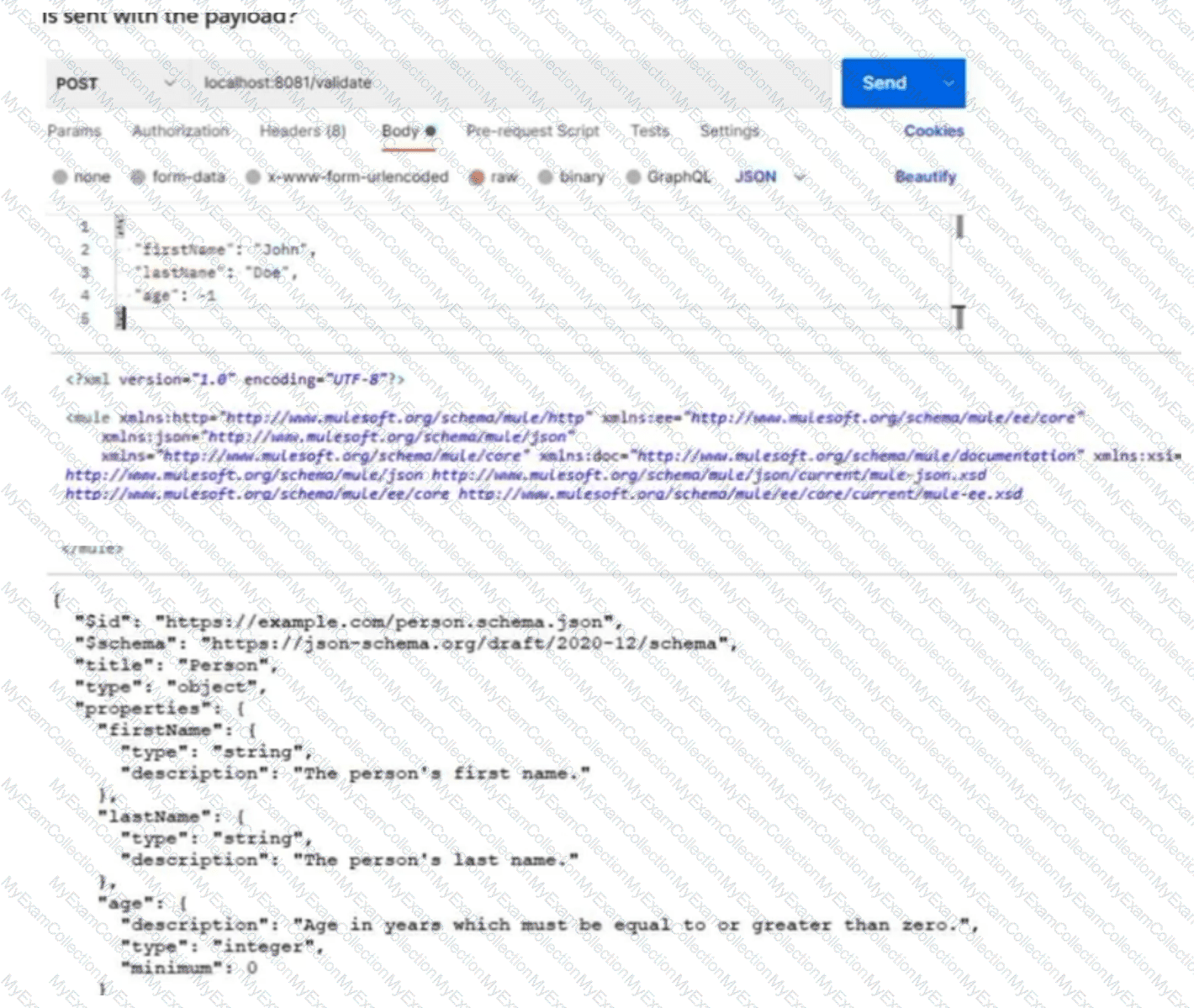
Based on the code snippet, schema.json file, and payload below, what is the outcome of the given code snippet when a request is sent with the payload?
Exhibits:
A.
The Mule flow will execute successfully with status code 204
B.
The Mule flow will execute successfully with status code 200, and in response will display the message "Age in years which must be equal to or greater than zero."
C.
The Mule flow will throw the exception "JSON:SCHEMA_NOT_HONOURED"
D.
The Mule flow will execute successfully with status code 200, and the response will be the JSON sent in request
Full Access
Answer:
C
Explanation:
The flow passes the incoming HTTP request payload directly to the JSON Module's Validate schema operation. The referenced schema.json defines the age property as an integer with "minimum": 0. However, the request shown in the exhibit contains:
"age": -1
This violates the schema because -1 is below the permitted minimum. MuleSoft specifies that the JSON Module's Validate schema operation compares the input content with the supplied JSON Schema and, when the document does not conform, raises JSON:SCHEMA_NOT_HONOURED.
Consequently, normal flow execution stops at the validation operation unless an error handler explicitly consumes the exception. The Logger positioned after the validation operation is not executed in this flow because validation fails first.
The schema's description text—"Age in years which must be equal to or greater than zero."—is metadata describing the property; it does not automatically become a successful HTTP response. Similarly, the request payload is not returned through a successful normal path after the schema violation.
Therefore, because the supplied age value violates minimum: 0, Mule raises JSON:SCHEMA_NOT_HONOURED.
Reference topics: JSON Module; Validate Schema operation; JSON Schema constraints; minimum; JSON:SCHEMA_NOT_HONOURED.
Official documentation: https://docs.mulesoft.com/json-module/latest/json-schema-validation
===============================================================
Question # 13
An organization uses CloudHub to deploy all of its applications.
How can a common-global-error-handler flow be configured so that it can be reused across all of the organization's deployed applications?
A.
Create a Mule plugin project. Create a common-global-error-handler flow inside the plugin project. Use this plugin as a dependency in all Mule applications. Import that configuration file in Mule applications.
B.
Create a Mule domain project. Create a common-global-error-handler flow inside the domain project. Use this domain project as a dependency.
C.
Create a Mule plugin project. Create a common-global-error-handler flow inside the plugin project. Use this plugin as a dependency in all Mule applications.
D.
Create a common-global-error-handler flow in all Mule applications. Refer to it via flow-ref wherever needed.
Full Access
Answer:
A
Explanation:
Reusable global configuration should be packaged once and consumed as a dependency rather than duplicated across individual Mule applications. A shared Mule project/plugin can contain common flows and global elements, including reusable error handlers. Each consuming application then declares the shared artifact as a dependency.
The crucial additional step is that the Mule configuration containing that global error handler must be imported into the consuming application. Simply placing a JAR/plugin on the Maven dependency graph does not automatically make every Mule XML configuration inside that artifact part of the application's active configuration.
MuleSoft currently documents the same pattern through imported project references: a JAR containing a shared Mule project can expose flows, error handlers, and connection configurations, and the consuming project specifies which Mule configuration file to import. Mule's configuration model also supports < import file="..."/ > for merging shared configuration files such as a global error handler.
A Mule domain is not the appropriate CloudHub reuse mechanism in this scenario. Option C is incomplete because it omits the configuration import step.
Reference topics: reusable Mule configurations; Mule plugin/shared project; Maven dependency reuse; configuration imports; global error handlers.
Official documentation: https://docs.mulesoft.com/anypoint-code-builder/int-global-config-elements
===============================================================
Question # 14
A Mule application deployed to a standalone Mule runtime uses VM queues to publish messages to be consumed asynchronously by another flow.
In the case of a system failure, what will happen to in-flight messages in the VM queues that have not been consumed?
A.
For persistent queues, the message will be processed after the system comes online
B.
For transient queues, the message will be processed after the system comes online
C.
For any type of queue, the message will be lost
D.
For any type of queue, the message will be processed after the system comes online
Full Access
Answer:
A
Explanation:
VM Connector supports both transient and persistent asynchronous queues, and their recovery behavior differs fundamentally. MuleSoft specifies that transient queues provide better performance but are not reliable when the runtime or host fails. Persistent queues are slower because their content must be persisted, but they provide recovery across failures.
For a standalone Mule runtime, persistent VM queues serialize and store queued message data on disk. Consequently, if the Mule runtime or underlying system stops before an in-flight queued message is consumed, the message can remain available and processing can resume after the runtime becomes operational again.
A transient queue stores its queued state in volatile runtime memory. A system failure destroys that state, so an unconsumed transient message cannot be assumed to survive restart.
Therefore, neither "all messages are lost" nor "all messages are recovered" accurately describes VM behavior; durability depends specifically on the queue type.
For workloads where asynchronous events must survive process or host failure in a supported standalone runtime architecture, a persistent VM queue is therefore the appropriate choice.
Reference topics: VM Connector; persistent queues; transient queues; asynchronous messaging; durability and recovery.
Official documentation: https://docs.mulesoft.com/vm-connector/latest/vm-reference
===============================================================
Question # 15
Refer to the exhibit.
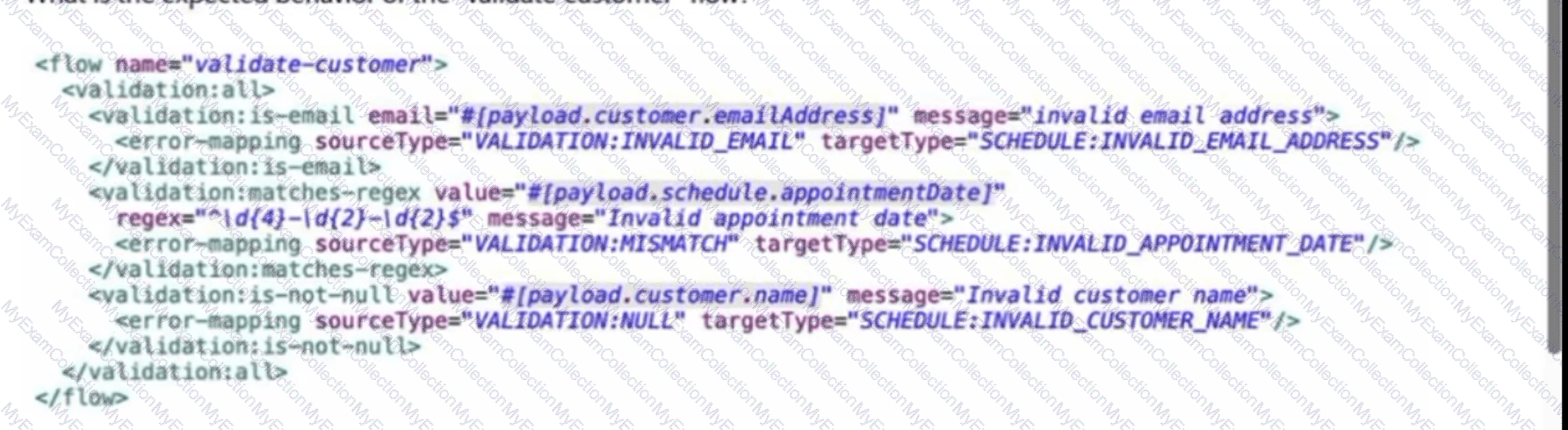
An API has been built to enable scheduling emails for a healthcare provider. The front-end system does very little data entry validation, and problems have started to appear in the emails that go out to patients. A "validate-customer" flow is added to validate the data.
What is the expected behavior of the "validate-customer" flow?
Exhibit:
A.
If the appointment date and customer name are invalid, a SCHEDULE:INVALID_APPOINTMENT_DATE error is raised
B.
If only the email address is invalid, a VALIDATION:INVALID_EMAIL error is raised
C.
If the email address is invalid, processing continues to see if the appointment date and customer name are also invalid
D.
If all of the values are invalid, the last validation error is raised: SCHEDULE:INVALID_CUSTOMER_NAME
Full Access
Answer:
C
Explanation:
The three validation operations are nested inside a validation:all scope. The defining behavior of this scope is that it executes every nested validation even if one or more earlier validations fail. Consequently, an invalid email does not immediately terminate validation processing. Mule continues to evaluate the appointment-date regular expression and the customer-name null check.
MuleSoft explicitly documents that all validations inside the All scope are executed even if all of them fail. If one or more nested validations fail, the All validator produces a consolidated VALIDATION:MULTIPLE error describing the failures rather than simply throwing the first or final validation error.
The flow does contain error mappings for individual validators—for example mapping VALIDATION:INVALID_EMAIL to SCHEDULE:INVALID_EMAIL_ADDRESS. However, those mappings do not change the central behavioral point being tested: the All scope evaluates the entire set rather than short-circuiting after the first failed validator.
Thus, if the email address is invalid, the remaining appointment-date and customer-name validations are still evaluated. This makes C the only option accurately describing the scope's execution behavior.
Reference topics: Validation Module; validation:all; validation aggregation; VALIDATION:MULTIPLE; error mappings.
Official documentation: https://docs.mulesoft.com/validation-connector/latest/validation-examples
===============================================================
Question # 16
Refer to the exhibit.
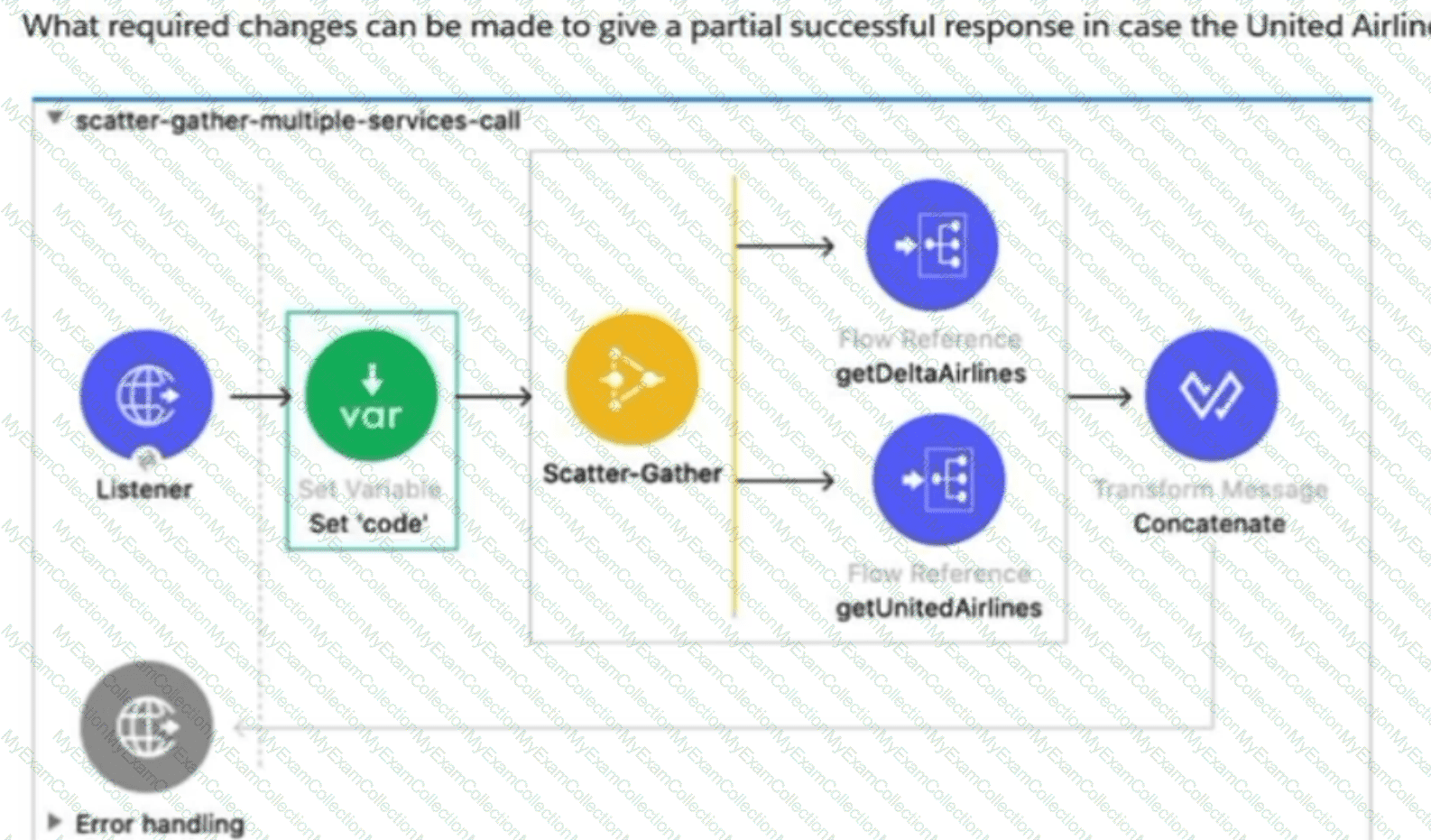
What required changes can be made to give a partial successful response in case the United Airlines API returns with a timeout?
Exhibit:
A.
Add Flow Reference components inside a Try scope. Set the payload to a default value "" inside the error handler using the On Error Continue scope.
B.
Add a Scatter-Gather component inside a Try Scope. Set the payload to a default value "Error" inside the error handler using the On Error Propagate scope.
C.
Add a Scatter-Gather component inside a Try Scope. Set the payload to a default value "Error" inside the error handler using the On Error Continue scope.
D.
Add Flow Reference components inside a Try Scope. Set the payload to a default value "" inside the error handler using the On Error Propagate scope.
Full Access
Answer:
A
Explanation:
Scatter-Gather normally expects all routes to complete successfully before combining their results. If the United Airlines route times out and that error escapes the route, Scatter-Gather raises a MULE:COMPOSITE_ROUTING error instead of continuing normally to the downstream Transform Message. That behavior prevents the required partial-success response.
The correct design is to handle failure inside the affected Scatter-Gather route. Each Flow Reference can be wrapped in a Try scope, with the timeout or relevant connector error handled using On Error Continue. The handler can replace the failed route's payload with a neutral/default value such as an empty string. The route is then considered successfully handled, allowing Scatter-Gather to consolidate the successful Delta response and the default United value and proceed to the concatenation step.
MuleSoft documents this exact Scatter-Gather behavior: when a route's Try scope successfully handles an error with on-error-continue, Scatter-Gather completes and passes the combined events onward. If on-error-propagate is used, the route remains failed and Scatter-Gather produces a composite-routing error.
Reference topics: Scatter-Gather Router; Try Scope; On Error Continue; partial results; MULE:COMPOSITE_ROUTING.
Official documentation: https://docs.mulesoft.com/mule-runtime/4.3/scatter-gather-concept
===============================================================
Question # 17
A Mule implementation uses an HTTP Request within an Until Successful scope to connect to an API.
How should a permanent error response like HTTP:UNAUTHORIZED be handled inside Until Successful to reduce latency?
A.
In Until Successful configuration, set the retry count to 1 for error type HTTP:UNAUTHORIZED.
B.
Continue retrying until a MULE:RETRY_EXHAUSTED error is raised or the API responds back with a successful response.
C.
Put the HTTP Request inside a try scope in Until Successful. In the error handler, use On Error Propagate to catch permanent errors like HTTP:UNAUTHORIZED.
D.
Put the HTTP Request inside a try scope in Until Successful. In the error handler, use On Error Continue to catch permanent errors like HTTP:UNAUTHORIZED.
Full Access
Answer:
D
Explanation:
Until Successful is intended for failures that can reasonably succeed when retried, such as temporary connectivity issues or transient downstream unavailability. Mule executes the processors in the scope repeatedly until processing succeeds or the configured retry count is exhausted. If an error continues to propagate from the scope, Mule performs another attempt and ultimately raises MULE:RETRY_EXHAUSTED after all retries fail.
An HTTP:UNAUTHORIZED response represents a permanent application/security condition for the current request. Repeating the identical request does not normally repair invalid credentials or insufficient authorization and simply increases latency and downstream traffic.
The HTTP Request should therefore be placed inside a Try scope. An On Error Continue handler specifically catches the permanent error and handles it inside that Try scope. Because the error is consumed rather than propagated, the Until Successful scope does not interpret the attempt as a retryable failure.
Using On Error Propagate would have the opposite effect: the error would escape the Try scope and cause Until Successful to retry. Continuing until MULE:RETRY_EXHAUSTED unnecessarily delays the response.
Reference topics: Until Successful Scope; Try Scope; On Error Continue; permanent versus transient errors; MULE:RETRY_EXHAUSTED.
Official documentation: https://docs.mulesoft.com/mule-runtime/latest/until-successful-scope
===============================================================
Question # 18
A developer has created the first version of an API designed for business partners to work with commodity prices.
What should the developer do to allow more than one major version of the same API to be exposed by the implementation?
A.
In Design Center, open the RAML and modify each operation to include the major version number
B.
In Anypoint Studio, generate scaffolding from the RAML, and then modify the < http:listener > in the generated flows to include a parameter to replace the version number
C.
In Design Center, open the RAML and modify baseUri to include a variable that indicates the version number
D.
In Anypoint Studio, generate scaffolding from the RAML, and then modify the flow names generated by APIkit to include a variable with the major version number
Full Access
Answer:
C
Explanation:
Major API versions should be distinguishable at the API's external URI rather than being encoded independently into every resource operation or into internal Mule flow names. MuleSoft recommends including the consumer-facing API version in the application URL, for example /v1/..., so clients can explicitly select the major API contract they intend to consume.
RAML supports this cleanly through the baseUri. A version variable can be included in the base URI, for example baseUri: https://api.example.com/v{version}, with the corresponding version or base URI parameter defined in the specification. This keeps the versioning concern at the API contract and endpoint-addressing level.
Changing every operation would unnecessarily duplicate version information. Modifying generated APIkit flow names affects Mule implementation internals but does not provide distinct public API addresses. Similarly, manually changing generated HTTP listeners after scaffolding makes the implementation diverge from the API specification and weakens API-led lifecycle management.
MuleSoft's versioning guidance explicitly recommends exposing the major version in the API URL and using simple major identifiers such as v1, v2, and so forth.
Reference topics: API Versioning; RAML baseUri; Base URI Parameters; Major API Versions.
Official documentation: https://docs.mulesoft.com/exchange/to-change-raml-version
===============================================================