Spring Sale Special - Limited Time 70% Discount Offer - Ends in 0d 00h 00m 00s - Coupon code: mxmas70

Home > PeopleCert > MSP > MSP-Practitioner

MSP-Practitioner MSP Practitioner, 5th edition Exam Question and Answers

Question # 4

Which of the following is a KEY attribute for a Programme Manager?

A.

Have ongoing operational responsibilities within their business area

B.

Change management skills

C.

A good knowledge of project management approaches

D.

Have access to key stakeholders

Full Access
Question # 5

Which of the following is a Governance document?

A.

Blueprint

B.

Project Dossier

C.

Quality and assurance strategy

D.

Risk Register

Full Access
Question # 6

The Training Project has included some interactive games in the training materials. This is to help engineering staff members share ideas and experiences during the training of how to apply the new processes. However, the CEngO thinks that the engineering staff members will find this approach rather childish as they are very experienced and normally work independently. As a result, the CEngO has asked for the games to be removed from the training materials.

Is the CEngO's request an appropriate application of the 'knowledge' theme, and why?

A.

Yes, because the training materials should be documented in a clear format so that the engineers can access it

B.

Yes, because the engineers should be given time to reflect on the training so they can make improvements

C.

No, because games can be used to help the engineers think creatively and improve their learning

D.

No, because the objective of training is to ensure that the engineers learn lessons as quickly as possible

Full Access
Question # 7

During the 'identify the programme’ process, the SRO identified that the utility regulator may be considering a fair pricing policy to protect vulnerable customers. The introduction of this policy would have a significant impact on the benefits expected by UU. The programme manager included this information in the programme brief.

How well does this apply the 'deal with ambiguity’ principle, and why?

A.

It applies it well, because the sponsoring group needs to understand the possible impact of this risk when deciding whether to proceed

B.

It applies it well, because UU needs to understand their risk appetite in the current business climate before they start the programme

C.

It applies it poorly, because a formal, documented, risk management process should be used to assess the risk before it is included in the programme brief

D.

It applies it poorly, because this risk is so significant that it should have been identified in the programme mandate by the sponsoring group

Full Access
Question # 8

Who produces Business Case?

A.

Sponsoring Group

B.

SRO

C.

Programme Manager

D.

BCM

Full Access
Question # 9

The Department of Utilities Oversight (DOUO) is the regulating body overseeing utility companies in the region. The regulator has advised UU that they are concerned there will be a lack of competition in the industry, once UU sales are increased. UU has contacted both the DOUO and other water companies in the region to work on identifying solutions that would be practical for everyone.

Is this an appropriate application of the 'collaborate across boundaries' principle, and why?

A.

Yes, because this should ensure open and honest two-way communication with key stakeholders about the expected UU sales

B.

Yes, because this should ensure that the right stakeholders are involved in creating the right policies for future industry regulation

C.

No, because making knowledge as clear and accessible as possible is an application of the 'deal with ambiguity' principle

D.

No, because the application of the 'collaborate across boundaries' principle should focus on effective interaction between UU's internal departments

Full Access
Question # 10

The programme is in the ‘design the outcomes’ process for the first time. The Research and Development Project team has recommended that UU sources an imported next generation smart meter. This is an alternative to the development of the smart meter internally. The imported meter can be fully implemented before the CEO retires in three years' time. However, there is a possibility that this meter could lead to future information security risks.

Is this recommendation an appropriate application of the ‘decisions' theme, and why?

A.

Yes, because the proposed option should gain the CEO’s full support

B.

Yes, because providing a clear recommendation should bring pace and value

C.

No, because there are security risks identified with the option proposed

D.

No, because a ‘do-nothing’ option and at least two others should be provided

Full Access
Question # 11

Which of following documents are parts of governance themes?

A.

Blueprint, Vision, Quality management strategy

B.

Business Case, Programme mandate

C.

Blueprint, Requirement Specification

D.

System and product specification

Full Access
Question # 12

In which document would you expect to find the levels of confidentiality to be applied in the programme?

A.

The Information Management Strategy

B.

The Quality Management Strategy

C.

The Resource Management Strategy

D.

The Benefits Management Strategy

Full Access
Question # 13

Which of below sentences describes Project Brief?

A.

List of all projects that will be part of programme

B.

Control framework for programme

C.

Control framework for projects

D.

Describes purpose, cost, time, performance requirements and constraints of a project

Full Access
Question # 14

In delivering the capability, who is responsible for aligning projects with benefits realization?

A.

BCM

B.

Programme Manager

C.

Both

D.

None

Full Access
Question # 15

Which of the following is a critical organizational element?

A.

Leading change

B.

Stakeholder engagement

C.

Quality management and assurance

D.

Delivery mechanisms for change

Full Access
Question # 16

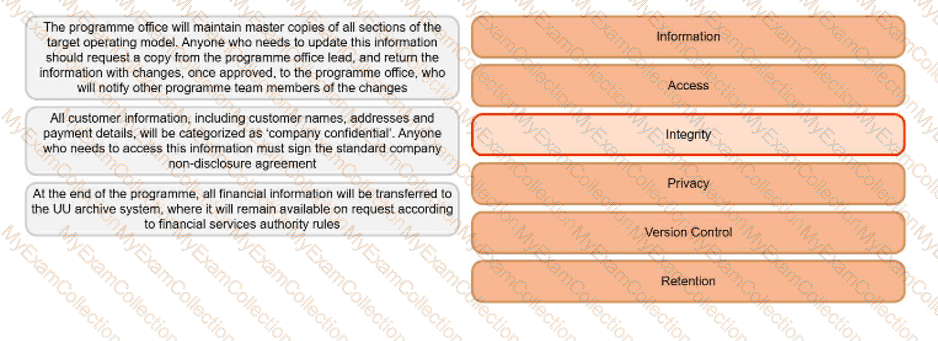
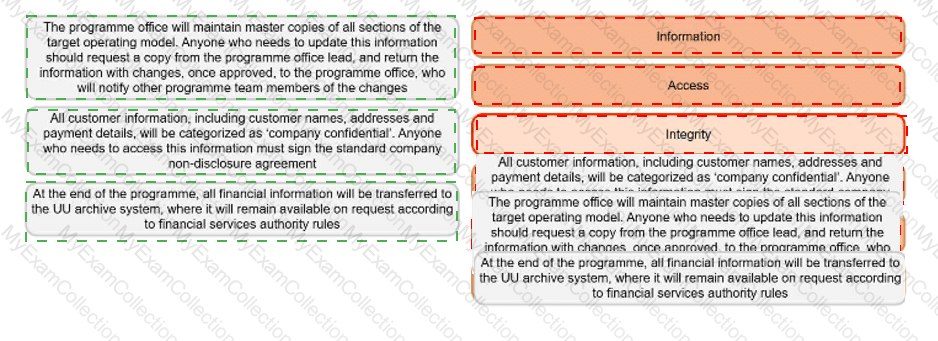
Three pieces of information should be documented in the information approach section of the programme strategy. In which section should this information be documented?
Full Access
Question # 17

Which of the following defines Dis-benefit?

A.

Measurable improvement resulting from outcome perceived as an advantage

B.

A scenario that may bring profit or loss to programme

C.

Unplanned scenario that has happened and needs management intervention to reduce negative impact

D.

Measurable decline resulting from outcome perceived as negative

Full Access
Question # 18

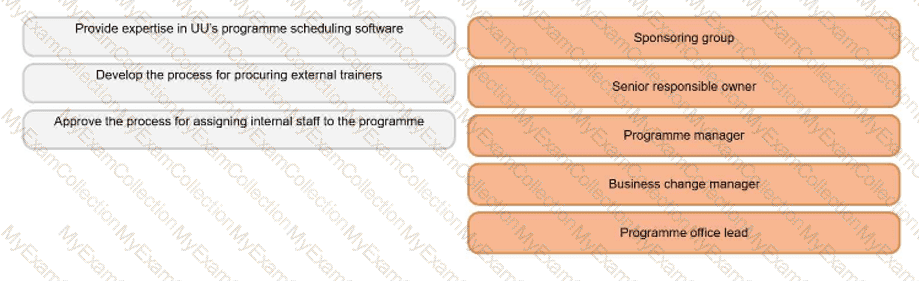
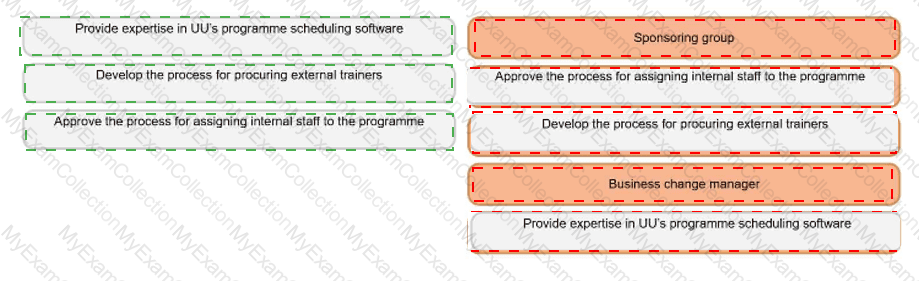
Here are three actions to be performed during the Smart Meter Programme. Which role has an area of focus associated with each statement?
Full Access
Question # 19

The programme is in the ‘design the outcomes’ process. The programme team is reviewing the programme brief and a revised version of the vision statement that has been prepared and validated in a workshop with key stakeholders.

What action should the programme manager and BCM take FIRST?

A.

Capture uncertain events that would affect one or more outcomes of benefit in the risk register

B.

Hold a workshop to confirm and document the increased customer numbers with call centre managers

C.

Schedule the activities and resources to track the observable outcomes and realization of benefits

D.

Analyse past programme benefit profiles in order to agree a new, standard template to be used by the programme team

Full Access
Question # 20

Which of following groups can be a stakeholder for building a city programme?

A.

Employees

B.

Political leadership

C.

People interested in being residents

D.

All of above

Full Access
Question # 21

During Tranche 1, the Call Centre Manager had played an active role in the programme as a BCM. However, at the end of the tranche, it was decided that they were not required during Tranche 2. In addition, the CTO was appointed as a new BCM for Tranche 2.

Which principle is being applied by the ‘organization’ theme, and why?

A.

Lead with purpose, because the new BCM has a more senior role in UU and will be able to lead the work in Tranche 2

B.

Lead with purpose, because the appointment of the new BCM should result in more integrated decisionmaking in Tranche 2

C.

Align with priorities, because the new BCM is able to provide support to operations to deliver the Tranche 2 outcomes

D.

Align with priorities, because the appointment of the new BCM shows senior commitment to Tranche 2

Full Access
Question # 22

Which of following is part of critical benefits validation test?

A.

Currency

B.

Accurate

C.

Attribution

D.

Availability

Full Access
Question # 23

Which of the following is Not one of MSP defined levels of stakeholder engagement?

A.

Maintain Interest

B.

Formally Approve

C.

Active Consultation

D.

Keep informed

Full Access
Question # 24

Which of the following is kind of a vision led programme?

A.

Programme evolved from concurrent, individual projects with need to ensure compliance to organization strategy

B.

Must do programmes due to change in legislation

C.

Public programme started to fulfil electoral promises

D.

Programme focused on bringing organization in tune with laws of the country of operations

Full Access
Question # 25

The programme is halfway through the first tranche. The CRO has contacted the programme manager with exciting news. They have been shown a new piece of technology which makes it easier and cheaper to service and maintain smart meters. They think that it might be possible to add this technology to future smart water meter installations without much additional cost. The programme manager has added this to the risk register.

Is this an appropriate application of the design' theme, and why?

A.

Yes, because if smart meter installations include this technology then future maintenance costs could be reduced

B.

Yes, because changing the existing installation plan could bring uncertainty to the programme and should be avoided

C.

No, because reduced maintenance costs should be added to the benefits map as a new benefit of the programme

D.

No, because the possibility of reducing maintenance costs should be treated as an issue and action taken immediately

Full Access
Question # 26

Which document is created from Programme mandate and works as input for Business Case?

A.

Programme preparation plan

B.

Blueprint

C.

Programme Brief

D.

Programme management plan

Full Access
Question # 27

Which of the following statements is FALSE?

A.

The SRO must have enough seniority to take on accountability for the programme delivery.

B.

The SRO is likely to be a peer of the Sponsoring Group.

C.

The SRO is appointed by the Sponsoring Group.

D.

The SRO acts as the Project Executive on all the Project Boards.

Full Access
Question # 28

Which document is prepared with a purpose to share with stakeholders?

A.

Programme Plan

B.

Vision

C.

Business Case

D.

Blueprint

Full Access
Question # 29

The programme is in the middle of Tranche 2. A new SRO has been appointed. To understand the current status of the programme, the SRO has asked for a health check to be carried out. The programme office lead has recruited an external consultant to carry out the health check.

Which assurance success factor does this demonstrate?

A.

Independence

B.

Accountability

C.

Coordination

D.

Risk appetite

Full Access
Question # 30

At which transformational flow basic programme controls are established?

A.

Identifying the programme

B.

Defining the programme

C.

Managing the tranches

D.

None of above

Full Access
Question # 31

UU has always used a linear project management methodology in the past with varying degrees of success. During the ‘design the outcomes’ process, UU has decided to trial an agile approach to deliver projects throughout Tranche 1.

Which theme is being applied to the ‘design the outcomes' process?

A.

The ‘knowledge' theme is being applied by making use of lessons from their previous agile projects

B.

The ‘decisions’ theme is being applied by coming to a conclusive decision to use an agile approach for delivery

C.

The ’structure' theme is being applied by using an agile delivery method to a complex piece of work

D.

The ‘design’ theme is being applied by deliberately designing the work to make use of an iterative approach

Full Access
Question # 32

The Smart Meter Programme is in Tranche 2 and the Customer Processes Project is delivering ahead of schedule. This means that fewer resources are required to complete the project. The Training Project, which was due to start in Tranche 3, has now become a higher priority and needs to be started early. The programme manager has recommended starting the Training Project now although Tranche 2 and Tranche 3 will then overlap.

Is this an appropriate application of the structure' theme, and why?

A.

Yes, because available resource capacity should be fully utilized throughout the programme

B.

Yes, because tranches may overlap if the programme is making good progress and capability is available

C.

No, because tranches should be sequential to enable end-of-tranche reviews to take place before the next tranche is approved

D.

No, because tranches should remain sequential if overlapping the tranches would increase the risks to programme delivery

Full Access
Question # 33

Which of the following is a Boundary document?

A.

Programme preparation plan

B.

Risk register

C.

Stakeholder profiles

D.

Benefits Map

Full Access
Question # 34

The following statement needs to be recorded:

"The vision statement will be developed and tested in a facilitated workshop with the senior officers from each department, before final approval by the CEO."

In which section of the programme strategy should this be recorded?

A.

Governance approach

B.

Stakeholder engagement approach

C.

Design approach

D.

Decision-making approach

Full Access
Question # 35

Which of following is not responsibility of Programme Office?

A.

Repository of programme information

B.

Providing regular updates on progress to SRO

C.

Risk and Issue tracking

D.

Ensuring the control and management frameworks are effectively implemented

Full Access
Question # 36

Which of the following is an activity in Defining a Programme?

A.

Design the Projects Dossier

B.

Manage transition

C.

Produce the Programme Brief

D.

Align the projects with benefits realization

Full Access
Question # 37

Where in the transformational flow would the Benefits Map normally be created?

A.

Identifying a Programme

B.

Defining a Programme

C.

Managing the Tranches

D.

Realizing the Benefits

Full Access
Question # 38

Which of the following statements is NOT TRUE?

A.

The SRO is accountable for confirming Programme Mandate.

B.

The SRO is accountable for the Programme Brief.

C.

The Programme Manager is responsible for the Vision Statement.

D.

The Programme Manager is responsible for the Blueprint.

Full Access
Question # 39

The programme is in the ‘plan progressive delivery' process. The programme manager has recommended that the funds for the HR Work should come from a different source to the funding for the project work.

During which activity is the SRO responsible for providing formal approval for this recommendation?


A.

Continue to develop and validate programme plans

B.

Confirm business case

C.

Prepare for the next process

D.

Agree to proceed (or close)

Full Access