Question # 4
According to ISO 45001, who should participate in the continuous improvement of the health and safety management system?
Question # 5
You are conducting an ISO 45001 audit of Widgets Inc.., an organization manufacturing machine parts for the aerospace industry, You find a short entry in the incident report file connecting a machine operator who suffered minor injury to his face four weeks ago when a small ribbon of metal hit him while operating his machine.
The subsequent investigation found that he was not wearing the required protective Personal Protective Equipment (PPE). He was subject to disciplinary action and warned that he would lose his job if it happened again.
Select two option of points of investigation which you would consider in order to determine conformity or nonconformity with clause 10.2 of ISO 45001.
Question # 6
A multi-level shopping centre is open every day to the public from 09:00–21:00. During an external audit of the centre to ISO 45001, you establish that there are 120 retail outlets. There are eight escalators to all levels and four sets of elevators. When asked about safety performance improvement objectives, the Centre Manager says that there are plans to reduce the number of reported incidents and complaints.
You: I note from the incident log that reported incidents have increased in the past year. Why is this?
Centre Manager: The number of shoppers coming into the centre has increased by about 10 per cent in the last year. More people around means that more things will happen.
You: What actions have been taken to deal with this increase?
Centre Manager: We conducted awareness training for staff. For example, making sure that any hazardous areas are well signed.
You: I see that the escalators account for a number of accidents. Have you taken any actions to try and reduce this?
Centre Manager: Most of these accidents are caused by people failing to take care at the ends. So, the answer is no, it is difficult to do anything about that.
You: How do you monitor safety in the centre?
Centre Manager: We train our staff to be alert to potential safety problems when walking around the centre. We empower them to take whatever action is necessary.
Which four actions should you take to investigate the situation further?
Question # 7
Select two of the following options which are not the responsibility of an audit team leader.
Question # 8
An audit team leader arrives at a fabrication organisation that manufactures stairways to ..certification audit. At a meeting with the OHSMS Manager the audit finds that the responsibility for worker consultation and participation lies with the managerial team. Select from the options four actions by the managerial team that encourage worker consultation and participation.
Question # 9
Select three options that would provide evidence of conformance with clause 9.1.1 of ISO 45001.
Question # 10
Out of the following, which is not the Part of PDCA cycle ISO 45001? Select the correct option, and then select Submit.
Question # 11
You are an audit team leader conducting an ISO 45001 surveillance audit of a nautical college that provides course for those working in the maritime sector. The College Principle Is absent, and you are interviewing the Deputy (DP)
DP: 1 apologise for the absence of the College Principle. He has called in sick today and we are really short of staff.
You: 1 see, it really should not affect the OHSMS so the audit can progress as normal.
DP: The College principle set up the system. I am afraidi am not as familiar with it as he is.
You: OK, let’s start with the OH and S policy. What are the main issues for the OHSMS here?
DP: Give me a minute. I need look at the OH and S Policy on the noticeboard in his office.
As the audit progresses, It is clear that the Deputy College Principle has a very low knowledge of the OHSMS. He continually has to search the answers to your questions or asks staff members about their processes.
Choose one of the following options that best describes the basis for the nonconformity.
Question # 12
Showitoff is an organization specialization in the design and production of wall decorating materials for the domestic market.
During an ISO 45001 certification audit of the site, the auditor comes across an open, walled area just outside the maintenance department. It contains various scraps of wood and metal as well as serveral rusty components. Several heavy concrete beams are learning against a thin brick wall in which cracks are available. When asked about it, the OHS Manager states that he presumes that the materials come from maintenance work, so it is the Maintenance Manager’s responsibility.
The auditor interview the Maintenance Manager in his department. He asks about the area outside and is told that it contains some excess material that the Manager likes to keep in case they come in handy at some stage. The auditor points out that the wall appears to be unstable and could collapse at any moment. The Maintenance Manager is not aware of such a situation.
The auditor decides to review the process for evaluation of compliance with health and safety regulations in more depth.
Select six option that provide a meaningful audit trail for this process.
Question # 13
You are preparing for a surveillance audit of an organisation that is ISO 45001 certified. When preparing the checklist, you decided to ask whether the auditee has a documented procedure for the workers ' consultation and participation. They submitted the documented procedure with the word " OBSOLETE " on the first page.
Which of the following would be the best reaction?
Question # 14
Match the correct responsibility with each participant of a second-party audit:Â
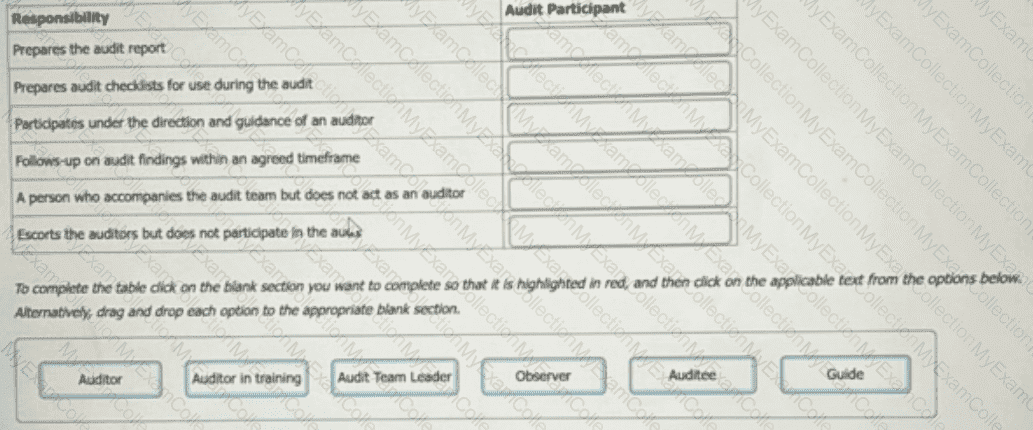
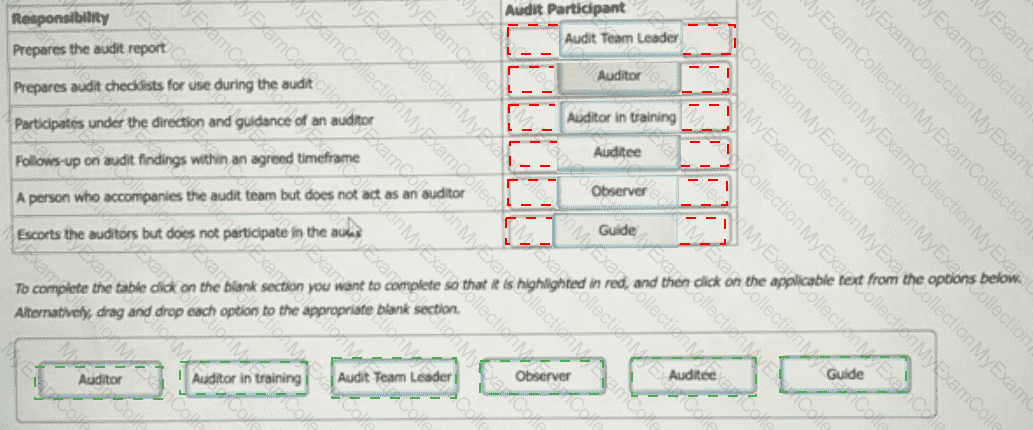
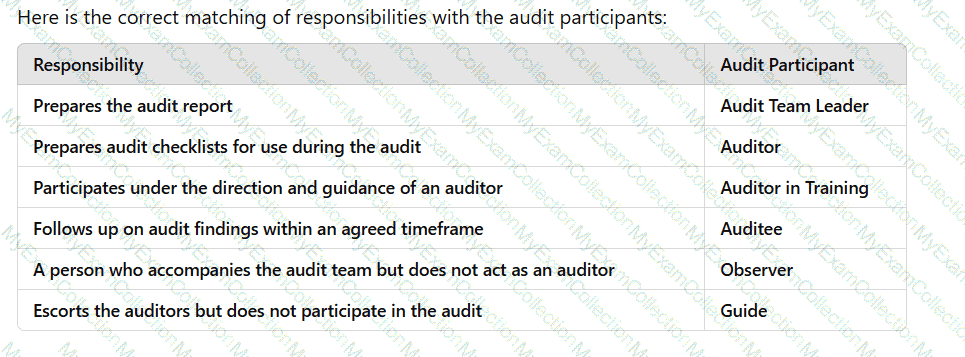
Question # 15
You identify that the OSHMS manager conducts a safety inspection of the building each day before the museum opens to the public. You review your latest report and note that there seems to be some confusion between what constitutes a hazard and what constitutes a risk.
Which three of the following observations has the OHSMS manager correctly rated?
Question # 16
Based on the image you provided, the question asks to identify which two phrases would apply to a first-party audit.
Question # 17
An auditor of a manufacturer of plastic packaging products for the food industry found a nonconformity in an internal audit report raised against section 10.2 of ISO 45001 in Report IA202. The nonconformity (NC3) stated: " The level of reported health and safety incidents has increased by 9.7% over the last 12 months. This included an increase in reported accidents. " Against this background, the third-party audit team found more than twenty minor nonconformities during the audit, which they agreed should be combined into one major nonconformity against clause 4.4 of ISO 45001. " The organisation has failed to demonstrate that it is maintaining and continually improving a health and safety management system. " Select two options which would represent acceptable corrective actions for the nonconformity.
Question # 18
Whistlekleen is a national dry cleaning and laundry organization with 50 shops. You are conducting an OHSMS surveillance audit of the head office and are sampling health and safety performance monitoring. You find that 80 per cent of incident originate from five shops in the same region. Most of these relate to staff and customer feeling unwell due to breathing in the pungent atmosphere. Some required to be hospitalized. The OHS Manager tells you that these are the oldest shops in the organization. The cleaning equipment emits Volatile Organic Compounds (VOCs) and needs replacing but the organisation cannot afford it at the moment.
Question # 19
In the ISO 45001 health and safety management system, what is ' documented information ' ? Select the ONE best answer.
Question # 20
As a third-party auditor, you must audit company ABC, which has agreed with the Certification Body that the scope will be " manufacture of food for domestic animals " . They have recently bought the company XYZ across the road, which can manufacture the packaging materials for their food products. They have implemented a single OHS management system (ISO 45001) for both plants. However, for marketing purposes, they want to certify the management system for the food manufacturing only. They argue that XYZ has the role of a supplier.
What would be your response? Select one
Question # 22
You are the OH and S manager in an organisation that makes plastic toys using injection moulding machines. You are currently training three new internal auditors who will be responsible for carrying out first- and second-party audits on behalf of your organisation. You ask them to identify which of the following statements about grading first and/or second-party nonconformities are correct.
Identify which three of the following are true:
Question # 23
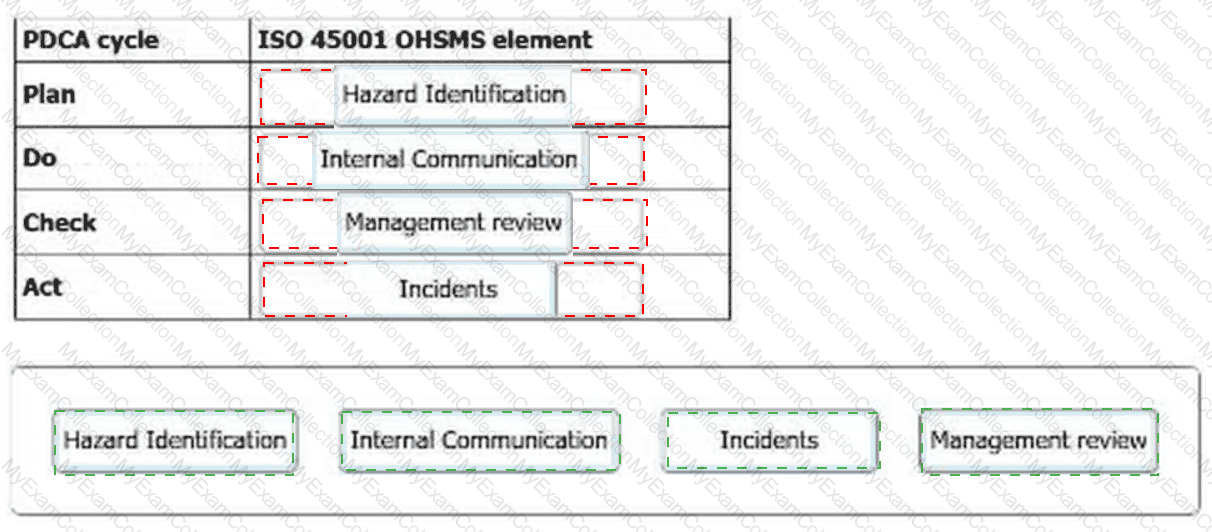
Plan-Do-Check-Act (PDCA) provides a framework for continually improving an OHSMS in accordance with ISO 45001.
Match each OHSMS element with the relevant stage in the PDCA cycle.
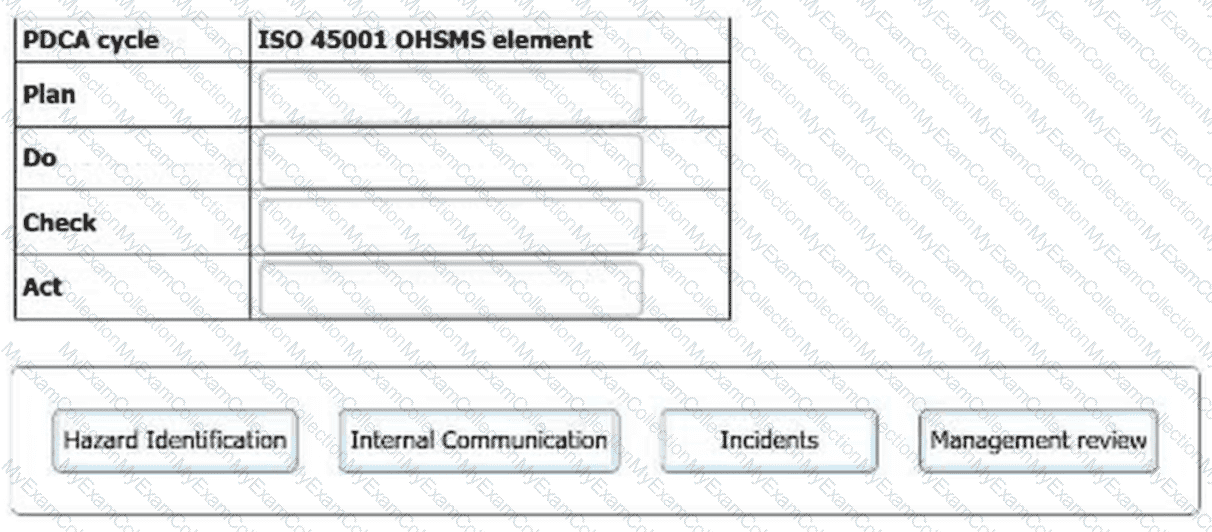
Question # 24
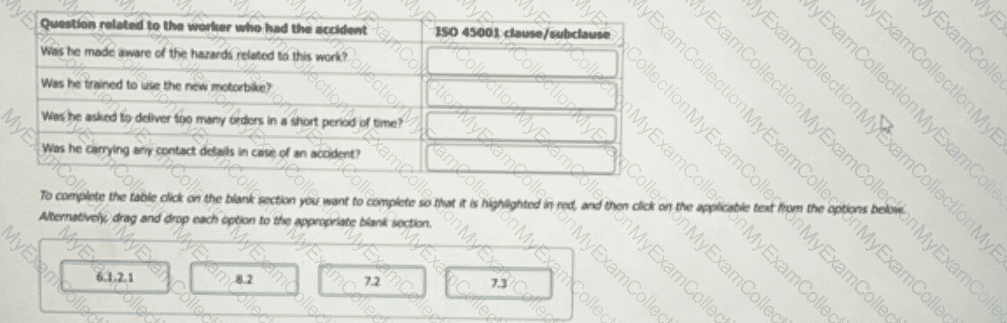
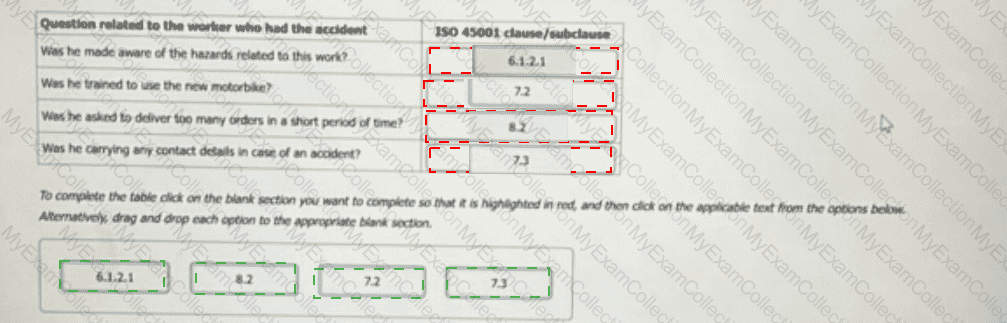
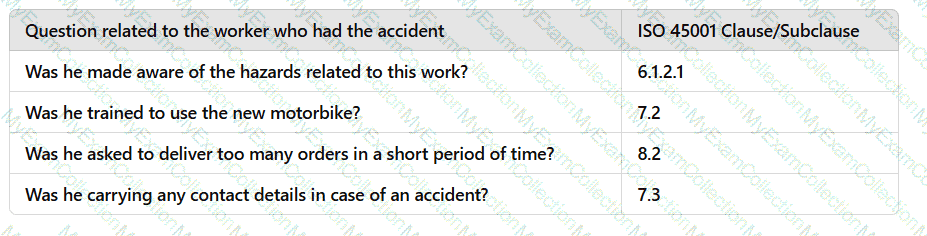
A well-known fast-food organisation (ISO 45001 certified) contracts young people to deliver orders; last week one of them died in a street accident riding for the first time a new motorbike provided by the organisation. You will lead the recertification audit in two weeks, and you plan to prepare a checklist to investigate this incident. The following are potential questions you might ask; match them to the related ISO 45001 clause/subclause.Â
Question # 25
Just before the closing meeting of a third-party audit, the audit team leader is invited to a meeting with the OHS Manager. He tells the audit team leader that a member of the audit team was seen taking videos on the factory floor using his mobile phone and wants him suspended from the closing meeting with any nonconformities raised by him rescinded. When asked about this, the auditor said that he had obtained permission from one of the supervisors who was a member of the safety team.
Select the three best options of how the audit team leader might deal with this situation.
Question # 26
Auditors should have certain knowledge and skills, while audit team leaders should have some additional knowledge and skills.
From the following list, select two that only apply to audit team leaders.
Question # 27
Which two of the following are ' criteria ' in relation to a first-party audit?
Question # 28
An adventure park has the following health and safety policy document displayed in the reception area:
" This organisation is committed to providing safe experiences, in accordance with health and safety regulations for their delivery. The organisation will strive to increase the health and safety awareness of its personnel, contractors and customers. Continual health and safety improvement is a permanent objective of the organisation. This policy shall be communicated to all employees with the opportunity for them to seek clarification where required. Where required, the policy shall be communicated to all interested parties. "
Referring to the policy statement, select three options for which the organisation is meeting ISO 45001 requirements.
Question # 29
During a second-party audit at a sawmill, you find that the OHSMS Manager conducted the hazard identification process. In the risk assessment report, hazards were listed as physical hazards, chemical hazards, biological hazards and psychosocial hazards, with the hazards categories as low medium and high to be addressed. The OHSMS Manager did not have an action plan for low and medium risks, saying that they ignored those He stated that they brought in a health and safety consultant to advise on treatment for the high risks.
When interviewing the OHSMS Manager, the auditor presents a nonconformity relating to potential hazards In the factory If the dust extraction system broke down. The OHSMS Manager said that. If that happened, the agreed planned action is that workers would put masks on.
Select one of the options for how the auditor should respond to this statement.
Question # 30
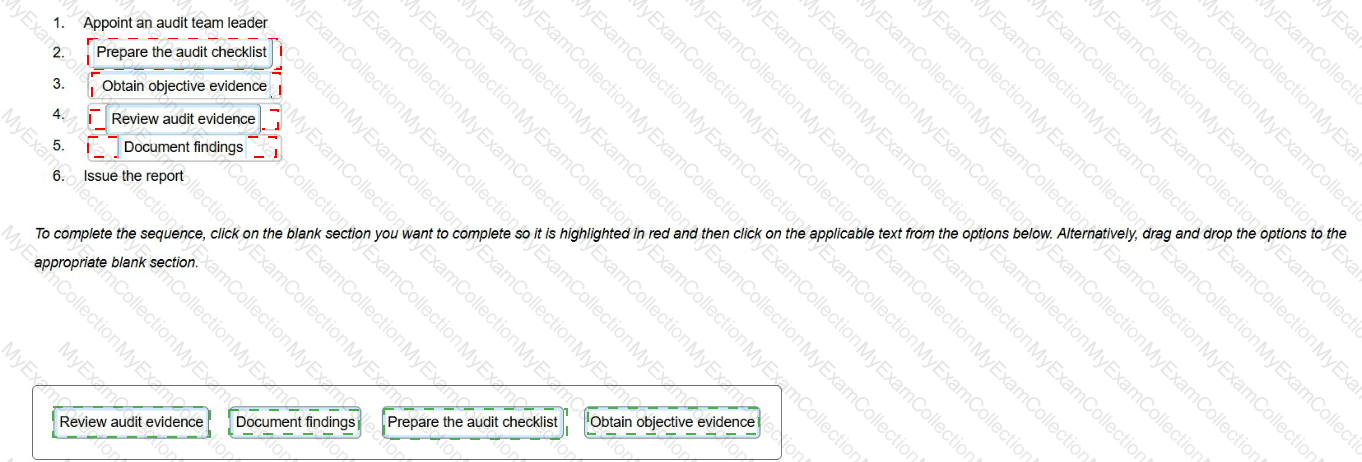
The following options are key actions involved in a first-party audit.
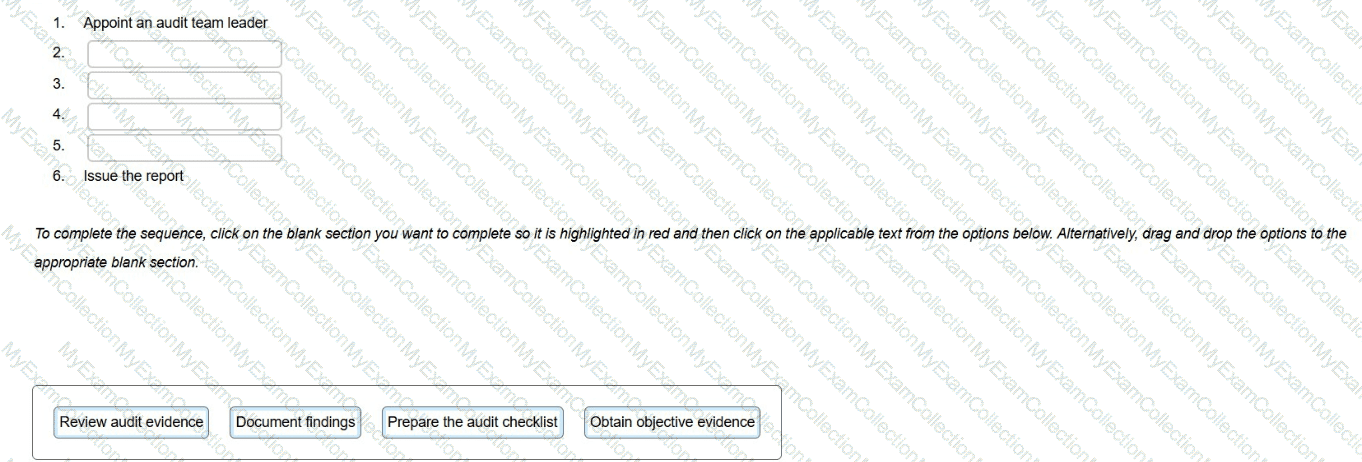
Put them in order to show the sequence in which the actions should take place.
Question # 31
You are an audit team leader conducting an ISO 45001 Stage 2 audit of a nautical college that provides courses for those working in the maritime sector. The College Principal is absent, and the Deputy Principal represents top management.
At the closing meeting attended solely by the Deputy Principal, you inform him that you have found numerous gaps in the OHSMS processes which constitute poor planning and control of the OHSMS. Your team raises a large number of findings including major nonconformities, minor nonconformities, and opportunities for improvement.
Select three of the options which would represent major nonconformities from the evidence described.
Question # 32
Out of the following, which is not the Part of PDCA cycle of ISO 45001? Select the correct option, and then select Submit.
Question # 33
" An audit finding is the result of the evaluation of the collected audit evidence against audit criteria.
Evaluate the following potential formats of audit evidence and select the two that are acceptable.
Question # 34
Select the two options which describe a disadvantage of using a checklist.
Question # 35
During a second-party audit at a sawmill, you find that the OHSMS Manager conducted the hazard identification process. In the risk assessment report, hazards were listed as physical hazards, chemical hazards, biological hazards, and psychosocial hazards, with the hazards categorized as low, medium, and high risk to be addressed. The OHSMS Manager did not have an action plan for low and medium risks, saying that they ignored those. He stated that they brought in a health and safety consultant to advise on treatment for the high risks.
When interviewing the OHSMS Manager, the auditor presents a nonconformity relating to potential hazards in the factory if the dust extraction system broke down. The OHSMS Manager said that, if that happened, the agreed planned action is that workers would put masks on.
Select one of the options for how the auditor should respond to this statement.