Question # 4
XYZ Regional Hospital is an integrated healthcare system comprising hospitals, neighborhood health centers, and small doctor offices. XYZ Regional Hospital recently merged with 4x neighborhood health centers and 125 doctor branch offices. Its wireless, wired-access, and AAA solutions are outdated and must be replaced.
XYZ Regional Hospital wants to future-proof and improve efficiency at every site by enhancing wired and wireless access and moving to centralized, unified wired/wireless and policy management that provides uninterrupted availability for all systems.
Locations:
XYZ Regional Hospital is located in New York City.
Dila Health Center is located in City A.
Mount Health Center is located in City B.
Rock Health Center is located in City C.
Branch clinics are located at different locations across the United States.
Requirements:
Provide, through management software, a single pane of glass to manage wired and wireless LANs and VPNs across campus, branch, and remote locations through a web/cloud architecture that provides near-real-time insight, troubleshooting tools, and Service Level performance reporting.
Seamless integration across wired, wireless, WAN, SD-Branch, and IoT.
Provide secure wireless access for all Regional Hospital employees and partners, as well as wireless Internet access for medical citizens when they visit the facilities.
All access points must support these features and specifications: 802.11 ax (Wi-Fi 6E Certified).
Security options including WP2/WPA3 and 802.1X with Radius secure authentication.
Identify and authenticate every wireless and wired device.
End-to-end role-based security.
Seamless mobility across the hospital for medical teams, patients, and visitors.
Reduce Wi-Fi deployment time from days to hours and enable Zero-Touch deployments across the site.
Establish a resilient, future-ready network infrastructure with the intelligence, scalability, and intuitive toolsets to address emerging needs.
Fully redundant branch solution with dynamic path selection to the hospital.
XYZ Regional Hospital is concerned about the performance of new latency-sensitive applications that will be introduced when connected wirelessly. Which solution addresses this concern?
Question # 5
A global cruise-line company needs to refresh its current fleet. It will refresh the ship’s internal infrastructure to be cost-effective and improve sustainability. It will replace all WLAN/LAN hardware on the ship. As part of this refresh, the company will not change its existing security requirements. The CIO also wants to minimize the number of unused switch ports. Any future expansion will always require a hardware refresh. The company will begin with the smallest ship, with a maximum of 800 guests.
Each ship has a LAN infrastructure comprising two core switches, up to 10 redundant distribution switches, and up to 500 access switches (400 cabins and 100 technical rooms). The core switches are in the ship’s MDF, and the distribution switches are in the IDFs. Each cabin and technical room receives a single access switch.
The ship’s cabling infrastructure will not be replaced. Each IDF connects to the MDF over SMF, with two pairs available for the interconnect between core and distribution. The SMF length between the MDF and IDF is less than 300 meters (980 ft), and it is OS1 fiber. Each cabin connects to its IDF with one OM2 pair, with a maximum length of 60 meters (200 ft). Each technical room connects to its IDF with one OM2 pair, with lengths from 100 to 150 meters (320 to 500 ft).
For every cabin and technical room, the customer wants to replace its current fanless 2530/2540 switches without changing the requirements, except that the uplink to the distribution switch must be upgraded to 10GbE to accommodate increased network traffic, and the technical rooms require redundant power.
The WLAN infrastructure will be refreshed 1:1, with no new cabling or AP locations. Its WLAN infrastructure uses 200/300-series indoor and outdoor APs running InstantOS (fewer than 300 APs), and the customer has no changes to WLAN requirements.
The cruise-line company will replace its existing Internet connection before the LAN/WLAN refresh. The new Internet connection will offer 99.8% uptime, needed to keep paid guest Wi-Fi continuously operational. With this new Internet connection, the CIO wants to base the design on Aruba’s ESP architecture because the Internet connection is guaranteed.
Based on best practices, what optic type should be recommended for the connection between the MDF and the IDFs?
Question # 6
Manufacturing A.B.C. is an international, mid-sized company that specializes in manufacturing industrial equipment. It has operated in the market for more than two decades and has become a reputable player in its industry. However, rapid technological advances have left its present network infrastructure outdated and unable to keep pace with modern manufacturing-process demands.
Manufacturing A.B.C.'s network combines multi-vendor legacy wired and wireless components, resulting in frequent downtime and reduced production efficiency. Its aging equipment causes slow data-transfer rates, unreliable connectivity, and greater exposure to cyber threats. Fiber cabling should also be upgraded because OM2 is used for the most part.
Further compounding the network problems, the recent departure of the CTO has left the company without a clear course for the network-refresh project. The management team lacks consensus on the upgrade's scope, budget, and timeline.
The manufacturing customer's primary objectives are:
Improve network performance and reliability to improve production processes and minimize downtime.
Strengthen network security to safeguard sensitive data and intellectual property.
Streamline communication and collaboration among the organization's different departments.
Provide scalability for future growth and technological advances.
Manufacturing A.B.C. wants a comprehensive network refresh that includes:
Upgrading the wired infrastructure with high-speed Ethernet switches to support higher data-transfer rates and lower latency.
Deploying a robust wireless solution using enterprise-grade access points to provide seamless connectivity throughout the manufacturing facility.
Centralized network-management tools to simplify network administration and monitoring.
Expectations:
The customer expects the network-refresh project to be completed efficiently, with minimal disruption to ongoing operations. They want a reliable, experienced network-solutions provider that understands their distinctive manufacturing requirements and can deliver a tailored solution that meets their budget constraints. Given the recent CTO change, the manufacturing customer is eager to receive clear project proposals and decision-making support.
As the network-solutions provider, your role is to address these concerns, provide expert guidance, and present a clearly defined plan that effectively meets their objectives.
Assume that the current network infrastructure has no wireless shadow-IT equipment operating across the different floors/production sites, but you want to confirm this. How can you determine whether wireless shadow-IT equipment is currently in operation?
Question # 7
Which statements correctly describe the Unified Communication (UCC) and Intelligent Call Handling (ICH) capabilities available in HPE Aruba Networking AOS-10, along with their associated subscription and configuration requirements?
Choose two.
Question # 8
What is the recommended practice for using VSX at the core of a three-tier design?
Question # 9
Following your initial meeting with the customer, which questions must you be able to answer?
Choose two.
Question # 10
XYZ Regional Hospital is an integrated healthcare system consisting of hospitals, neighborhood health centers, and small doctor offices. XYZ Regional Hospital recently merged with 4x neighborhood health centers and 125 doctor branch offices. Its wireless, wired-access, and AAA solutions are outdated and must be replaced.
XYZ Regional Hospital wants to future-proof and improve efficiency at all sites by enhancing wired and wireless access and moving to centralized, unified wired/wireless and policy management that provides uninterrupted availability of all systems.
Locations:
XYZ Regional Hospital is located in New York City
Dila Health Center is located in City A
Mount Health Center is located in City B
Rock Health Center is located in City C
Branch clinics are located at different locations across the United States
Requirements:
Provide, through management software, a single pane of glass to manage wired and wireless LANs and VPNs across campus, branch, and remote environments through a web/cloud architecture that provides near real-time insight, troubleshooting tools, and Service Level performance reporting.
Seamless integration across wired, wireless, WAN, SD-Branch, and IoT
Provide secure wireless access for all Regional Hospital employees and partners, and provide wireless Internet access to medical citizens when they visit our facilities.
All access points must support these features and specifications: 802.11 ax (Wi-Fi 6E Certified)
Security options including WP2/WPA3 and 802.1X with Radius secure authentication
Identify and authenticate every wireless and wired device
End-to-end role-based security
Seamless mobility throughout the hospital for medical teams, patients, and visitors
Reduce Wi-Fi deployment times from days to hours and enable Zero-Touch deployments across the site
Establish a resilient, future-ready network infrastructure with the intelligence, scalability, and intuitive toolsets to meet emerging needs
Fully redundant branch solution with dynamic path selection to the hospital
XYZ Regional Hospital plans a wireless site survey at its main campus. It must address recurring Wi-Fi coverage issues.
Which pieces of information are required?
Choose two.
Question # 11
XYZ Regional Hospital is an integrated healthcare system consisting of hospitals, neighborhood health centers, and small doctor offices. XYZ Regional Hospital recently merged with 4x neighborhood health centers and 125 doctor branch offices. Its wireless, wired-access, and AAA solutions are outdated and require replacement.
XYZ Regional Hospital wants to future-proof and improve efficiency at all sites by enhancing wired and wireless access and moving to centralized, unified wired/wireless and policy management that provides uninterrupted availability for all systems.
Locations:
XYZ Regional Hospital is in New York City.
Dila Health Center is in City A.
Mount Health Center is in City B.
Rock Health Center is in City C.
Branch clinics are in different locations across the United States.
Requirements:
Provide, through management software, a single pane of glass to manage wired and wireless LANs and VPNs across campus, branch, and remote environments through a web/cloud architecture that delivers near-real-time insight, troubleshooting tools, and Service Level performance reporting.
Provide seamless integration across wired, wireless, WAN, SD-Branch, and IoT.
Provide secure wireless access for all Regional Hospital employees and partners, and provide wireless Internet access to medical citizens when they visit the facilities.
All access points must support these features and specifications: 802.11 ax (Wi-Fi 6E Certified).
Include security options such as WP2/WPA3 and 802.1X with Radius secure authentication.
Identify and authenticate every wireless and wired device.
Provide end-to-end role-based security.
Provide seamless mobility across the hospital for medical teams, patients, and visitors.
Reduce Wi-Fi deployment time from days to hours and enable Zero-Touch deployments across the site.
Establish a resilient, future-ready network infrastructure with the intelligence, scalability, and intuitive toolsets needed to meet emerging needs.
Provide a fully redundant branch solution with dynamic path selection to the hospital.
The hospital CIO wants to review the phase 1 approach and framework that will be used to achieve the network-refresh project goals.
What is the phase 1 task?
Question # 12
Your organization plans to deploy HPE Aruba Networking User Experience Insight (UXI) sensors to improve network visibility and proactive troubleshooting throughout its enterprise environment. The objective is to continuously monitor user experience, application performance, and network health across wired, wireless, and WAN segments.
Which capabilities accurately describe the features and requirements of HPE Aruba Networking UXI sensors?
Choose two.
Question # 13
You are developing a technical proposal for a customer that plans to deploy HPE Aruba Networking Cloud Central-managed AOS-10 Access Points in a typical campus office environment. The customer has used ARM-based radio resource management successfully for many years. During their transition to AOS-10, they ask for guidance on suitable initial EIRP (Effective Isotropic Radiated Power) values for new radio profiles in HPE Aruba Networking Central.
Which EIRP configuration option should be recommended as an appropriate starting point for this office deployment?
Question # 14
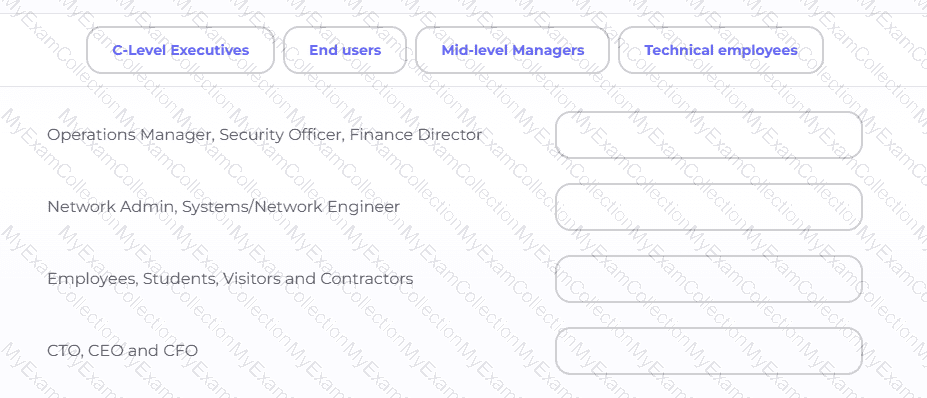
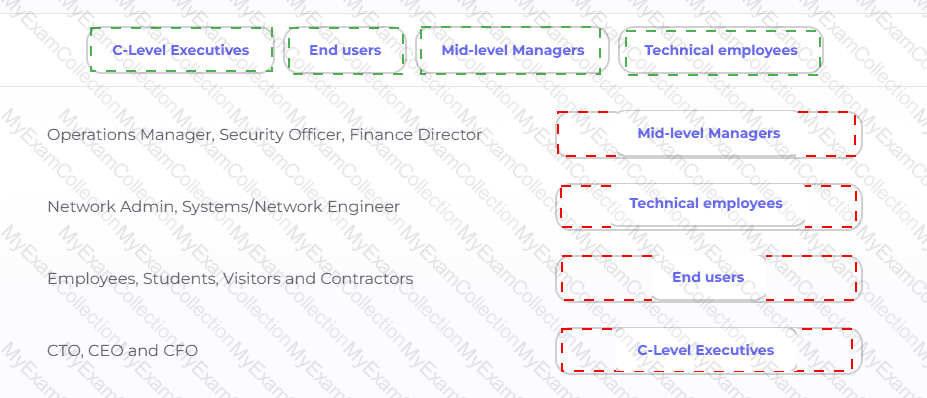
You hired a junior engineer to help with a large-scale network-infrastructure project. Because the engineer has not previously worked on a project this complex, they want a clearer understanding of each stakeholder’s role.
What is the role of Network Operations in this project?
Question # 16
Which type of member must be rebooted when performing an In-Service Software Upgrade within a VSF stack?
Question # 17
You are presenting your network-design solution to a customer. What is important to include in the presentation?
Question # 18
A large multinational financial institution has engaged you to design a new full-stack wired and wireless network for its new 6-story regional office building. The facility’s bottom two floors will be retail space for a large banking branch. The upper floors will be carpeted corporate office space, with each floor approximately 100,000 sq ft (9290 sq m). Data centers are all offsite and are out of scope for this project. The customer is underserved by its current L2-based network infrastructure and wants to use modern best practices in the new design. The network must be fully resilient and fault-tolerant, with dynamic segmentation at the edge.
The retail space will provide public guest Wi-Fi access. Retail associates will use corporate tablets for customer service, with a mix of wired and wireless devices throughout the retail floors. Corporate users will mainly use wireless connectivity, although several wired clients, printers, and hard VoIP phones will also be used.
The customer also plans to renovate the corporate office space to take advantage of 'smart office' technology. These enhancements will enable blue-dot wayfinding, presence analytics, and other location-based services.
The client wants to provide Blue Dot wayfinding for its carpeted office space. The retail floors are not currently in scope.
What is required to ensure the solution is properly licensed?
Question # 19
You are a member of a cross-functional team developing a detailed design proposal for a customer deploying EVPN-VXLAN in a modern campus core and data center fabric. The customer is moving from a traditional VLAN-based Layer 2 design to a VXLAN-based overlay architecture to support segmentation scalability and automation.
As the solution undergoes review, you are asked to contribute by identifying and explaining core technical behaviors and configuration considerations critical to the success of EVPN-VXLAN in this environment.
Which statements accurately describe key characteristics of EVPN-VXLAN in modern campus or data center networks?
Question # 20
A global cruise-line company must refresh its current fleet. It will refresh the ship’s “insides†to remain cost-effective and improve sustainability, replacing all WLAN/LAN hardware. During this refresh, the company will retain its current security requirements. The CIO also wants to minimize the number of unused switch ports. Any future expansion will always involve a hardware refresh. The company begins with its smallest ship, supporting a maximum of 800 guests.
Each ship has a LAN infrastructure comprising two core switches, up to 10 redundant distribution switches, and up to 500 access switches (400 cabins and 100 technical rooms). The core switches are in the ship’s MDF, and the distribution switches are in the IDFs. Each cabin and technical room has one access switch.
The ship’s cabling structure will not be refreshed. Each IDF connects to the MDF through SMF, with two pairs available for the core-to-distribution interconnect. The MDF-to-IDF SMF run is under 300 meters (980 ft) and uses OS1 fiber. Each cabin connects to its IDF through a single OM2 pair, with a maximum length of 60 meters (200 ft). Each technical room connects to its IDF through a single OM2 pair, with lengths from 100 to 150 meters (320 to 500 ft).
For every cabin and technical room, the customer wants to replace its current fanless 2530/2540 without changing requirements, except that the uplink to the distribution switch must be upgraded to 10GbE to accommodate increased network traffic, and technical rooms require redundant power.
The WLAN infrastructure will be refreshed 1:1, with no new cabling or AP locations. It uses 200/300-series indoor and outdoor APs running InstantOS (fewer than 300 APs), and the customer has no changes to WLAN requirements.
The cruise-line company will replace its current Internet connection before the LAN/WLAN refresh. The new Internet connection will provide 99.8% uptime, required to keep paid guest Wi-Fi operational. With this new Internet connection, the CIO wants to base the design on Aruba’s ESP architecture because the Internet connection is guaranteed.
Based on HPE Aruba Networking best practices and the customer’s stated requirements, which segmentation design approach is suitable for this environment?
Question # 21
You and the customer agree that DUR will be used for centralized policy management. The plan also includes dynamic VNBT-based distributed Dynamic Segmentation. Which switch model should be selected?
Question # 22
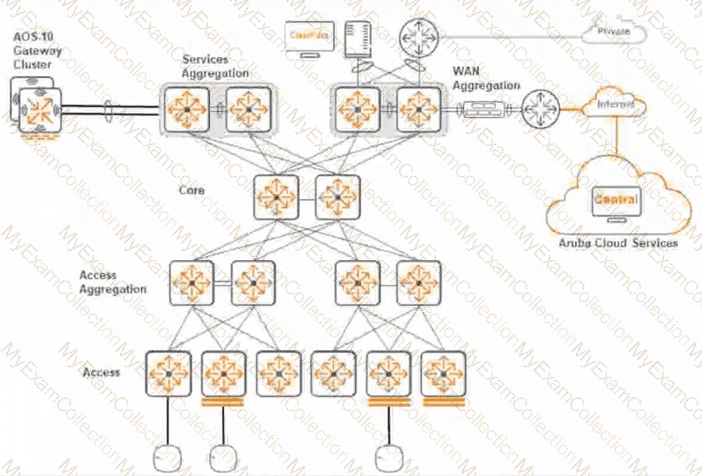
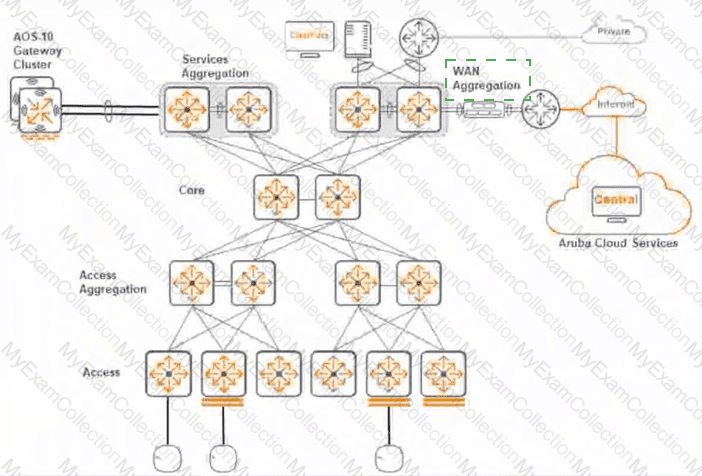
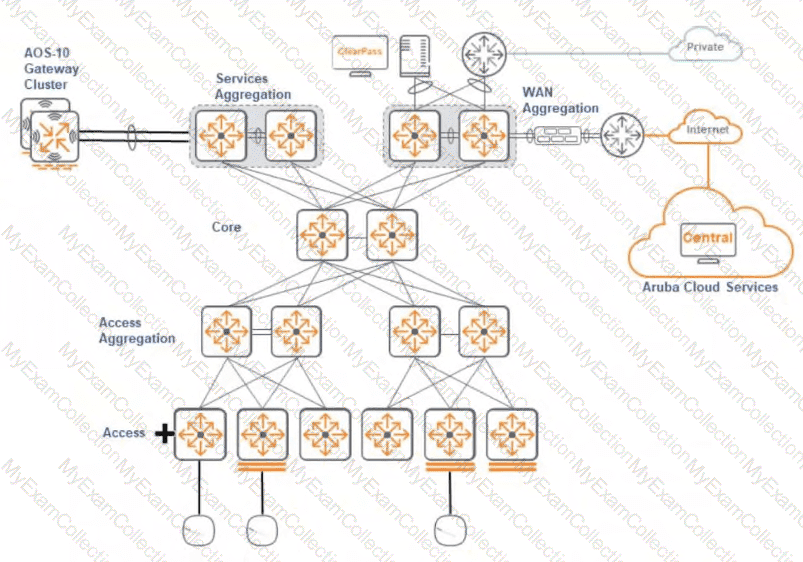
Based on this campus design, select the layer most suitable to be designed as a Border Persona when considering an EVPN VXLAN Fabric.
Original network architecture exhibit
Question # 23
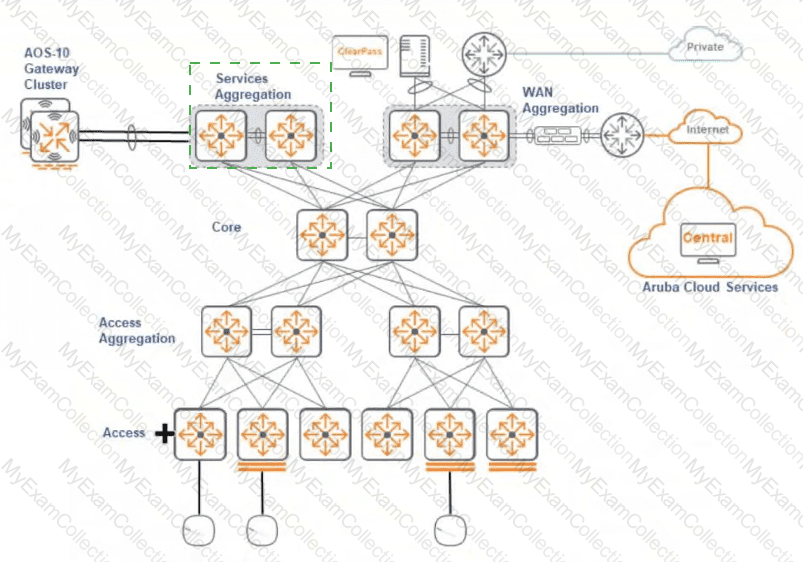
Based on this campus design, click the layer that is most appropriate to design as a Stub Persona when considering an EVPN VXLAN Fabric?
Question # 24
XYZ Regional Hospital is an integrated healthcare system comprising hospitals, neighborhood health centers, and small doctor offices. XYZ Regional Hospital has recently merged with 4x neighborhood health centers and 125 doctor branch offices. Its wireless, wired access, and AAA solutions are outdated and must be replaced.
XYZ Regional Hospital wants to future-proof and improve efficiency at all sites by enhancing wired and wireless access and moving to centralized, unified wired/wireless and policy management that delivers uninterrupted availability of all systems.
Locations:
XYZ Regional Hospital is located in New York City
Dila Health Center is located in City A
Mount Health Center is located in City B
Rock Health Center is located in City C
Branch clinics are located at different locations across the United States
Requirements:
Provide, through management software, a single pane of glass to manage wired and wireless LANs and VPNs across campus, branch, and remote environments through a web/cloud architecture that provides near-real-time insight, troubleshooting tools, and Service Level performance reporting.
Seamless integration across wired, wireless, WAN, SD-Branch, and IoT
Provide secure wireless access for all Regional Hospital employees and partners, and wireless Internet access for medical citizens when they visit the facilities.
All access points must support these features and specifications: 802.11 ax (Wi-Fi 6E Certified)
Security options including WP2/WPA3 and 802.1X with Radius secure authentication
Identify and authenticate every wireless and wired device
End-to-end role-based security
Seamless mobility across the hospital for medical teams, patients, and visitors
Cut Wi-Fi deployment times from days to hours and enable Zero-Touch deployments across the site
Establish a resilient, future-ready network infrastructure with the intelligence, scalability, and intuitive toolsets to meet emerging needs
Fully redundant branch solution with dynamic path selection to the hospital
The hospital IT director is concerned that branch clinics will lack an onsite resource to troubleshoot issues that may arise and wants a solution that enables the hospital IT team to proactively monitor the branch offices.
Requirements:
Monitor wireless and wired connections
Provide an end-to-end experience view that identifies points of failure
Proactively troubleshoot issues that affect application performance
What is the correct solution?
Question # 25
You are the lead network architect completing the Bill of Materials (BoM) for a new HPE Aruba Networking ClearPass Policy Manager (CPPM) deployment that must support the following environment:
3,000 wired IoT devices using MAC authentication.
2,000 wireless IoT devices using MPSK.
12,000 corporate laptops—a mix of Windows 11 Desktop PCs and Surface Pro devices—joined to Active Directory and authenticating through EAP-TLS, with posture assessments required through a ClearPass client agent.
1,000 BYOD users, each onboarding 2–3 personal devices and receiving certificates through ClearPass Onboard.
Up to 2,500 guest users per day, using ClearPass Guest with sponsor-based registration.
Which HPE Aruba Networking ClearPass license combination most accurately reflects what should be included in the IRIS-generated Bill of Materials to support this deployment?
Question # 26
A customer needs integration with ServiceNow.
Which CX feature automatically creates ServiceNow tickets from network events?
Question # 27
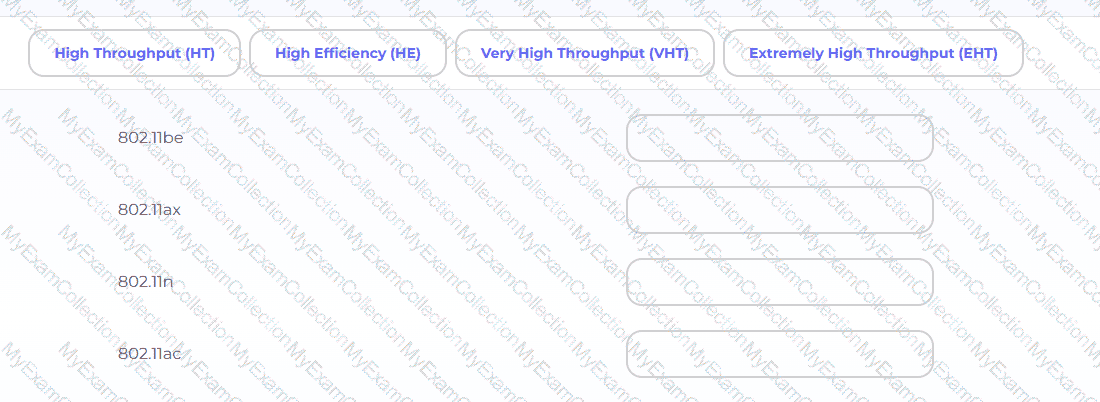
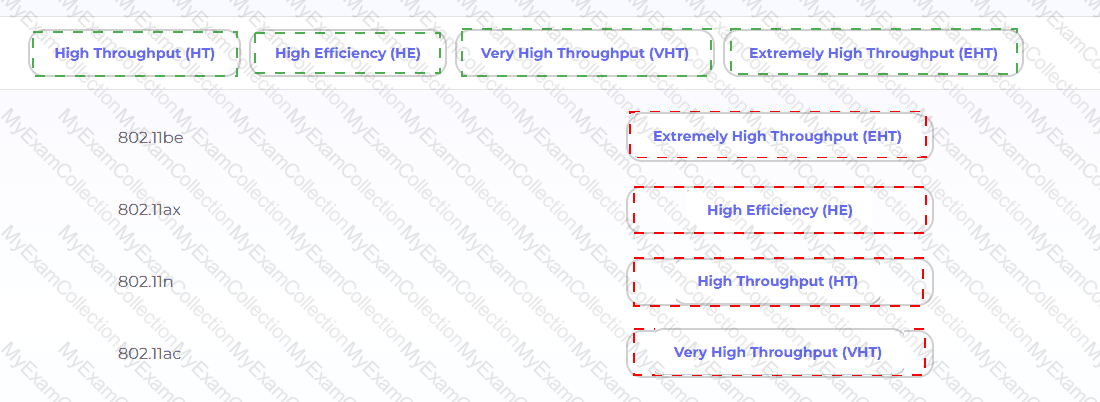
Match each IEEE designation with its official technical Physical Layer (PHY) protocol acronym.
Question # 28
You meet with a customer to update the network after the prior network manager has left the company for another role.
Which methods can validate the current network state when the available network documentation is invalid?
Choose two.