Question # 4
A customer needs the following rights for clients in the medical-mobile AOS firewall role on HPE Aruba Networking Mobility Controllers (MCs):
* They may receive IP addresses through DHCP.
* They may access DNS services at 10.8.9.7, and no other server.
* They may access all subnets in the 10.1.0.0/16 range, except 10.1.12.0/22, which must be denied.
* They must be denied access to other 10.0.0.0/8 subnets.
* They may access the Internet.
* They must be denied WLAN access for a period of time if they send any SSH traffic.
* They must be denied WLAN access for a period of time if they send any Telnet traffic.
* They must be denied access to all high-risk websites.
* External devices must not be allowed to initiate sessions with medical-mobile clients; they may send only return traffic.
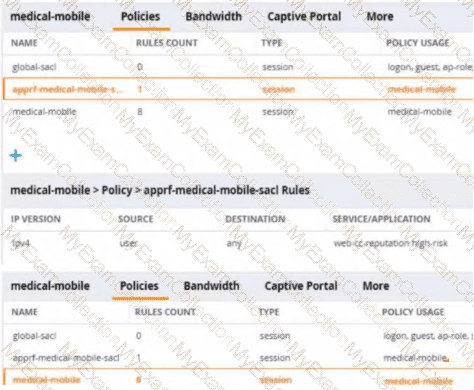
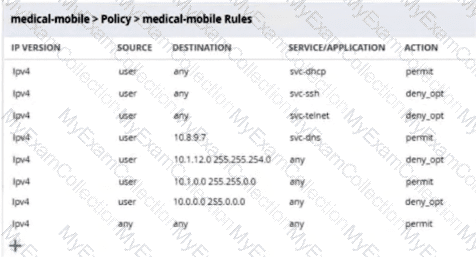
Refer to the scenario. The exhibits below show the role configuration.
* Role policies: `apprf-medical-mobile-sacl` (Rule: `user any web-cc-reputation high-risk deny`) and `medical-mobile` (8 rules configured).
Which setting not shown in the exhibits must you check to ensure the scenario requirements are met?
Question # 5
When should BPDU protection be implemented on an AOS-CX switch port rather than BPDU filtering?
Question # 6
The customer needs a secure wireless solution that lets users onboard new wireless clients. You are recommending a new WLAN that will give users limited access for this process.
Which WLAN security should you recommend, assuming users have a mixture of WPA2- and WPA3-capable devices?
Question # 7
Introduction to the customer
You are assisting a company with adding HPE Aruba Networking ClearPass to its network, which uses HPE Aruba Networking network-infrastructure devices.
The company already has a Windows domain and Windows CA. The Windows CA issues certificates to domain computers, domain users, and servers such as domain controllers.
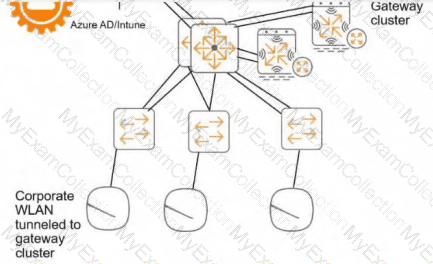
ClearPass cluster IP addressing and hostnames
Publisher = 10.47.47.5
Subscriber 1 = 10.47.47.6
Subscriber 2 = 10.47.47.7
Virtual IP with Subscriber 1 and Subscriber 2 = 10.47.47.8
Refer to the scenario.
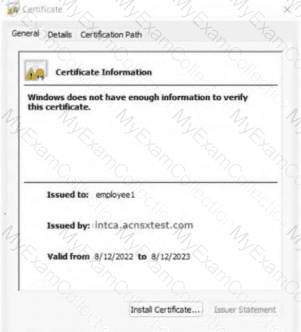
You imported the root certificate for the Windows CA into the ClearPass CA Trust list. Based on the scenario requirements, which usages should be added to it?
Question # 8
Refer to the exhibit, which depicts the topology for an HPE Aruba Networking network.
* Gateways: GW1 (10.1.30.2 / 10.1.36.2), GW2 (10.1.30.3 / 10.1.36.3), VRRP: 10.1.36.1
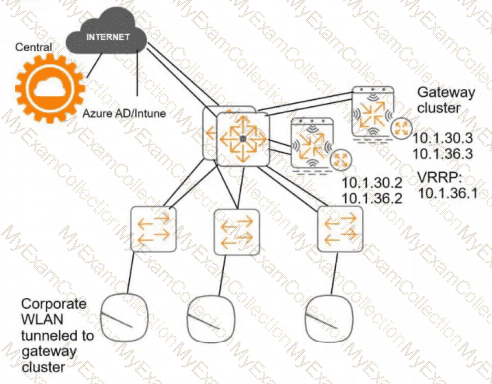
The gateways have sent the following logs to your Syslog server:
```text
< 142 > Jan 9 18:01:15 GW1 authmgr[6118]: < 124039 > < 6118 > Time-range night-hours activated
< 142 > Jan 9 18:01:15 GW1 authmgr[6118]: < 124040 > < 6118 > Time-range working-hours deactivated
< 142 > Jan 9 18:13:07 GW2 authmgr[6159] : < 124709 > < 6159 > Drop ARP-packet with unknown-IP: smac:a0:e7:7b:97:a2:98 sender-mac: a0:e7:7b:97:a2:98 sender-ip:10.1.30.2
< 142 > Jan 9 18:13:38 GW2 authmgr[6159]: < 124709 > < 6159 > Drop ARP-packet with unknown-IP: smac: a0:e7:7b:97:a2:98 sender-mac: a0:e7:7b:97:a2:98 sender-ip:10.1.30.2
< 142 > Jan 9 18:21:24 GW2 isakmpd[6132]: < 103076 > < 6132 > IKEv2 IPSEC Tunnel created for peer 10.1.30.2:500
< 142 > Jan 9 18:21:24 GW2 isakmpd[6132]: < 103101 > < 6132 > IPSEC SA deleted for peer 10.1.30.2
< 142 > Jan 9 18:21:24 GW2 isakmpd[6132]: < 103078 > < 6132 > IKEv2 CHILDSA successful for peer 10.1.30.2:500
< 142 > Jan 9 18:21:26 GW1 isakmpd[6091]: < 103076 > < 6091 > IKEv2 IPSEC Tunnel created for peer 10.1.30.3:500
< 142 > Jan 9 18:21:26 GW1 isakmpd[6091]: < 103101 > < 6091 > IPSEC SA deleted for peer 10.1.30.3
< 142 > Jan 9 18:21:26 GW1 isakmpd[6091]: < 103078 > < 6091 > IKEv2 CHILDSA successful for peer 10.1.30.3:500
```
What potential security issue can be identified from these logs?
Question # 9
A company uses an HPE Aruba Networking AOS-10 mobility infrastructure. Network administrators recently enabled wireless detection on the APs, which checks for all infrastructure and client threats. However, the administrators quickly became overwhelmed and now want to disable most checks.
They want a recommendation for the checks most likely to indicate genuine threats.
Which one should be mentioned?
Question # 10
A customer operates an HPE Aruba Networking ClearPass cluster. The customer has AOS-CX switches that use 802.1X authentication with HPE Aruba Networking ClearPass Policy Manager (CPPM).
The switches use local port-access policies. The customer wants to begin tunneling wired clients that pass only user authentication to an HPE Aruba Networking gateway cluster. The gateway cluster must assign these clients the eth-internet role. The gateway must also assign the clients to VLAN 20.
The intended enforcement policy and profiles are shown below:
* Policy: `written-exam-3`
* Profile: `written-exam-b`
The gateway cluster contains two gateways with the following IP addresses:
Gateway 1: VLAN 4085 (system IP) = 10.20.4.21 | VLAN 20 (users) = 10.20.20.1 | VLAN 4094 (WAN) = 198.51.100.14
Gateway 2: VLAN 4085 (system IP) = 10.20.4.22 | VLAN 20 (users) = 10.20.20.2 | VLAN 4094 (WAN) = 198.51.100.12 | VRRP on VLAN 20 = 10.20.20.254
The customer needs high availability for tunnels between the switches and the gateway cluster. If one gateway fails, the other gateway must take over its tunnels. The switch must also be able to discover the gateway cluster even if one gateway in the cluster is unavailable.
Refer to the scenario. Assume that `myzone` is the name used for the UBT zone.
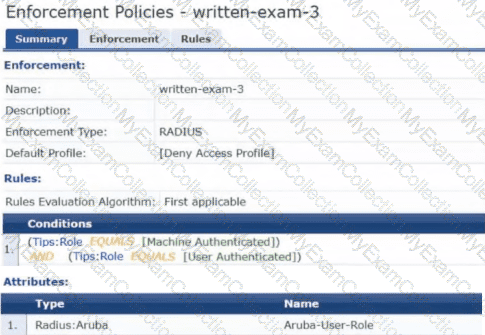
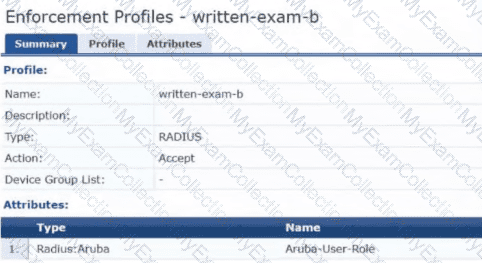
Which option is a valid minimal configuration for the AOS-CX port-access roles?
Question # 11
Your company uses an HPE Aruba Networking AOS-10 architecture managed by HPE Aruba Networking Central. A ClearPass Policy Manager (CPPM) cluster supplies authentication. The company also has a Palo Alto firewall. You want to configure the HPE Aruba Networking infrastructure to quarantine clients for which the firewall sends Syslog Threat messages to CPPM.
Network infrastructure devices already have a “quarantine†role configured.
You checked the CPPM event dictionary and found an entry for Palo Alto Syslog Threats that includes:
Prefix: PANW-Threat
Attributes such as syslogtimestamp and logtype
What is a correct component of the configuration in ClearPass server settings?
Question # 12
A hospital uses an AOS-10 architecture managed through HPE Aruba Networking Central. The customer has deployed a pair of HPE Aruba Networking 9000 Series gateways with Security licenses at every clinic. The gateways run IDS/IPS in IDS mode.
The Security Dashboard displays several recent events with the same signature, as shown below:
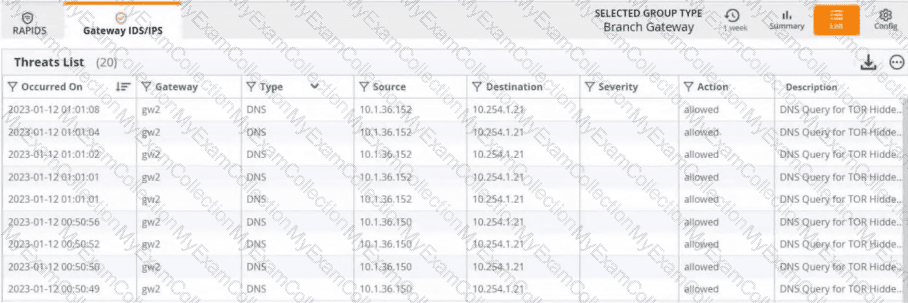
Occurred On: 2023-01-12 | Gateway: gw2 | Type: DNS | Source: 10.1.36.152 | Destination: 10.254.1.21 | Action: allowed | Description: DNS Query for TOR Hidden...
Which action could provide valuable context about the incident?
Question # 13
How does HPE Aruba Networking Central secure site-to-site connections between AOS-10 gateways?
Question # 14
A financial institution must authenticate managers of HPE Aruba Networking Mobility Controllers (MCs) and HPE Aruba Networking Mobility Conductors through ClearPass Policy Manager (CPPM). The institution’s security policies require strong encryption for manager-authentication communications between the HPE Aruba Networking devices and CPPM.
What is a valid solution?
Question # 15
A customer uses an AOS-10 architecture that includes HPE Aruba Networking APs. The customer recently enabled WIDS at the High level on the APs. Administrators observe many "detect disconnect station" events.
What should you explain?
Question # 16
A hospital has an AOS-10 architecture managed by HPE Aruba Networking Central. The customer has deployed a pair of HPE Aruba Networking 9000 Series gateways with Security licenses at each clinic. The gateways implement IDS/IPS in IDS mode.
The Security Dashboard shows several recent events with the same signature, as shown below:
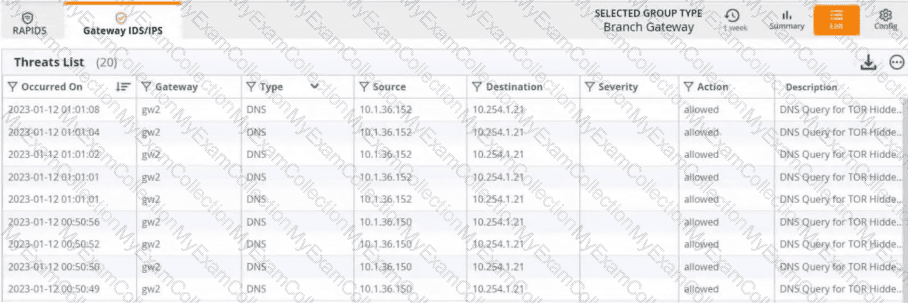
Occurred On: 2023-01-12 | Gateway: gw2 | Type: DNS | Source: 10.1.36.152 | Destination: 10.254.1.21 | Action: allowed | Description: DNS Query for TOR Hidden...
Refer to the scenario.
You have learned that nurse call stations are the source of the events. What can you conclude?
Question # 17
Refer to the exhibit.
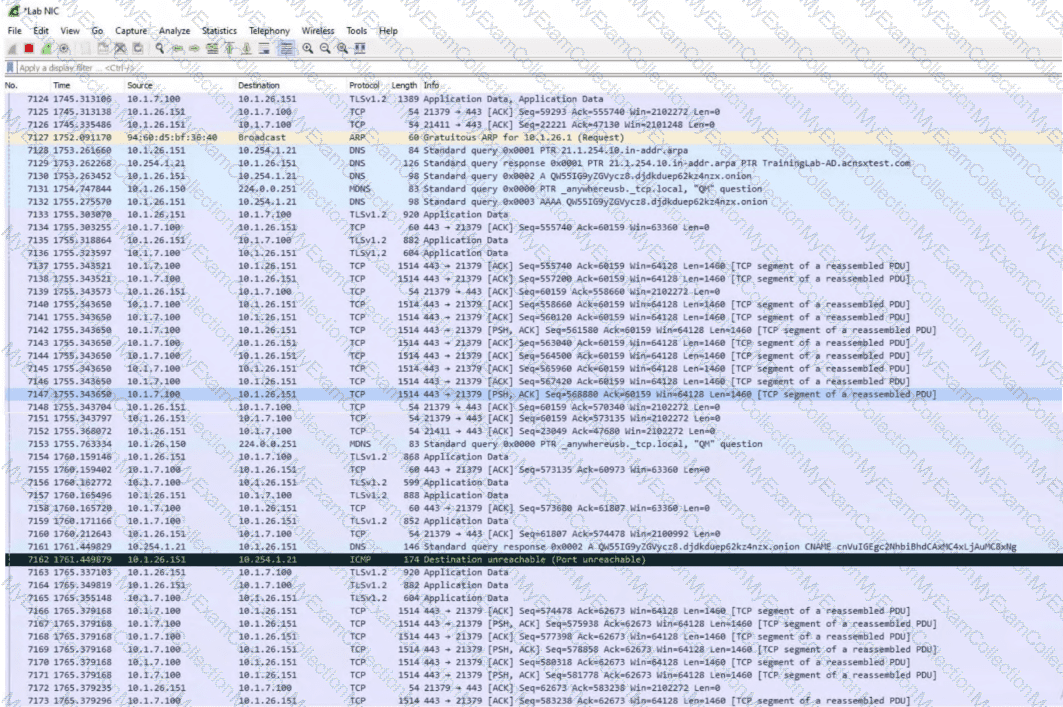
Frame 7128: 10.1.26.151 - > 10.254.1.21 DNS Standard query 0x0001 PTR 21.1.254.10.in-addr.arpa
Frame 7130: 10.1.26.151 - > 10.254.1.21 DNS Standard query 0x0002 A Qw5SIG9yZGvycz8.djdkduep62kz4nzx.onion
Frame 7147: 10.1.26.151 - > 10.1.7.100 TCP 443 - > 21379 [PSH, ACK]
Frame 7162: 10.1.26.151 - > 10.254.1.21 ICMP Destination unreachable (Port unreachable)
Which IP address should be recorded as a potentially compromised client?
Question # 18
You are assisting a company with adding HPE Aruba Networking ClearPass to its network, which uses HPE Aruba Networking network infrastructure devices.
The company already has a Windows domain and Windows CA. The Windows CA issues certificates to domain computers, domain users, and servers such as domain controllers.
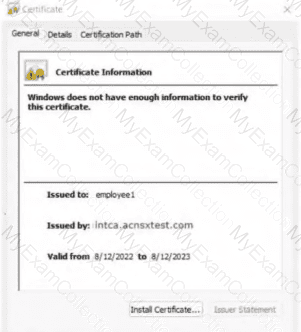
Refer to the scenario. On CPPM, you are creating the authentication source. You have configured the settings displayed on the tab and have not changed any other settings.
Authentication Sources - UniversityAD
Hostname: ad.acnsxtest.com
Connection Security: AD over SSL
Port: 636
Verify Server Certificate: [X] Enable
Bind DN: bind@acnsxtest.com
NetBIOS Domain Name: ACNSXTEST
Base DN: dc=acnsxtest,dc=com
Search Scope: SubTree Search
User Certificate: userCertificate
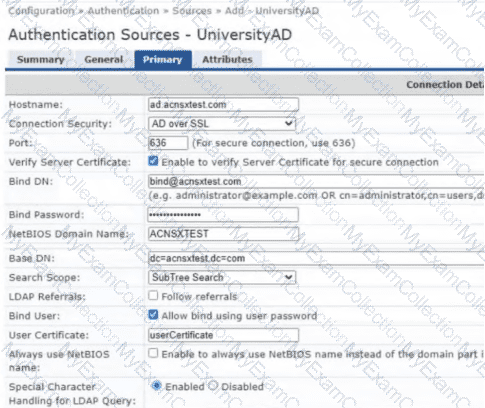
What else must you do to help authentication proceed correctly?
Question # 19
Your company uses HPE Aruba Networking AOS-10 APs and gateways, along with AOS-CX switches, all managed through HPE Aruba Networking Central. In HPE Aruba Networking Central, you need to collect a packet capture for a client connected to an AP.
What is a prerequisite?
Question # 20
The customer's security team has added a requirement: TEAP settings delivered to domain clients must use anonymous for the outer method. AOS mobility administrators now report that every wireless client appears under the same anonymous name, which makes troubleshooting difficult.
What should you recommend to best balance the security and mobility-administration needs?
Question # 21
Introduction to the customer
You are assisting a company with adding HPE Aruba Networking ClearPass to its network, which uses HPE Aruba Networking infrastructure devices.
The company already has a Windows domain and Windows CA. The Windows CA issues certificates to domain computers, domain users, and servers such as domain controllers.
ClearPass cluster IP addressing and hostnames
A customer's ClearPass cluster uses these IP addresses:
Publisher = 10.47.47.5
Subscriber 1 = 10.47.47.6
Subscriber 2 = 10.47.47.7
Virtual IP with Subscriber 1 and Subscriber 2 = 10.47.47.8
The customer's DNS server contains these entries:
cp.acnsxtest.com = 10.47.47.5
cps1.acnsxtest.com = 10.47.47.6
cps2.acnsxtest.com = 10.47.47.7
radius.acnsxtest.com = 10.47.47.8
onboard.acnsxtest.com = 10.47.47.8
Refer to the scenario.
The Onboard CA uses the settings shown in the exhibits below.
* CA Name: Onboard CA, CA ID: 2
* Common Name: ClearPass Intune Certificate Authority
Microsoft Entra ID (Azure AD) administrators need assistance configuring the app registration for integration with ClearPass Onboard.
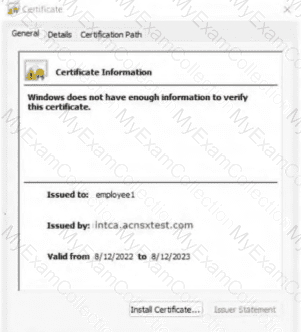
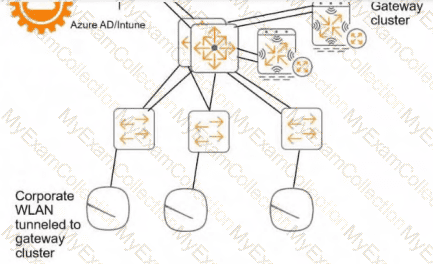
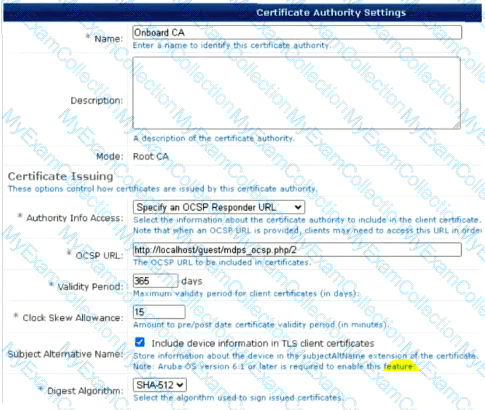
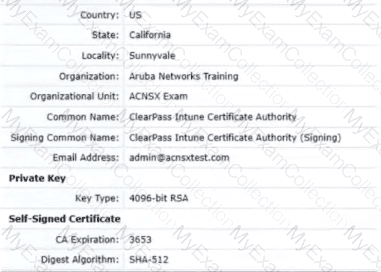
Which URL should you tell them to use?
Question # 22
A company has HPE Aruba Networking gateways and plans to begin implementing gateway IDS/IPS. The customer has chosen Block as the Fail Strategy.
What could you recommend to help reduce unexpected outages caused by this particular fail strategy?