Question # 4
Which of the following statements about the differences between a domain and an OU are true?
A.
Users can log in to a domain but not to an OU.
B.
Group policies can be configured for both OUs and domains.
C.
An OU can exist in a domain, and a domain can also exist in an OU.
D.
Both OUs and domains can contain AD objects.
Full Access
Answer:
A, B, D
Explanation:
In the context of FusionAccess deployment, understanding Microsoft Active Directory (AD) is critical. According to the official Huawei curriculum, a Domain and an Organizational Unit (OU) serve different purposes in a network hierarchy. Statement A is TRUE because a domain is a security and administrative boundary; users authenticate "to the domain." An OU is merely a logical container inside that domain used for organization; it does not function as an authentication boundary itself.
Statement B isTRUE. Group Policy Objects (GPOs) are the primary tool for managing desktop settings in a Huawei VDI environment. GPOs can be linked at the Domain level (applying to everyone) or at the OU level (applying only to the users or computers within that specific folder). This allows FusionAccess administrators to apply specific security rules—such as disabling USB ports or setting custom wallpapers—to one department (one OU) without affecting the entire company.
Statement D is alsoTRUE. Both entities are containers for AD objects such as User accounts, Computer accounts, and Security Groups. However, statement C isFALSE. While an OU always existsinsidea domain (to organize that domain's objects), a domaincannotexist inside an OU. Domains exist within a Forest or Tree structure.2This distinction is vital for HCIA candidates because the FusionAccessITA (IT Adapter)requires a specific OU structure to be pre-created (e.g., an OU for Desktops and an OU for Users) to properly apply the automated provisioning and management policies that define the desktop cloud environment.
====================
Question # 5
On FusionAccess, modifying or deleting a full copy template will affect the virtual machines created using the template.
A.
TRUE
B.
FALSE
Full Access
Answer:
B
Explanation:
In FusionAccess, full copy desktops are created by completely copying the template into an independent virtual machine. After the VM is created, it no longer depends on the template.
According to HCIA–Cloud Computing materials:
Modifying or deleting a full copy template does not affect already provisioned desktops.
Only linked clone desktops depend on the template and snapshot chain.
Therefore, the statement is FALSE.
Question # 6
Which of the following statements about HDP display technology is false?
A.
It applies lossless compression to non-natural images.
B.
It only supports Huawei-developed image compression algorithms.
C.
It compresses natural images such as photos at an appropriate rate.
D.
It automatically identifies text and non-natural images such as Windows frames and lines within images.
Full Access
Answer:
B
Explanation:
According to the Huawei HCIA-Cloud Computing curriculum, specifically the sections covering the Huawei Desktop Protocol (HDP), statement B is FALSE. While HDP is a proprietary protocol developed by Huawei with many specialized optimizations, it is not restricted to using "only" Huawei-developed image compression algorithms. HDP is an adaptive and compatible protocol that incorporates industry-standard codecs and technologies, such as H.264 and H.265, for video redirection and high-definition multimedia handling. Additionally, it supports hardware acceleration from third-party GPU vendors like NVIDIA.
The other statements accurately describe the "Intelligent Recognition" and "Adaptive Compression" features of HDP. Statement D and A are correct because HDP can distinguish between "non-natural images" (such as text, window borders, and office application lines) and "natural images" (such as high-resolution photographs or video). For non-natural images, HDP useslossless compression. This ensures that text remains perfectly sharp and readable, preventing the "blurring" or "ghosting" often seen in legacy remote desktop protocols.
Statement C is also true; when the protocol identifies a "natural image," it switches to alossy compressionalgorithm at an appropriate rate. This provides a balance between visual quality and bandwidth efficiency. If the system attempted to use lossless compression for a high-definition photograph, the bandwidth consumption would spike, causing latency for the user. By automatically identifying content types and applying the most suitable compression method, HDP ensures a high-quality user experience while minimizing the load on the network. This intelligence is what makes HDP superior to standard RDP in a VDI (Virtual Desktop Infrastructure) environment, especially over WAN (Wide Area Network) links with limited capacity.
Question # 7
A router manages path information by managing its___
Full Access
Answer:
Answer:
Routing Table
Explanation:
As defined in the "Network Technology Basics" module of the HCIA-Cloud Computing training, a router is a Layer 3 (Network Layer) device responsible for interconnecting different network segments and selecting the optimal path for data packets. To perform this function, the router maintains and manages a Routing Table. This table is the "map" of the network that the router uses to make forwarding decisions. Every entry in the routing table typically includes several key parameters: the destination network address, the subnet mask, the protocol (how the route was learned, such as Static, OSPF, or BGP), the preference value, the cost (metric), and the next-hop address or outbound interface.
When a router receives an IP packet, it examines the destination IP address and performs a lookup in its routing table to find the most specific match (longest match rule). If a matching entry is found, the router encapsulates the packet into a new frame and sends it toward the next hop. If no match is found and no default route exists, the packet is discarded. This process is fundamental to the operation of a Cloud Data Center where multiple Virtual Private Clouds (VPCs) and subnets must communicate through virtual or physical routers.
While a switch manages a MAC address table to forward frames at Layer 2, and a host manages an ARP table to map IP addresses to MAC addresses, only the routing table provides the cross-network path intelligence required for routing. In Huawei’s virtualization solutions, virtual routers within the software-defined networking (SDN) layer use these same logic principles to ensure that traffic between virtual machines in different subnets is directed efficiently to the correct destination. Proper management of the routing table is therefore the cornerstone of network reachability in cloud environments.
====================
Question # 8
Which of the following statements aretrueabout the features and functions of the FusionCompute virtualization suite?
A.
Allowing users to add or reduce VM resources on demand without interrupting applications.
B.
Supporting x86- or Arm-based servers, various storage devices, and mainstream Linux/Windows operating systems, thereby allowing mainstream applications to run on virtualization platforms.
C.
Allowing users to define service level agreement (SLA) policies to control VM resources, thereby allocating physical resources based on application priority.
D.
Automatically migrating workloads based on preset policies, thereby optimizing resource allocation, system response efficiency, and user experience.
Full Access
Answer:
A, B, C, D
Explanation:
Huawei FusionCompute provides a comprehensive virtualization platform with advanced management and scheduling capabilities.
Ais true. FusionCompute supportsdynamic resource adjustment, including CPU and memory scaling, helping applications adapt to workload changes.
Bis true. FusionCompute supportsx86 and Arm architectures, multiple storage backends, and mainstream operating systems such as Linux and Windows, ensuring broad application compatibility.
Cis true. SLA policies allow administrators to define priorities for virtual machines, ensuring that critical applications receive sufficient resources.
Dis true. FusionCompute supportsautomatic VM migration (such as DRS-like features)based on predefined policies to balance workloads and optimize system performance.
All listed statements correctly describe FusionCompute capabilities.
Question # 9
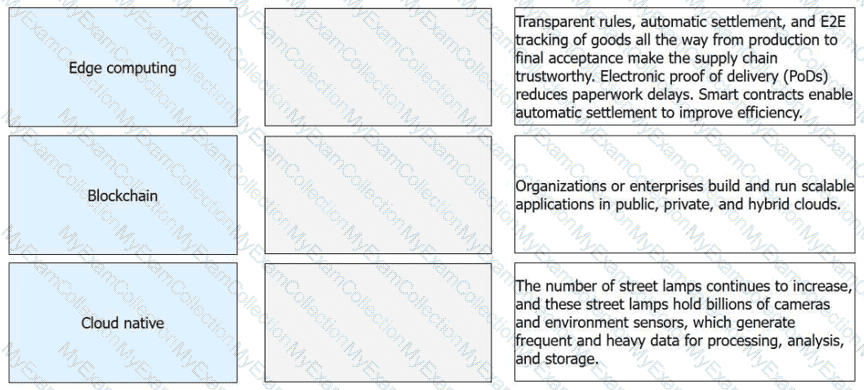
Match the emerging technologies with their respective features or application scenarios
Full Access
Answer:
Answer: 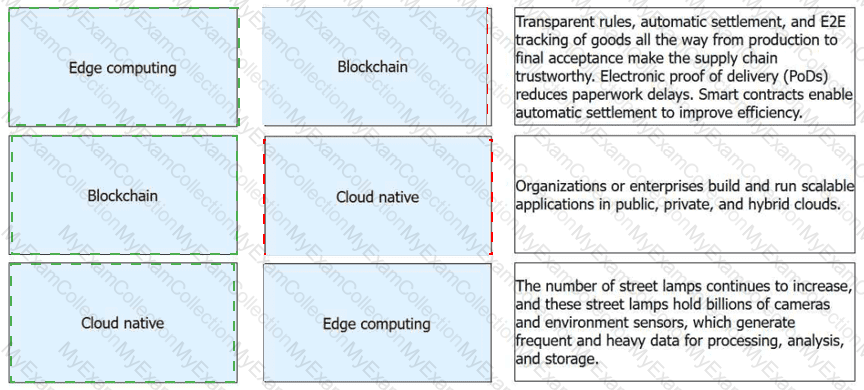
Explanation:
Emerging Technology
Feature / Application Scenario
Edge computing
The number of street lamps continues to increase, and these street lamps hold billions of cameras and environment sensors, which generate frequent and heavy data for processing, analysis, and storage.
Blockchain
Transparent rules, automatic settlement, and E2E tracking of goods all the way from production to final acceptance make the supply chain trustworthy. Electronic proof of delivery (PoDs) reduces paperwork delays. Smart contracts enable automatic settlement to improve efficiency.
Cloud native
Organizations or enterprises build and run scalable applications in public, private, and hybrid clouds.
According to the Huawei HCIA-Cloud Computing curriculum, emerging technologies like Edge Computing, Blockchain, and Cloud Native are reshaping modern IT infrastructures to handle data more efficiently and securely. In the context ofEdge Computing, the massive proliferation of IoT devices in smart cities—such as billions of cameras and environmental sensors mounted on street lamps—creates a data influx that traditional centralized clouds cannot process in real time without significant latency. Edge computing solves this by moving processing and storage capabilities physically closer to the data sources, allowing for nearly instantaneous response times for critical urban systems like traffic management and public surveillance.
Blockchaintechnology provides a decentralized, distributed ledger that is transformative for global supply chain management. By creating a "single source of truth" that is transparent and immutable, it enables end-to-end (E2E) tracking of goods from production to the final consumer. A core feature is the use ofsmart contracts, which are automated, self-executing rules that trigger settlements and payments immediately upon meeting conditions like electronic proof of delivery (PoD), thereby eliminating intermediaries and reducing paperwork delays.
Finally,Cloud Nativerepresents an architectural approach designed to fully exploit the cloud computing model. The official definition from the Cloud Native Computing Foundation (CNCF) states that these technologies "empower organizations to build and run scalable applications in modern, dynamic environments such as public, private, and hybrid clouds". By utilizing independent microservices and portable containers, cloud-native applications achieve the high availability, elasticity, and rapid deployment speed required to meet evolving business needs across diverse infrastructure types.
Question # 10
Which of the following statements is false about centralized storage and distributed storage?
A.
Distributed storage stores data on multiple independent devices. During data reading, data is read from these devices at the same time, affecting read efficiency.
B.
Centralized storage has a simple deployment structure. It can leverage the redundant array of independent disks (RAID) technology to ensure data security and reliability.
C.
In terms of technical architectures, centralized storage can be classified into network attached storage (NAS) and storage area network (SAN). SANs are further divided into Fibre Channel storage area networks (FC SANs) and IP storage area networks (IP SANs).
D.
Distributed storage adopts a scalable system architecture and enables multiple storage servers to share the storage load, improving scalability, reliability, availability, and access efficiency.
Full Access
Answer:
A
Explanation:
In the Huawei HCIA-Cloud Computing curriculum, specifically within the "Storage Technology Basics" module, the comparison between centralized and distributed storage is a fundamental topic. Statement A is FALSE because it incorrectly suggests that reading data from multiple independent devices simultaneously has a negative impact on read efficiency. According to the official technical documentation, the opposite is true: distributed storage utilizes a parallel I/O architecture. When a data request is made in a distributed system (such as Huawei FusionStorage), the system retrieves data blocks from multiple nodes at once. This concurrency significantly improves the overall throughput and read/write speed of the system rather than "affecting" it negatively.
The other statements are technically accurate according to Huawei standards. Centralized storage (Statement B) is indeed known for its simpler deployment and reliance on traditional RAID levels (0, 1, 5, 6, 10) to protect against disk failures within a single controller or enclosure. Statement C correctly outlines the taxonomy of centralized storage, distinguishing between file-level NAS and block-level SAN (which includes both FC and IP variants). Statement D accurately describes the core value proposition of distributed storage: its ability to scale out by adding more commodity hardware nodes. By spreading the storage load across a cluster, distributed storage eliminates the performance bottlenecks often found in centralized controllers and enhances system reliability through multi-replica or erasure coding mechanisms. In Huawei’s cloud solutions, distributed storage is the preferred architecture for large-scale resource pools because it ensures that performance scales linearly with capacity, providing the high availability and efficiency required for modern virtualized data centers.
====================
Question # 11
Which of the following statements istrueabout the FusionCompute storage architecture?
A.
Physical storage media that deliver storage space for virtualization are called storage devices.
B.
LUNs allocated by Huawei Distributed Storage can be encapsulated as datastores.
C.
After storage resources are converted to datastores and associated with hosts, virtual disks can be created for VMs.
D.
FusionCompute uniformly encapsulates storage units of storage resources into datastores.
Full Access
Answer:
D
Explanation:
FusionCompute uses aunified storage abstraction model. Regardless of whether the backend storage is SAN, NAS, local disks, or distributed storage, FusionComputeencapsulates storage resources into datastores.
This abstraction simplifies management and allows virtual machines to consume storage in a standardized manner. While statements A, B, and C describe correct individual concepts,D best represents the core architectural principleemphasized in HCIA documentation.
Therefore, the correct answer isD.
Question # 12
Which of the following statements aboutservice adjustmentin FusionAccess aretrue?
A.
A computer whose assignment type isAssign a Computer to Multiple UsersorAssign Computers to a Desktop Groupcannot be assigned again after being unassigned.
B.
If a computer whose assignment type isAssign a Computer to a Useris unassigned and then assigned again, the computer automatically starts. After the virtual desktop icon on the WI turns on, wait about three minutes and then log in.
C.
If a computer whose assignment type isAssign a Computer to a Useris unassigned and then assigned again, the computer can only be assigned to the original user and cannot be assigned to other users.
D.
A computer whose assignment type isAssign a Computer to a Useris automatically shut down after being unassigned.
Full Access
Answer:
B, D
Explanation:
FusionAccess defines clear behaviors for desktop service adjustment:
Bis true. After reassignment, the systemautomatically starts the desktop, and a short wait time is required before user login.
Dis true. When a desktop assigned to a single user is unassigned, the systemautomatically shuts it downto save resources.
Ais false. Desktops assigned to multiple users or desktop groupscan be reassignedafter being unassigned.
Cis false. After unassignment, a desktop can beassigned to a different user, not only the original one.
Thus, the correct answers areB and D.
Question # 13
FusionCompute integrates physical CPU and memory resources on hosts into a compute resource pool and divides the resources into virtual CPU and memory resources for VMs. The compute resources actually used by a VM cannot exceed the specifications of the hardware resources on the host because the CPU and memory resources used by the VM must be provided by the same host. If this host malfunctions, the system automatically assigns another host to the VM to provide compute resources.
A.
TRUE
B.
FALSE
Full Access
Answer:
A
Explanation:
This statement is TRUE and covers two fundamental concepts within the Huawei HCIA-Cloud Computing curriculum: resource locality and High Availability (HA).
First, the statement addresses the constraint ofresource locality. In the current architecture of Huawei FusionCompute (and most mainstream virtualization platforms), a single Virtual Machine (VM) cannot "span" its core compute resources (vCPU and RAM) across multiple physical hosts simultaneously. For instance, if a physical host has 128GB of RAM, you cannot create a single VM with 256GB of RAM, because that VM’s memory address space must be mapped to the physical DIMMs of a single physical server to maintain performance and synchronization. Therefore, the maximum specifications of a VM are always bounded by the physical hardware limits of a single host within the cluster.
Second, the statement accurately describes theHigh Availability (HA)function. While a running VM is tied to one host, cloud computing overcomes this physical dependency through cluster-level management. When theVRM (Virtual Resource Management)node detects that a physical host has malfunctioned (via heartbeat loss), it triggers the HA policy. Since the VM’s disk files are stored on shared storage (like a SAN or NAS), the system "assigns" the VM to a different healthy host in the same cluster. The VM is then automatically restarted on that new host, which provides the necessary CPU and memory resources to resume services.
This combination of strict host-level resource allocation for execution and cluster-level flexibility for recovery is what allows Huawei’s cloud solutions to provide stable, enterprise-grade infrastructure. Understanding that compute resources are provided by a "single host" at runtime, but protected by the "cluster" during a failure, is a core objective of the HCIA-Cloud Computing certification.
Question # 14
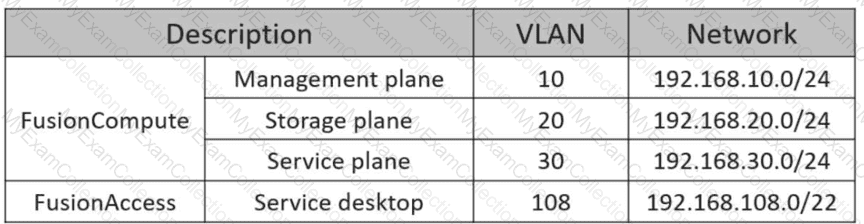
The following table lists the FusionAccess environment plan. Which of the following network segments is the most suitable for deploying FusionAccess Linux infrastructure VMs?
A.
192.168.108.0/22
B.
192.168.10.0/24
C.
192.168.30.0/24
D.
192.168.20.0/24
Full Access
Answer:
B
Explanation:
According to the Huawei HCIA-Cloud Computing documentation, specifically within the "Planning and Deployment of FusionAccess" module, the network architecture of a cloud data center is divided into distinct planes to ensure security, isolation, and efficient management. In a FusionAccess deployment, infrastructure virtual machines (VMs)—which include critical components such as the ITA (IT Adapter), HDC (Huawei Desktop Controller), WI (Web Interface), and the GaussDB database—are considered the "management brain" of the desktop cloud solution.
TheManagement planeis specifically designed to facilitate communication between management systems and all nodes within the cloud environment. In the provided scenario, the network segment192.168.10.0/24(VLAN 10) is designated as the FusionCompute Management plane. Huawei's official best practices dictate that Linux infrastructure VMs must be deployed on this plane to allow them to communicate directly with theVirtual Resource Management (VRM)node and theComputing Node Agent (CNA)hosts. This placement ensures that management traffic for desktop provisioning and resource orchestration remains isolated from general user traffic and heavy storage data flows.
In contrast, theService plane(192.168.30.0/24) is intended for the traffic of standard user applications, while theService desktopsegment (192.168.108.0/22) is reserved for the end-user virtual desktops themselves. Placing infrastructure VMs on theStorage plane(192.168.20.0/24) would be technically incorrect, as it is strictly dedicated to disk I/O and would not provide the necessary logical path to the management portal. Therefore, selecting network segment B ensures that infrastructure components are securely positioned to manage the desktop lifecycle while maintaining high availability and administrative accessibility.
Question # 15
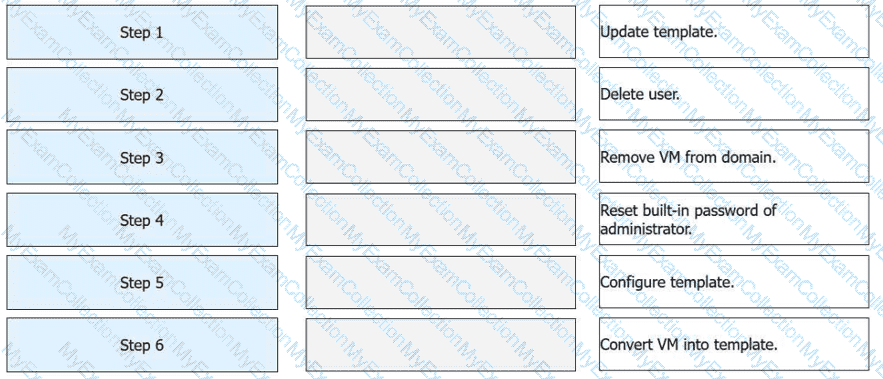
FusionAccess can use a provisioned full copy VM as a full copy VM template. Place the following operations in the correct order.
Full Access
Answer:
Answer: 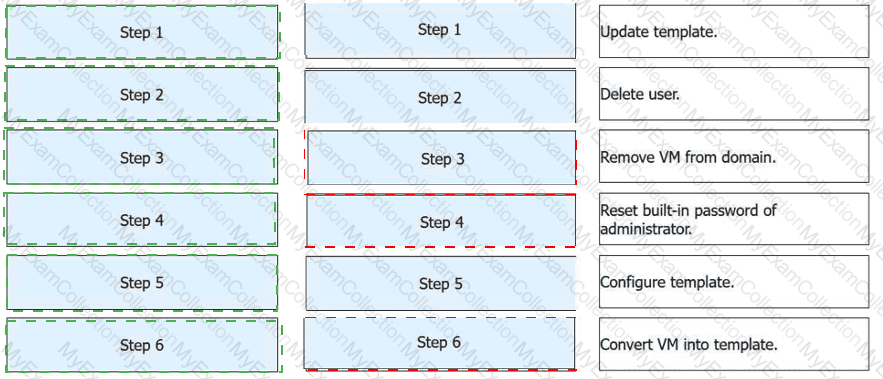
Explanation:
Step
Operation
Step 1
Update template.
Step 2
Delete user.
Step 3
Remove VM from domain.
Step 4
Reset built-in password of administrator.
Step 5
Configure template.
Step 6
Convert VM into template.
Step
Operation
Technical Rationale
Step 1
Update template
Power on the VM to install the latest OS patches and software updates.
Step 2
Delete user
Remove user profiles and personal data to ensure the master image is clean.
Step 3
Remove VM from domain
Disjoin the VM from the AD domain to prevent Security Identifier (SID) or account name conflicts on new clones.
Step 4
Reset built-in administrator password
Set a secure, standardized baseline credential for the local administrator account.
Step 5
Configure template
Run theHuawei Desktop Preparation Toolto optimize the OS and encapsulate the system.
Step 6
Convert VM into template
Use the management console to officially mark the VM as a read-only template resource.
ï‚· Initialization (Steps 1-4):Before a VM can be turned into a "Golden Image," it must be stripped of its unique identity. This includes removing it from anyActive Directory (AD)domain and clearing out specific user accounts. Failing to remove the VM from the domain can lead to "duplicate computer name" errors when new desktops are provisioned from the final template.
ï‚· System Encapsulation (Step 5):The "Configure template" phase is often synonymous withSysprepor the Huawei-specific encapsulation process. This step resets the OS clock and generalizations, such as the hardware-dependent drivers, so the image can boot correctly on any host in the cluster.
ï‚· Finalization (Step 6):Once converted into a template, the VM is no longer a running instance. It becomes a master file that theITA (IT Adapter)uses for rapid service provisioning.
According to the official Huawei HCIA-Cloud Computing documentation, converting a provisioned full-copy virtual machine (VM) back into a template is a specific administrative workflow used for updating "Golden Images" without starting from a bare VM. The process must follow a logical sequence to ensure that the final template is clean, generalized, and compatible with the FusionAccess management plane.
The workflow begins withStep 1: Update template, which involves powering on the VM to install necessary software patches, security updates, or new applications. Once updated,Step 2: Delete useris performed to remove any cached user profiles, temporary files, or local user data that should not exist in the master image.Step 3: Remove VM from domainis a critical step to ensure that the VM is no longer associated with a specific Active Directory security identifier (SID) or domain account, preventing SID conflicts when the template is later used to provision multiple new desktops.
Following the domain disjunction,Step 4: Reset built-in password of administratoris required to ensure the FusionAccess system can maintain management access via a known, local credential during the subsequent automation phases.Step 5: Configure templateinvolves running theHuawei Desktop Preparation Tool. This tool performs system encapsulation (similar to Sysprep), optimizes the OS for VDI usage, and prepares the Huawei Desktop Agent (HDA). Finally,Step 6: Convert VM into templateis the final action performed in the FusionCompute or FusionAccess management console. This marks the VM as a read-only template resource, ready to be used by the ITA (IT Adapter) for rapid service provisioning.
Question # 16
Which of the following statements is false about virtualized storage?
A.
LUNs allocated by Huawei Distributed Block Storage can be encapsulated as data stores.
B.
Storage virtualization abstracts storage devices to a data store so that each VM can be stored as a group of files in a directory on the data store.
C.
A data store is a logical repository that is similar to a file system. It combines storage devices of different types and provides a unified model to store VM files.
D.
Storage virtualization greatly improves storage resource utilization.
Full Access
Answer:
C
Explanation:
According to the Huawei HCIA-Cloud Computing curriculum, statement C is FALSE regarding the architecture of a datastore. While a datastore is indeed a logical repository similar to a file system, it does not "combine storage devices of different types" into a single unified model. In FusionCompute, a datastore has a strict 1-to-1 relationship with its underlying storage resource. For example, a datastore created on an FC SAN LUN is separate from a datastore created on an NFS share or a local disk. You cannot merge a LUN from a SAN and a folder from a NAS into a single "Datastore" entity. Each datastore is formatted with a specific file system (like VIMS for block storage or NFS for file storage) that is native to that specific storage type.
The other statements represent the core principles of storage virtualization in the Huawei ecosystem. Statement A is true; LUNs from Huawei's distributed block storage (FusionStorage) are presented to hosts as block devices and can then be initialized as VIMS datastores. Statement B is a fundamental definition ofVirtualized Storage: the hypervisor uses a cluster file system (VIMS) to hide the complexities of the hardware, allowing each VM to exist simply as a set of files (configuration files, disk files like .vhd, and log files) inside a directory.
Statement D is also correct; storage virtualization significantly improves utilization through technologies likeThin Provisioning. In a traditional environment, if you allocate 100GB to a server, that space is "locked." In a virtualized environment with thin provisioning, the datastore only consumes the actual physical space being used by the data, allowing administrators to "over-allocate" storage and maximize the efficiency of their physical disk arrays.
Question # 17
In FusionCompute, which of the following statements are false about security groups?
A.
Similar to firewalls, security groups use iptables to filter packets for access control.
B.
A running VM can be added to a security group.
C.
If VM A is added to security group B, it cannot be added to other security groups.
D.
Users can create security groups on VMs and add security group rules.
Full Access
Answer:
C, D
Explanation:
According to the Huawei HCIA-Cloud Computing documentation, security groups act as a distributed virtual firewall for Virtual Machines (VMs). Statement C is FALSE because FusionCompute allows a single Virtual Machine (or more specifically, a virtual NIC) to belong to multiple security groups simultaneously. This multi-group association allows for tiered security policies, such as having one security group for general web traffic and another for specific management access. When a VM belongs to multiple groups, the rules from all groups are aggregated to determine the final access control list.
Statement D is alsoFALSEbecause of the terminology regarding the "creation" location. In the FusionCompute architecture, security groups are logical objects created and managed within theVRM (Virtual Resource Management)portal, not "on the VMs" themselves. A security group exists independently of any specific VM; administrators create the group and define its rules first, and then they associate VMs with that group. Furthermore, users do not add rules "on VMs"; they add rules to the security group object in the management plane, which the system then automatically pushes to the corresponding CNA hosts where the VMs are running.
The other statements are technically accurate. Statement A is correct as Huawei’s security groups utilize the underlying LinuxiptablesorOVS (Open vSwitch)flow rules to filter packets at the hypervisor level. Statement B is also true; a VM's security group membership can be modified dynamically while the VM is in a running state without requiring a restart or causing a service interruption. This flexibility is a key feature of Huawei’s software-defined networking, allowing for real-time security adjustments in a dynamic cloud environment.
====================
Question # 18
On FusionAccess software deployment, if multiple FusionAccess systems share a License, the License component should be deployed independently.
A.
TRUE
B.
FALSE
Full Access
Answer:
A
Explanation:
According to the Huawei HCIA-Cloud Computing curriculum, specifically the "FusionAccess Planning and Deployment" section, the statement is TRUE. When an enterprise scales its desktop cloud across multiple regions or deploys separate FusionAccess environments (each with its own ITA/HDC/DB set), there is often a requirement to share a single license pool to optimize costs and management.
In a standard small-scale deployment, the License component is typically co-deployed with theITA (IT Adapter). However, if multiple independent FusionAccess systems (different clusters or management sets) need to draw from the same license file, the License component must be "de-coupled" from any specific ITA anddeployed independentlyas a standalone service. This standalone License Server acts as a centralized repository that tracks the total number of permitted desktop users or VMs. Each FusionAccess system is then configured to point to this central server's IP address.
This independent deployment model ensures that license seats are not "trapped" in one specific system. For example, if System A has 500 licenses but only 200 active users, and System B is at its limit, a centralized license server allows System B to utilize the excess capacity. This flexibility is a core architectural principle in Huawei’s large-scale VDI solutions. During deployment planning, administrators must decide whether to use a local license (co-deployed) or a centralized license (independent). For multi-system environments, the independent deployment is the official Huawei recommendation to ensure proper license reconciliation and to prevent "over-use" or "under-use" of purchased ICT assets across the enterprise.
====================
Question # 19
TAP is a virtual network device independently maintained in Linux.
A.
TRUE
B.
FALSE
Full Access
Answer:
A
Explanation:
In Linux-based virtualization environments, aTAP deviceis a software-based virtual network interface that operates atLayer 2of the OSI model.
TAP devices are independently maintained by the Linux kernel and are commonly used to connect virtual machines to virtual switches or bridges. They simulate physical Ethernet interfaces, allowing VMs to send and receive Ethernet frames.
This definition aligns with HCIA–Cloud Computing networking fundamentals, so the statement isTRUE.
Question # 20
Match the following service models for cloud computing with their descriptions.
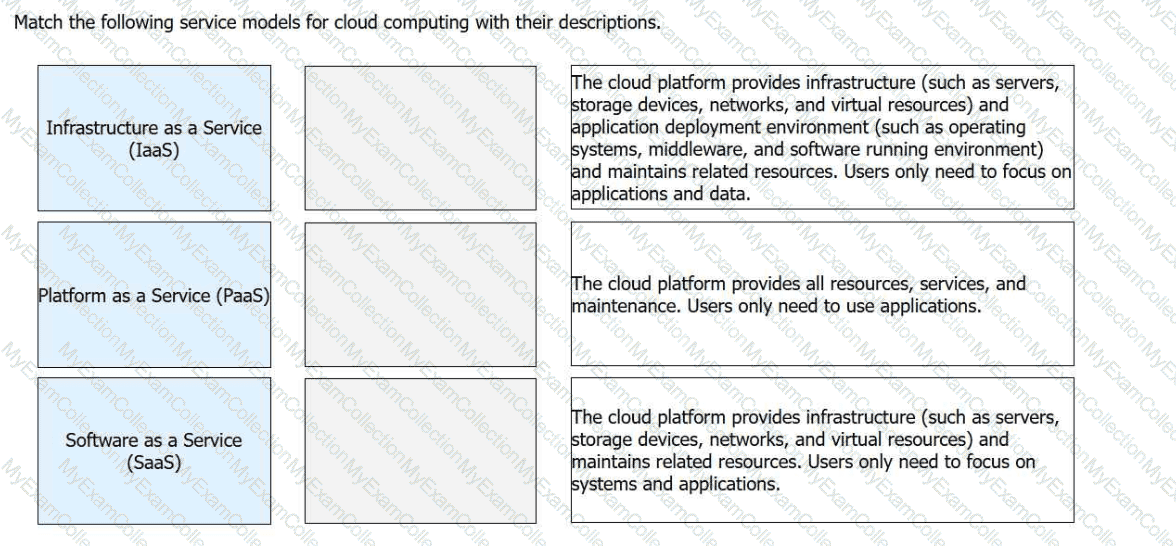
Full Access
Answer:
Answer: 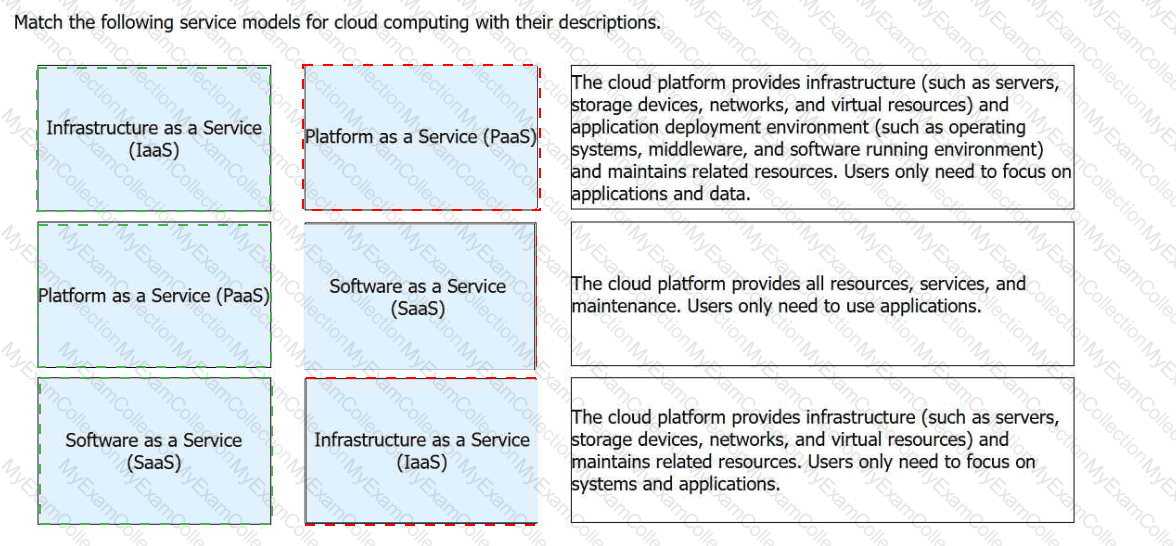
Explanation:
Service Model
Description
Infrastructure as a Service (IaaS)
The cloud platform provides infrastructure (such as servers, storage devices, networks, and virtual resources) and maintains related resources. Users only need to focus on systems and applications.
Platform as a Service (PaaS)
The cloud platform provides infrastructure (such as servers, storage devices, networks, and virtual resources) and application deployment environment (such as operating systems, middleware, and software running environment) and maintains related resources. Users only need to focus on applications and data.
Software as a Service (SaaS)
The cloud platform provides all resources, services, and maintenance. Users only need to use applications.
According to the official Huawei HCIA-Cloud Computing curriculum, cloud services are categorized into three standard models:IaaS, PaaS, and SaaS, distinguished by the boundary of responsibility between the provider and the user.
In theIaaS(Infrastructure as a Service) model, the provider is responsible for the physical and virtualized hardware resources, including compute, networking, and storage. The user retains control over the "system" level, meaning they must install and manage the operating system, middleware, and applications. This model offers the highest level of flexibility and is the foundation for Huawei's FusionCompute services.
PaaS(Platform as a Service) moves the boundary higher. The cloud platform provides not only the infrastructure but also the entire development and deployment environment. This includes the operating system, database management systems, and middleware. The user is relieved of system maintenance and only needs to focus on the "applications and data" layer. This model is ideal for developers who want to deploy software without managing the underlying server stack.
Finally,SaaS(Software as a Service) represents the highest level of abstraction. The provider manages the entire stack, from hardware to the application itself. Users simply access and "use the application" via a web browser or client. The user has no responsibility for maintenance, updates, or infrastructure scaling. Understanding these models is critical for the HCIA exam as it defines how Huawei Cloud Stack delivers different value propositions to enterprise customers.
Question # 21
Which of the following statements isfalseabout High Availability (HA) in Huawei FusionCompute?
A.
Administrators can set different HA policies for VMs based on their importance.
B.
When data is stored in shared storage, if a VM is faulty, no data will be lost.
C.
This function enables a VM to reboot if the VM encounters a failure.
D.
The system periodically detects VM status. If a VM fault caused by a CNA host failure is detected, the system automatically migrates the VM to another CNA host in the same cluster and restarts the VM, thereby quickly restoring VM services.
Full Access
Answer:
B
Explanation:
Huawei FusionComputeHigh Availability (HA)is designed to improve service continuity by automatically responding to VM or host failures.
OptionAis true. FusionCompute allows administrators to configuredifferent HA policiesfor virtual machines based on service importance, which aligns with SLA-driven management principles.
OptionCis true. One of the core functions of HA isautomatic VM rebootwhen a virtual machine encounters a failure, ensuring rapid service recovery.
OptionDis true. FusionCompute continuously monitorsCNA host and VM status. If a CNA host fails, HA triggers VM migration or restart on another available host in the same cluster, minimizing downtime.
OptionBis false. Even when usingshared storage, HAdoes not guarantee zero data loss. HA focuses onservice recovery, not data consistency. Data loss may still occur depending on application state and write operations at the time of failure.
Therefore, the false statement isB.
Question # 22
Cloud-native technologies enable organizations to build and run scalable applications in public, private, or hybrid cloud environments. Which of the following isnota representative cloud-native technology?
A.
Service mesh
B.
Virtualization
C.
Microservice
D.
Container
Full Access
Answer:
B
Explanation:
Cloud-native architecture emphasizesapplication-level design and management, focusing on agility, scalability, and resilience.
Microservices,containers, andservice meshesare core cloud-native technologies.
Virtualizationis a foundational cloud technology but belongs totraditional cloud infrastructure, not cloud-native application architecture.
Therefore, the correct answer isVirtualization.
Question # 23
Which of the following are functions of FusionCompute?
A.
Datastores support file system formats VIMS, NFS, and EXT4.
B.
Users can expand or reduce the memory capacity for online or offline VMs as needed.
C.
Storage live migration is to migrate data within a storage device or between different storage devices.
D.
VM live migration only allows VMs to migrate among hosts that share the same storage.
Full Access
Answer:
A, B, C
Explanation:
As detailed in the Huawei HCIA-Cloud Computing technical documentation, FusionCompute offers a robust suite of resource management functions. Statement A is correct: FusionCompute datastores support multiple file system formats to accommodate different storage backends. VIMS (Virtual Image Management System) is Huawei’s high-performance cluster file system used for SAN storage; NFS is used for Network Attached Storage; and EXT4 is used for local disk virtualization on a single host. This variety allows administrators to build heterogeneous storage pools.
Statement B is also a verified function. FusionCompute supports dynamic resource adjustment. Users can modify memory capacity for both offline VMs (while the VM is stopped) and online VMs (while running). Online memory expansion requires the "Hot Add" feature and Guest OS support, while reduction typically requires the VM to be in a state where the kernel can release the address space. Statement C accurately describes Storage Live Migration. This feature allows a VM's virtual disk files to be moved from one datastore to another (or within the same storage device) while the VM remains running, which is essential for storage maintenance and load balancing.
Statement D is incorrect because of the word "only." While traditional VM live migration (vMotion style) does require shared storage so that both hosts can see the same disk, modern versions of FusionCompute also support Shared-Nothing Live Migration. This technology migrates both the VM's memory state and its disk data simultaneously over the network, allowing a VM to move between hosts that do *not* share a common backend storage. Because D ignores this advanced capability, it is excluded from the list of correct functions in the context of FusionCompute's full feature set.
Question # 24
After installing infrastructure VMs, you must configure the virtualized environment and vAG/vLB so that FusionAccess can work properly. Which of the following statements aboutFusionAccess initializationaretrue?
A.
After interconnection with a Windows AD domain is configured for authentication and authorization and the local domain is not enabled, the priority of the default LiteAS authentication and authorization is lower than that of the interconnected Windows AD domain.
B.
When the vAG and vLB are used as the gateway and load balancer, related parameters of a WI cluster must be configured on FusionAccess.
C.
If the CNA node or storage device where the backup server resides is faulty, backup data may be lost. Therefore, a third-party FTP backup server is preferred on the live network.
D.
When configuring the License on FusionAccess and the License supports both per-desktop and per-user modes, you must selectUser CountorConcurrent User Count.
Full Access
Answer:
A, B, C, D
Explanation:
All four statements accurately describe keyinitialization and configuration principlesof FusionAccess:
Ais true: When Windows AD is interconnected and local authentication is disabled,AD authentication has higher prioritythan LiteAS.
Bis true: vAG/vLB deployment requires properWI cluster configurationto enable access services.
Cis true: To avoid backup data loss caused by infrastructure failures,external FTP backup serversare recommended in production networks.
Dis true: When a License supports multiple charging modes, administrators must explicitly chooseUser Count or Concurrent User Count.
Thus,all options are correct.
Question # 25
On FusionAccess policy management, match the following scenarios with their operations
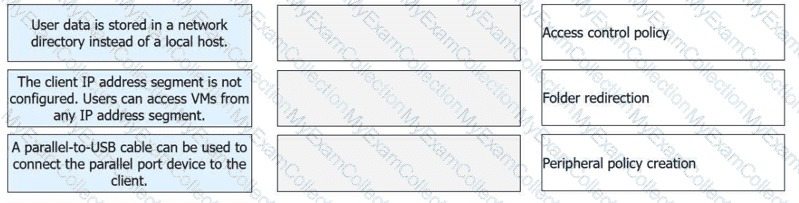
Full Access
Answer:
Answer: 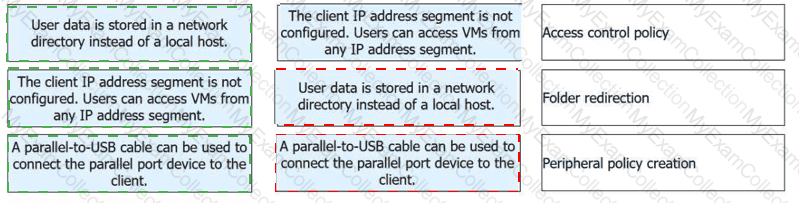
Explanation:
Scenario
Operation
User data is stored in a network directory instead of a local host.
Folder redirection
The client IP address segment is not configured. Users can access VMs from any IP address segment.
Access control policy
A parallel-to-USB cable can be used to connect the parallel port device to the client.
Peripheral policy creation
In FusionAccess, policy management allows for deep customization of the user environment.Folder redirectionis a key feature for maintaining data persistence and centralized backup. It ensures thatuser data is stored in a network directoryrather than locally on the virtual machine's disk. This prevents data loss if a VM is refreshed or deleted, which is common in linked-clone pool environments.
Access control policiesare used to define the security boundaries of the VDI environment. When theclient IP address segment is not configured, it defaults to a permissive state whereusers can access VMs from any IP segment. Administrators typically use this policy to restrict access to known corporate subnets or specific VPN ranges to enhance overall security.Peripheral policy creationprovides support for legacy hardware or specialized equipment. By configuring these policies, aparallel-to-USB cable can be usedto bridge legacy parallel port devices to the modern USB ports of the client terminal, ensuring business continuity for specialized printing or diagnostic hardware.
Question # 26
When FusionAccess is running properly, you are advised to restart infrastructure VMs once every quarter during off-peak hours. You can run the reboot command to restart Linux infrastructure VMs at the same time.
A.
TRUE
B.
FALSE
Full Access
Answer:
B
Explanation:
According to the Huawei HCIA-Cloud Computing curriculum and the FusionAccess Maintenance Guide, the statement is FALSE. While it is a recommended best practice to restart infrastructure virtual machines (VMs) approximately once every quarter to clear system cache, refresh memory resources, and ensure long-term stability, the method of execution described in the statement is incorrect and dangerous for production environments.
Infrastructure VMs in FusionAccess—such as theWI (Web Interface),HDC (Huawei Desktop Controller),ITA (IT Adapter), andGaussDB (Database)—are the "brains" of the desktop solution. Most of these components are deployed in active/standby or load-balancing pairs to ensure High Availability (HA). If an administrator were to run the reboot command on all Linux infrastructure VMs "at the same time," it would cause a complete service interruption. During this period, users would be unable to log in to their desktops, the management portal would be inaccessible, and active desktop sessions might lose their connection persistence.
The official Huawei documentation mandates astaggered restartapproach. For example, if there are two WI nodes, the administrator should restart the first node, verify it has returned to service, and only then proceed to restart the second node. This ensures that the "Service Plane" remains active at all times. Additionally, restarts should always be performed during off-peak hours to minimize the impact of the brief transition period between active and standby nodes. Therefore, while the frequency (quarterly) is correct, the instruction to restart them all simultaneously contradicts the fundamental principles of high-availability management within the Huawei ICT framework.
====================
Question # 27
Which of the following statements about Huawei FusionAccess isfalse?
A.
FusionAccess allows users to access personal desktops through thin clients (TCs), software clients (SCs), and Android/iOS mobile terminals, supporting hybrid office scenarios.
B.
FusionAccess uses the open-source Huawei Desktop Protocol (HDP) and supports 4K HD display.
C.
FusionAccess (cloud desktop) is a mature cloud computing application.
D.
FusionAccess supports the x86 + Kunpeng dual-stack architecture.
Full Access
Answer:
B
Explanation:
Huawei FusionAccess is a maturecloud desktop (VDI)solution with broad access capabilities and architecture support.
OptionsA,C, andDare all correct according to HCIA–Cloud Computing materials.
OptionBis false. Although FusionAccess usesHDP (Huawei Desktop Protocol)and supports high-resolution displays (including 4K),HDP is not open source. It is aHuawei proprietary protocoloptimized for cloud desktop scenarios.
Therefore, the false statement isB.
Question # 28
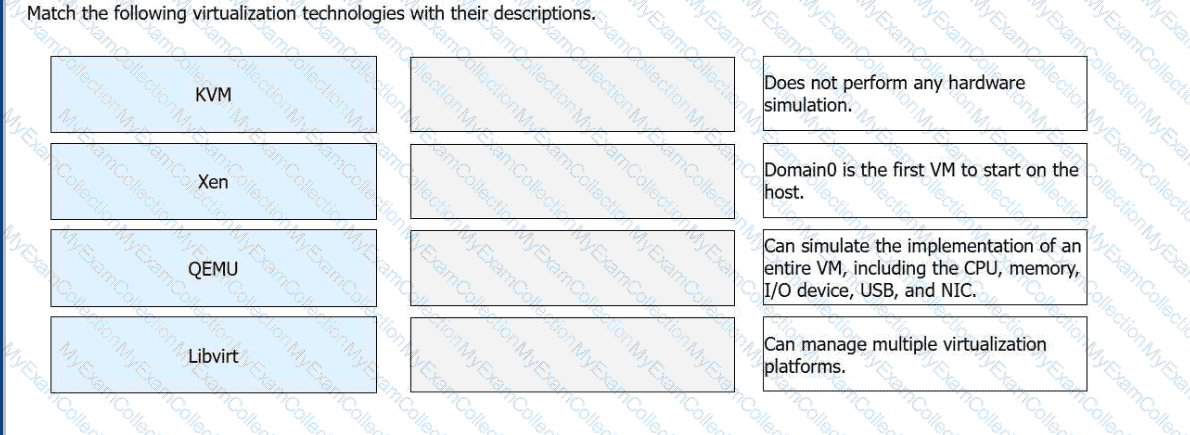
Match the following virtualization technologies with their descriptions.
Full Access
Answer:
Answer: 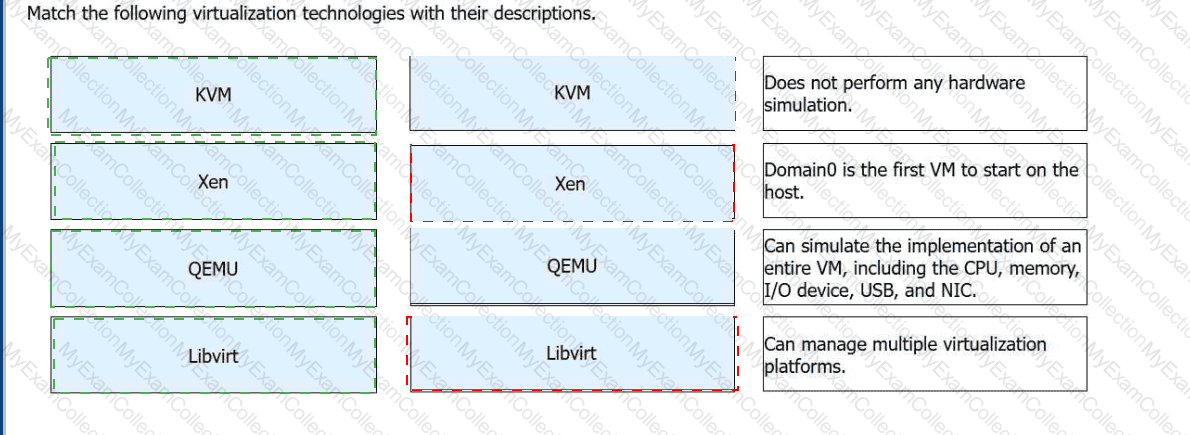
Explanation:
Virtualization Technology
Description
KVM
Does not perform any hardware simulation.
Xen
Domain0 is the first VM to start on the host.
QEMU
Can simulate the implementation of an entire VM, including the CPU, memory, I/O device, USB, and NIC.
Libvirt
Can manage multiple virtualization platforms.
Huawei's technical materials differentiate between these technologies based on their specific roles within the virtualization ecosystem.KVM (Kernel-based Virtual Machine)is an open-source module within the Linux kernel. While it provides the core virtualization capabilities for CPU and memory, it is defined in the HCIA curriculum as a technology thatdoes not perform hardware simulationitself. Instead, it typically relies on hardware-assisted virtualization or integrates with other tools to handle I/O operations.
Xenis a Type-1 hypervisor that operates directly on the hardware. A unique feature of the Xen architecture isDomain0, which is a privileged virtual machine that starts first and provides the management environment and drivers for other guest VMs (DomainU). In contrast,QEMUis a pure software-based emulator. It is powerful because itcan simulate an entire VM, including all peripherals like the CPU, NIC, and USB. However, because it relies on software simulation, its performance is lower than hardware-assisted technologies unless it is used as a backend for KVM.
Finally,Libvirtserves as the universal management layer. It is a set of open-source library functions and APIs that allow administrators tomanage multiple virtualization platforms(including KVM, Xen, and VMware) using a standardized command set. It provides transparency to upper-layer management software by abstracting the complexities of the underlying hypervisor. Understanding how these technologies interact—such as KVM utilizing Libvirt for management and QEMU for I/O—is a critical learning objective for candidates preparing for the Huawei H13-511 exam.
Question # 29
Which of the following statements isfalseabout the development of cloud computing architecture?
A.
In terms of cloud platforms and cloud management software, it has evolved from closed-source and closed architecture to open-source and open architecture.
B.
It has evolved from non-critical IT applications to critical enterprise applications.
C.
It has evolved from unstructured or semi-structured data to structured data.
D.
It has evolved from small-scale resource virtualization and integration to large-scale resource pool construction.
Full Access
Answer:
C
Explanation:
According to the HCIA–Cloud Computing curriculum, the evolution of cloud computing architecture reflects changes intechnology openness, business importance, resource scale, and data characteristics.
OptionAis correct because early cloud platforms were often proprietary and closed, while modern cloud computing architectures increasingly adoptopen-source technologies(such as OpenStack and Kubernetes) and open architectures to improve interoperability and innovation.
OptionBis also correct. Cloud computing initially hostednon-critical workloadssuch as testing, development, and backup systems. As reliability, security, and availability improved, cloud platforms became capable of supportingmission-critical enterprise applications, including ERP, financial systems, and core business services.
OptionDcorrectly describes the evolution of cloud architecture. Early virtualization focused onsmall-scale resource integration, while modern cloud computing emphasizeslarge-scale resource pools, enabling centralized management, elastic scheduling, and efficient utilization of massive compute, storage, and network resources.
OptionCisfalse. The evolution of cloud computing data has movedfrom structured data to semi-structured and unstructured data, not the other way around. With the rise of big data, IoT, social media, logs, images, and videos, cloud platforms are increasingly designed to processmassive volumes of unstructured and semi-structured data, which is a key trend emphasized in HCIA learning materials.
Question # 30
There are two types of virtual switches. FusionCompute uses ___, which can be distributed on different physical hosts and configured in a unified manner using the virtualization management tool. (Enter the abbreviation.)
Full Access
Answer:
Answer:
DVSAccording to the Huawei HCIA-Cloud Computing curriculum, specifically the "Network Technology Basics" and "FusionCompute Network Virtualization" modules, there are two primary types of virtual switches in a virtualized environment: the standard virtual switch and the Distributed Virtual Switch (DVS). The DVS is the advanced switching model used within Huawei’s FusionCompute to provide a consistent and simplified networking environment for Virtual Machines (VMs) across a cluster of physical hosts.The statement correctly identifies the DVS as the component that can be distributed across multiple physical hosts. In a traditional setup, each host would have its own local virtual switch that must be managed independently, leading to configuration inconsistencies and operational complexity as the data center scales. However, the DVS functions as a single, logical switch that spans all the hosts within a cluster. This allows administrators to perform "unified configuration" from theVRM (Virtual Resource Management)portal. When a port group or a VLAN is configured on a DVS, that configuration is automatically pushed to all theCNA (Computing Node Agent)nodes associated with that switch.This architecture is essential for advanced cloud features likeVM Live Migration. Because the DVS maintains a consistent network state (such as port IDs, VLAN tags, and security policies) across different physical servers, a VM can move from one host to another without losing its network connection or requiring a reconfiguration of its virtual NIC. The DVS effectively decouples the virtual network from the physical network hardware, allowing the logical network to "follow" the VM wherever it goes. In the Huawei ecosystem, the DVS is the cornerstone of Software-Defined Networking (SDN) at the computing layer, ensuring that large-scale virtualized networks are both manageable and resilient.
Question # 31
When deploying vLB, you can usually deploy vAG and vLB on the same VM, but you cannot deploy vLB and WI on the same VM.
A.
TRUE
B.
FALSE
Full Access
Answer:
B
Explanation:
According to the official Huawei FusionAccess component deployment guidelines, the statement is FALSE. In the Huawei HCIA-Cloud Computing V5.5 curriculum, the deployment modes for infrastructure components are highly flexible to accommodate different business scales.
In adistributed deployment(large scale), it is a best practice to keep roles separate for performance and security. However, in astandalone or small-scale deployment, Huawei explicitly supports and even provides a "vAG/vLB/WI" all-in-one template. In this scenario, theWeb Interface (WI),Virtual Access Gateway (vAG), andVirtual Load Balancer (vLB)are all co-deployed on the same Virtual Machine. This reduces the hardware resource footprint and simplifies the management of the desktop cloud for small offices or testing environments.
ThevLB (Virtual Load Balancer)is responsible for distributing traffic among multiple WI servers to ensure high availability. ThevAG (Virtual Access Gateway)handles the secure HDP protocol traffic from the terminal to the desktop VM. TheWIprovides the login portal. Because these three roles interact directly during the user's login and desktop connection phase, they are technically compatible for co-residency on a single Linux-based appliance.
While the statement correctly identifies that vAG and vLB can be co-deployed (a very common practice), it incorrectly claims that vLB and WIcannotbe co-deployed. In the HCIA exam, it is important to remember that Huawei's "Standalone" deployment mode allows for the consolidation of these specific access-layer components into a single VM to maximize resource efficiency. Therefore, the assertion that such a deployment is impossible is technically incorrect.
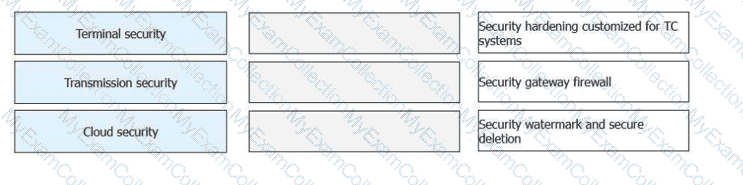
Question # 32
FusionAccess provides three protection mechanisms and 11 key measures to prevent data from being stored locally and make behaviors traceable and processes auditable, enhancing
end-to-end security. Match the key measures with the following protection mechanisms.
Full Access
Answer:
Answer: 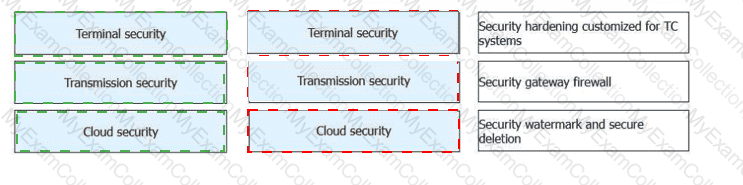
Explanation:
Terminal Security
âž¡Security hardening customized for TC systems
Focuses on endpoint protection
Prevents data from being stored locally on thin clients
Enhances terminal OS security and access control
Transmission Security
âž¡Security gateway firewall
Protects data during network transmission
Controls and filters access traffic
Prevents unauthorized access and attacks during desktop access
Cloud Security
âž¡Security watermark and secure deletion
Ensures data traceability through watermarks
Prevents data leakage
Guarantees secure deletion of cloud-side data
Question # 33
Hypervisor is the key to virtualize compute resources.7Which of the following is also called a hypervisor?
A.
VPM
B.
VRM
C.
VNM
D.
VMM
Full Access
Answer:
D
Explanation:
According to the Huawei HCIA-Cloud Computing technical documentation, the term Hypervisor is used interchangeably with Virtual Machine Monitor (VMM). The VMM is the core software component that creates the virtualization layer between the physical hardware and the Guest Operating Systems. Its primary responsibility is to abstract physical resources (CPU, Memory, I/O) and present them as logical, virtualized resources to the Virtual Machines. The VMM manages the execution of the Guest OS and ensures that different VMs remain isolated from one another on the same physical host.8
In the Huawei ecosystem, specifically within theFusionComputearchitecture, the hypervisor functionality is provided by theCNA (Computing Node Agent)node using the UVP (Universal Virtualization Platform) engine.9While "Hypervisor" is a general industry term, "VMM" specifically describes the role of monitoring and mediating the hardware requests from virtualized guests.10The other options provided are incorrect in this context:VRM (Virtual Resource Management)is the centralized management node that coordinates multiple CNA nodes but is not the hypervisor itself.VNA (Virtual Node Agent)is an agent running on the CNA node that communicates with the VRM, but it does not perform the actual hardware virtualization.
The VMM performs critical tasks such as instruction trapping and emulation.11When a Guest OS attempts to execute a "privileged instruction" that would normally interact directly with the hardware, the VMM intercepts it and executes it safely on behalf of the VM.12This ensures that a single VM cannot crash the entire physical host or access the data of another VM. Understanding that the Hypervisor and VMM are the same entity is fundamental to mastering the taxonomy of virtualization used in Huawei's ICT training and exams.
====================
Question # 34
Which of the following statements is false about concepts of virtualization?
A.
A guest OS is the OS running on a virtual machine (VM).
B.
A host machine is a physical machine.
C.
A host OS is the virtualization software layer.
D.
A guest machine is a VM.
Full Access
Answer:
C
Explanation:
In the "Virtualization Basics" section of the Huawei HCIA-Cloud Computing training material, the taxonomy of virtualization components is strictly defined. Statement C is FALSE because the virtualization software layer is technically called the Hypervisor or Virtual Machine Monitor (VMM), not the "Host OS." While a "Host OS" exists in Type-2 (hosted) virtualization (where the hypervisor runs as an application on top of an existing OS like Windows or Linux), the software layer that actually performs the resource abstraction and logical partitioning is the Hypervisor itself.
The other definitions are central to Huawei's technical documentation. AGuest OS(Statement A) is indeed the operating system—such as Windows Server or Ubuntu—that is installed inside a Virtual Machine. It is "unaware" that it is running on virtual hardware. TheHost Machine(Statement B) refers to the underlying physical server (e.g., a Huawei FusionServer Pro) that provides the actual CPU, RAM, and physical NICs. Finally, aGuest Machine(Statement D) is a synonym for a Virtual Machine (VM), representing the logical container that houses the Guest OS and applications.
In a Type-1 virtualization architecture (like HuaweiFusionCompute), the Hypervisor (CNA) sits directly on the hardware. In this scenario, there is no "Host OS" at all, further proving why statement C is incorrect. The Hypervisor is responsible for trapping "privileged instructions" from the Guest OS and translating them into actions on the physical hardware. Correctly identifying these roles—Host Machine, Hypervisor, and Guest VM—is a prerequisite for understanding more advanced cloud features like Resource Clusters and Distributed Resource Scheduling (DRS).