Question # 4
Which of the following statements about the IVS3800 are correct?
A.
Management nodes can be deployed only in cluster mode.
B.
A system containing only management nodes is allowed.
C.
A service node refers to a server that does not contain the CSPOM container.
D.
A management node refers to a server that contains the CSPOM container.
Full Access
Answer:
A, C, D
Explanation:
The correct answers are A, C, and D . In IVS3800 architecture, the distinction between management nodes and service nodes is based on whether the node carries the platform’s management container set, especially the CSPOM role. A management node is the server that contains the management component, while a service node is the server that does not contain that management component and instead focuses on service workloads. This is why C and D are correct from the node-role definition perspective.
The cluster nature of the management role is also consistent with the platform design. The training material repeatedly refers to BMU and management addressing in two-node cluster mode , for example: “If the BMU is deployed in two-node cluster mode, enter the external service floating IP address of the BMU†and similarly references external management floating IP handling for clustered upper-level nodes . This reflects that the management layer is designed around clustered high-availability deployment, supporting A . By contrast, B is not accepted because an IVS3800 system made up of only management nodes would lack the service-bearing nodes needed to deliver actual intelligent vision workloads. Therefore, A, C, and D are the correct statements.
Question # 5
The IVS3800 and CloudIVS 3000 can be deployed in the same cluster, but the CloudIVS 3000 can serve only as a service node.
A.
TRUE
B.
FALSE
Full Access
Answer:
A
Explanation:
In Huawei's intelligent video surveillance architecture, the IVS3800 and CloudIVS 3000 represent different tiers of the platform but share a compatible underlying software-defined framework. The IVS3800 is often deployed as a foundational or management node in smaller to medium-sized clusters, whereas the CloudIVS 3000 is designed for large-scale cloud-based environments. While the two systems are interoperable and can be integrated within a unified cluster environment to ensure resource sharing and centralized management, there are specific functional roles assigned to each.
Specifically, when these systems coexist in a hybrid cluster, the CloudIVS 3000 typically functions in a capacity-extension role. According to the technical deployment standards, the IVS3800 and CloudIVS 3000 can be deployed in the same cluster, but the CloudIVS 3000 can serve only as a service node . This means that while the IVS3800 can handle management tasks, database operations, and service logic, the CloudIVS 3000 nodes are primarily utilized for their heavy-duty media processing and storage capabilities (service tasks). This hierarchical arrangement allows for flexible scaling, where users can add CloudIVS nodes to increase the total channel count and storage capacity of an existing IVS3800 infrastructure without overcomplicating the management plane.
Question # 6
Match the following IVS1800 networks with their features:
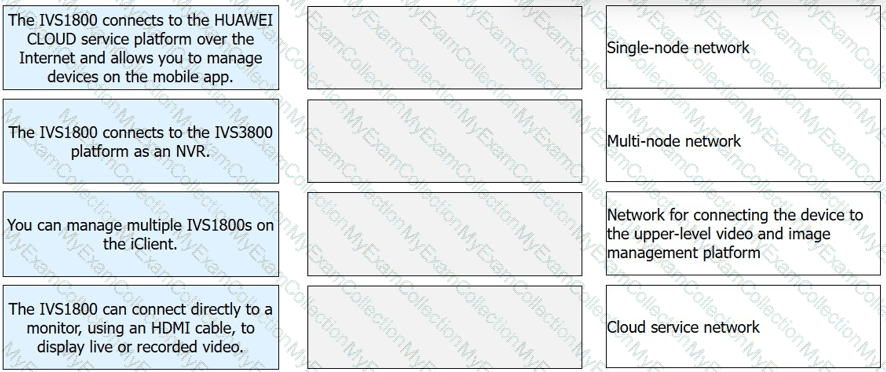
Full Access
Answer:
Answer: 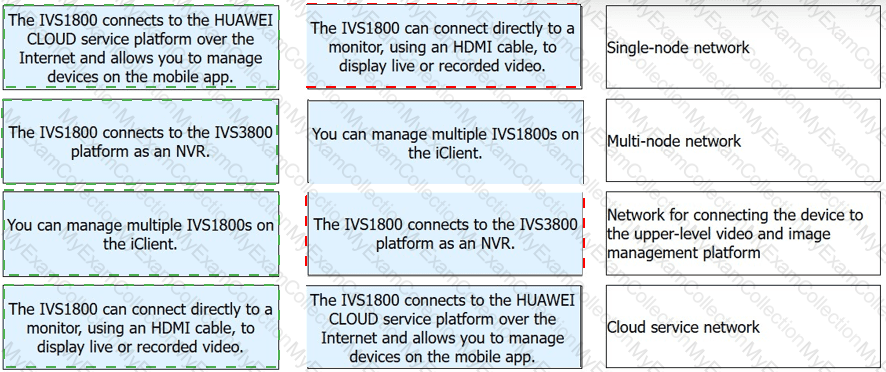
Explanation:
Cloud service network → The IVS1800 connects to the HUAWEI CLOUD service platform over the Internet and allows you to manage devices on the mobile app.
Network for connecting the device to the upper-level video and image management platform → The IVS1800 connects to the IVS3800 platform as an NVR.
Multi-node network → You can manage multiple IVS1800s on the iClient.
Single-node network → The IVS1800 can connect directly to a monitor, using an HDMI cable, to display live or recorded video.
The matching is based on the deployment role of each IVS1800 network type. The cloud service network is the mode used when the IVS1800 connects outward through the Internet to Huawei cloud services for remote device management, so it matches the feature about connection to the HUAWEI CLOUD service platform and mobile-app management. The network for connecting the device to the upper-level video and image management platform is the upstream integration path used when the IVS1800 works under a larger platform such as the IVS3800 , so that feature matches the statement about connecting to the IVS3800 platform as an NVR .
The multi-node network is intended for centralized management of multiple IVS1800 devices, which is why it matches the feature stating that multiple IVS1800s can be managed on the iClient . The single-node network is the standalone deployment model, so it matches the feature where the IVS1800 connects directly to a monitor through HDMI for local live or playback display. This mapping follows the standard Huawei deployment logic of standalone, clustered, upstream-integrated, and cloud-managed operation.
Question # 7
Which of the following measures cannot be used to protect camera cables against water?
A.
Cut off unnecessary pigtail cables.
B.
Wrap waterproof tape around the power cable.
C.
Wrap three layers of waterproof tape around cable connectors.
D.
Make a drip loop for cables.
Full Access
Answer:
A
Explanation:
The correct answer is A because cutting off unnecessary pigtail cables is not a valid waterproofing method and can actually compromise device integrity and long-term reliability. In installation practice, pigtails are retained as part of the camera’s original interface design, and the emphasis is placed on proper handling and protection , not removal. The material specifically warns that “When moving the devices, use hands and do not lift the pigtails†, which reflects that pigtails are treated as protected connection elements rather than disposable parts. It also stresses correct cable outlet orientation, for example, “The strobe light and flash light cannot be installed upside down. The cable outlet must be vertically at the bottom†, showing that water protection relies on installation method and cable routing.
From a field engineering perspective, waterproofing is achieved by sealing exposed connectors with waterproof tape, protecting cable joints thoroughly, and forming a drip loop so water flows away from the connector rather than into it. These are standard outdoor installation controls. Therefore, B, C, and D are all valid anti-water measures, while A is not.
Question # 8
To prevent light reflection, strobe lights are installed on both sides of the checkpoint camera, are more than 2 m away from the camera, and compensate light for nearby lanes.
A.
TRUE
B.
FALSE
Full Access
Answer:
B
Explanation:
The correct answer is B. FALSE . The installation guidance for strobe lights in the material focuses on orientation and illumination angle , not on a fixed rule that they must be installed on both sides of the checkpoint camera and more than 2 meters away. The document states that “Strobe light: provides light compensation at night to clearly capture license plates and pedestrians†and further emphasizes that “The strobe light and flash light cannot be installed upside down. The cable outlet must be vertically at the bottom†and “It is recommended that a certain angle be formed between the strobe light or flash light and the lane to avoid excessive exposure of license plates caused by direct illuminationâ€
This means the critical design requirement is to avoid direct reflective glare and overexposure by controlling the installation angle relative to the lane. The statement in the question adds rigid conditions such as both sides installation and a distance of more than 2 m , but those are not established in the cited training guidance. Since the PDF does not define those conditions as universal requirements, the statement is inaccurate as written.
Question # 9
Which of the following best describes the primary-secondary camera observation function also called 1 + N?
A.
One generic camera connects to multiple intelligent cameras for storage expansion.
B.
One intelligent camera connects to multiple generic cameras and performs intelligent analysis on their streams.
C.
Multiple intelligent cameras connect to one PTZ camera for panoramic tracking.
D.
One intelligent camera can only analyze its own local video stream.
Full Access
Answer:
B
Explanation:
The correct answer is B because the 1 + N function is designed to extend intelligent analysis capability to existing non-intelligent cameras without replacing them. This is one of Huawei’s practical upgrade approaches for legacy surveillance systems. The material states that “With the proprietary 1 + N technology, a single intelligent camera can connect to N generic cameras on a live network, request streams from these cameras, and perform intelligent analysis on the streamsâ€
This directly matches option B .
From a solution-design standpoint, this function is highly valuable in reconstruction projects where the existing camera network is still usable but lacks intelligent features such as target capture or vehicle recognition. Instead of replacing all cameras, one intelligent camera can act as the analysis point for several generic cameras, reducing upgrade cost and deployment complexity. Option A is wrong because the function is not for storage expansion. Option C incorrectly changes the relationship into intelligent-camera-to-PTZ cooperation. Option D is also wrong because the whole purpose of 1 + N is to analyze additional external streams, not just the local one. Therefore, B is the correct answer.
Question # 10
Which of the following issues need to be focused on during solar PV module check?
A.
Check whether the solar PV module support is corroded or rusty.
B.
Check whether the solar PV module is damaged.
C.
Check whether there are covers such as oil stains, dust, or snow on the surface of the solar PV module.
D.
Check whether the solar PV module support is stable.
Full Access
Answer:
A, B, C, D
Explanation:
The correct answers are A, B, C, and D because a proper solar PV module check must cover both the module condition and the mechanical support condition . A damaged panel can reduce charging efficiency or create safety risks. Dirt, oil stains, dust, or snow on the panel surface can block sunlight and reduce power-generation performance. At the same time, the support structure must be checked for corrosion, rust, and stability , because outdoor PV assemblies are continuously exposed to weather, vibration, and environmental aging.
This conclusion is also consistent with the overall site-power design described in the training material, where Huawei’s integrated site solution includes “PV modules: two PV modules†and uses “SolarMax, and GridMax technologies to maximize energy efficiency of solar energy and mains and provide secure and reliable power supply†. Since PV modules are part of the site power system, both energy-conversion efficiency and structural reliability must be maintained. In actual maintenance practice, a clean, intact, and firmly supported PV module is necessary for stable long-term operation. Therefore, all four listed checks are valid and should be included.
Question # 11
For a manual zoom camera, you can adjust the knob labeled N--F to ( ) and the knob labeled W--T to ( ).
A.
Adjust the focal length; adjust the focus position
B.
Adjust the focus position; adjust the focus position
C.
Adjust the focus position; adjust the focal length
D.
Adjust the focal length; adjust the focal length
Full Access
Answer:
C
Explanation:
The correct answer is C . In manual zoom lens terminology, N--F stands for Near to Far , which is the focus adjustment range, while W--T stands for Wide to Tele , which is the focal length or zoom adjustment range. This is standard optical-camera labeling and is consistent with the training material’s broader treatment of camera angle and image adjustment, where physical image tuning is performed through controlled mechanical or optical adjustment rather than through resolution changes alone. The material also shows that image framing and observation behavior depend on controlled camera adjustment, for example through tilt, horizontal, and vertical tuning during installation.
From an optical engineering standpoint, focus adjustment changes the sharpness plane of the subject, while focal length adjustment changes the field of view and magnification. Therefore, a technician first uses the W--T ring to set the desired scene scale and then uses the N--F ring to make the image sharp at the chosen distance. Since the question asks which function each labeled knob performs, N--F = adjust the focus position and W--T = adjust the focal length , making C the only correct option.
Question # 12
Which of the following operations cannot be performed when you adjust images in the web system of a PTZ dome camera?
A.
Use the virtual joystick to adjust the camera's shooting direction
B.
Switch the secondary stream type
C.
Take snapshots
D.
Perform electronic pan-tilt-zoom ePTZ operations
Full Access
Answer:
B
Explanation:
The correct answer is B because switching the secondary stream type is a stream configuration task, not an image-adjustment operation in the PTZ dome camera web interface. During image adjustment, the operator typically works with live-view and framing tools, such as directional control, local inspection, and capture assistance. That is why operations such as using a virtual joystick to move the PTZ direction, taking snapshots , and performing ePTZ for local image inspection fit naturally into image adjustment behavior.
The broader training content confirms that PTZ control belongs to live-view operation, stating that users can “perform PTZ controls … for example, control the PTZ direction, set PTZ preset positions, and set the home position†. That supports directional adjustment as a valid operation. A snapshot is also a live-view support function, while ePTZ is commonly used for image observation and local enlargement. However, secondary stream type belongs to video stream configuration, such as choosing or modifying stream properties, and is not part of direct image-adjustment handling. Therefore, the option that cannot be performed in image adjustment is B .
Question # 13
Link the following features of Huawei intelligent cameras to the corresponding description.
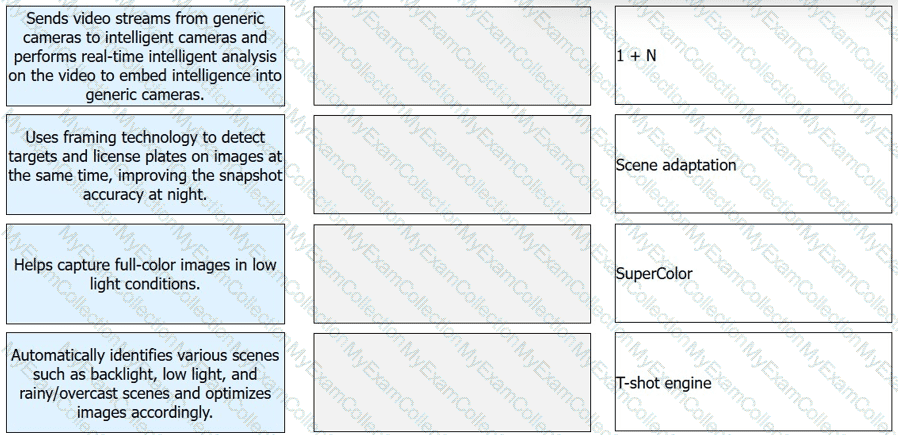
Full Access
Answer:
Answer: 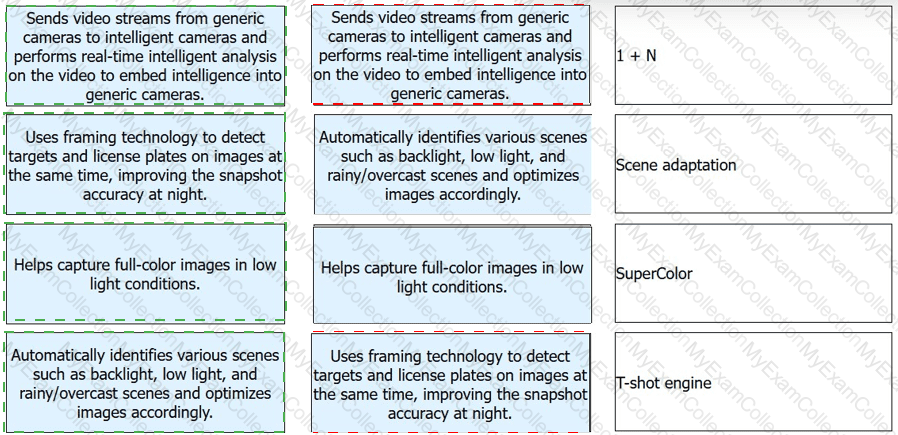
Explanation:
1 + N → Sends video streams from generic cameras to intelligent cameras and performs real-time intelligent analysis on the video to embed intelligence into generic cameras.
T-shot engine → Uses framing technology to detect targets and license plates on images at the same time, improving the snapshot accuracy at night.
SuperColor → Helps capture full-color images in low light conditions.
Scene adaptation → Automatically identifies various scenes such as backlight, low light, and rainy/overcast scenes and optimizes images accordingly.
The matching is determined directly from the intelligent camera feature definitions. The 1 + N function is the primary-secondary camera observation capability, where “a single intelligent camera can connect to N generic cameras on a live network, request streams from these cameras, and perform intelligent analysis on the streamsâ€
so it matches the description about embedding intelligence into generic cameras.
The T-shot engine corresponds to the snapshot-related description because the material states that “M-Q and X-H series omni-data structuring cameras support T-Shot snapshot engine†and explains that “T-Shot, Huawei's patented exposure technology, enables optimal imaging of targets and vehicles at the same time†. That fits target and license plate capture in the same image.
Scene adaptation matches the description about identifying backlight, low light, and rainy or overcast scenes because the material states that AI chips “identify the weather and illumination conditions at different time points in the observation scenario, and then automatically adjust the image settingsâ€
The remaining feature, SuperColor , therefore matches full-color imaging in low-light conditions.
Question # 14
What is the function of a strobe light? ( )
A.
Strobe lights are mainly used in checkpoint mode in order to illuminate vehicle interiors.
B.
Strobe lights illuminate ambient environments and vehicles/license plates at adjustable frequencies to increase the brightness and clarity of live video images and captured images.
C.
Strobe lights can connect to sensors that can detect passing vehicles and transmit detection signals to the camera.
D.
Precise speed measurement
Full Access
Answer:
B
Explanation:
The correct answer is B . The material defines the strobe light as a lighting compensation device, stating that “Strobe light: provides light compensation at night to clearly capture license plates and pedestrians†. This directly shows that the purpose of the strobe light is to improve scene illumination so that important visual targets can be captured more clearly, especially in low-light conditions. That function most closely matches option B .
From an engineering standpoint, a strobe light is used to enhance the effective brightness of the monitored area and improve the visibility of vehicles, license plates, and other targets in both live viewing and snapshot capture. The installation notes further mention that the strobe light should be angled properly relative to the lane to avoid overexposure of license plates caused by direct illumination , which confirms that its role is optical illumination rather than sensing or speed detection. Option A is more consistent with a flash light , because the material states that “Flash light: provides strong light compensation to clearly capture targets and vehicle interiors†. Options C and D describe sensor and radar-related functions, not strobe light behavior.
Question # 15
Which of the following statements is true about the video site planning and design process?
A.
Video site selection planning-Video site survey-Video site device selection planning
B.
Video site survey-Video site selection planning-Video site device selection planning
C.
Video site device selection planning-Video site selection planning-Video site survey
D.
None of the above
Full Access
Answer:
A
Explanation:
The correct answer is A because video site planning follows a logical engineering sequence: first determine where the site should be deployed, then perform a detailed site survey , and finally complete device selection planning based on the confirmed environmental and construction conditions. The material first lists typical site selection targets such as “Road intersections and entrances and exits†and “Key areas in cities†, which clearly corresponds to site selection planning. It then moves into survey items such as “Environment survey†, “Power supply†, and “Construction conditions†, showing that the survey is performed after the preliminary site location is determined and before final device planning is completed
This sequence is consistent with actual project practice. A project team cannot choose appropriate poles, anti-corrosion levels, cameras, power schemes, or transmission methods until the physical environment has been checked. For example, the survey determines whether the site is near the sea, whether mains power is stable, and whether enough construction space is available. Those findings directly affect the final device model and solution design. Therefore, the correct process is video site selection planning → video site survey → video site device selection planning .
Question # 16
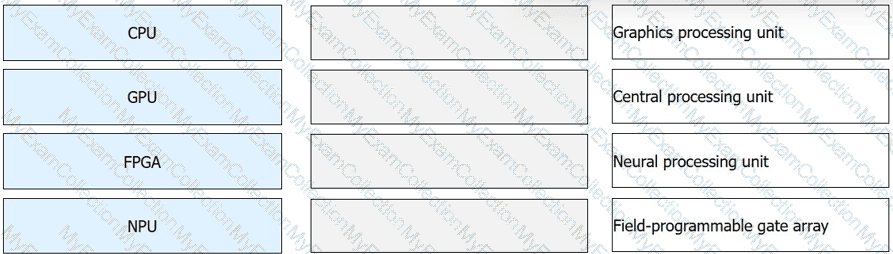
Processors are important to the Intelligent Vision system, and different processors have different functions. Link the following processor types to the corresponding description.
Full Access
Answer:
Answer: 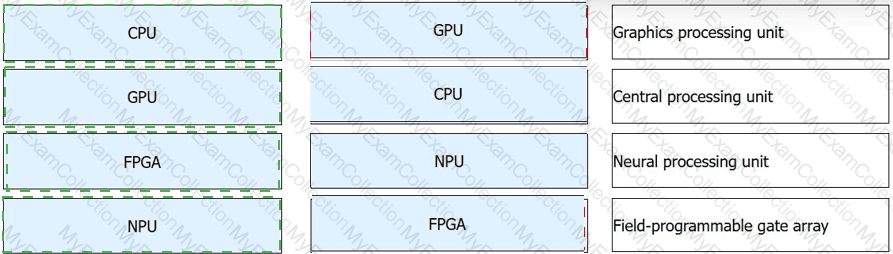
Explanation:
CPU → Central processing unit
GPU → Graphics processing unit
FPGA → Field-programmable gate array
NPU → Neural processing unit
The correct matching is based on the standard definitions of the four processor types used in intelligent vision architecture. A CPU is the central processing unit , which handles general-purpose control, logic execution, and system coordination. A GPU is the graphics processing unit , originally designed for graphics rendering but now widely used for parallel computing tasks. An FPGA is a field-programmable gate array , which can be reconfigured for specific hardware logic functions and is valuable in acceleration and low-latency processing scenarios. An NPU is a neural processing unit , specialized for AI inference and deep-learning operations.
In intelligent vision systems, these processors serve different but complementary roles. The CPU manages operating control and service orchestration. The GPU accelerates highly parallel workloads. The FPGA supports custom hardware logic and fast pipeline processing. The NPU is especially important for AI-based vision services because it is optimized for neural-network computation, target recognition, and inference efficiency. This processor division is fundamental in intelligent camera, edge, and cloud architecture, where workload specialization improves overall system performance and intelligence capability.
Question # 17
Which of the following is not an ONVIF standard?
A.
Profile B
B.
Profile T
C.
Profile A
D.
Profile S
Full Access
Answer:
A
Explanation:
The Open Network Video Interface Forum (ONVIF) provides a standardized framework for the interoperability of IP-based physical security products. These standards are organized into specific "Profiles" that define the features supported by devices and clients. Standard interfaces such as ONVIF are used to connect cameras to the IVS platform, facilitating a future-proof ecosystem where hardware from different vendors can communicate seamlessly.
Among the recognized standards, Profile S is the most common, used for basic video streaming and configuration. Profile T is a more modern standard designed for advanced video streaming, specifically supporting H.265 encoding and metadata reporting. Profile A is utilized for broader access control configurations, allowing for the integration of security management systems. Other profiles include Profile G for edge storage and Profile Q for quick installation. However, Profile B is not a recognized ONVIF standard profile. Adhering to these standardized formats ensures that recording streams can be accessed through external interfaces and that the system provides a channel for reporting metadata (structured data) for exchange with the platform, regardless of the underlying hardware differences.
Question # 18
Which of the following components constitute the Kunpeng computing industry?
A.
Software such as the operating system, database, and AI framework
B.
Hardware server
C.
Application
D.
Chip
Full Access
Answer:
A, B, C, D
Explanation:
The correct answer is A, B, C, and D because the Kunpeng computing industry is an end-to-end ecosystem rather than a single hardware product category. In the material, Kunpeng is presented not only as a processor platform, but as part of a broader ecosystem. The chip layer is evident from the discussion of processor architecture and capabilities, while the software layer is reflected where the document notes that “Kunpeng products use the following mainstream OSs: CentOS, Ubuntu, NeoKylin, Debian, Huawei EulerOS, Kylin, SUSE, and Deepin†. That directly confirms software and operating-system support as part of the industry foundation.
The hardware server layer is also intrinsic because Kunpeng processors are deployed through server products and computing infrastructure, not in isolation. On top of hardware and software, applications complete the industry chain by delivering business value in cloud, AI, and intelligent vision scenarios. In industry terminology, a computing ecosystem normally spans chips, hardware platforms, basic software, and applications , and Kunpeng follows that same structure. Therefore, all four options describe valid components of the Kunpeng computing industry, making A, B, C, and D the correct answer set.