Question # 4
Actual packet transmission rates of STAs differ greatly depending on the radio modes that STAs support and the radio environment. The airtime scheduling function allocates channel resources according to the channel-occupation time of users connected to the same radio. Each user receives equal time to occupy the channel, ensuring fairness in channel occupation. If multiple users send different packet types, airtime scheduling still takes effect.
A.
TRUE
B.
FALSE
Full Access
Answer:
B
Explanation:
Airtime fair scheduling addresses the performance imbalance created when wireless stations operate at different physical-layer transmission rates. A station transmitting at a lower PHY rate requires more channel-occupation time to transfer the same amount of data than a station operating at a higher rate. Without airtime fairness, slower stations can disproportionately consume radio resources and reduce overall WLAN throughput.
Huawei implements airtime fair scheduling by tracking the channel-occupation time of individual users and preferentially scheduling stations that have consumed less airtime. This mechanism improves fairness among users transmitting the same category of traffic.
However, the final statement in the question makes the proposition incorrect. When Wireless Multimedia Extensions (WMM) classify packets into different access categories—voice (VO), video (VI), best effort (BE), and background (BK)—airtime fairness is applied within the relevant service category, not indiscriminately across different packet types.
For example, airtime fair scheduling does not perform a common fairness comparison between one user transmitting voice packets and another transmitting video packets. Those packets are handled according to their respective traffic categories and scheduling priorities.
Therefore, FALSE is the correct answer.
Training Material reference: WLAN Optimization Solution → Configuration Optimization → Airtime Fair Scheduling. Huawei WLAN-AC Command Reference → airtime-fair-schedule enable.
────────────────────────────────────────────────────────
Question # 5
Which of the following statements are true regarding STA steering?
A.
STAs with voice or video services running are not steered.
B.
An AP steers 802.11v-capable STAs in Deauthentication mode.
C.
Before sending BTM or Deauthentication messages, an AP instructs neighboring APs to suppress association of STAs.
D.
An AP steers 802.11v-incapable STAs in BTM mode.
Full Access
Answer:
C
Explanation:
STA steering is a WLAN optimization mechanism used to influence a wireless station's AP association when a better connection candidate is available.
Huawei supports steering modes according to the station's IEEE 802.11v capabilities.
For an 802.11v-capable station, the AP uses BSS Transition Management (BTM) messages to recommend a suitable target AP. The STA can evaluate the recommendation and initiate a transition.
For a station without 802.11v support, Huawei uses deauthentication-based steering because the station cannot process BTM requests.
Consequently, options B and D reverse the correct relationship between client capabilities and steering modes.
Option C is correct. Huawei explicitly describes a mechanism in which neighboring APs are instructed to suppress Probe or Authentication responses for the STA before the steering AP sends the BTM or deauthentication message. This helps direct the client toward the preferred target AP.
Option A contradicts the wording in the supplied Huawei Training Material, which states that stations running voice or video services may also be steered.
Steering decisions must nevertheless consider service continuity, candidate AP signal quality, and the effects of handover latency.
The course also specifies a five-minute interval following association or roaming during which a STA is not steered again.
Training Material reference: WLAN Radio Resource Management → STA Steering → STA Steering Mode, PDF p. 312; AP-Based Load Balancing → Implementation of Load Balancing, p. 322.
Lab Guide reference: Lab 8 — RRM Lab → Load Balancing Configuration.
────────────────────────────────────────────────────────
Question # 6
An AP steers a STA when that STA satisfies the steering conditions. STAs running voice or video services are not steered.
A.
TRUE
B.
FALSE
Full Access
Answer:
B
Explanation:
Huawei's STA steering mechanism is designed to influence wireless client association decisions when a more suitable AP becomes available.
The mechanism evaluates whether a station satisfies configured steering conditions and then initiates an appropriate steering procedure.
Huawei distinguishes between two principal steering methods.
For stations supporting IEEE 802.11v, the AP uses BSS Transition Management (BTM) messages to recommend a neighboring AP.
For stations that do not support 802.11v, the AP uses a deauthentication-based steering mechanism to encourage the station to select another AP.
Before sending the steering message, neighboring APs can be instructed to suppress certain Probe or Authentication responses from the affected station.
The first statement in the question is correct: an AP steers a STA when the station satisfies the relevant steering conditions.
However, the second statement is inconsistent with Huawei's Training Material.
The course explicitly states that stations running voice or video services are steered.
Huawei also specifies that a station is not steered again within five minutes after it connects or completes roaming. This restriction reduces excessive repeated handovers and improves connection stability.
Therefore, the assertion that voice- or video-service stations are categorically excluded from steering is incorrect.
The complete statement is FALSE.
Training Material reference: WLAN Radio Resource Management → STA Steering → STA Steering Mode, PDF p. 312, slide 24.
────────────────────────────────────────────────────────
Question # 7
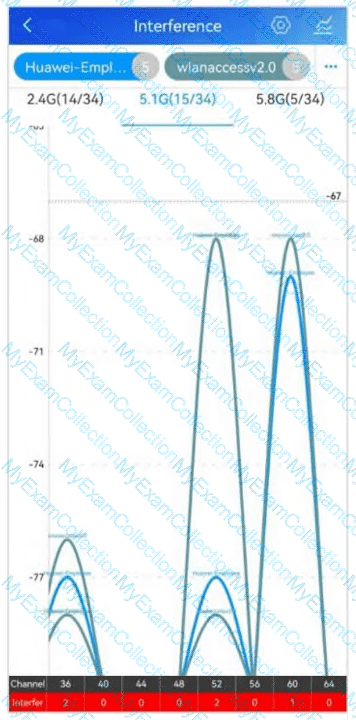
During WLAN optimization, an engineer uses the CloudCampus APP to test and identify interference from nearby wireless signals. The following figure displays the test results. Which statements are true about radio-signal interference in the current environment?
Original exhibit: Q24 Interference Exhibit
CHOOSE THREE
A.
The radio signal strength on channel 36 is high, and it is recommended that channel 36 be avoided.
B.
The current working frequency bandwidth of all channels is 20 MHz.
C.
It is recommended that set the working channel of the AP be set to 44 to reduce interference.
D.
Radio signals are mainly distributed on channels 36, 52, and 60.
Full Access
Answer:
B, C, D
Explanation:
Huawei's CloudCampus APP includes an interference-analysis function that identifies nearby wireless signals and displays their operating channels, signal strengths, and interference distribution.
The exhibit presents measurements from the 5 GHz radio environment. Three primary signal concentrations appear around channels 36, 52, and 60.
Option A is incorrect. The signals detected on channel 36 are relatively weak, approximately −76 to −78 dBm, compared with the stronger signals near channels 52 and 60, which reach approximately −68 to −69 dBm. Therefore, channel 36 is not the highest-interference channel shown.
Option B is the intended selection. The plotted channel footprints are treated as 20 MHz operating channels in the question's interpretation.
Option C is correct. Channel 44 shows no significant detected signal activity, making it a preferable candidate for avoiding the interference concentrations illustrated in the exhibit.
Option D is correct. The plotted signals are primarily concentrated around channels 36, 52, and 60.
In production, channel selection must also consider regulatory restrictions, channel utilization, neighboring AP configurations, and the selected channel bandwidth.
Training Material reference: WLAN Network Optimization Overview and Tools → CloudCampus APP → Interference Analysis, PDF pp. 840–842; WLAN Radio Resource Management → Wi-Fi Interference, pp. 293–295.
────────────────────────────────────────────────────────
Question # 8
In a network with Huawei's CloudCampus Solution deployed, an AP cannot come online on iMaster NCE-Campus. Which of the following could cause this issue?
CHOOSE THREE
A.
The AP is not switched to the cloud mode.
B.
AP information added on the cloud management controller is incorrect leading to a registration failure.
C.
The network between the AP and cloud management platform is disconnected.
D.
The CAPWAP source IP address is not configured on the AP.
Full Access
Answer:
A, B, C
Explanation:
Huawei's CloudCampus architecture enables cloud-managed APs to register with iMaster NCE-Campus for centralized configuration, monitoring, and network management.
Successful AP onboarding requires the device to operate in the correct management mode, possess appropriate registration information, and maintain IP connectivity to the management platform.
Option A is correct. An AP not operating in cloud mode cannot complete the required cloud-management onboarding process. The device must first be switched to the appropriate operating mode.
Option B is correct. Incorrect device registration information can cause onboarding failure. Huawei identifies problems involving missing device ESNs, incorrect site assignments, and unauthorized device information as possible registration failure causes.
Option C is correct. The AP must communicate with the cloud management platform. Routing failures, disconnected interfaces, DNS problems, or inaccessible controller ports may prevent registration.
Option D is incorrect. Configuring a CAPWAP source IP address is associated with traditional WAC-based CAPWAP operation, not the cloud AP registration requirement described in this question.
Huawei recommends using display cloud-mng info to inspect management configuration and display cloud-mng online-fail-record in diagnostic view to identify onboarding failure reasons.
Therefore, the correct selections are A, B, and C.
Training Material reference: WLAN Troubleshooting → Cloud Management Faults → Flowchart and Procedure for Troubleshooting Onboarding Failures of Cloud WACs and APs, PDF pp. 972–975.
Lab Guide reference: Lab 4 — Cloud Management Networking → Device Registration and Verification.
────────────────────────────────────────────────────────
Question # 9
A VLAN pool can be configured to supply service VLANs. Which of the following statements about a VLAN pool is false?
A.
If the VLAN assignment algorithm is set to hash and a STA goes online multiple times, the STA is preferentially assigned the IP addresses it uses previously.
B.
Configuring a VLAN pool to provide service VLANs can reduce the number of STAs in each VLAN and also the size of the broadcast domain.
C.
If the VLAN assignment algorithm is set to even and a STA goes online multiple times, the STA obtains different IP addresses each time.
D.
Nonexistent VLANs cannot be added to a VLAN pool.
Full Access
Answer:
D
Explanation:
VLAN pools allow a Huawei WAC to distribute wireless users across multiple service VLANs instead of assigning every station associated with an SSID to a single VLAN. This reduces the concentration of users in an individual broadcast domain and improves address allocation scalability.
Huawei supports two primary VLAN assignment algorithms: hash and even.
Under hash assignment, the controller uses the station's MAC address to determine its service VLAN. Provided the pool membership remains unchanged, a returning station is ordinarily assigned the same VLAN and preferentially obtains its previous IP address. Therefore, option A is correct.
Under even assignment, VLAN selection follows the order in which stations connect. Repeated associations can result in different VLAN assignments and IP addresses, supporting option C. Option B correctly describes the scalability advantage of VLAN pooling.
Option D is false because Huawei permits an administrator to reference a VLAN ID in a VLAN pool even when the corresponding VLAN has not yet been created.
However, the configuration does not make the nonexistent VLAN operational. The administrator must subsequently create that VLAN and ensure the required forwarding path is configured; otherwise, traffic associated with it cannot function correctly.
Training Material reference: WLAN Networking Technologies → VLAN Pool Configuration → VLAN Assignment Algorithms. Huawei WLAN-AC Command Reference → vlan in VLAN Pool View.
────────────────────────────────────────────────────────
Question # 10
When using the CloudCampus APP to run a speed test, the Internet speed test cannot be performed if the radio signal associated with the current STA cannot access the Internet.
A.
TRUE
B.
FALSE
Full Access
Answer:
A
Explanation:
Huawei's CloudCampus APP provides speed-testing functions for evaluating network transmission performance from a connected wireless terminal.
The application supports two different categories of speed testing: Internet speed testing and intranet speed testing.
An Internet speed test requires the station to communicate with an externally accessible testing destination. This communication depends on correct wireless association, IP address assignment, gateway reachability, routing, DNS resolution where required, and Internet access.
If the associated WLAN does not provide Internet connectivity, the application cannot successfully communicate with the external testing service over that connection. As a result, an Internet speed measurement cannot be completed.
However, this limitation does not necessarily prevent all network-performance testing.
Huawei also provides intranet speed testing, which measures communication performance between the wireless terminal and a reachable internal network destination.
When Internet connectivity is unavailable but local network access remains operational, engineers can still perform internal network-delay measurements and intranet throughput testing.
This distinction is useful during troubleshooting because it helps separate wireless access or LAN performance problems from upstream Internet connectivity faults.
Huawei's Training Material explicitly distinguishes Internet and intranet speed tests within the CloudCampus APP.
Therefore, the statement is TRUE when the test is performed using the currently associated WLAN connection.
Training Material reference: WLAN Network Optimization Overview and Tools → CloudCampus APP → Network Module: Speed Test, PDF pp. 841–842.
────────────────────────────────────────────────────────
Question # 11
Which of the following factors must be considered and validated during signal coverage design for a WLAN planning project?
CHOOSE THREE
A.
AP antenna selection
B.
Per-user bandwidth
C.
AP deployment positions
D.
Signal attenuation caused by obstacles
Full Access
Answer:
A, C, D
Explanation:
WLAN signal coverage design determines whether the wireless network can deliver sufficient received signal strength throughout the required service areas.
Huawei's planning methodology evaluates coverage according to the effective coverage range of individual APs, attenuation caused by obstacles, AP installation positions, and antenna characteristics.
Option A is correct. Antenna selection affects the direction, gain, beamwidth, and distribution of transmitted radio signals. An unsuitable antenna may produce coverage gaps or excessive signal leakage.
Option C is correct. AP deployment positions determine the geometric relationship between transmitting radios and intended coverage areas. Poor positioning can introduce coverage holes, excessive cell overlap, or unnecessary interference.
Option D is correct. Building materials such as concrete, brick, glass, and metal attenuate RF signals. Huawei emphasizes that attenuation must be considered when estimating coverage boundaries and determining AP quantities.
Option B is not part of the specific signal-coverage design factors requested. Per-user bandwidth belongs primarily to WLAN capacity design, which determines aggregate throughput requirements, concurrent users, and the AP resources required to satisfy application demand.
Huawei explicitly separates signal coverage analysis from capacity design within the WLAN planning workflow.
Therefore, the correct selections are A, C, and D.
Training Material reference: WLAN Planning Process → Planning and Design → Signal Coverage Analysis and Signal Coverage Design Rules, PDF pp. 458–459.
Lab Guide reference: Lab 9 — Indoor WLAN Planning → Coverage Requirements and AP Deployment.
────────────────────────────────────────────────────────
Question # 12
APs may be deployed either automatically or manually in WLAN Planner. In most scenarios, manual AP deployment is recommended. Automatic AP deployment applies only to certain scenarios with simple structures.
A.
TRUE
B.
FALSE
Full Access
Answer:
A
Explanation:
Huawei WLAN Planner supports both automatic and manual AP deployment as part of the wireless network design process. The selection of the deployment method depends on the physical structure of the environment, wireless coverage requirements, installation restrictions, and the complexity of the proposed network.
Automatic AP deployment is primarily intended for environments with relatively simple structures and predictable coverage requirements. The tool uses the defined planning area, floor drawings, obstacle information, and coverage parameters to determine suitable AP positions. Although this mechanism can accelerate initial network design, its results must still be evaluated against actual implementation requirements.
Manual deployment offers greater control over AP placement. Engineers can select installation positions according to room layouts, wall attenuation, ceiling heights, expected user density, interference sources, and available cabling infrastructure.
For complex environments, manual deployment generally produces more practical designs because the engineer can incorporate deployment constraints that may not be adequately represented by automated placement calculations.
Following AP placement, WLAN Planner can calculate channel assignments, perform power calibration, and simulate wireless coverage. These capabilities allow engineers to refine the proposed design before physical installation.
Huawei's training material explicitly recommends manual deployment for most scenarios and reserves automatic deployment for simpler network structures.
Training Material reference: WLAN Planning Tools → WLAN Planner → Network Planning Procedure → Deploy Devices.
────────────────────────────────────────────────────────
Question # 13
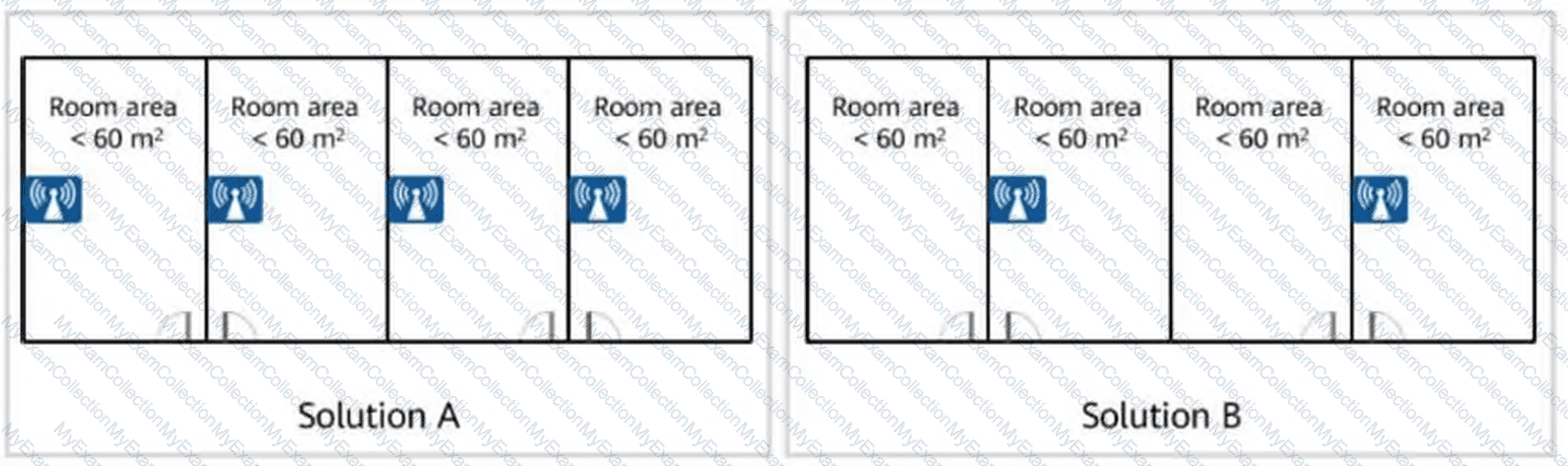
During WLAN planning and design for hospital wards and consultation rooms, two planning solutions are proposed, as illustrated. Which of the following statements are correct for selecting a solution in this scenario?
Original exhibit: Q55 Enlarged Exhibit
CHOOSE TWO
A.
If the walls between rooms are gypsum walls, solution Ð’ is recommended, where one AP or RU is ceiling-mounted to cover two rooms.
B.
If the walls between rooms are brick walls, solution A is recommended, where one wall plate AP or RU is ceiling-mounted in each room.
C.
If the walls between rooms are gypsum walls, solution Ð’ is recommended, where one AP or RU is wall-mounted to cover two rooms.
D.
If the walls between rooms are brick walls, solution A is recommended, where one wall plate AP or RU is wall-mounted in each room.
Full Access
Answer:
A, D
Explanation:
Healthcare WLAN planning must account for the construction materials separating wards and consultation rooms because obstacle attenuation significantly affects achievable wireless coverage.
Huawei's Training Material presents two deployment solutions corresponding to different wall structures.
Solution A is intended for rooms separated by brick walls or other materials producing relatively high signal attenuation. In this arrangement, a wall-plate AP or agile distributed RU is installed in each room to provide independent wireless coverage.
The illustrated installation method is wall mounting. Therefore, option D is correct.
Solution B is intended for rooms separated by gypsum boards, foam partitions, or other materials with lower attenuation characteristics. In this arrangement, one AP or RU can cover two adjacent rooms.
The recommended installation method for Solution B is ceiling mounting, making option A correct.
Option B is incorrect because it identifies ceiling mounting rather than the wall-mounted installation shown for Solution A.
Option C is incorrect because it identifies wall mounting rather than ceiling mounting for Solution B.
Huawei additionally recommends positioning APs or RUs away from room doors to improve coverage distribution and reduce interference between adjacent coverage areas.
The correct selections are therefore A and D.
Training Material reference: WLAN Planning Scenarios → WLAN Planning in Healthcare Scenarios → WLAN Deployment Solution for Wards and Consulting Rooms, PDF p. 652, slide 25.
Lab Guide reference: Lab 9 — Indoor WLAN Planning → AP Placement and Coverage Design.
────────────────────────────────────────────────────────
Question # 14
In a network running Huawei's CloudCampus Solution, all APs are managed by iMaster NCE-Campus. Users experience STA roaming failures and worsening WLAN service quality. Which of the following can cause STA roaming failures in cloud AP scenarios?
CHOOSE THREE
A.
Cloud APs are deployed at different sites.
B.
Inter-AP roaming is disabled on iMaster NCE-Campus.
C.
No mobility group is established between cloud APs.
D.
Cloud APs have gone online in NAT mode.
Full Access
Answer:
A, C, D
Explanation:
Successful roaming between Huawei cloud-managed APs requires the participating APs to satisfy specific management, mobility-group, and network connectivity conditions. Although iMaster NCE-Campus manages the APs centrally, controller management alone does not guarantee that inter-AP roaming will operate correctly.
Option A is correct. Huawei's cloud AP roaming design requires the relevant APs to belong to the same site. APs configured under different sites do not support the expected roaming relationship.
Option C is correct. Cloud APs must establish the required mobility-group relationship. Without that relationship, they cannot establish the inter-AP mobility connectivity necessary for supported roaming operations.
Option D is correct. Huawei identifies cloud AP onboarding through NAT as a potential cause of roaming failures. NAT can interfere with the connectivity and addressing relationships required between participating APs.
Option B is not one of the specified causes in Huawei's cloud AP roaming troubleshooting procedure.
Engineers should first verify site membership and then inspect mobility-group establishment using display wlan wmg mobility-group. Huawei indicates that a State value of 2 represents a successfully established inter-AP roaming link.
If the mobility relationship fails, engineers should check AP-to-AP reachability, NAT deployment, and whether the APs can discover suitable neighbors.
Training Material reference: WLAN Troubleshooting → Cloud Management Faults → Flowchart and Procedure for Troubleshooting STA Roaming Failures in Cloud AP Scenarios.
────────────────────────────────────────────────────────
Question # 15
In roaming scenarios, because of individual differences, some STAs do not roam to APs with stronger signals and instead remain connected to the initially associated APs, even if they are disconnected. These STAs might not initiate association requests again after disconnection. To resolve this problem, the WAC directly takes these sticky STAs offline.
A.
TRUE
B.
FALSE
Full Access
Answer:
B
Explanation:
A sticky STA is a wireless client that continues associating with its original AP despite the availability of another AP offering better signal quality.
This behavior commonly occurs when client roaming algorithms prioritize maintaining the existing association rather than selecting the strongest available connection.
Sticky STAs may experience low transmission rates, excessive retransmissions, increased packet loss, and poor application performance. They may also consume disproportionate channel airtime, affecting other users.
Huawei addresses this problem through smart roaming, which enables the network infrastructure to identify poorly connected stations and initiate steering toward suitable neighboring APs.
The WAC evaluates reported information, including signal-to-noise ratio, access rate, and neighboring AP conditions.
For STAs supporting IEEE 802.11v, steering can use BSS Transition Management mechanisms.
For STAs lacking 802.11v support, the WAC instructs the currently associated AP to disconnect the sticky STA and delivers appropriate blacklist information to influence the subsequent association process.
Therefore, the WAC coordinates the steering procedure rather than directly disconnecting the wireless client independently of the AP.
The question also inaccurately suggests that a STA can remain associated after its association has already been disconnected.
These technical inaccuracies make FALSE the correct selection.
Training Material reference: WLAN Networking Technologies → WLAN Roaming → Sticky STAs in Mobility Scenarios, PDF pp. 273–274; Smart Roaming Process, pp. 279–282.
────────────────────────────────────────────────────────
Question # 16
In Portal authentication scenarios, when no trusted security certificate is installed on the Portal server, the authentication page is not displayed automatically on an STA.
A.
TRUE
B.
FALSE
Full Access
Answer:
B
Explanation:
Huawei identifies certificate-related problems as a possible cause of Portal authentication pages failing to appear automatically, particularly on Apple iOS terminals.
However, the Training Material specifies important conditions that are absent from this question.
The documented scenario involves a Portal server delivering its authentication page through HTTPS without a valid certificate issued by a trusted Certificate Authority (CA). Under those circumstances, iOS devices may refuse to display the authentication page automatically because certificate validation cannot establish trust in the server.
Huawei explains that iOS devices use the Captive Network Assistant (CNA) mechanism to detect captive portals and initiate user authentication.
The absence of a trusted certificate does not independently establish that automatic Portal display must fail on every STA. For example, the Training Material explicitly identifies changing authentication-page delivery from HTTPS to HTTP as a possible corrective action.
Other operating systems and captive-portal implementations may also behave differently.
Therefore, the statement is overgeneralized when applied to all Portal authentication scenarios, making FALSE the defensible answer as written.
Training Material reference: User Access and Authentication → Portal Authentication → Portal Authentication Issue (3/3): iOS Terminals Not Automatically Displaying an Authentication Page, PDF p. 228.
Lab Guide reference: Lab 6 — Portal Authentication, §6.2–6.3.
────────────────────────────────────────────────────────