Pre-Summer Sale Special - Limited Time 70% Discount Offer - Ends in 0d 00h 00m 00s - Coupon code: mxmas70

Home > Fortinet > Fortinet Certified Solution Specialist > FCSS_NST_SE-7.6

FCSS_NST_SE-7.6 Fortinet NSE 6 - Network Security 7.6 Support Engineer Question and Answers

Question # 4

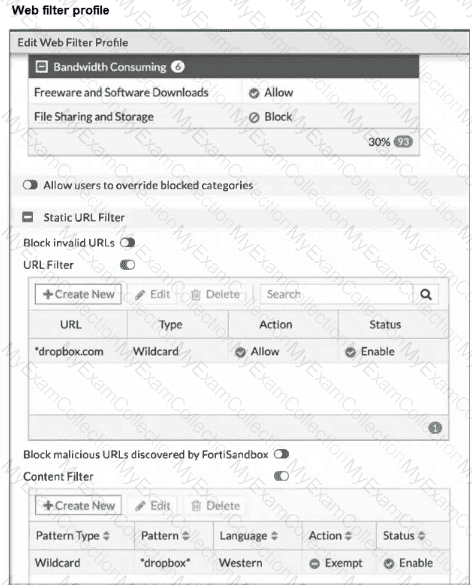
While troubleshooting a FortiGate web filter issue, users report that they cannot access any websites, even though those sites are not explicitly blocked by any web filter profiles that are applied to firewall policies.

What are the three most likely reasons for this behavior? (Choose three answers)

A.

The web filter cache has been cleared causing all websites to take longer to be rated.

B.

The SSL/TLS deep inspection was configured but the browsers do not have the FortiGate certificate installed.

C.

The webfilter-force-off setting has been enabled under config system fortiguard.

D.

The DNS server is unreachable, preventing URL resolution.

E.

The FortiGuard Web Filtering license has expired, causing FortiGate to apply the default block action.

Full Access
Question # 5

During which phase of IKEv2 does the Diffie-Helman key exchange take place?

A.

IKE_Req_INIT

B.

Create_CHILD_SA

C.

IKE_Auth

D.

IKE_SA_INIT

Full Access
Question # 6

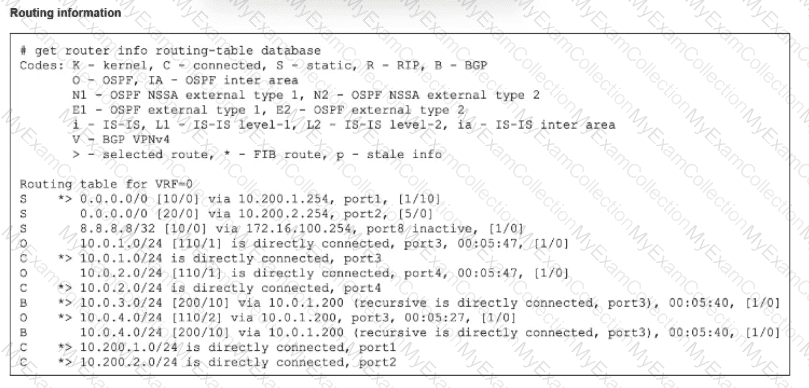
Refer to the exhibit.

The modified output of live routing kemel is shown

Which two statements about the output are (rue? (Choose two.)

A.

The BGP route to 10.0.4.0/24 is not in the forwarding information base.

B.

The default static route through 10.200.1 254 is in the forwarding information base.

C.

FortiGate is performing ECMP using both default static routes.

D.

The local FortiGate is receiving only one LSA from one OSPF neighbor.

Full Access
Question # 7

Refer to the exhibit, which shows the output of a diagnose command.

What two conclusions can you draw from the output shown in the exhibit? (Choose two answers)

A.

This is an expected session created by the IPS engine.

B.

Traffic in the original direction (coming from the IP address 10.171.121.38) will be routed to the next-hop IP address 10.0.1.10.

C.

Traffic in the original direction (coming from the IP address 10.171.121.38) will be routed to the next-hop IP address 10.200.1.1.

D.

This is a pinhole session created to allow traffic for a protocol that requires additional sessions to operate through FortiGate.

Full Access
Question # 8

Refer to the exhibit, which shows the modified output of the routing kernel.

Which statement is true?

A.

The egress interface associated with static route 8.8.8.8/32 is administratively up.

B.

The default static route through 10.200.1.254 is not in the forwarding information base.

C.

The default static route through port2 is in the forwarding information base.

D.

The BGP route to 10.0.4.0/24 is not in the forwarding information base.

Full Access
Question # 9

What can cause an IKEv2 tunnel to go down after it was initially brought up successfully?

A.

A mismatched proposal was detected during the IKE_AUTH exchange.

B.

A mismatched Diffie-Hellman group was detected during the IKE_SA_INIT exchange.

C.

A mismatched pre-shared key was detected during the IKE_AUTH exchange.

D.

Mismatched quick-mode selectors were detected during the CREATE_CHILD_SA exchange.

Full Access
Question # 10

Refer to the exhibit.

Which two statements about the output are true, considering NGFW-1 and NGFW-2 have been up for a week? (Choose two.)

A.

If FGVM...649 is rebooted, FGVM...650 will become the primary FortiGate and retain that role, even after FGVM...649 rejoins the cluster.

B.

If port7 becomes disconnected on the secondary FortiGate, both FortiGate devices will elect themselves as primary.

C.

If a configuration change is made to the secondary FortiGate, the Configuration Status will not change.

D.

If a configuration change is made to the primary FortiGate at this time, the secondary will initiate a synchronization reset.

Full Access
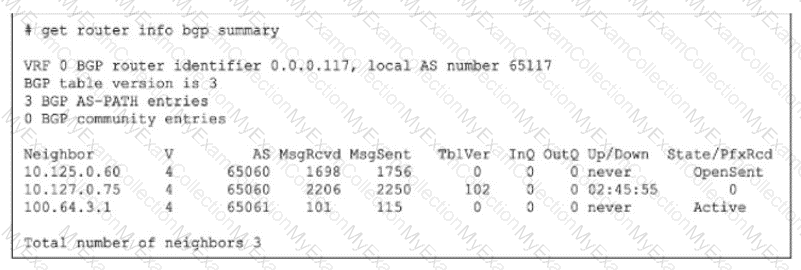
Question # 11

Refer to the exhibit.

The output of a BGO debug command is shown.

What is the most likely reason that the local FortiGate is not receiving any prefixes from its neighbors?

A.

The local router is waiting for the keepalive message from the router 10.125.0.60.

B.

None of the three neighbors has successfully established the TCP three-way handshake with the local router.

C.

The router 100.64.3.1 is waiting for the OPEN message from the local router.

D.

The RIB-OUT configuration for router 10.127.0.75 prevents any route advertisement to the local router.

Full Access
Question # 12

Refer to the exhibit, which shows the partial output of a diagnose command.

Which two conclusions can you draw from the output shown in the exhibit? (Choose two.)

A.

FortiGate will drop the expected traffic if it does not arrive within 23 seconds.

B.

Clearing the master session has no impact on the expectation session.

C.

This is a pinhole session to allow traffic for a TCP protocol that dynamically assigns TCP ports.

D.

The session is checked against firewall policy ID 25.

Full Access
Question # 13

Refer to the exhibit.

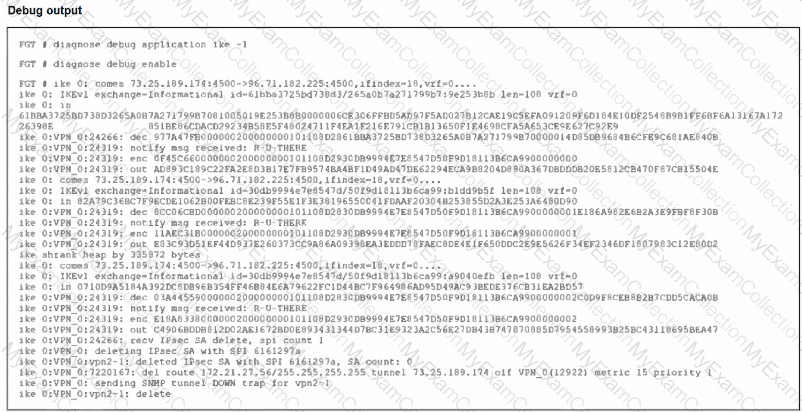
An IPsec VPN tunnel using IKEv2 was brought up successfully, but when the tunnel rekey takes place the tunnel goes down.

The debug command for IKE was enabled and, in the exhibit, you can review the partial output of the debug IKE while attempting to bring the tunnel up.

What is causing. The tunnel to be down?

A.

A Diffie-Hellman mismatch

B.

Blocked traffic on UDP port 500

C.

A mismatch m the Phase 1 negotiations

D.

A mismatch in the Phase 2 negotiations

Full Access
Question # 14

Refer to the exhibit, which shows the output of get router info bgp summary.
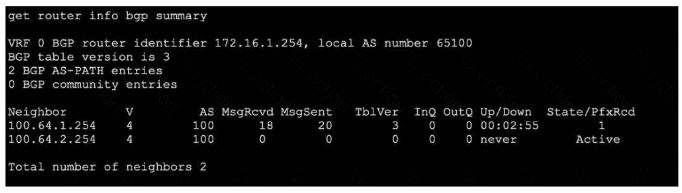
Which two statements are true? (Choose two.)

A.

The local ForliGate has received one prefix from BGP neighbor 100.64.1.254.

B.

The TCP connection with BGP neighbor 100.64.2.254 was successful.

C.

The local FortiGate has received 18 packets from a BGP neighbor.

D.

The local FortiGate is still calculating the prefixes received from BGP neighbor 100.64.2.264

Full Access
Question # 15

Refer to the exhibit, which shows the output of a real-time debug. Which statement about this output is true? (Choose one answer)

A.

The server hostname was extracted from the SNI in the client request, or from the CN in the server certificate.

B.

FortiGate found the requested URL in its local cache.

C.

This web request was inspected using the ftgd-allow web filter profile.

D.

The requested URL belongs to category ID 255.

Full Access
Question # 16

Refer to the exhibit.

Which route will traffic take to get to the 100.65.0.0/24 network considering the routes are all configured with the same distance?

A.

The BGP route

B.

The policy route

C.

The static route

D.

The OS PF route

Full Access
Question # 17

Refer to the exhibits.

FGT-1 is an area border router (ABR) that has interfaces in OSPF areas 0.0.0.0 and 0.0.0.5. FGT-3 acts as an autonomous system border router (ASBR), importing static routes into OSPF. FGT-2 is an internal router with all its interfaces belonging to area 0.0.0.5. FGT-1 is receiving all advertised routes from FGT-2, however, FGT-3 is not receiving any of the advertised routes from FGT-1. What is the most likely reason for this? (Choose one answer)

A.

Area 0.0.0.5 is configured not to propagate type 5 LSAs.

B.

FGT-2 is configured with a distribution list to block all advertised routes from FGT-3.

C.

FGT-3 and FGT-2 have not formed an OSPF adjacency yet.

D.

IP protocol 89 is blocked between FGT-1 and FGT-3.

Full Access
Question # 18

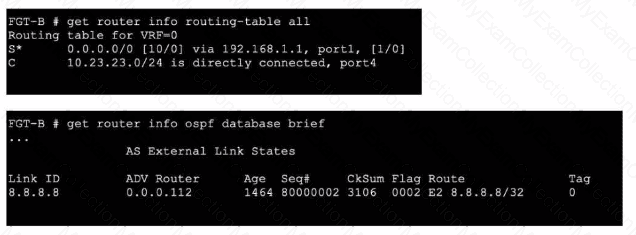
Refer to the exhibit, which shows partial outputs from two routing debug commands.

Which change must an administrator make on FortiGate to route web traffic from internal users to the internet, using ECMP?

A.

Set snat-route-change to enable.

B.

Set the priority of the static default route using port2 to 1.

C.

Set preserve-session-route to enable.

D.

Set the priority of the static default route using port1 to 10.

Full Access
Question # 19

Refer to the exhibit, which shows the output of a policy route table entry.

Which type of policy route does the output show?

A.

An ISDB route

B.

A regular policy route

C.

A regular policy route, which is associated with an active static route in the FIB

D.

An SD-WAN rule

Full Access
Question # 20

A VPN tunnel is up. To monitor traffic flow, the administrator enters the following CLI commands on an SSH session on FortiGate:

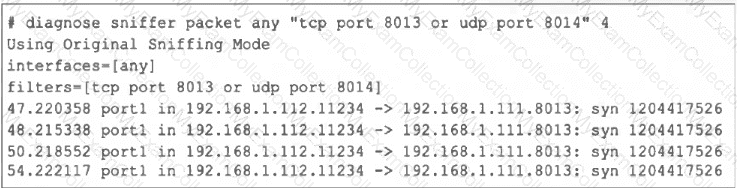
# diagnose debug enable

# diagnose sniffer packet any ' udp and port 500 ' 4

However, the sniffer does not show any output. Assuming default configuration values, what are two possible reasons there is no output? (Choose two answers)

A.

The filter should be modified to also capture packets for TCP port 443 or UDP port 4500 .

B.

NAT Traversal is enabled.

C.

The sniffer must be restricted to the remote peer IP address.

D.

The sniffer output will be ignored because running diagnose debug enable shows only application real-time debugs.

Full Access
Question # 21

Exhibit.

Refer to the exhibit, which shows the output of diagnose automation test.

What can you observe from the output? (Choose two.)

A.

The automation stitch test is not being logged.

B.

The automation stitch test failed but the HA failover was successful.

C.

An HA failover occurred.

D.

The test was unsuccessful.

Full Access
Question # 22

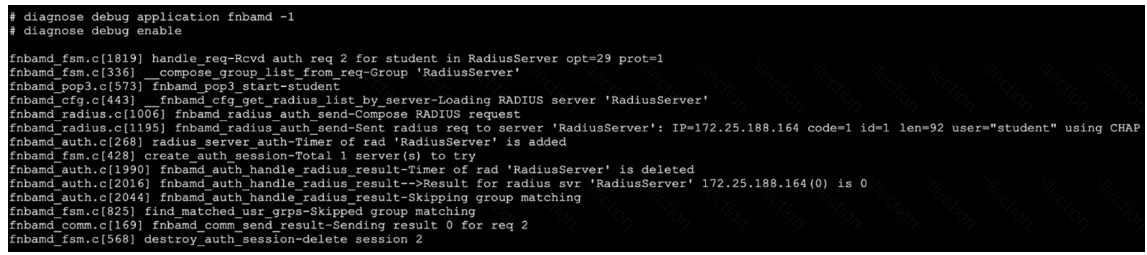
Refer to the exhibit showing a debug output.

An administrator deployed FSSO in DC Agent Mode but FSSO is failing on FortiGate. Pinging FortiGate from where the collector agent is deployed is successful.

The administrator then produces the debug output shown in the exhibit.

What could be causing this error message?

A.

The TCP port 445 is blocked between FortiGate and collector agent.

B.

The collector agent preshared password is mismatched.

C.

The FortiGate cannot resolve the active directory server name.

D.

The FortiGate and the collector agent are using different TCP ports.

Full Access
Question # 23

Which two observations can you make from the output? (Choose two.)

A.

The configuration was backed up

B.

A high availability (HA) failover occurred.

C.

The lest was unsuccessful.

D.

The automation stitch test is not being logged.

Full Access
Question # 24

What is the correct order of the IKEv2 request-and-response protocol?

A.

Create_Child_SA, IKEAUTH, IKESAJNIT

B.

Create_Child_SA, IKE_SA_INIT. IKE_AUTH

C.

IKE SA INIT, IKE AUTH. Create Child SA OIKE AUTH.

D.

IKE_AUTH_IKE_SA_INIT, Create_Child_SA

Full Access
Question # 25

Consider the scenario where the server name indication (SNI) does not match either the common name (CN) or any of the subject alternative names (SAN) in the server certificate. Which two actions will FortiGate take when using the default settings for SSL certificate inspection? (Choose two answers)

A.

FortiGate uses the SNI from the user ' s web browser.

B.

FortiGate does not decrypt the traffic if the traffic is blocked by the web filter profile.

C.

FortiGate uses the CN information from the Subject field in the server certificate.

D.

FortiGate does not decrypt the traffic if the traffic is allowed by the web filter profile.

Full Access
Question # 26

Which three common FortiGate-to-collector-agent connectivity issues can you identify using the FSSO real-time debug? (Choose three.)

A.

Log is full on the collector agent.

B.

Inability to reach IP address of the collector agent.

C.

Refused connection. Potential mismatch of TCP port.

D.

Mismatched pre-shared password.

E.

Incompatible collector agent software version.

Full Access
Question # 27

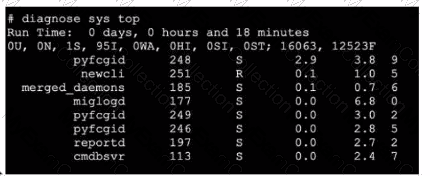
Refer to the exhibit.

Which three pieces of information does the diagnose sys top command provide? (Choose three.)

A.

The miglogd daemon is running on CPU core ID 0.

B.

The diagnose sys top command has been running for 18 minutes.

C.

The miglogd daemon would be on top of the list, if the administrator pressed m on the keyboard.

D.

The cmdbsvr process is occupying 2.4% of the total user memory space.

E.

If the neweli daemon continues to be in the R state, it will need to be manually restarted.

Full Access
Question # 28

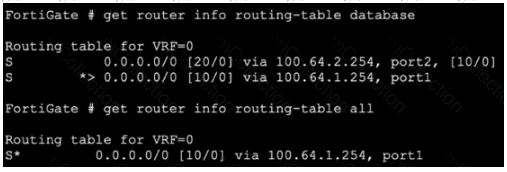
Refer to the exhibit, which shows a partial output from the get router info routing-table database command.

The administrator wants to configure a default static route for port3 and assign a distance of 50 and a priority of 0.

What will happen to the port1 and port2 default static routes after the port3 default static route is created?

A.

The port2 default static route will be injected into the forwarding information base (FIB).

B.

The port1 default static route will be injected into the FIB.

C.

Neither of the routes shown in the output will be injected into the FIB.

D.

Both default static routes shown in the output will be injected into the FIB.

Full Access
Question # 29

Refer to the exhibit.

A partial output from an IKE real-time debug is shown

The administrator does not have access to (he remote gateway

Based on the debug output, which two conclusions can you draw? (Choose two.)

A.

The remote peer is the initiating peer.

B.

This is a phase1 negotiation.

C.

There is a Diffie-Hellman group mismatch.

D.

This is a phase2 negotiation

Full Access
Question # 30

Refer to the exhibit.

Partial output of diagnose sys session stat command is shown.

An administrator has noticed unusual behavior from FortiGate. It appears that sessions are randomly removed. Which two reasons could explain this? (Choose two.)

A.

FortiGate is deleting sessions because the kernel cannot allocate more memory pages

B.

FortiGate is dropping all TCP sessions with incomplete three-way handshakes.

C.

FortiGate is not accepting sessions because the device has been down 10 out of 120 seconds.

D.

FortiGate is flushing sessions because of high memory usage.

Full Access
Question # 31

Which three common FortiGate-to-collector-agent connectivity issues can you identify using the FSSO real-time debug? (Choose three.)

A.

The SSL certificate used for FSSO over SSL has expired.

B.

The connection was refused. There may be a mismatch of the TCP port.

C.

FortiGate cannot reach the IP address of the collector agent.

D.

The pro-shared key does not match

E.

The group filters do not match.

Full Access
Question # 32

Refer to the exhibit.

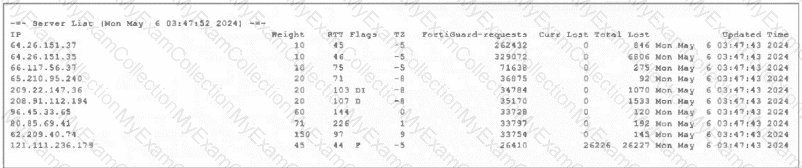
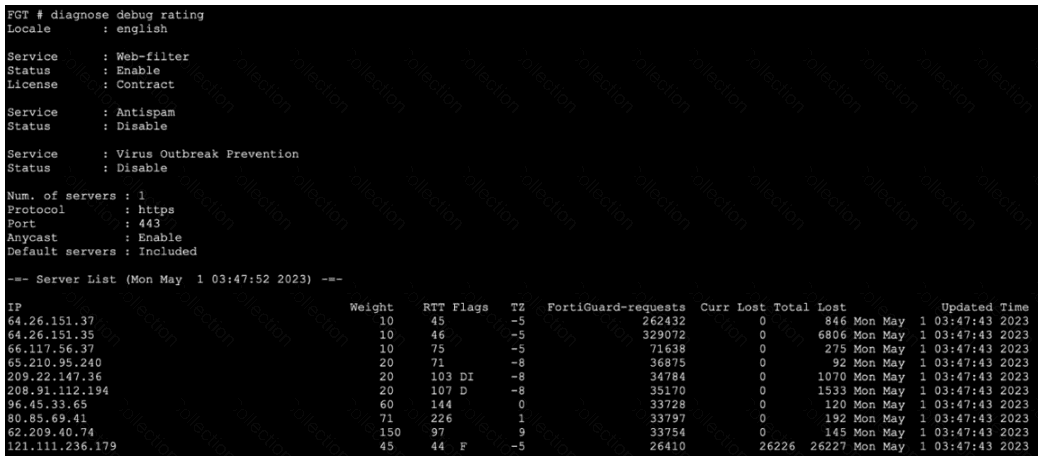
Partial output of command diagnose debug rating is shown. Which FDS server will the FortiGate algorithm choose?

A.

96.45.33.65

B.

208.91.112.194

C.

64.26.151.37

D.

209.22.147.36

Full Access
Question # 33

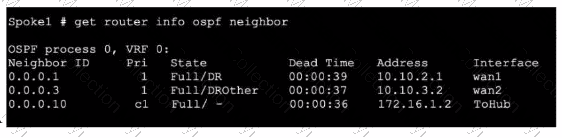
Refer to the exhibit, which shows the output of a debug command.

Which two statements about the output are true? (Choose two.)

A.

The interlace is part of the OSPF backbone area.

B.

There are a total of five OSPF routers attached to the vorz4 network segment

C.

One of the neighbors has a router ID of 0.0.0.4.

D.

In the network connected to port4, two OSPF routers are down.

Full Access
Question # 34

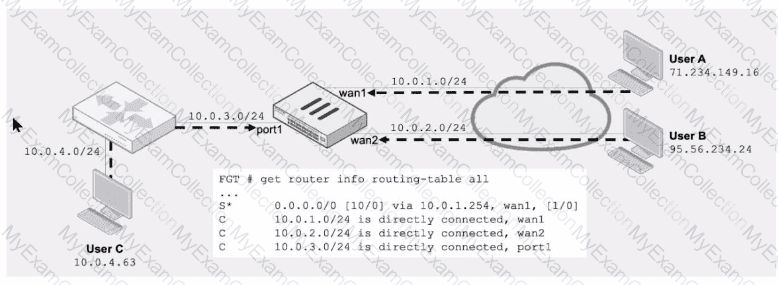
Refer to the exhibit, which a network topology and a partial routing table.
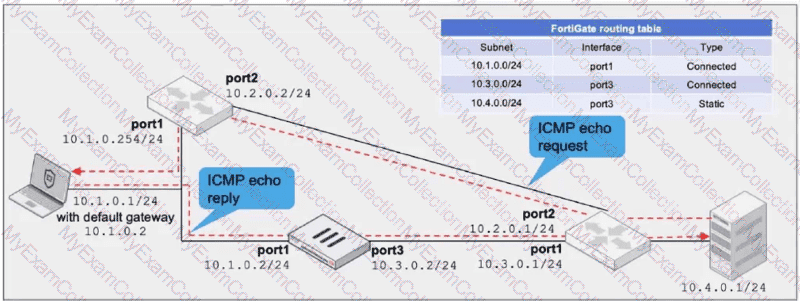
FortiGate has already been configured with a firewall policy that allows all ICMP traffic to flow from port1 to port3.

Which changes must the administrator perform to ensure the server at 10.4.0.1/24 receives the echo reply from the laptop at 10.1.0.1/24?

A.

Enable asymmetric routing under config system settings.

B.

Change the configuration from strict RPF check mode to feasible RPF check mode.

C.

A firewall policy that allows all ICMP traffic from port3 to port1.

D.

Modify the default gateway on the laptop from 10.1.0.2 to 10.2.0.2.

Full Access
Question # 35

Refer to the exhibit.

An administrator has configured a firewall policy to use proxy-based inspection mode. What could explain the messages observed in the debug flow output?

A.

At least one protocol port under Protocol Options has been mapped to Any.

B.

SSL deep inspection is not configured.

C.

The FTP protocol has not yet been mapped to port 211 under Protocol Options.

D.

FortiGate does not have enough free memory to perform proxy-based inspections.

Full Access
Question # 36

What are two reasons that an OSPF router does not have any type 5 tank-state advertisements (LSAs) In its link-stale database (LSD6)? (Choose two.)

A.

There is no autonomous system border router (ASBR) in the network,

B.

The peer of the local router is using a prefix-list-out. configuration to prevent all type 5 LSAs to be advertised.

C.

The local router is located in a stub area

D.

IP protocol 89 is blocked between the local router and its peer.

Full Access
Question # 37

Refer to the exhibit, which shows the output of diagnose sys session list.

If the HA ID for the primary device is 0, what happens if the primary fails and the secondary becomes the primary?

A.

The secondary device has this session synchronized; however, because application control is applied, the session is marked dirty and has to be re-evaluated after failover.

B.

Traffic for this session continues to be permitted on the new primary device after failover, without requiring the client to restart the session with the server.

C.

The session will be removed from the session table of the secondary device because of the presence of allowed error packets, which will force the client to restart the session with the server.

D.

The session state is preserved but the kernel will need to re-evaluate the session because NAT was applied.

Full Access
Question # 38

Refer to the exhibit, which shows the output of a BGP debug command.
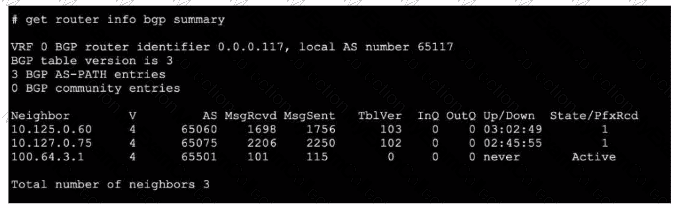
What can you conclude about the router in this scenario?

A.

The router 100.64.3.1 needs to update the local AS number in its BGP configuration in order to bring up the 8GP session with the local router.

B.

An inbound route-map on local router is blocking the prefixes from neighbor 100.64.3.1.

C.

All of the neighbors displayed are part of a single BGP configuration on the local router with the neighbor-range set to a value of 4.

D.

The BGP session with peer 10.127.0.75 is up.

Full Access
Question # 39

Refer to the exhibit.

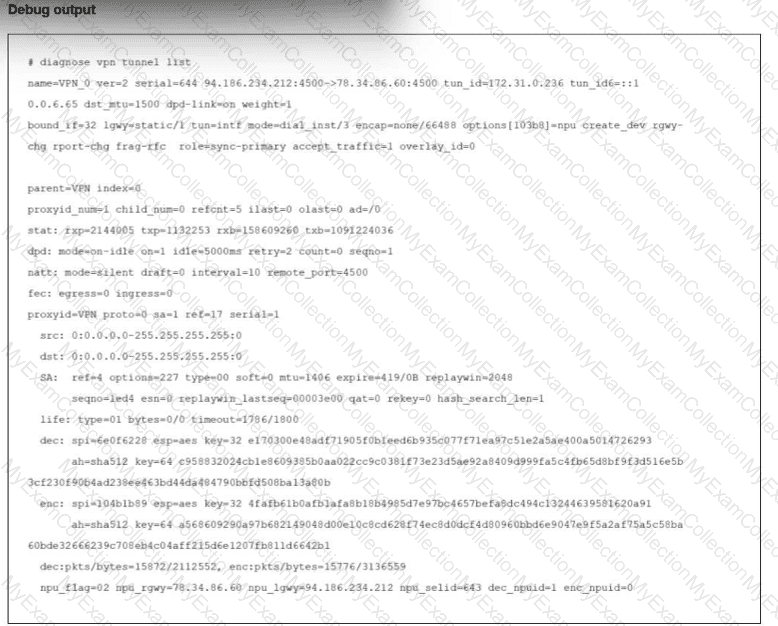
Partial output of the get vpn ipsec tunnel details command is shown. Based on the output, which two statements are correct? (Choose two.)

A.

The npu_flag for this tunnel is 02.

B.

Different SPI values are a result of auto-negotiation being disabled for phase2 selectors.

C.

The npu_flag for this tunnel is 03.

D.

Anti-replay is enabled.

Full Access