Question # 4
Refer to the exhibit, which shows a network diagram showing the addition of site 2 with an overlapping network segment to the existing VPN IPsec connection between the hub and site 1.
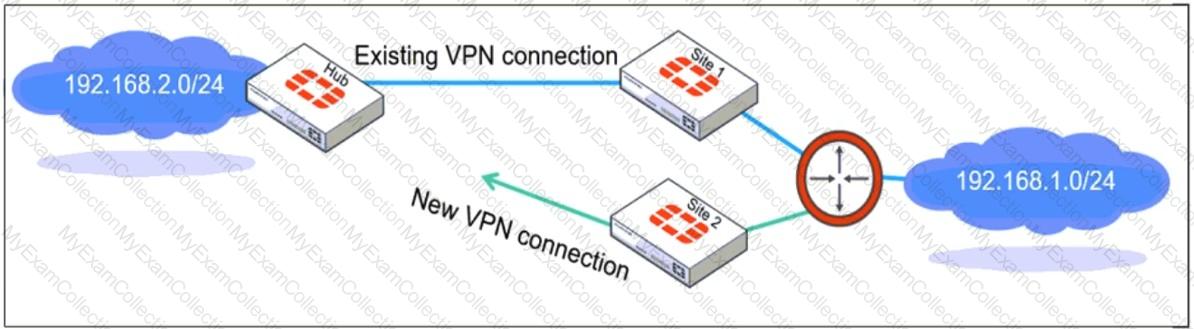
Which IPsec phase 2 configuration must an administrator make on the FortiGate hub to enable equal-cost multi-path (ECMP) routing when multiple remote sites connect with overlapping subnets?
Question # 5
Refer to the exhibits.
The system administrator settings configured on a root FortiGate and the Security Fabric settings configured on a downstream FortiGate are shown.
When prompted to sign in with Security Fabric to the downstream FortiGate, a user enters the single sign-on (SSO) provider credentials.
What is the result?
Question # 6
Which three approaches can successfully deploy advanced initial configurations?
Question # 7
Refer to the exhibit.
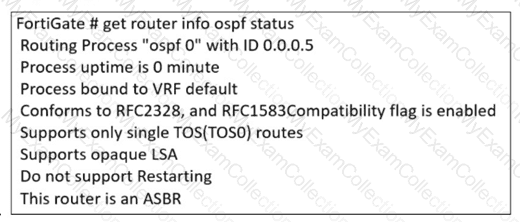
The partial output of an OSPF command is shown. You are checking the OSPF status of a FortiGate device when you receive the output shown in the exhibit. Based on the output, which two statements about FortiGate are correct? (Choose two answers)
Question # 8
A FortiGate device with UTM profiles is reaching the resource limits, and the administrator expects the traffic in the enterprise network to increase.
The administrator has received an additional FortiGate of the same model.
Which two protocols should the administrator use to integrate the additional FortiGate device into this enterprise network? (Choose two.)
Question # 9
Refer to the exhibit, which shows an OSPF network.
Which configuration must the administrator apply to optimize the OSPF database?
Question # 10
A company that acquired multiple branches across different countries needs to install new FortiGate devices on each of those branches. However, the IT staff lacks sufficient knowledge to implement the initial configuration on the FortiGate devices.
Which three approaches can the company take to successfully deploy advanced initial configurations on remote branches? (Choose three.)
Question # 12
Refer to the exhibits.
A policy package conflict status and information from the import device wizard in the Core1 VDOM are shown. When you import a policy package, the following message appears for the Web_restrictions web filter profile and the deep-inspection SSL-SSH profile: " The following objects were found having conflicts. Please confirm your settings, then continue. " The Web_restrictions and deep-inspection profiles are used by other FortiGate devices within FortiManager. Which step must you take to resolve the issue? (Choose one answer)
Question # 13
Refer to the exhibit.
A pre-run CLI template that is used in zero-touch provisioning (ZTP) and low-touch provisioning (LTP) with FortiManager is shown.
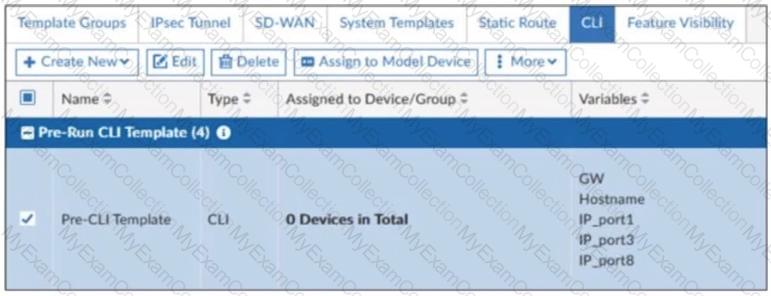
The template is not assigned even though the configuration has already been installed on FortiGate.
What is true about this scenario?
Question # 14
A vulnerability scan report has revealed that a user has generated traffic to the website example.com (10.10.10.10) using a weak SSL/TLS version supported by the HTTPS web server.
What can the firewall administrator do to block all outdated SSL/TLS versions on any HTTPS web server to prevent possible attacks on user traffic?
Question # 17
How can you automate updates to firewall policies using a daily updated IP block list?
Question # 18
Refer to the exhibit, which shows an enterprise network connected to an internet service provider.
The administrator must configure the BGP section of FortiGate A to give internet access to the enterprise network.
Which command must the administrator use to establish a connection with the internet service provider?
Question # 19
Refer to the exhibit, which shows a partial troubleshooting command output.
An administrator is extensively using IPsec on FortiGate. Many tunnels show information similar to the output shown in the exhibit.
What can the administrator conclude?
Question # 20
Refer to the exhibit, which shows the ADVPN network topology and partial BGP configuration.
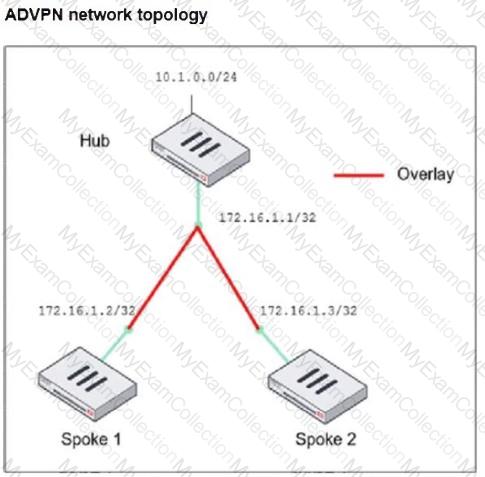
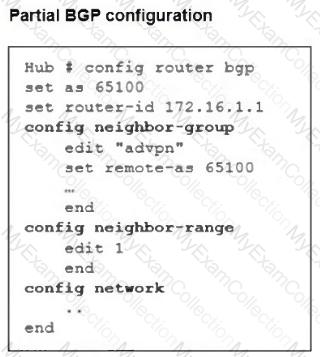
Which two parameters must an administrator configure in the config neighbor range for spokes shown in the exhibit? (Choose two.)
Question # 21
Refer to the exhibit, which shows a physical topology and a traffic log.
The administrator is checking on FortiAnalyzer traffic from the device with IP address 10.1.10.1, located behind the FortiGate ISFW device.
The firewall policy in on the ISFW device does not have UTM enabled and the administrator is surprised to see a log with the action Malware, as shown in the exhibit.
What are the two reasons FortiAnalyzer would display this log? (Choose two.)
Question # 22
An administrator must enable direct communication between multiple spokes in a company ' s network. Each spoke has more than one internet connection.
The requirement is for the spokes to connect directly without passing through the hub, and for the links to automatically switch to the best available connection.
How can this automatic detection and optimal link utilization between spokes be achieved?
Question # 25
An administrator is checking an enterprise network and sees a suspicious packet with the MAC address e0:23:ff:fc:00:86.
What two conclusions can the administrator draw? (Choose two.)
Question # 26
You applied a block-all intrusion prevention system (IPS) profile for client and server targets to secure the server but the database team reported that applications stopped working immediately after.
How can you apply IPS in a way that ensures it does not disrupt existing applications in the network?
Question # 27
The IT department discovered during the last network migration that all zero phase selectors in phase 2 IPsec configurations impacted network operations.
What are two valid approaches to prevent this during future migrations? (Choose two.)
Question # 28
Refer to the exhibit, which shows an enterprise network connected to an internet service provider.
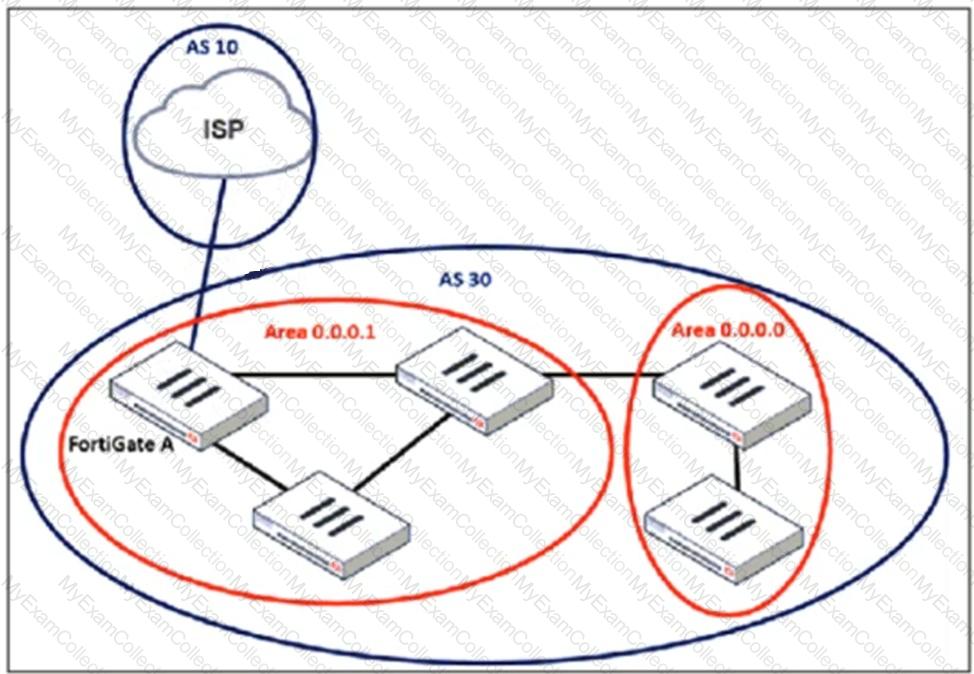
An administrator must configure a loopback as a BGP source to connect to the ISP.
Which two commands are required to establish the connection? (Choose two.)
Question # 29
Refer to the exhibit, which shows the FortiGuard Distribution Network of a FortiGate device.
FortiGuard Distribution Network on FortiGate
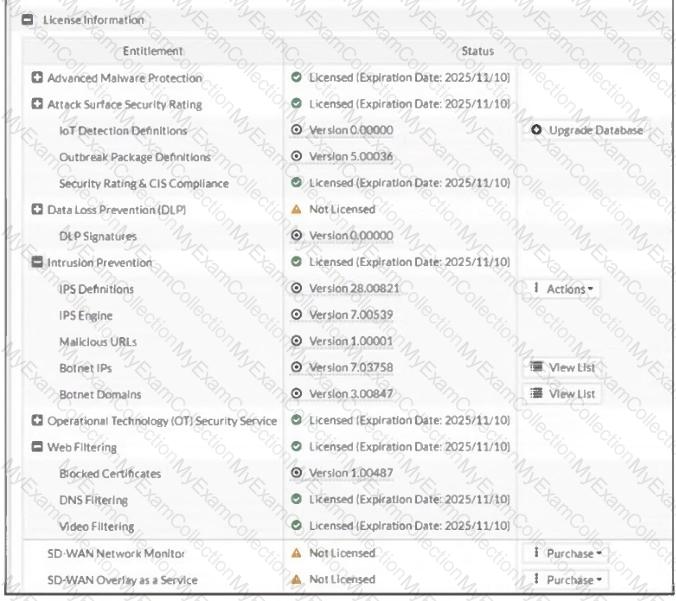
An administrator is trying to find the web filter database signature on FortiGate to resolve issues with websites not being filtered correctly in a flow-mode web filter profile.
Why is the web filter database version not visible on the GUI, such as with IPS definitions?
Question # 30
An administrator configured the FortiGate devices in an enterprise network to join the Fortinet Security Fabric. The administrator has a list of IP addresses that must be blocked by the data center firewall. This list is updated daily.
How can the administrator automate a firewall policy with the daily updated list?
Question # 31
Refer to the exhibit, which shows the VDOM section of a FortiGate device.
An administrator discovers that webfilter stopped working in Core1 and Core2 after a maintenance window.
Which two reasons could explain why webfilter stopped working? (Choose two.)
Question # 32
Refer to the exhibit, which contains a partial command output.
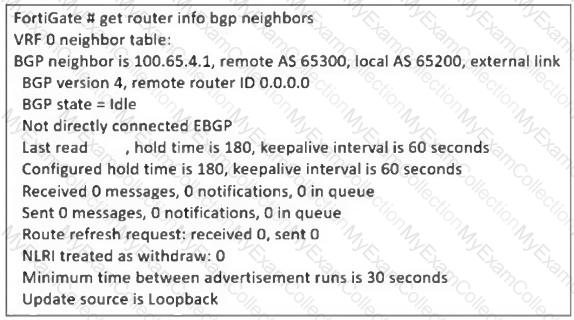
The administrator has configured BGP on FortiGate. The status of this new BGP configuration is shown in the exhibit.
What configuration must the administrator consider next?
Question # 33
A company ' s guest internet policy, operating in proxy mode, blocks access to Artificial Intelligence Technology sites using FortiGuard. However, a guest user accessed a page in this category using port 8443.
Which configuration changes are required for FortiGate to analyze HTTPS traffic on nonstandard ports like 8443 when full SSL inspection is active in the guest policy?