Question # 4
Which of the following conditions would most likely result in pulmonary edema? Select the two correct options.
Question # 6
While responding to an emergency, a car is tailgating the ambulance. Which of the following actions should the EMT take?
Question # 7
A 44-year-old patient with diabetes feels weak and dizzy. The EMT provides oral glucose and transports the patient to the hospital, where the patient recovers. The EMT tells their partner they did not provide the patient with a blanket because they felt the patient was wasting their time. What best describes the action the EMT took?
Question # 9
A 67-year-old patient is unresponsive, and an EMT checks for a pulse prior to applying an AED. Which of the following screenable rhythms, ventricular fibrillation or ventricular tachycardia, if either, may still produce a pulse in this patient?
Question # 10
A 78-year-old patient has chest pain that began upon awakening. The vital signs are BP 92/72 mmHg, P 82/min, R 22/min, and SpOâ‚‚ 88% on room air. Which of the following actions should the EMT perform? Select the three answer options that are correct.
Question # 11
A 67-year-old patient reports crushing chest pressure. The vital signs are BP 156/98, P 64, R 14, and SpO2 94%. What treatments should the EMT provide first? Select the two correct options.
Question # 12
An 84-year-old patient becomes dyspneic, feels faint, and develops blurred vision when going from sitting to standing. When at rest, the patient ' s symptoms resolve. The vital signs are BP 188/90, P 78, R 20, and SpOâ‚‚ 93% on room air. Which of the following causes is the patient ' s most likely presentation?
Question # 13
You have achieved ROSC (Return of Spontaneous Circulation) in a 77-year-old female. She remains unresponsive and her vital signs are BP 94/58, P 82, and R 18. In what position should she be placed?
Question # 14
A 58-year-old patient reports chest pain and difficulty breathing after missing their last three hemodialysis treatments. Which of the following signs and symptoms should the EMT suspect to find?
Question # 15
At which of the following anatomic locations can wound packing be performed to stop bleeding? Select the three answer options that are correct.
Question # 16
Defusing sessions should do which of the following in order to be successful? Select the two correct options.
Question # 17
A 45-year-old male is lying unresponsive on the floor. He is cyanotic with shallow respirations. After opening his airway, you should
Question # 18
What are the proper procedures for performing CPR on a 9-month-old patient? Select the three answer options that are correct.
Question # 19
A 56-year-old patient has substernal chest discomfort radiating to the left arm and shoulder. The patient is nauseous, weak, and diaphoretic. The vital signs are BP 118/68, P 88, R 16, and SpOâ‚‚ 95% on room air. Which of the following interventions would be appropriate for this patient? Select the two answer options that are correct.
Question # 20
A 10-year-old patient is in hypovolemic shock. Which of the following signs would be early indicators of shock for this patient? Select the three correct options.
Question # 21
A 67-year-old patient reports crushing chest pressure. The vital signs are BP 156/98, P 64, R 14, and SpOâ‚‚ 94%. What treatments should the EMT provide first? Select the two answer options that are correct.
Question # 23
A 65-year-old patient with a history of angina reports chest pain and shortness of breath after playing golf. The patient stated the pain began one hour ago and has not stopped with rest. The vital signs are BP 86/64, P 112, R 22, and SpOâ‚‚ 89% on room air. Which of the following actions should the EMT do next?
Question # 24
During transport, an 86-year-old patient becomes unresponsive. The airway is open, and the patient has adequate spontaneous breathing. How should an EMT position this patient?
Question # 25
Which of the following types of shock is pericardial tamponade associated with?
Question # 26
While performing an initial scene size-up at a motor vehicle collision, what should the EMT determine? Select the three answer options that are correct.
Question # 27
The crew is requested to respond by law enforcement to a riot scene in a large downtown area. Upon arrival, the EMT notices the police are in full riot gear, with multiple persons lying on the ground under arrest. There is a strong odor of chemicals in the air. What actions should the EMT prioritize during the scene survey? Select the two answer options that are correct.
Question # 29
A patient in cardiac arrest is currently being resuscitated. How should the EMT communicate with family members at the scene?
Question # 31
When communicating with a patient, what are the best methods for showing respect and concern for the patient? Select the three answer options that are correct.
Question # 32
Which of the following components can be determined by assessing the mechanism of injury? Select the two correct options.
Question # 33
A 30-year-old patient becomes unresponsive after choking. Which of the following should the EMT perform next? Select the two answer options that are correct.
Question # 34
A 9-month-old patient is unresponsive in a crib. The patient is not breathing. Which of the following actions should the EMT perform first?
Question # 35
A 28-year-old patient was in a physical altercation. Which of the following signs or symptoms would most likely indicate this patient has a significant brain injury? Select the two answer options that are correct.
Question # 36
An 18-month-old patient has had a fever and cough for the past week and is now having difficulty breathing. The patient has coarse crackles in their right lower lung. Which of the following conditions should the EMT most strongly suspect as the cause of the patient ' s signs and symptoms?
Question # 37
A 27-year-old patient reports trouble breathing after being struck by a car. Which of the following findings are indicative of a possible chest wall injury? Select the three answer options that are correct.
Question # 38
A 52-year-old patient is in cardiac arrest. During CPR, the patient begins to groan. There is a strong carotid pulse at a rate of 67. Which of the following actions should the EMT perform next?
Question # 39
A 7-year-old patient is confused and disoriented. What should the EMT assess to rapidly determine the patient ' s condition? Select the three answer options that are correct.
Question # 40
A 21-year-old patient has difficulty swallowing. The patient is leaning forward and drooling. The skin is hot to the touch. The vital signs are BP 128/82 mmHg, P 116/min, R 22/min, and SpOâ‚‚ 94% on room air. What should the EMT do for this patient? Select the two correct options.
Question # 41
What characteristics of the pediatric airway are different from the adult airway?
Question # 42
Witnesses state a patient is unresponsive and not breathing after a vehicle collision. What action should the EMT perform first?
Question # 43
A 24-year-old patient is in respiratory distress after being stung by a bee. What initial management action should the EMT take for this patient?
Question # 44
A 50-year-old male became disoriented while playing basketball. His skin is hot and red. You should suspect
Question # 45
An EMS unit is dispatched to a mass casualty incident along with police and fire resources. Which command structure, singular or unified, should the crew expect to find in use?
Question # 46
The police have placed a 20-year-old patient into custody. The patient is in handcuffs, is agitated, and is angry. The skin is hot and diaphoretic. The vital signs are BP 180/98, P 150, R 28, and SpOâ‚‚ 97% on room air. Which of the following actions would be appropriate for the EMT to take while transporting this patient? Select the two answer options that are correct.
Question # 48
Which of the following bones is most likely to cause external leg rotation when fractured?
Question # 50
A 33-year-old patient with an irregular heart rhythm has chest pain and shortness of breath. The vital signs are BP 124/92, P 170, R 24, and SpOâ‚‚ 89% on room air. Which of the following medications is most appropriate for this patient?
Question # 52
A 48-year-old patient was shot in their left shoulder. The EMT observes bright red blood pulsating from the wound. Which of the following actions should the EMT perform first?
Question # 53
A 32-year-old patient fell 10 feet off of an embankment. The patient is unresponsive with non-purposeful extension of the extremities. The vital signs are BP 220/106, P 54, and R 16 and irregular. Which of the following conditions should the EMT most strongly suspect?
Question # 54
A confused 2-year-old female is vomiting after she was in a car while it was running in a garage. You should expect her pulse oximetry reading to be
Question # 55
An 11-month-old patient has difficulty breathing. Which of the following findings would indicate respiratory failure to the EMT?
Question # 56
You observe your partner as he completes a patient care report. He documents giving a medication that you know he did not administer. You should first
Question # 57
When using the SALT method for triage, which of the following interventions should the EMT perform during the individual assessment step?
Question # 58
An EMT cannot find a pulse on a responsive patient. Which of the following should the EMT do next?
Question # 59
A 22-year-old patient fell and had pain in their right arm. The EMT began transporting the patient without splinting the arm. During transport, the patient’s pain increased, and a deformity formed. The patient required surgical intervention for a displaced fracture. Based on this example, which of the following elements of negligence could be applied?
Question # 60
A 74-year-old patient has epigastric pain without relief from three doses of prescribed nitroglycerin. The patient is anxious, nauseated, and diaphoretic. The vital signs are BP 180/90 mmHg, P 62/min, R 20/min and shallow, and SpOâ‚‚ 92% on room air. What actions should the EMT prioritize for this patient? Select the two answer options that are correct.
Question # 61
A 42-year-old patient with a history of COPD has exertional dyspnea. The patient has a productive cough with green-tinged sputum. Which additional findings should the EMT expect to see with this patient? Select the two answer options that are correct.
Question # 62
What are the greatest morbidity risks associated with poorly controlled patient agitation in patients exhibiting delirium? Select the two answer options that are correct.
Question # 63
A 2-month-old patient is drowsy following generalized tonic-clonic activity. The baby has no medical history and feels warm to the touch. There is a petechial rash on the baby ' s trunk and extremities. The vital signs are BP 76/50 mmHg, P 120/min, R 24/min, and SpO₂ 99% on room air. The temperature is 103.1°F (39.5°C). Is the patient more likely experiencing febrile seizure or meningitis, and why?
Question # 64
Which of the following signs and symptoms indicate dehydration in an infant? Select the three correct options.
Question # 65
An EMT is ventilating a 27-year-old patient who is unresponsive. There is a decrease in airway compliance. Which of the following factors is the most likely cause?
Question # 66
A 49-year-old patient is in cardiac arrest. The EMT applies an AED that shocks the patient into a rhythm with a pulse. Which of the following concepts permits the EMT to use the AED in this situation?
Question # 67
A 32-year-old female has a history of dysmenorrhea, abdominopelvic pain, and pain when having a bowel movement. She has not been sexually active in 8 months. Her symptoms are most likely caused by
Question # 70
A 40-year-old patient is unresponsive following an electrical injury. What is the most likely cause of the patient ' s mental status?
Question # 71
A 50-year-old patient has shortness of breath and chest pain that worsens with inspiration. The skin is hot and dry. The patient also has a non-productive cough, and coarse crackles are heard upon auscultation on the right side. What condition is most likely causing this patient’s signs and symptoms?
Question # 72
A patient is having a stroke. Which of the following details are most important to report to the receiving hospital? Select the two answer options that are correct.
Question # 74
Which of the following would directly increase public safety in the community?
Question # 75
An 80-year-old female who has diabetes complains of generalized weakness, nausea, vomiting, and fatigue that began 1 hour ago. She has equal hand grasp and her face is symmetrical. Her blood glucose level is 130 mg/dL. What is the most likely cause of her symptoms?
Question # 76
In which of the following positions should a patient with an altered level of consciousness be transported?
Question # 77
An infectious disease spread by the fecal-oral route that is considered an acute infection with a currently available vaccine is
Question # 78
A 4-year-old female has trouble breathing. Her respiratory rate is 40 and you hear grunting. She has a weak pulse and only responds to painful stimuli. You should suspect:
Question # 79
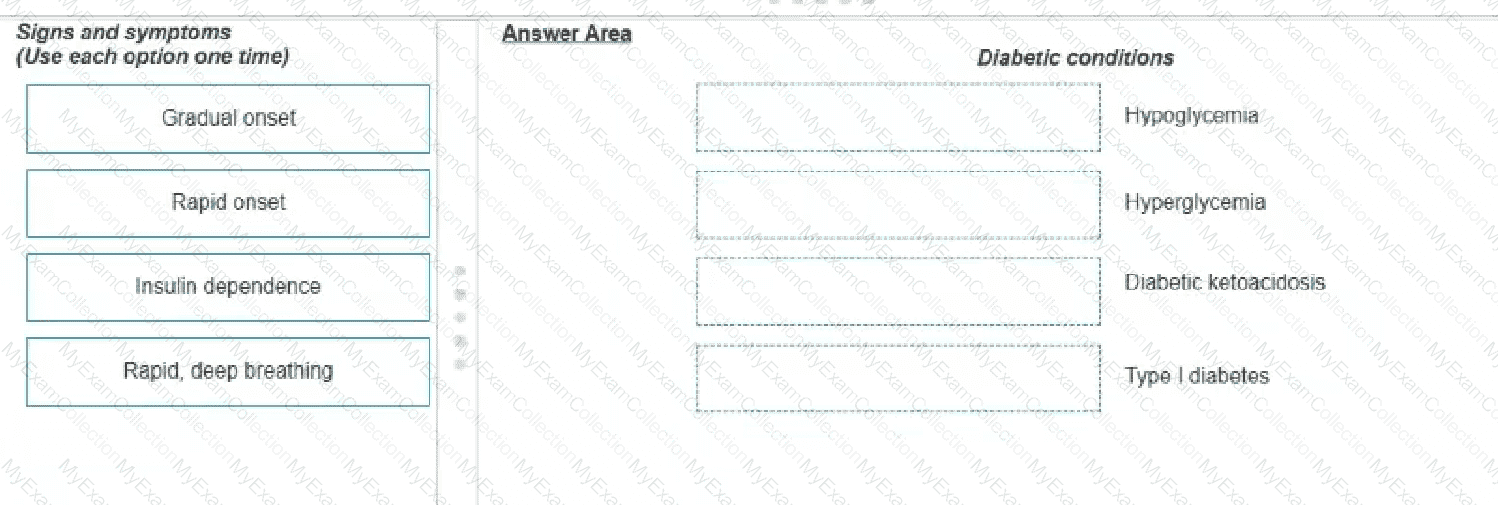
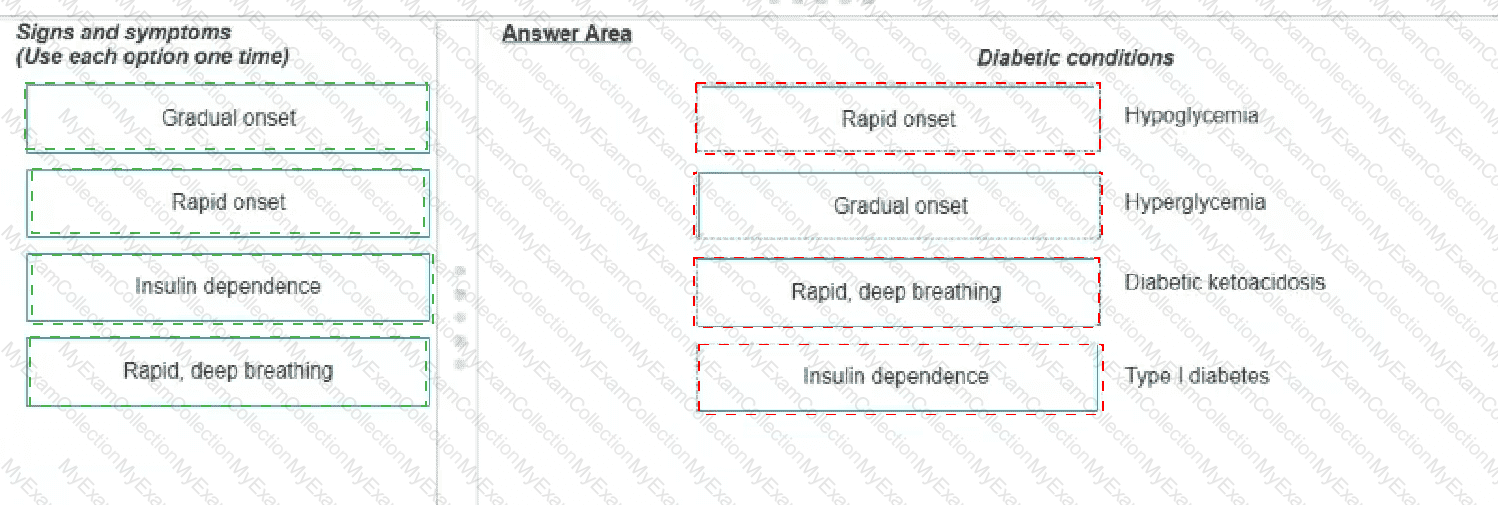
Which of the following signs or symptoms would be most closely associated with each of these diabetic conditions? Move each sign or symptom into the Answer Area one time to indicate the most closely associated diabetic condition.
Question # 80
A 45-year-old male complains of a sudden onset of right flank pain that radiates to his right groin. He is pale, diaphoretic, and restless. You should suspect
Question # 81
A 43-year-old patient is experiencing a sudden onset of coughing, nausea, and shortness of breath. The patient has a history of alcohol use disorder and major depressive disorder. The patient spent the day cleaning. The kitchen has food in various forms of decay. The patient ' s condition improves slightly once oxygen has been administered. Which of the following environmental factors is the most likely cause of the patient ' s presentation?
Question # 82
A 27-year-old patient is under arrest and in handcuffs after an altercation with police. The patient has a swollen left wrist that is tender to the touch. There is no deformity to the wrist, and distal pulses are present. The EMT is considering the following transport options:
• Option 1: Transport the patient in the ambulance, handcuffed, with the key-holding officer following the ambulance in a police car.
• Option 2: Transport the patient in the ambulance, but exchange the handcuffs for locking leather restraints to which the EMT has a key.
Which of these options should the EMT choose, if either?
Question # 83
A 6-year-old female rode her bicycle into a parked car. She is in moderate respiratory distress and you palpate subcutaneous emphysema. Of the following, what is the most important management for her?
Question # 84
A 17-year-old patient was stung by a bee and is now confused and short of breath. The vital signs are BP 78/60 mmHg, P 140/min, R 26 and shallow, and SpOâ‚‚ 86% on room air. After administering epinephrine, what should the EMT do next?