Question # 4
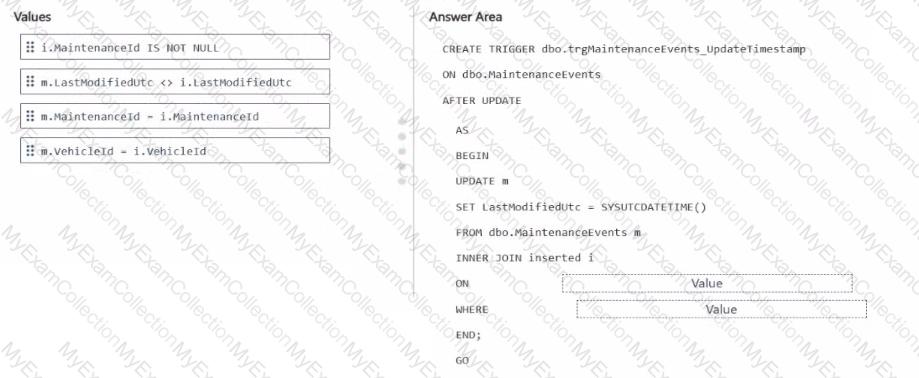
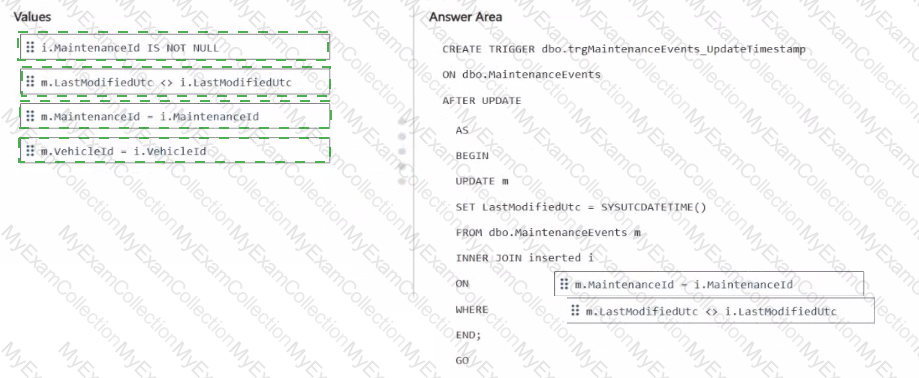
You need to meet the database performance requirements for maintenance data
How should you complete the Transact-SQL code? To answer, drag the appropriate values to the correct targets. Each value may be used once, more than once, or not at all. You may need to drag the split bar between panes or scroll to view content.
NOTE: Each correct selection is worth one point.
Question # 5
You need to recommend a solution to lesolve the slow dashboard query issue. What should you recommend?
Question # 6
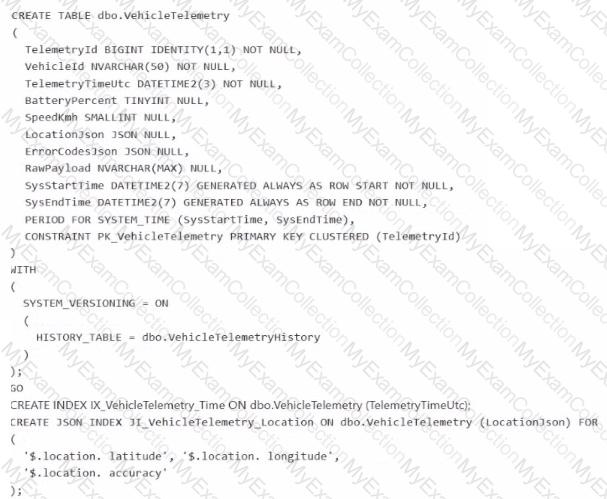
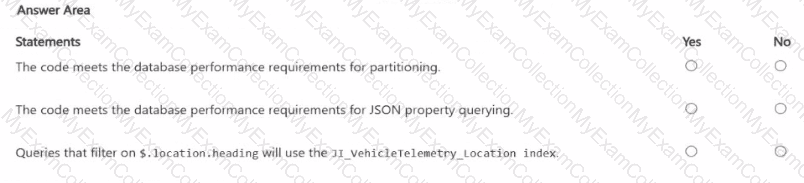
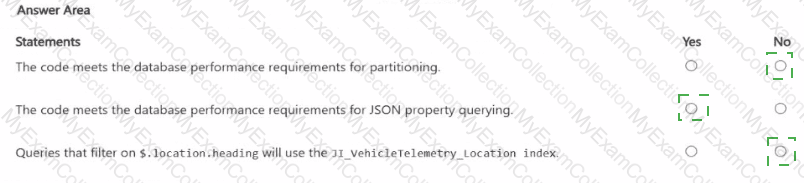
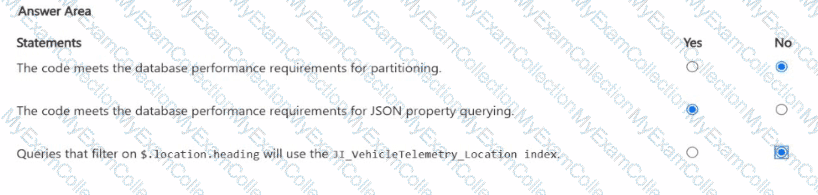
You need to create a table in the database to store the telemetry data. You have the following Transact-SQL code.
Question # 7
You need to enable similarity search to provide the analysts with the ability to retrieve the most relevant health summary reports. The solution must minimize latency.
What should you include in the solution?
Question # 8
You need to recommend a solution for the development team to retrieve the live metadata. The solution must meet the development requirements.
What should you include in the recommendation?
Question # 9
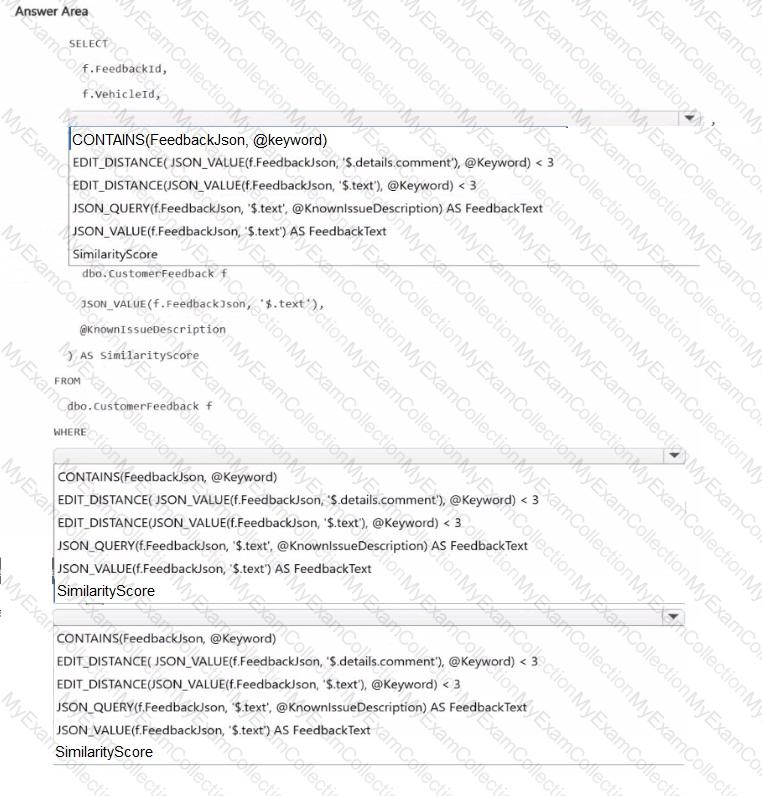
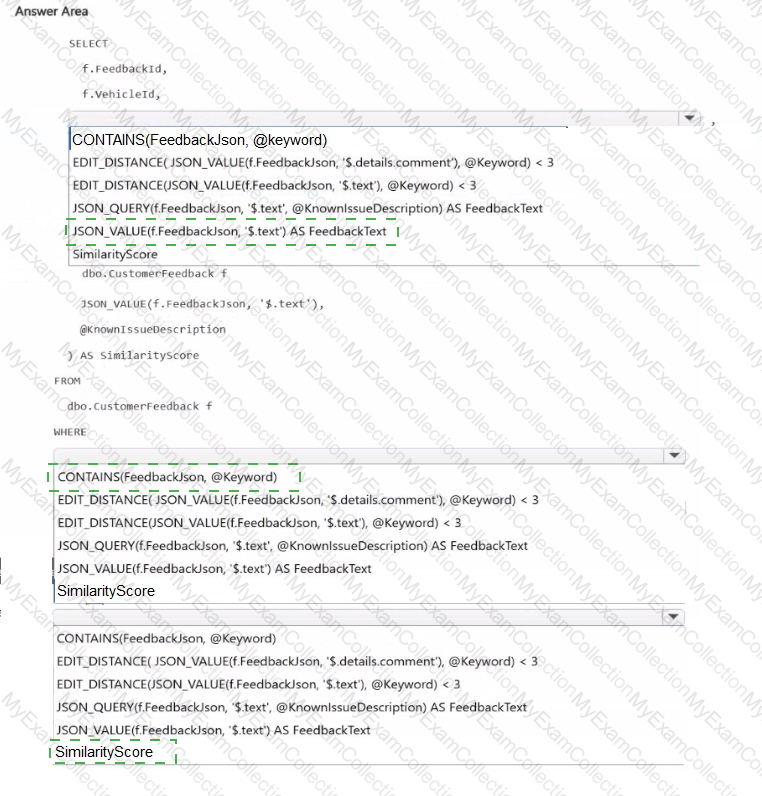
You need to meet the development requirements for the FeedbackJson column
How should you complete the Transact SQL query? To answer, select the appropriate options in the answer area.
NOTE: Each correct selection is worth one point.
Question # 10
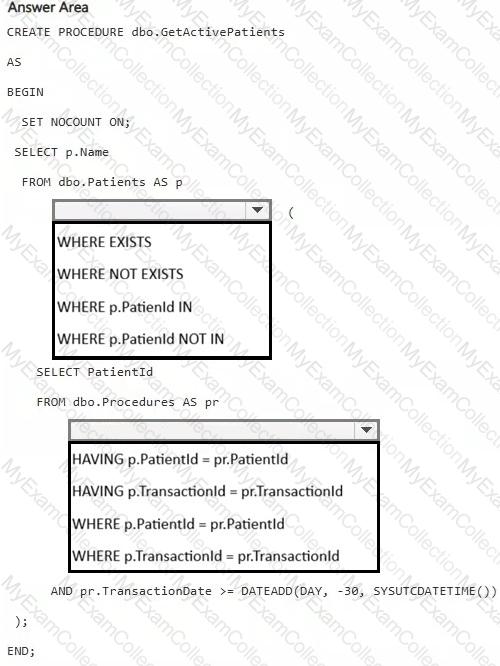
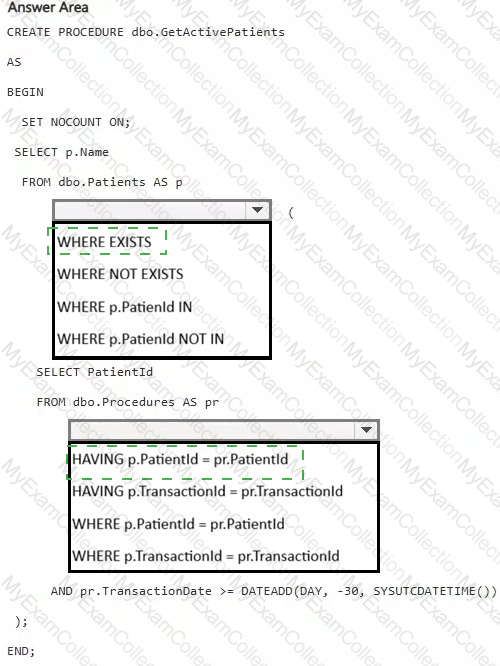
You need to create a solution that meets the development requirements for retrieving the patient lists.
How should you complete the Transact-SQL code? To answer, select the appropriate options
in the answer area.
NOTE: Each correct selection is worth one point.
Question # 11
You need to recommend a solution that will resolve the ingestion pipeline failure issues. Which two actions should you recommend? Each correct answer presents part of the solution. NOTE: Each correct selection is worth one point.
Question # 12
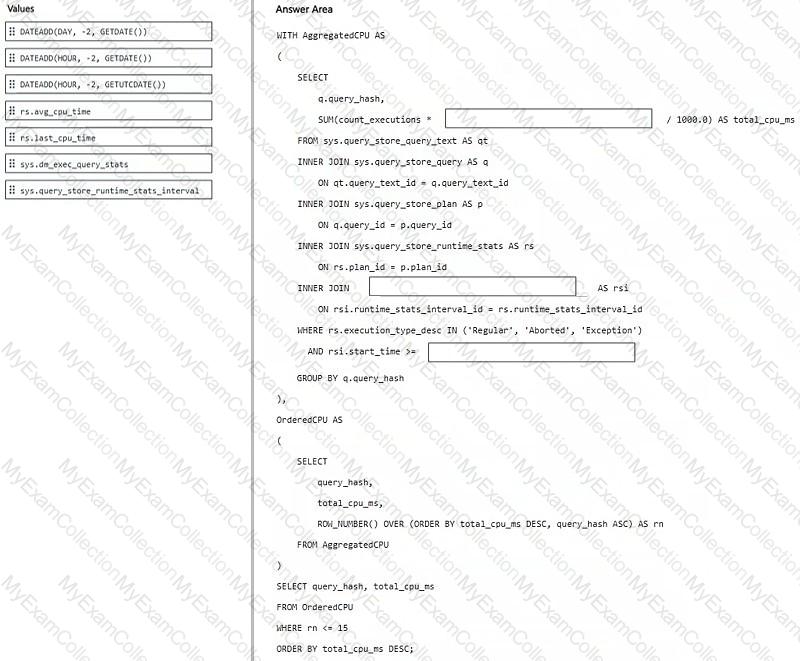
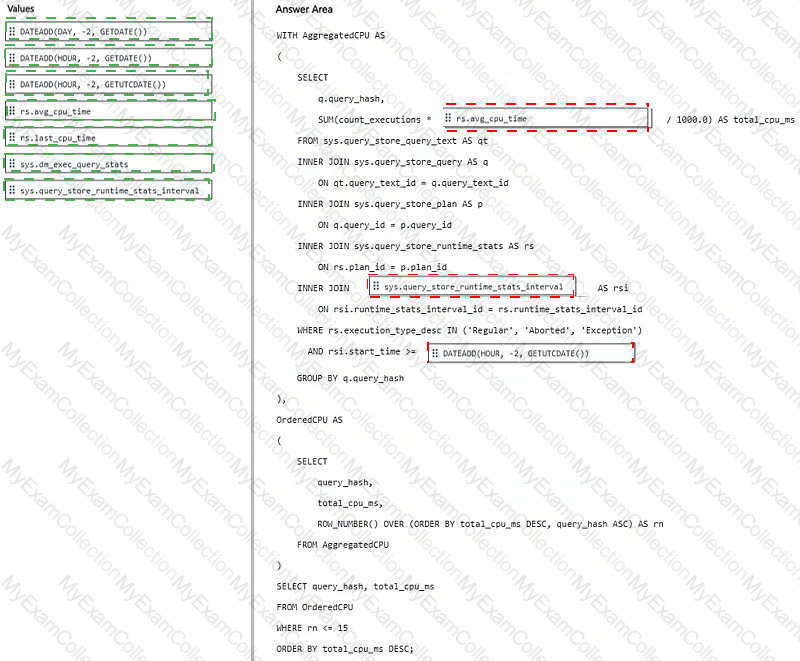
You have an Azure SQL database that supports an AI-driven product search API.
You need to identify the top CPU-consuming queries from the last two hours by using Query Store data. The solution must aggregate CPU consumption across executions and return only the top 15 query hashes.
How should you complete the Transact-SQL code? To answer, drag the appropriate values to the correct targets. Each value may be used once, more than once, or not at all.
NOTE: Each correct selection is worth one point.
Question # 13
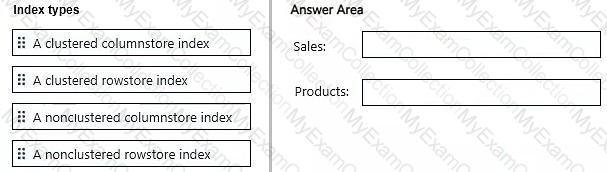
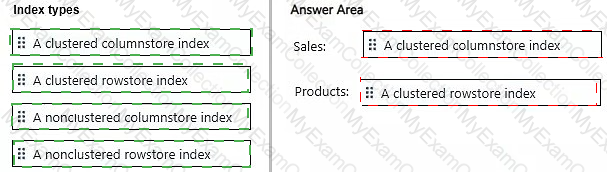
You have an Azure SQL database that stores sales data and contains tables named Sales and Products . Sales contains three columns named SalesDate , ProductKey , and TotalSale .
Sales is 10 TB and is loaded nightly by using a batch process. Most reporting queries scan large portions of Sales , filter on SalesDate or ProductKey , and use SUM() to aggregate TotalSale .
Products is relatively small and is used primarily for point lookups and joins to Sales .
You need to recommend which indexes to create to optimize the reporting queries. The solution must minimize storage requirements.
Which type of index should you recommend for each table? To answer, drag the appropriate index types to the correct tables. Each index type may be used once, more than once, or not at all. You may need to drag the split bar between panes or scroll to view content.
NOTE: Each correct selection is worth one point.
Question # 14
You have an Azure SQL database that contains a table named dbo.ManualChunks. dbo.HonualChunks contains product manuals
A retrieval query already returns the top five matching chunks as nvarchar(max) text.
You need to call an Azure OpenAI REST endpomt for chat completions. The request body must include both the user question and theretiieved chunks.
You write the following Transact-SQL code.
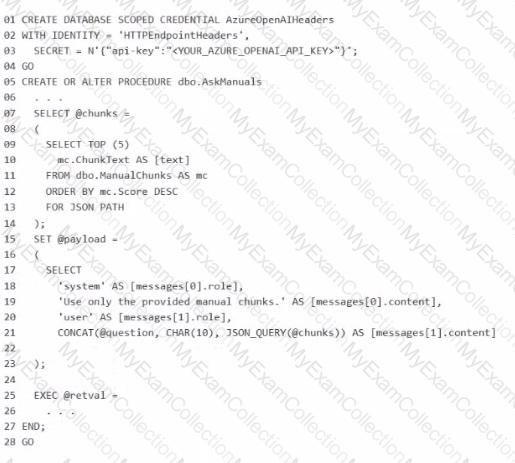
What should you insert at line 22?
Question # 15
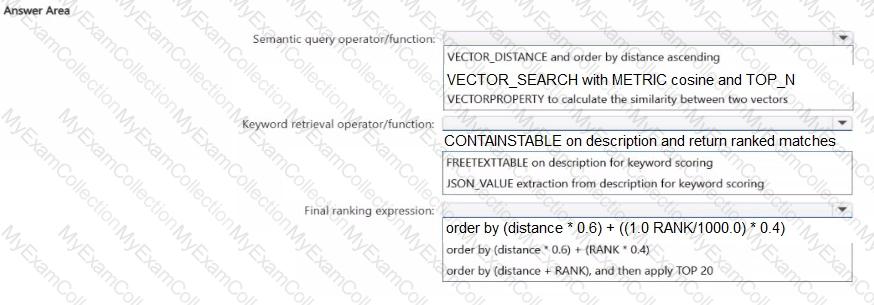
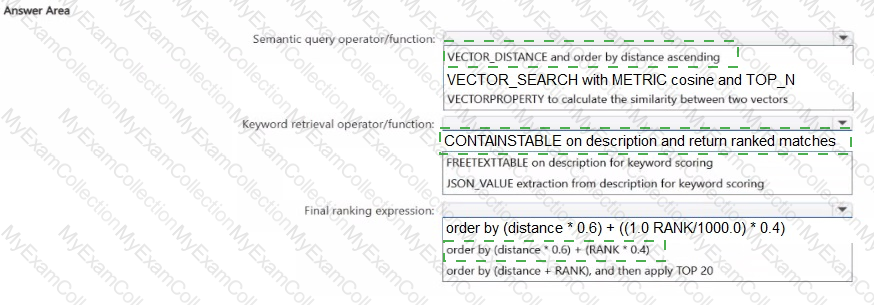
You have an Azure SQL database that contains a table named stores, stores contains a column named description and a vector column named embedding.
You need to implement a hybrid search query that meets the following requirements:
• Uses full-text search on description for the keyword portion
• Returns the top 20 results based on a combined score that uses a weighted formula of 60% vector distance and 40% full-text rank
How should you configure the query components? To answer, select the appropriate options in the answer area.
NOTE: Each correct selection is worth one point.

Question # 16
You have an Azure SQL database named ToDo that contains a table named dbo.ToDo.
Your company plans to develop an Azure Functions app to run whenever the rows in dbo.ToDo change. The app will process INSERT, UPDATE, and DELETE events by using the Azure SQL trigger binding.
You need to configure ToDo to support the planned app.
What should you do?
Question # 17
You have an Azure SQL database that contains a table named Sales.Orders. Sales.Orders contains the following columns.
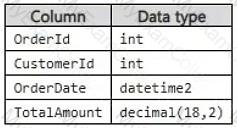
Reporting queries frequently repeat logic to calculate the number of days since an order was placed.
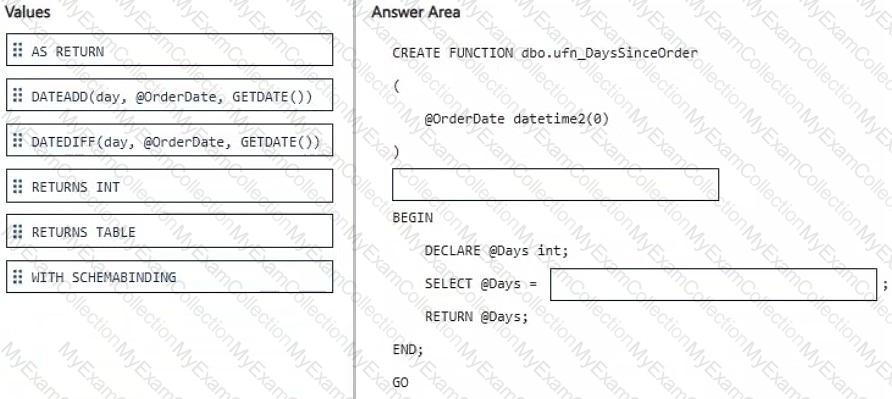
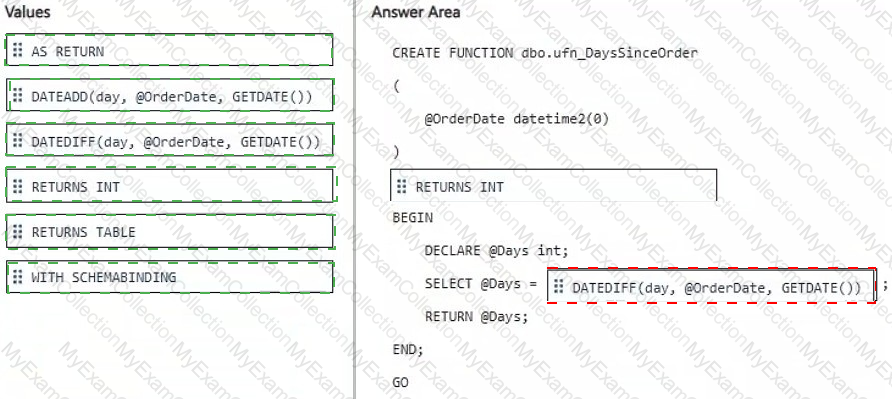
You need to create a scalar user-defined function (UDF) that returns the number of days between an input value of @OrderDate and the current date and time.
How should you complete the Transact-SQL code? To answer, drag the appropriate values to the correct targets. Each value may be used once, more than once, or not at all. You may need to drag the split bar between panes or scroll to view content.
NOTE: Each correct selection is worth one point.
Question # 18
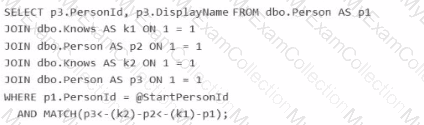
You have an Azure SQL database that contains the following SQL graph tables:
• A NODE table named dbo.Person
• An EDGE table named dbo.Knows
Each row in dbo.Person contains the following columns:
• Personid (int)
• DisplayName (nvarchar(100))
You need to use a HATCH operator and exactly two directed Knows relationships to return the Personid and DisplayName of people that are reachable from the person identified by an input parameter named @startPersonid.
Which Transact-SQL query should you use?
A)

B)
C)

D)