Question # 4
You have an Azure Databricks workspace that is enabled for Unity Catalog.
You have a Lakeflow Spark Declarative Pipelines (SDP) pipeline that writes numerical data to a table named Table1 by using a data quality validation rule named rule1.
You need to modify rule1 to meet the following requirements:
• Ensure that amount is always greater than 0.
• Fail the pipeline update for Table1 when data that violates rule1 is detected.
Which statement should you execute?
Question # 5
You need to configure compute for the ingestion of telemetry data. The solution must meet the data ingestion and processing requirements.
What should you do?
Question # 6
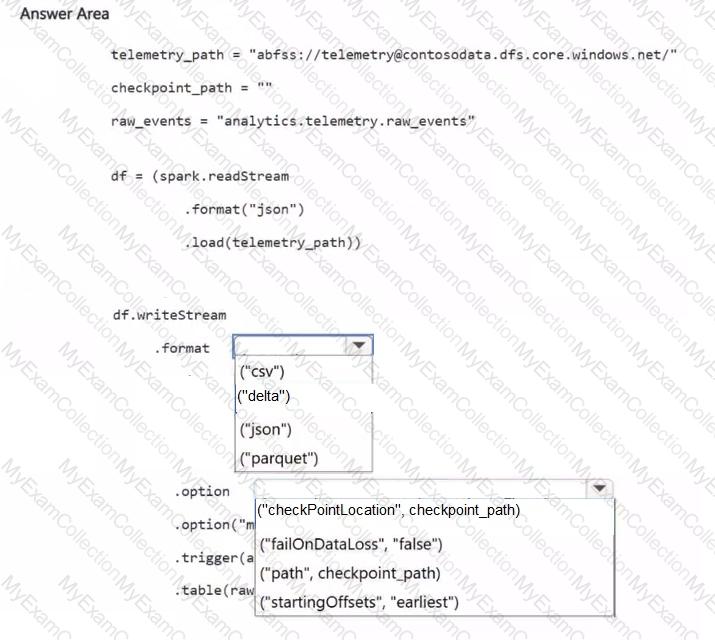
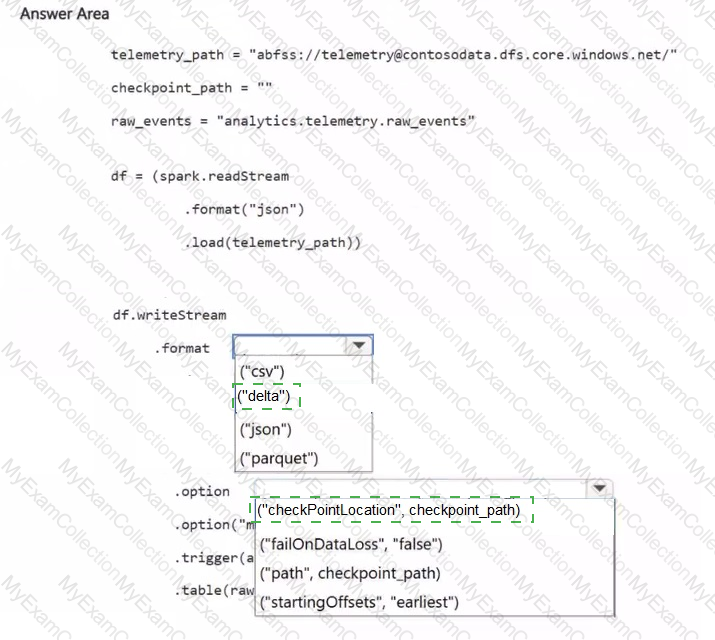
You need to complete the PySpark code for the Spark Structured Streaming pipelines. The solution must meet the data ingestion and processing requirements.
How should you complete the code segment? To answer, select the appropriate options in the answer area.
NOTE: Each correct selection is worth one point.
Question # 7
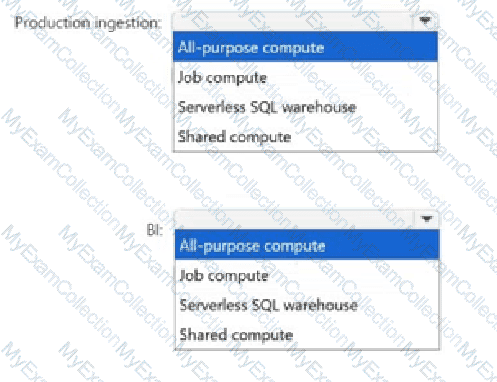
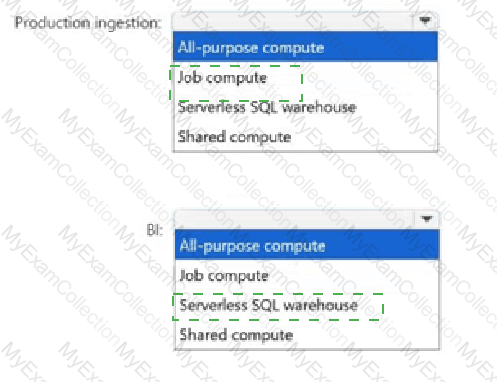
You need to recommend a compute type for the production ingestion workloads and BI workloads. The solution must meet the environment and compute requirements.
What should you recommend for each type of workload? To answer, select the appropriate options in the answer area.
NOTE: Each correct selection is worth one point.
Question # 8
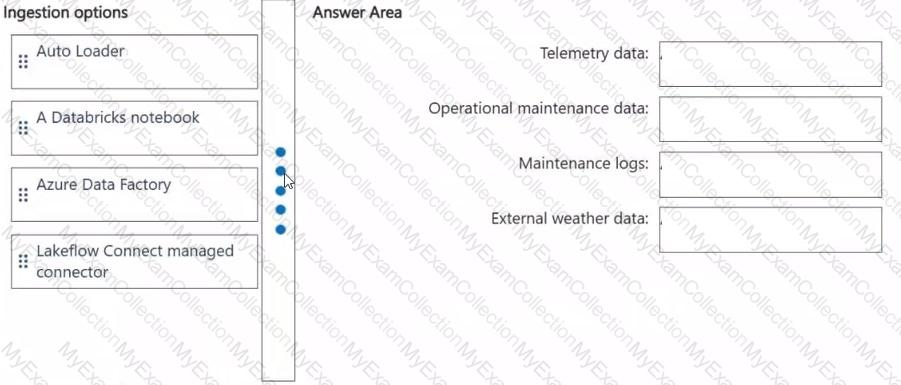
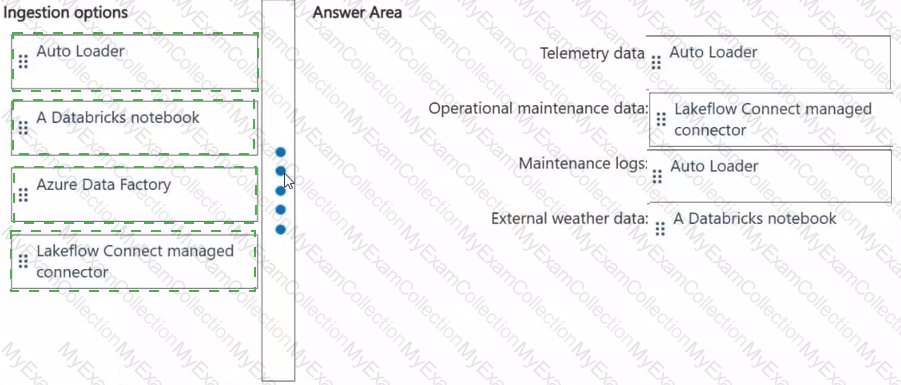
Which ingestion option should you recommend for each data source? To answer, drag the appropriate options to the correct data sources. Each option may be used once, more than once, or not at all. You may need to drag the split bar between panes or scroll to view content.
NOTE: Each correct selection is worth one point.
Question # 9
You need to develop the task logic for a new job in Lakeflow Jobs that processes telemetry data.
Each task must contain only the appropriate logic for its step in the pipeline. The solution must support the planned changes and meet the data ingestion and processing requirements.
What should you do?
Question # 10
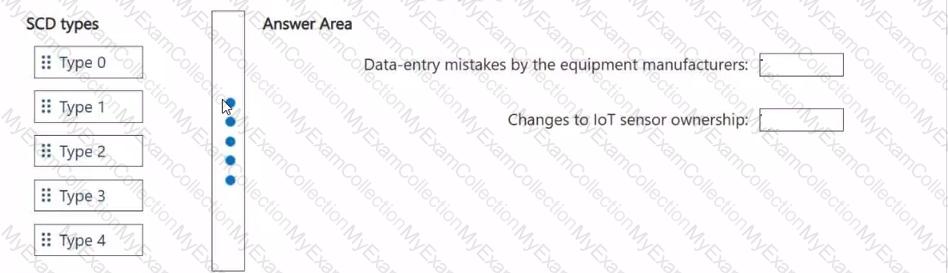
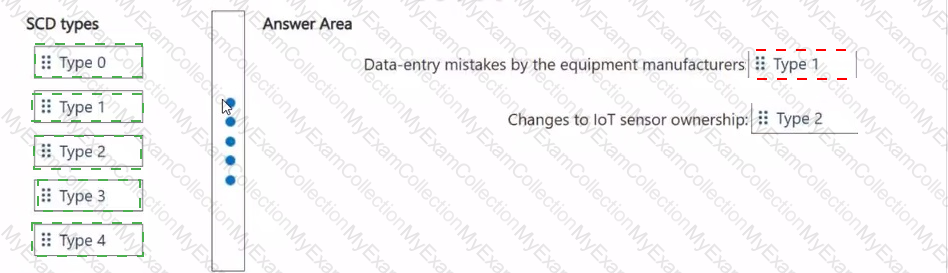
Which SCD type should you use to support the planned data modeling changes? To answer, drag the appropriate types to the correct issues. Each type may be used once, more than once, or not at all. You may need to drag the split bar between panes or scroll to view content.
NOTE: Each correct selection is worth one point.
Question # 11
You have an Azure Databticks workspace that is enabled for Unity Catalog and contains a catalog named catalog1.
You have a group named group!
You plan to create a schema named schema1 in catalog1.
You need to ensure that group1 meets the following requirements:
• Can create tables in schema1
• Can modify and query tables
• Cannot grant permissions for the schema and its objects
How should you complete the SQL statements? To answer, select the appropriate options in the answer area. NOTE: Each correct selection is worth one point.


Question # 12
You have a Lakeflow Spark Declarative Pipelines {SDP) pipeline in Azure Databricks. The pipeline ingests transaction data into a table named Table1.
You need to ensure that in the event of an invalid record, the pipeline continues to run. The solution must meet the following requirements:
• Invalid records must NOT be written to Table 1.
• Invalid records must be preserved for review.
• Minimize development effort
What should you do?
Question # 13
You have an Azure Databricks workspace that is enabled for Unity Catalog.
You have a complex job named Job1 that contains eight tasks. Job1 takes multiple hours to complete.
During the last job run, the final task fails due to a transient issue.
You need to retry the last task without rerunning tasks that have already completed.
What should you do?
Question # 14
You have an Azure Databricks workspace that is enabled for Unity Catalog and contains a managed Delta table named Sales. Sales stores transaction data and contains the following columns:
• transactionjd (string)
• transaction date (date)
• amount (decimal)
You need to implement the following data quality requirements by using table-level data quality enforcement:
• amount must be greater than 0.
• transaction id must never be null.
• Invalid records must be rejected when data is written to the Sales table.
What should you do?
Question # 15
You use Declarative Automation Bundles to manage two jobs and an app.
You need to deploy the bundle to development and production environments. The solution must meet the following requirements:
• Deploy the app to both environments.
• Deploy only one job to development.
• Minimize administrative effort.
What should you use?
Question # 16
You have an Azure Databricks workspace named Workspace! that uses a Git repository. The repository contains a Databricks notebook named Notebook1.
From the main branch, you create a feature branch named Branch! and commit changes to Notebooks Another user commits changes to Notebook1 in main.
When you attempt to merge Branch! into main, the merge fails due to conflicts.
You need to merge Branch! into the main branch. The solution must ensure that Notebook1 includes all the changes from both the branches.
What should you do?
Question # 17
You have an Azure Databricks workspace that is enabled for Unity Catalog.
You plan to create a job in Lakeflow Jobs named Job1 that:
• Ingests data from cloud storage
• Runs two independent transformation tasks
The transformation tasks must run only after the ingestion completes and must run in parallel.
You need to design the task logic for Job1.
What should you configure?
Question # 18
You have an Azure Databricks workspace that is enabled for Unity Catalog. You plan to run the following PySpark code.
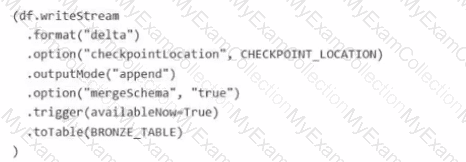
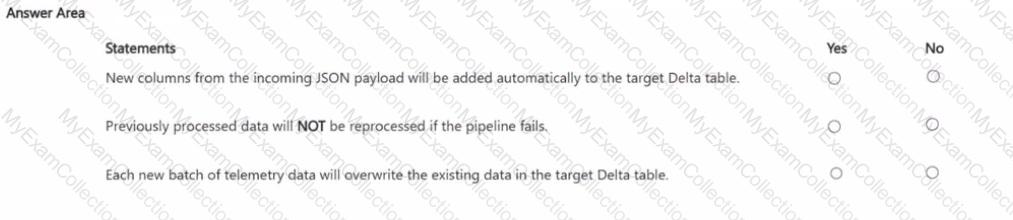
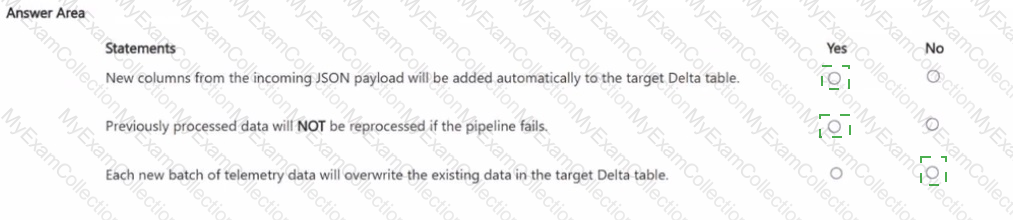
For each of the following statements, select Yes if the statement is true. Otherwise, select No. NOTE: Each correct selection is worth one point.
Question # 19
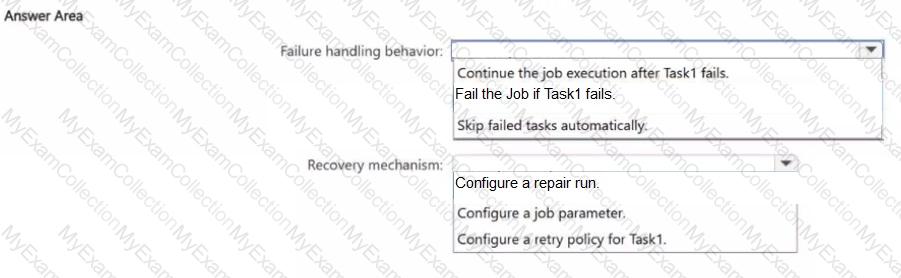
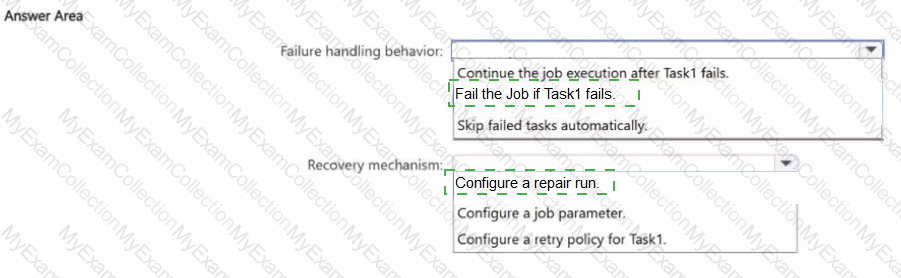
You have an Azure Databricks workspace that contains a job in Lakeflow Jobs named Job1.
Job! contains three tasks named Task1, Task2. and Task3.
If Task1 fails, Task2 and Task3 must be prevented from running. Successfully completed tasks must NOT rerun during recovery.
You need to configure Job1 to support controlled failure handling and recovery
What should you configure? To answer, select the appropriate options in the answer area.
NOTE: Each correct selection is worth one point.
Question # 20
You have an Azure Databricks workspace that contains an all-purpose cluster named Cluster! You need to configure Cluster1 to meet the following requirements;
• The cluster must scale up automatically when workloads increase.
• The cluster must scale down automatically when workloads decrease.
The solution must minimize costs.
Which two actions should you perform? Each correct answer presents part of the solution.
NOTE: Each correct selection is worth one point.