Question # 4
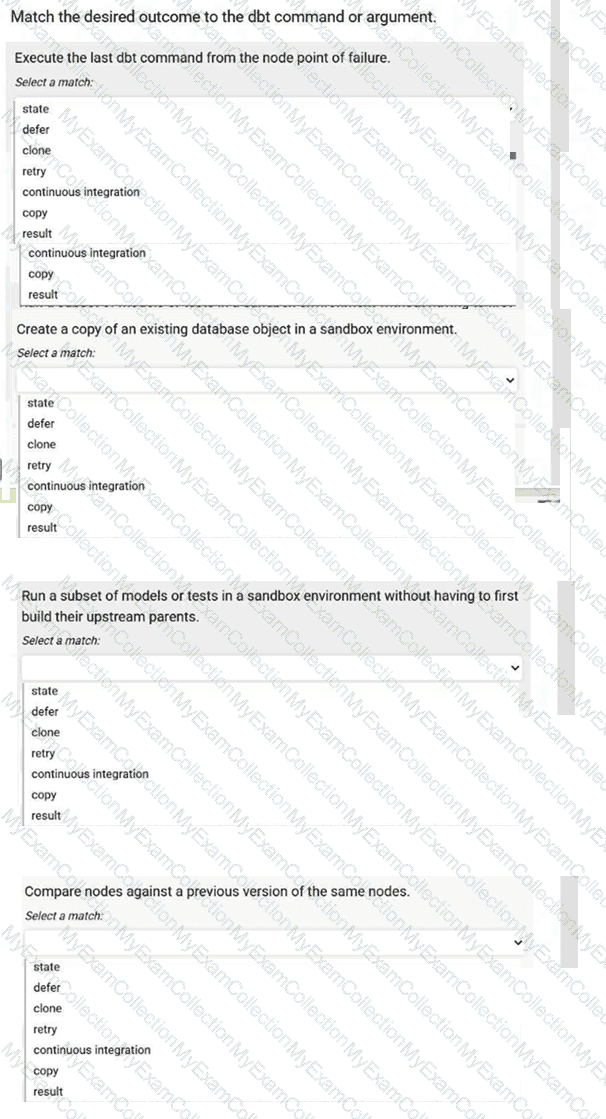
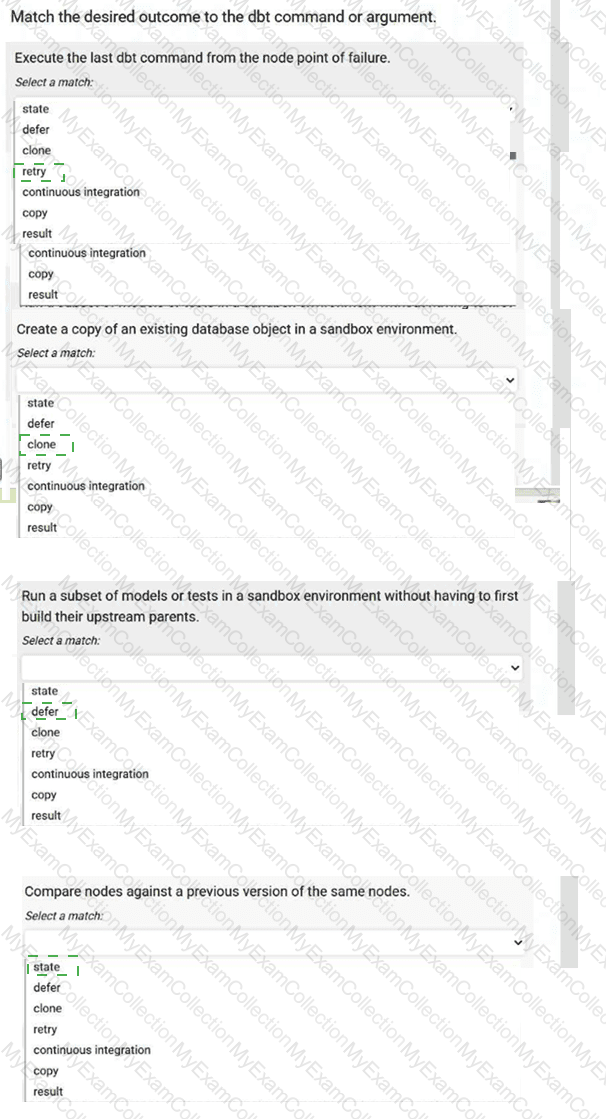
In development, you want to avoid having to re-run all upstream models when refactoring part of your project.
What could you do to save time rebuilding models without spending warehouse credits in your next command?
Question # 6
The dbt_project.yml file contains this configuration:
models:
+grants:
select: ['reporter']
How can you grant access to the object in the data warehouse to both reporter and bi?
Question # 8
Which two code snippets result in a lineage line being shown in the DAG? Choose 2 options.
Question # 9
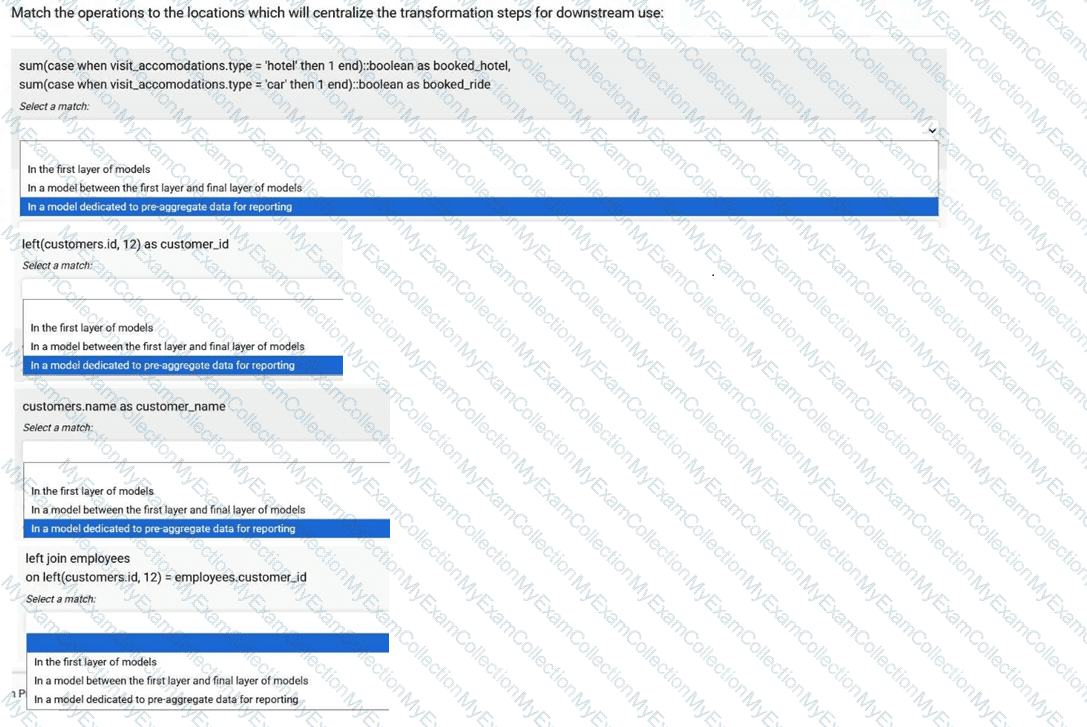
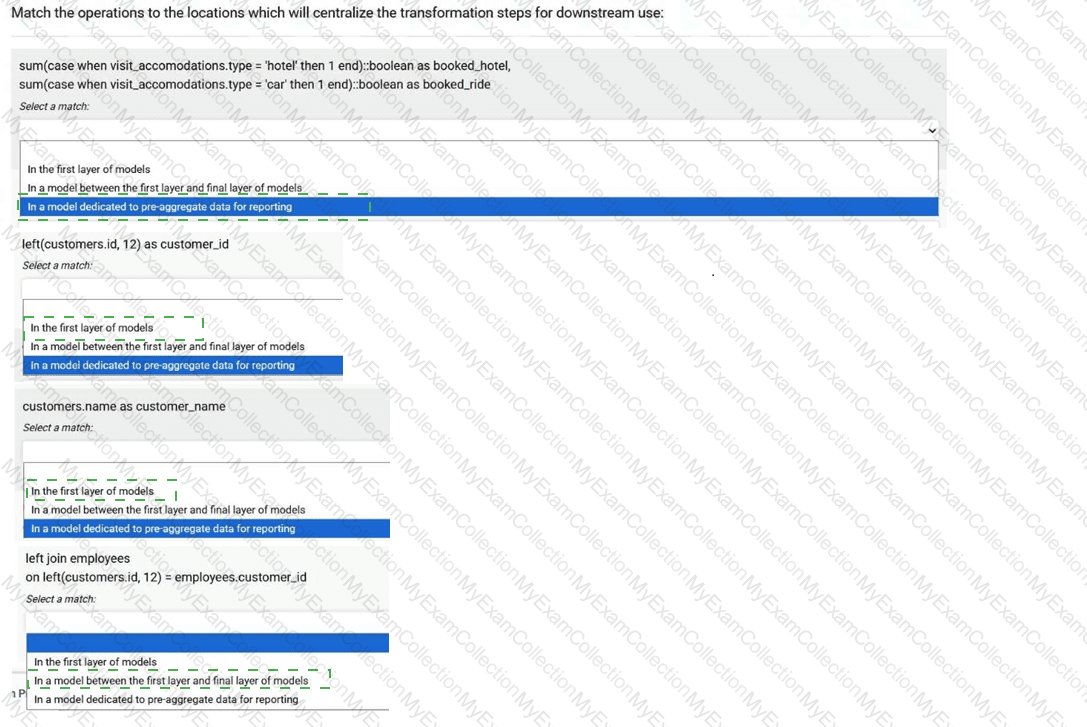
Examine the code:
select
left(customers.id, 12) as customer_id,
customers.name as customer_name,
case when employees.employee_id is not null then true else false end as is_employee,
event_signups.event_name,
event_signups.event_date,
sum(case when visit_accomodations.type = 'hotel' then 1 end)::boolean as booked_hotel,
sum(case when visit_accomodations.type = 'car' then 1 end)::boolean as booked_ride
from customers
-- one customer can sign up for many events
left join event_signups
on left(customers.id, 12) = event_signups.customer_id
-- an event signup for a single customer can have many types of accommodations booked
left join visit_accomodations
on event_signups.signup_id = visit_accomodations.signup_id
and left(customers.id, 12) = visit_accomodations.customer_id
-- an employee can be a customer
left join employees
on left(customers.id, 12) = employees.customer_id
group by 1, 2
Question # 10
Consider this DAG for a dbt project. You have configured your environment to use one thread.
When running dbt run, you determine that model_d fails to materialize.
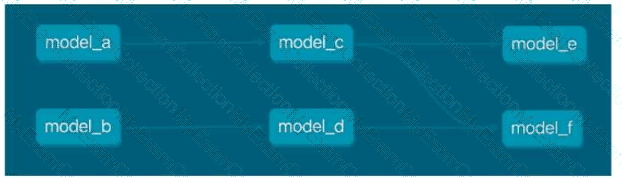
How will changing the command from dbt run to dbt run --fail-fast impact the execution of dbt run when model_d fails to materialize? Choose 1 option.
Options:
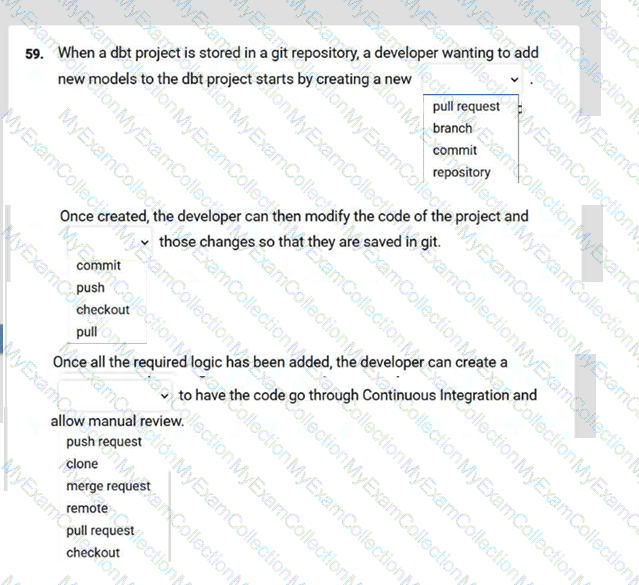
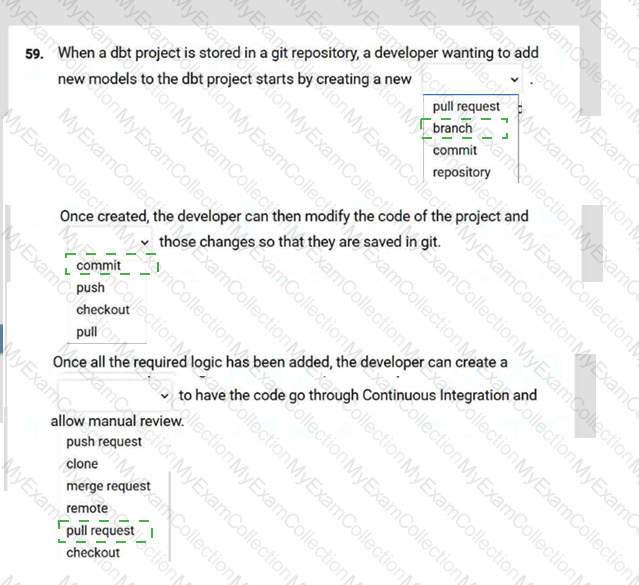
Question # 13
Examine how freshness is defined at the database level:
- name: raw
database: raw
freshness: # default freshness
warn_after: {count: 12, period: hour}
error_after: {count: 24, period: hour}
loaded_at_field: _etl_loaded_at
How can one table from the source raw be excluded from source freshness?
Question # 14
You want to run and test the models, tests, and snapshots you have added or modified in development.
Which will you invoke? Choose 1 option.
Options:
Question # 15
You want to configure dbt to prevent tests from running if one or more of their parent models is unselected.
Which test command should you execute?
Choose 1 option.
Question # 16
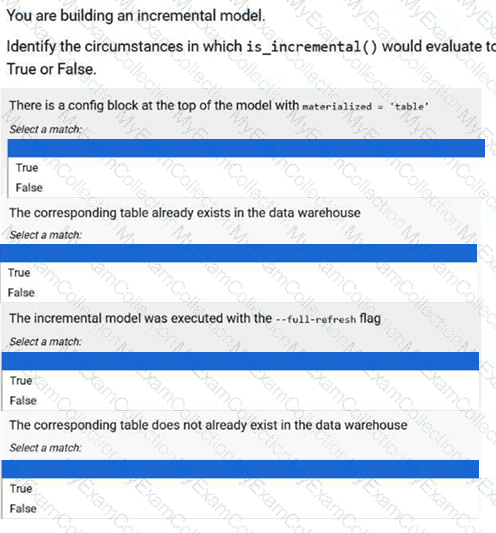
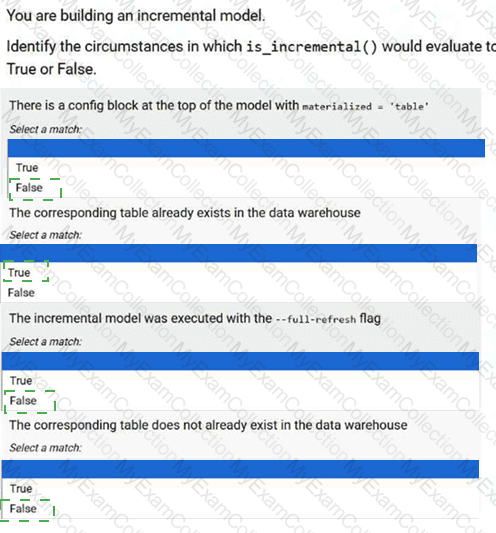
You are building an incremental model.
Identify the circumstances in which is_incremental() would evaluate to True or False.
Question # 17
Given this dbt_project.yml:
name: "jaffle_shop"
version: "1.0.0"
config-version: 2
profile: "snowflake"
model-paths: ["models"]
macro-paths: ["macros"]
snapshot-paths: ["snapshots"]
target-path: "target"
clean-targets:
- "logs"
- "target"
- "dbt_modules"
- "dbt_packages"
models:
jaffle_shop:
orders:
materialized: table
When executing a dbt run your models build as views instead of tables:
19:36:14 Found 1 model, 0 tests, 0 snapshots, 0 analyses, 179 macros, 0 operations, 0 seed files, 0 sources, 0 exposures, 0 metrics
19:36:16 Concurrency: 1 threads (target='default')
19:36:17 Finished running 1 view model in 3.35s.
19:36:17 Completed successfully
19:36:17 Done. PASS=1 WARN=0 ERROR=0 SKIP=0 TOTAL=1
Which could be a root cause of why the model was not materialized as a table?
The target-path is incorrectly configured.
Question # 18
Which two configuration items can be defined under models: in your dbt_project.yml file?
Choose 2 options.
Question # 19
You wrote this test against your fct_orders model to confirm status filters were properly applied by a parent model:
{{
config(
enabled=true,
severity='error'
)
}}
select *
from {{ ref('fct_orders') }}
where status_code = 13
Which statement about this test is true?