Question # 4
A Generative AI Engineer is building an LLM to generate article summaries in the form of a type of poem, such as a haiku, given the article content. However, the initial output from the LLM does not match the desired tone or style.
Which approach will NOT improve the LLM’s response to achieve the desired response?
Question # 5
Which indicator should be considered to evaluate the safety of the LLM outputs when qualitatively assessing LLM responses for a translation use case?
Question # 6
A Generative AI Engineer wants to build an LLM-based solution to help a restaurant improve its online customer experience with bookings by automatically handling common customer inquiries. The goal of the solution is to minimize escalations to human intervention and phone calls while maintaining a personalized interaction. To design the solution, the Generative AI Engineer needs to define the input data to the LLM and the task it should perform.
Which input/output pair will support their goal?
Question # 7
A Generative Al Engineer is tasked with improving the RAG quality by addressing its inflammatory outputs.
Which action would be most effective in mitigating the problem of offensive text outputs?
Question # 8
A Generative Al Engineer interfaces with an LLM with prompt/response behavior that has been trained on customer calls inquiring about product availability. The LLM is designed to output “In Stock†if the product is available or only the term “Out of Stock†if not.
Which prompt will work to allow the engineer to respond to call classification labels correctly?
Question # 9
A Generative AI Engineer has deployed a RAG application to production. Its Vector Search index is built from a Delta table that receives incremental updates every hour from an upstream ETL pipeline. The team wants the index to automatically reflect source-table changes without manual re-indexing and without changing the endpoint used by downstream applications.
Which approach should the engineer use?
Question # 10
A Generative Al Engineer is ready to deploy an LLM application written using Foundation Model APIs. They want to follow security best practices for production scenarios
Which authentication method should they choose?
Question # 11
A team uses Mosaic AI Vector Search to retrieve documents for their Retrieval-Augmented Generation (RAG) pipeline. The search query returns five relevant documents, and the first three are added to the prompt as context. Performance evaluation with Agent Evaluation shows that some lower-ranked retrieved documents have higher context relevancy scores than higher-ranked documents. Which option should the team consider to optimize this workflow?
Question # 12
A Generative AI Engineer is developing a chatbot designed to assist users with insurance-related queries. The chatbot is built on a large language model (LLM) and is conversational. However, to maintain the chatbot’s focus and to comply with company policy, it must not provide responses to questions about politics. Instead, when presented with political inquiries, the chatbot should respond with a standard message:
“Sorry, I cannot answer that. I am a chatbot that can only answer questions around insurance.â€
Which framework type should be implemented to solve this?
Question # 13
A Generative AI Engineer is deploying a conversational agent that provides financial-analysis insights to internal analysts at a company. The company has standardized on Microsoft 365 for all internal communications and collaboration. The analysts are distributed across multiple time zones and primarily work within Microsoft Teams channels, where they already discuss financial data and share reports. The agent needs to integrate with the company’s existing Azure Active Directory for authentication and must respect the company’s data-governance policies. Users should be able to interact with the agent within their existing workflow without switching applications.
Which interface should the engineer implement for this agent deployment?
Question # 14
A Generative Al Engineer is building an LLM-based application that has an
important transcription (speech-to-text) task. Speed is essential for the success of the application
Which open Generative Al models should be used?
Question # 15
A company has a typical RAG-enabled, customer-facing chatbot on its website.
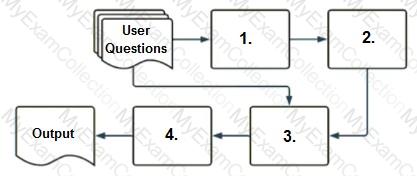
Select the correct sequence of components a user ' s questions will go through before the final output is returned. Use the diagram above for reference.
Question # 16
A Generative Al Engineer is creating an LLM system that will retrieve news articles from the year 1918 and related to a user ' s query and summarize them. The engineer has noticed that the summaries are generated well but often also include an explanation of how the summary was generated, which is undesirable.
Which change could the Generative Al Engineer perform to mitigate this issue?
Question # 17
A Generative AI Engineer has been asked to design an LLM-based application that accomplishes the following business objective: answer employee HR questions using HR PDF documentation.
Which set of high level tasks should the Generative AI Engineer ' s system perform?
Question # 18
A Generative AI Engineer is developing a patient-facing healthcare-focused chatbot. If the patient’s question is not a medical emergency, the chatbot should solicit more information from the patient to pass to the doctor’s office and suggest a few relevant pre-approved medical articles for reading. If the patient’s question is urgent, direct the patient to calling their local emergency services.
Given the following user input:
“I have been experiencing severe headaches and dizziness for the past two days.â€
Which response is most appropriate for the chatbot to generate?
Question # 19
What is the most suitable library for building a multi-step LLM-based workflow?
Question # 20
A Generative AI Engineer needs to allocate costs for an agent deployed via Agent Framework behind AI Gateway. The finance team requires daily reporting by workspace and endpoint, including token usage and request counts. The engineer wants to query this data with SQL and join it to an internal cost-center mapping table.
Which table type best serves their needs?
Question # 21
A Generative AI Engineer is testing a simple prompt template in LangChain using the code below, but is getting an error:
Python
from langchain.chains import LLMChain
from langchain_community.llms import OpenAI
from langchain_core.prompts import PromptTemplate
prompt_template = " Tell me a {adjective} joke "
prompt = PromptTemplate(input_variables=[ " adjective " ], template=prompt_template)
# ... (Error-prone section)
Assuming the API key was properly defined, what change does the Generative AI Engineer need to make to fix their chain?
Question # 22
A Generative Al Engineer has built an LLM-based system that will automatically translate user text between two languages. They now want to benchmark multiple LLM ' s on this task and pick the best one. They have an evaluation set with known high quality translation examples. They want to evaluate each LLM using the evaluation set with a performant metric.
Which metric should they choose for this evaluation?
Question # 23
What is an effective method to preprocess prompts using custom code before sending them to an LLM?
Question # 24
A Generative Al Engineer is tasked with developing a RAG application that will help a small internal group of experts at their company answer specific questions, augmented by an internal knowledge base. They want the best possible quality in the answers, and neither latency nor throughput is a huge concern given that the user group is small and they’re willing to wait for the best answer. The topics are sensitive in nature and the data is highly confidential and so, due to regulatory requirements, none of the information is allowed to be transmitted to third parties.
Which model meets all the Generative Al Engineer’s needs in this situation?
Question # 25
A Generative AI Engineer developed an LLM application using the provisioned throughput Foundation Model API. Now that the application is ready to be deployed, they realize their volume of requests are not sufficiently high enough to create their own provisioned throughput endpoint. They want to choose a strategy that ensures the best cost-effectiveness for their application.
What strategy should the Generative AI Engineer use?
Question # 26
A Generative Al Engineer is creating an LLM-based application. The documents for its retriever have been chunked to a maximum of 512 tokens each. The Generative Al Engineer knows that cost and latency are more important than quality for this application. They have several context length levels to choose from.
Which will fulfill their need?
Question # 27
A Generative AI Engineer received the following business requirements for an external chatbot.
The chatbot needs to know what types of questions the user asks and routes to appropriate models to answer the questions. For example, the user might ask about upcoming event details. Another user might ask about purchasing tickets for a particular event.
What is an ideal workflow for such a chatbot?