Summer Sale Special - Limited Time 70% Discount Offer - Ends in 0d 00h 00m 00s - Coupon code: mxmas70

Home > Databricks > Databricks Certification > Databricks-Certified-Data-Engineer-Associate

Databricks-Certified-Data-Engineer-Associate Databricks Certified Data Engineer Associate Exam Question and Answers

Question # 4

The Delta transaction log for the ‘students’ tables is shown using the ‘DESCRIBE HISTORY students’ command. A Data Engineer needs to query the table as it existed before the UPDATE operation listed in the log.
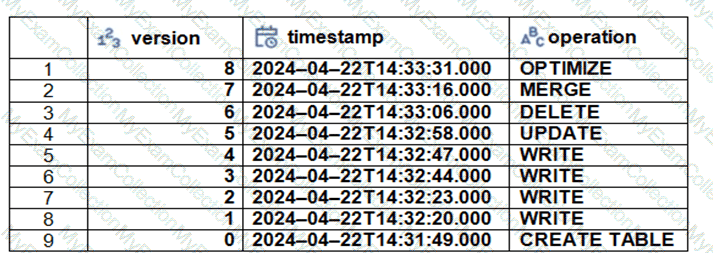
Which command should the Data Engineer use to achieve this? (Choose two.)

A.

SELECT * FROM students@v4

B.

SELECT * FROM students TIMESTAMP AS OF ‘2024-04-22T 14:32:47.000+00:00’

C.

SELECT * FROM students FROM HISTORY VERSION AS OF 3

D.

SELECT * FROM students VERSION AS OF 5

E.

SELECT * FROM students TIMESTAMP AS OF ‘2024-04-22T 14:32:58.000+00:00’

Full Access
Question # 5

A data engineer is troubleshooting two different pipeline failures:

    Pipeline A fails with a java.lang.OutOfMemoryError immediately after display(df.collect()) is called on a 100 GB dataset.

    Pipeline B fails during a wide transformation joining two large tables, with an ExecutorLostFailure message indicating executor-memory exhaustion during the shuffle.

Which action should the data engineer take to address these two issues?

A.

For Pipeline A, switch to a storage-optimized cluster; for Pipeline B, use a compute-optimized cluster.

B.

For both pipelines, enable Adaptive Query Execution because it automatically manages all driver and executor memory allocation.

C.

For Pipeline A, increase the number of executors; for Pipeline B, increase driver memory.

D.

For Pipeline A, address driver memory by removing the full collect() or increasing driver capacity; for Pipeline B, increase shuffle partitions or executor memory.

Full Access
Question # 6

A data engineer needs Task C to run only when Task A succeeds and Task B fails.

Which dependency configuration implements this conditional logic?

A.

Task C depends on Task A with Success, with Task B listed as a negative dependency.

B.

Use two dependency chains: one that proceeds only when Task A succeeds and another that proceeds only when Task B has at least one failure; Task C depends on both resulting branches.

C.

Create a Python task that checks dbutils.jobs.taskValues from Tasks A and B before running Task C.

D.

Configure Task C to depend on Task A and Task B with All done and use a notebook widget as the condition.

Full Access
Question # 7

Which of the following Structured Streaming queries is performing a hop from a Silver table to a Gold table?

A.

B.

C.

D.

E.

Full Access
Question # 8

A data engineer has manually created several Databricks jobs and dashboards using the workspace UI. The team now wants to manage these resources as code using Declarative Automation Bundles, formerly known as Databricks Asset Bundles, store the configuration in a Git repository, and deploy changes through CI/CD.

Which approach converts the existing resources into a bundle project?

A.

Run databricks bundle generate for each existing resource, then use databricks bundle deployment bind to link the generated configuration to the corresponding existing workspace resource, and commit the bundle project to Git for CI/CD deployment.

B.

Use the Databricks REST API to export each job’s JSON definition, save the JSON files into a Git repository, and configure CI/CD to import them using the REST API during each deployment.

C.

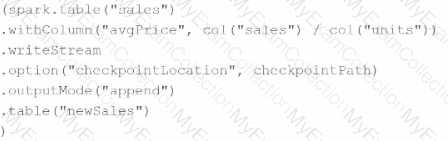
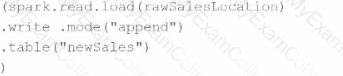
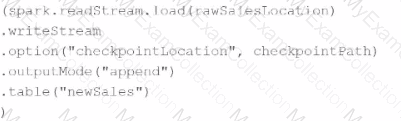
Clone an empty Git repository into a Git folder, manually recreate each job and dashboard configuration in YAML by referencing the workspace UI, and then deploy with databricks bundle deploy.

D.

Run databricks bundle init to create a new bundle project, and then use databricks bundle deploy to automatically detect and import all existing workspace resources.

Full Access
Question # 9

A data engineering team has noticed that their Databricks SQL queries are running too slowly when they are submitted to a non-running SQL endpoint. The data engineering team wants this issue to be resolved.

Which of the following approaches can the team use to reduce the time it takes to return results in this scenario?

A.

They can turn on the Serverless feature for the SQL endpoint and change the Spot Instance Policy to " Reliability Optimized. "

B.

They can turn on the Auto Stop feature for the SQL endpoint.

C.

They can increase the cluster size of the SQL endpoint.

D.

They can turn on the Serverless feature for the SQL endpoint.

E.

They can increase the maximum bound of the SQL endpoint ' s scaling range

Full Access
Question # 10

A Delta Live Table pipeline includes two datasets defined using STREAMING LIVE TABLE. Three datasets are defined against Delta Lake table sources using LIVE TABLE.

The table is configured to run in Development mode using the Continuous Pipeline Mode.

Assuming previously unprocessed data exists and all definitions are valid, what is the expected outcome after clicking Start to update the pipeline?

A.

All datasets will be updated once and the pipeline will shut down. The compute resources will be terminated.

B.

All datasets will be updated at set intervals until the pipeline is shut down. The compute resources will persist until the pipeline is shut down.

C.

All datasets will be updated once and the pipeline will persist without any processing. The compute resources will persist but go unused.

D.

All datasets will be updated once and the pipeline will shut down. The compute resources will persist to allow for additional testing.

E.

All datasets will be updated at set intervals until the pipeline is shut down. The compute resources will persist to allow for additional testing.

Full Access
Question # 11

A data engineer is setting up access control in Unity Catalog and needs to ensure that a group of data analysts can query tables but not modify data.

Which permission should the data engineer grant to the data analysts?

A.

SELECT

B.

INSERT

C.

MODIFY

D.

ALL PRIVILEGES

Full Access
Question # 12

A data engineer needs to optimize the data layout and query performance for an e-commerce transactions Delta table. The table is partitioned by " purchase_date " a date column which helps with time-based queries but does not optimize searches on user statistics " customer_id " , a high-cardinality column.

The table is usually queried with filters on " customer_i

d " within specific date ranges, but since this data is spread across multiple files in each partition, it results in full partition scans and increased runtime and costs.

How should the data engineer optimize the Data Layout for efficient reads?

A.

Alter table implementing liquid clustering on " customerid " while keeping the existing partitioning.

B.

Alter the table to partition by " customer_id " .

C.

Enable delta caching on the cluster so that frequent reads are cached for performance.

D.

Alter the table implementing liquid clustering by " customer_id " and " purchase_date " .

Full Access
Question # 13

Which of the following can be used to simplify and unify siloed data architectures that are specialized for specific use cases?

A.

None of these

B.

Data lake

C.

Data warehouse

D.

All of these

E.

Data lakehouse

Full Access
Question # 14

Which Databricks Asset Bundle format is valid?

A.

resources:

jobs:

hello-job:

name: hello-job

tasks:

- task_key: hello-task

existing_cluster_id: 1234-567890-abcde123

notebook_task:

notebook_path: ./hello.py

B.

{

" resources " : {

" jobs " : {

" name " : " hello-job " ,

" tasks " : {

" task_key " : " hello-task " ,

" existing_cluster_id " : " 1234-567890-abcde123 " ,

" notebook_task " : {

" notebook_path " : " ./hello.py "

}

}

}

}

}

C.

configuration = {

" resources " : {

" jobs " : {

" name " : " hello-job " ,

" tasks " : {

" task_key " : " hello-task " ,

" existing_cluster_id " : " 1234-567890-abcde123 " ,

" notebook_task " : {

" notebook_path " : " ./hello.py "

}

}

}

}

}

D.

resources {

jobs {

name = " hello-job "

tasks {

task_key = " hello-task "

existing_cluster_id = " 1234-567890-abcde123 "

notebook_task {

notebook_path = " ./hello.py "

}

}

}

}

Full Access
Question # 15

A data engineer needs access to a table new_table, but they do not have the correct permissions. They can ask the table owner for permission, but they do not know who the table owner is.

Which of the following approaches can be used to identify the owner of new_table?

A.

Review the Permissions tab in the table ' s page in Data Explorer

B.

All of these options can be used to identify the owner of the table

C.

Review the Owner field in the table ' s page in Data Explorer

D.

Review the Owner field in the table ' s page in the cloud storage solution

E.

There is no way to identify the owner of the table

Full Access
Question # 16

A data engineer needs to find all customers who have never placed an order. The customers table contains customer_id, customer_name, and other customer attributes. The orders table contains order_id, customer_id, and other order attributes. Both tables share customer_id as the join key. The result must include only customer columns, with no order-related columns in the output.

Which expression exactly achieves this requirement?

A.

A left outer join from orders to customers

B.

An inner join followed by filtering for a NULL order_id

C.

A left anti-join from customers to orders

D.

A full outer join followed by filtering where order_id IS NULL

Full Access
Question # 17

What is the maximum output supported by a job cluster to ensure a notebook does not fail?

A.

10MBS

B.

25MBS

C.

30MBS

D.

15MBS

Full Access
Question # 18

A data engineer needs to provide access to a group named manufacturing-team. The team needs privileges to create tables in the quality schema.

Which set of SQL commands will grant a group named manufacturing-team to create tables in a schema named production with the parent catalog named manufacturing with the least privileges?

A)

B)

C)

D)

A.

Option A

B.

Option B

C.

Option C

D.

Option D

Full Access
Question # 19

A data engineer wants to create a data entity from a couple of tables. The data entity must be used by other data engineers in other sessions. It also must be saved to a physical location.

Which of the following data entities should the data engineer create?

A.

Database

B.

Function

C.

View

D.

Temporary view

E.

Table

Full Access
Question # 20

A data engineer needs to combine sales data from an on-premises PostgreSQL database with customer data in Azure Synapse for a comprehensive report. The goal is to avoid data duplication and ensure up-to-date information

How should the data engineer achieve this using Databricks?

A.

Develop custom ETL pipelines to ingest data into Databricks

B.

Use Lakehouse Federation to query both data sources directly

C.

Manually synchronize data from both sources into a single database

D.

Export data from both sources to CSV files and upload them to Databricks

Full Access
Question # 21

An organization is looking for an optimized storage layer that supports ACID transactions and schema enforcement. Which technology should the organization use?

A.

Cloud File Storage

B.

Unity Catalog

C.

Data lake

D.

Delta Lake

Full Access
Question # 22

A data engineering project involves processing large batches of data on a daily schedule using ETL. The jobs are resource-intensive and vary in size, requiring a scalable, cost-efficient compute solution that can automatically scale based on the workload.

Which compute approach will satisfy the needs described?

A.

Databricks SQL Serverless

B.

Dedicated Cluster

C.

All-Purpose Cluster

D.

Job Cluster

Full Access
Question # 23

What are the transformations typically included in building the Bronze layer ?

A.

Perform extensive data cleansing

B.

Aggregate data from multiple sources

C.

Business rules and transformations

D.

Include columns Load date/time, process ID

Full Access
Question # 24

An organization is building a data lakehouse and needs to ingest data from multiple sources into Unity Catalog-managed tables:

    Salesforce: More than 50 objects, frequent schema changes, and OAuth authentication

    An on-premises SQL Server database: More than 100 tables, CDC enabled, and private network connectivity required

    Daily JSON files landing in Azure Data Lake Storage Gen2

The organization wants all ingested data governed by Unity Catalog, minimal engineering effort for schema changes, and serverless processing wherever possible.

Which ingestion strategy meets these requirements?

A.

Use partner connectors such as Fivetran for all three sources through Partner Connect

B.

Use Auto Loader for all three sources, with custom Python code for Salesforce API calls and SQL Server CDC extraction

C.

Use Lakeflow Connect managed connectors for Salesforce and SQL Server, and Auto Loader for the ADLS files, within Lakeflow Spark Declarative Pipelines

D.

Use Lakeflow Connect managed connectors for all three sources

Full Access
Question # 25

A company is collaborating with a partner that does not use Databricks but needs access to a large historical dataset stored in Delta format. The data engineer needs to ensure that the partner can access the data securely, without the need for them to set up an account, and with read-only access.

How should the data be shared?

A.

Share the dataset using Delta Sharing, which allows your partner to access the data using a secure, read-only URL without requiring a Databricks account, ensuring that they cannot modify the data.

B.

Share the dataset using Unity Catalog, ensuring that both teams have full write access to the data within the same organization.

C.

Share the dataset by exporting it to a CSV file and manually transferring the file to the partner ' s system.

D.

Grant your partner access to your Databricks workspace and assign them full write permissions to the Delta table, enabling them to modify the dataset.

Full Access
Question # 26

What is the structure of an Asset Bundle?

A.

A single plain text file enumerating the names of assets to be migrated to a new workspace.

B.

A compressed archive (ZIP) that solely contains workspace assets without any accompanying metadata.

C.

A YAML configuration file that specifies the artifacts, resources, and configurations for the project.

D.

A Docker image containing runtime environments and the source code of the assets

Full Access
Question # 27

A data engineer wants to schedule their Databricks SQL dashboard to refresh every hour, but they only want the associated SQL endpoint to be running when It is necessary. The dashboard has multiple queries on multiple datasets associated with it. The data that feeds the dashboard is automatically processed using a Databricks Job.

Which approach can the data engineer use to minimize the total running time of the SQL endpoint used in the refresh schedule of their dashboard?

A.

O They can reduce the cluster size of the SQL endpoint.

B.

Q They can turn on the Auto Stop feature for the SQL endpoint.

C.

O They can set up the dashboard ' s SQL endpoint to be serverless.

D.

0 They can ensure the dashboard ' s SQL endpoint matches each of the queries ' SQL endpoints.

Full Access
Question # 28

Which of the following Git operations must be performed outside of Databricks Repos?

A.

Commit

B.

Pull

C.

Push

D.

Clone

E.

Merge

Full Access
Question # 29

A data engineer is designing a Bronze-to-Silver pipeline on the Databricks Data Intelligence Platform. The source system sends daily CSV files, and new optional columns are added over time.

The engineer needs a storage format and table capabilities that provide all of the following:

    Writes that do not conform to the defined schema are rejected.

    The schema can evolve to include new optional columns without manually recreating the table.

    Previous table versions can be queried for debugging and auditing.

Which solution fulfills these requirements?

A.

Use a Parquet table with Spark’s default schema inference and rerun the job whenever the schema changes.

B.

Use a Delta table with schema enforcement and recreate the table whenever new columns are added.

C.

Use an external table with Auto Loader schema inference for the CSV files.

D.

Use a Delta table with its native schema enforcement, schema evolution, and table-history capabilities.

Full Access
Question # 30

What is the functionality of AutoLoader in Databricks?

A.

Auto Loader automatically ingests and processes new files from cloud storage, handling batch data with support for schema evolution.

B.

Auto Loader automatically ingests and processes new files from cloud storage, handling only streaming data with no support for schema evolution.

C.

Auto Loader automatically ingests and processes new files from cloud storage, handling batch and streaming data with no support for schema evolution.

D.

Auto Loader automatically ingests and processes new files from cloud storage, handling both batch and streaming data with support for schema evolution.

Full Access
Question # 31

What is stored in a Databricks customer ' s cloud account?

A.

Data

B.

Cluster management metadata

C.

Databricks web application

D.

Notebooks

Full Access
Question # 32

A data engineer needs to migrate the Unity Catalog external Delta table catalog.schema.sales while meeting the following requirements:

    Databricks must manage file cleanup after the table is dropped.

    The migration must minimize downtime while retaining the same table name, permissions, and history.

    Access must be enforced through the registered Unity Catalog table name.

Which action should the engineer take?

A.

Run ALTER TABLE catalog.schema.sales SET MANAGED.

B.

Run DROP TABLE catalog.schema.sales PURGE.

C.

Run ALTER TABLE catalog.schema.sales SET LOCATION.

D.

Create a new managed table using CREATE TABLE AS SELECT and manually migrate all workloads.

Full Access
Question # 33

A data engineer has developed a data pipeline to ingest data from a JSON source using Auto Loader, but the engineer has not provided any type inference or schema hints in their pipeline. Upon reviewing the data, the data engineer has noticed that all of the columns in the target table are of the string type despite some of the fields only including float or boolean values.

Which of the following describes why Auto Loader inferred all of the columns to be of the string type?

A.

There was a type mismatch between the specific schema and the inferred schema

B.

JSON data is a text-based format

C.

Auto Loader only works with string data

D.

All of the fields had at least one null value

E.

Auto Loader cannot infer the schema of ingested data

Full Access
Question # 34

Which type of workloads are compatible with Auto Loader?

A.

Streaming workloads

B.

Machine learning workloads

C.

Serverless workloads

D.

Batch workloads

Full Access
Question # 35

A pipeline uses COPY INTO to ingest CSV files from cloud object storage into a Unity Catalog Delta table. Some files are occasionally re-uploaded with corrections using the same filename.

The engineer needs the corrected data to be ingested as soon as it becomes available.

What should the engineer do?

A.

Overwrite the target Delta table during every run.

B.

Load corrections as new files and apply updates to the target table.

C.

Recreate the target table before every run.

D.

Reload all files from the source path during every run.

Full Access
Question # 36

A Databricks single-task workflow fails at the last task due to an error in a notebook. The data engineer fixes the mistake in the notebook. What should the data engineer do to rerun the workflow?

A.

Repair the task

B.

Rerun the pipeline

C.

Restart the Cluster

D.

Switch the cluster

Full Access
Question # 37

A data engineer has a single-task Job that runs each morning before they begin working. After identifying an upstream data issue, they need to set up another task to run a new notebook prior to the original task.

Which of the following approaches can the data engineer use to set up the new task?

A.

They can clone the existing task in the existing Job and update it to run the new notebook.

B.

They can create a new task in the existing Job and then add it as a dependency of the original task.

C.

They can create a new task in the existing Job and then add the original task as a dependency of the new task.

D.

They can create a new job from scratch and add both tasks to run concurrently.

E.

They can clone the existing task to a new Job and then edit it to run the new notebook.

Full Access
Question # 38

A data engineering team is using Kafka to capture event data and then ingest it into Databricks. The team wants to be able to see these historical events. Medallion architecture is already in place. The team wants to be mindful of costs.

Where should this historical event data be stored?

A.

Gold

B.

Silver

C.

Bronze

D.

Raw layer

Full Access
Question # 39

Which tool is used by Auto Loader to process data incrementally?

A.

Spark Structured Streaming

B.

Unity Catalog

C.

Checkpointing

D.

Databricks SQL

Full Access
Question # 40

A data engineering team runs nightly batch ETL pipelines that transform large volumes of data stored in Delta Lake. The workloads are predictable and run on a fixed schedule. The team wants automatic scaling and cost efficiency, paying only for compute used during job execution.

Which Databricks compute option is appropriate for this workload?

A.

An all-purpose compute cluster configured with autoscaling.

B.

A single-node compute cluster configured without autoscaling.

C.

A Databricks SQL warehouse configured for serverless execution.

D.

A job compute cluster triggered by a scheduled workflow.

Full Access
Question # 41

A data engineer wants to create a new table containing the names of customers that live in France.

They have written the following command:
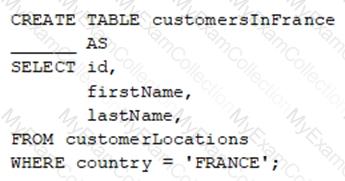
A senior data engineer mentions that it is organization policy to include a table property indicating that the new table includes personally identifiable information (PII).

Which of the following lines of code fills in the above blank to successfully complete the task?

A.

There is no way to indicate whether a table contains PII.

B.

" COMMENT PII "

C.

TBLPROPERTIES PII

D.

COMMENT " Contains PII "

E.

PII

Full Access
Question # 42

A data engineer that is new to using Python needs to create a Python function to add two integers together and return the sum?

Which of the following code blocks can the data engineer use to complete this task?

A)

B)

C)

D)

E)

A.

Option A

B.

Option B

C.

Option C

D.

Option D

E.

Option E

Full Access
Question # 43

Which file format is used for storing Delta Lake Table?

A.

Parquet

B.

Delta

C.

SV

D.

JSON

Full Access
Question # 44

A data engineer needs to use a Delta table as part of a data pipeline, but they do not know if they have the appropriate permissions.

In which location can the data engineer review their permissions on the table?

A.

Jobs

B.

Dashboards

C.

Catalog Explorer

D.

Repos

Full Access
Question # 45

A data engineer has a PySpark DataFrame named events_df with the following schema:

event_id STRING,

device STRUCT <

id: STRING,

model: STRING,

location: STRUCT <

latitude: DOUBLE,

longitude: DOUBLE

>

> ,

event_ts TIMESTAMP

The engineer needs to flatten all nested device fields into root-level columns while retaining the event identifier and timestamp.

Which PySpark expression achieves this requirement?

A.

events_df.withColumn( " device_id " , events_df[ " device.id " ]).withColumn( " device_model " , events_df[ " device.model " ]).withColumn( " location " , events_df[ " device.location " ])

B.

events_df.select( " event_id " , " event_ts " , " device.* " )

C.

events_df.select( " event_id " , " event_ts " , " device.id " , " device.model " , " device.location.latitude " , " device.location.longitude " )

D.

events_df.select( " event_id " , " device[id] " , " device[model] " , " device.location[latitude] " , " device.location[longitude] " , " event_ts " )

Full Access
Question # 46

A data engineer needs to create a table in Databricks using data from a CSV file at location /path/to/csv.

They run the following command:
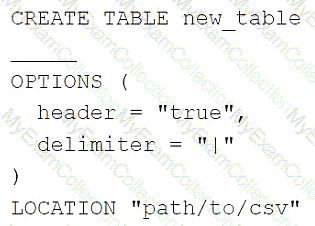
Which of the following lines of code fills in the above blank to successfully complete the task?

A.

None of these lines of code are needed to successfully complete the task

B.

USING CSV

C.

FROM CSV

D.

USING DELTA

E.

FROM " path/to/csv "

Full Access
Question # 47

What is the primary function of the Silver layer in the Databricks medallion architecture?

A.

lngest raw data in its original state

B.

Validate, clean, and deduplicate data for further processing

C.

Aggregate and enrich data for business analytics

D.

Store historical data solely for auditing purposes

Full Access
Question # 48

A team creates YAML manifests that declare jobs, resources, and dependencies, then deploys them to Databricks using the Databricks CLI . The deployment succeeds.

Which feature are they using?

A.

Databricks Asset Bundles

B.

GitHub

C.

Terraform

D.

DataOps

Full Access
Question # 49

A Python file is ready to go into production and the client wants to use the cheapest but most efficient type of cluster possible. The workload is quite small, only processing 10GBs of data with only simple joins and no complex aggregations or wide transformations.

Which cluster meets the requirement?

A.

Job cluster with Photon enabled

B.

Interactive cluster

C.

Job cluster with spot instances disabled

D.

Job cluster with spot instances enabled

Full Access
Question # 50

A data engineer ingests semi-structured JSON logs into a Delta table using Auto Loader with schema evolution enabled. A new string field named userAgent appears in the JSON source data.

What happens to the new userAgent field?

A.

Ingestion fails with a schema-mismatch error until the table is manually altered.

B.

All existing data is backfilled with a default value for userAgent, and the column is made non-nullable.

C.

The userAgent field is added as a new nullable column in the Delta table and populated for new data.

D.

The userAgent field is silently ignored, and its data is dropped from all new files.

Full Access
Question # 51

Which of the following data workloads will utilize a Gold table as its source?

A.

A job that enriches data by parsing its timestamps into a human-readable format

B.

A job that aggregates uncleaned data to create standard summary statistics

C.

A job that cleans data by removing malformatted records

D.

A job that queries aggregated data designed to feed into a dashboard

E.

A job that ingests raw data from a streaming source into the Lakehouse

Full Access
Question # 52

A data engineer needs to conduct Exploratory Analysis on data residing in a database that is within the company ' s custom-defined network in the cloud. The data engineer is using SQL for this task.

Which type of SQL Warehouse will enable the data engineer to process large numbers of queries quickly and cost-effectively?

A.

Serverless compute for notebooks

B.

Serverless SQL Warehouse

C.

Classic SQL Warehouse

D.

Pro SQL Warehouse

Full Access
Question # 53

A data engineer is cleaning a Bronze table. The requirement is to eliminate rows where either the customer_email field or the customer_phone field is NULL. The cleaning must be performed in one operation using a single method call.

Which PySpark approach supports filtering multiple columns for NULL values in one call?

A.

df.dropna(subset=[ " customer_email " , " customer_phone " ])

B.

df.where( " customer_email IS NOT NULL " ).where( " customer_phone IS NOT NULL " )

C.

df.na.drop(how= " all " )

D.

df.filter(col( " customer_email " ).isNotNull() & col( " customer_phone " ).isNotNull())

Full Access
Question # 54

Which of the following SQL keywords can be used to convert a table from a long format to a wide format?

A.

PIVOT

B.

CONVERT

C.

WHERE

D.

TRANSFORM

E.

SUM

Full Access
Question # 55

A data engineer is attempting to drop a Spark SQL table my_table and runs the following command:

DROP TABLE IF EXISTS my_table;

After running this command, the engineer notices that the data files and metadata files have been deleted from the file system.

Which of the following describes why all of these files were deleted?

A.

The table was managed

B.

The table ' s data was smaller than 10 GB

C.

The table ' s data was larger than 10 GB

D.

The table was external

E.

The table did not have a location

Full Access
Question # 56

A data engineer only wants to execute the final block of a Python program if the Python variable day_of_week is equal to 1 and the Python variable review_period is True.

Which of the following control flow statements should the data engineer use to begin this conditionally executed code block?

A.

if day_of_week = 1 and review_period:

B.

if day_of_week = 1 and review_period = " True " :

C.

if day_of_week == 1 and review_period == " True " :

D.

if day_of_week == 1 and review_period:

E.

if day_of_week = 1 & review_period: = " True " :

Full Access
Question # 57

A data engineer has realized that they made a mistake when making a daily update to a table. They need to use Delta time travel to restore the table to a version that is 3 days old. However, when the data engineer attempts to time travel to the older version, they are unable to restore the data because the data files have been deleted.

Which of the following explains why the data files are no longer present?

A.

The VACUUM command was run on the table

B.

The TIME TRAVEL command was run on the table

C.

The DELETE HISTORY command was run on the table

D.

The OPTIMIZE command was nun on the table

E.

The HISTORY command was run on the table

Full Access
Question # 58

A data engineer is attempting to write Python and SQL in the same command cell and is running into an error The engineer thought that it was possible to use a Python variable in a select statement.

Why does the command fail?

A.

Databricks supports multiple languages but only one per notebook.

B.

Databricks supports language interoperability in the same cell but only between Scala and SQL

C.

Databricks supports language interoperability but only if a special character is used.

D.

Databricks supports one language per cell.

Full Access
Question # 59

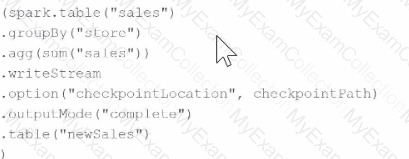
Which query is performing a streaming hop from raw data to a Bronze table?

A)
B)
C)
D)
A.

Option A

B.

Option B

C.

Option C

D.

Option D

Full Access
Question # 60

A data engineer has realized that the data files associated with a Delta table are incredibly small. They want to compact the small files to form larger files to improve performance.

Which of the following keywords can be used to compact the small files?

A.

REDUCE

B.

OPTIMIZE

C.

COMPACTION

D.

REPARTITION

E.

VACUUM

Full Access
Question # 61

A data engineer wants to create a new table containing the names of customers who live in France.

They have written the following command:

CREATE TABLE customersInFrance

_____ AS

SELECT id,

firstName,

lastName

FROM customerLocations

WHERE country = ’FRANCE’;

A senior data engineer mentions that it is organization policy to include a table property indicating that the new table includes personally identifiable information (Pll).

Which line of code fills in the above blank to successfully complete the task?

A.

COMMENT " Contains PIT

B.

511

C.

" COMMENT PII "

D.

TBLPROPERTIES PII

Full Access
Question # 62

Which SQL keyword can be used to convert a table from a long format to a wide format?

A.

TRANSFORM

B.

PIVOT

C.

SUM

D.

CONVERT

Full Access
Question # 63

A data engineer wants to create an external table in Databricks that references data stored in an Azure Data Lake Storage (ADLS) location. The goal is to enable Databricks to access and query this external data without moving it into Databricks-managed storage.

Which step should the data engineer take to successfully create the external table?

A.

Use the CREATE TABLE statement and specify the LOCATION clause with the path to the external data.

B.

Use the CREATE UNMANAGED TABLE statement without specifying a LOCATION clause.

C.

Use the CREATE EXTERNAL TABLE statement without specifying a LOCATION clause.

D.

Use the CREATE MANAGED TABLE statement and specify the LOCATION clause with the path to the external data.

Full Access
Question # 64

A data engineer is running a Spark SQL job on Databricks and notices that joins between a small lookup table and a large fact table are slow. The engineer wants Spark to automatically send the small lookup table to all executors to accelerate the join.

Which configuration parameter should the data engineer adjust?

A.

spark.sql.autoBroadcastJoinThreshold

B.

spark.default.parallelism

C.

spark.sql.shuffle.partitions

D.

spark.executor.memory

Full Access
Question # 65

A new data engineering team has been assigned to work on a project. The team will need access to database customers in order to see what tables already exist. The team has its own group team.

Which of the following commands can be used to grant the necessary permission on the entire database to the new team?

A.

GRANT VIEW ON CATALOG customers TO team;

B.

GRANT CREATE ON DATABASE customers TO team;

C.

GRANT USAGE ON CATALOG team TO customers;

D.

GRANT CREATE ON DATABASE team TO customers;

E.

GRANT USAGE ON DATABASE customers TO team;

Full Access
Question # 66

A data engineering team needs to integrate two data sources into Databricks:

    Clickstream events: 5,000 events per second from an Apache Kafka topic

    Customer master data: Only changed records every four hours from a Snowflake database

The solution must process clickstream data with latency under 30 seconds and prevent reprocessing customer master data that has not changed.

Which ingestion approach meets these requirements?

A.

Use Structured Streaming for Kafka and a Lakeflow Connect managed connector with incremental processing for Snowflake.

B.

Use a non-incremental Snowflake connector, fetch all data every four hours, and apply MERGE operations.

C.

Use spark.readStream() with Kafka and query Snowflake hourly using a time-based filter.

D.

Use Structured Streaming for Kafka and a Lakeflow Connect connector with a full refresh for Snowflake.

Full Access
Question # 67

A data engineer is deploying a dashboard through a Declarative Automation Bundle. The dashboard resource references ${var.dataset_catalog}, and the bundle contains the following configuration:

bundle:

name: workspace_assets

variables:

dataset_catalog:

default: catalog_dev

targets:

dev:

variables:

dataset_catalog: catalog_dev

prod:

variables:

dataset_catalog: catalog_prod

Which action deploys the dashboard to the production target using catalog_prod without changing the resource definition?

A.

Run databricks bundle deploy --var dataset_catalog=catalog_prod so that the CLI automatically selects targets.prod.

B.

Run databricks bundle deploy --profile prod so that the CLI selects targets.prod and applies catalog_prod.

C.

Run databricks bundle execute --profile prod so that the CLI selects targets.prod and applies catalog_prod.

D.

Run databricks bundle deploy --target prod so that the deployment uses targets.prod and its dataset_catalog override.

Full Access
Question # 68

A data engineer has multiple Unity Catalog-managed Delta tables that require regular maintenance. Currently, the engineer manually schedules OPTIMIZE and VACUUM jobs for each table, adjusting their frequency according to how often each table is queried and updated.

The engineer needs to eliminate this manual maintenance overhead and allow Databricks to determine automatically when and how to run these operations.

Which action should the engineer take?

A.

Enable predictive optimization at the account, catalog, or schema level so Databricks automatically identifies and runs maintenance operations on managed tables.

B.

Configure Auto Loader with schema evolution enabled so it automatically triggers OPTIMIZE and VACUUM after each ingestion batch.

C.

Enable liquid clustering with CLUSTER BY on each table so it automatically compacts files and removes stale files on a schedule.

D.

Set delta.autoOptimize.autoCompact and delta.autoOptimize.optimizeWrite table properties to trigger automatic VACUUM and file compaction.

Full Access
Question # 69

A data engineer uses the Databricks workspace UI with Unity Catalog enabled. In Catalog Explorer, they select catalog corp_marketing, then schema campaigns, and see table email_stats. The engineer must let the growth-analysts group read email_stats from its SQL warehouses, but not create, alter, or delete any objects in corp_marketing or campaigns.

Which action sequence meets the requirement?

A.

On schema campaigns, grant USE SCHEMA and SELECT; then grant SELECT on table email_stats.

B.

On catalog corp_marketing, grant USE CATALOG and CREATE SCHEMA; on schema campaigns, grant USE SCHEMA; then grant SELECT on email_stats.

C.

On catalog corp_marketing, grant USE CATALOG; on schema campaigns, grant USE SCHEMA; then grant SELECT on email_stats.

D.

On schema campaigns, grant USE SCHEMA; then grant SELECT and MODIFY on email_stats.

Full Access
