Question # 4
A management team is concerned about an unexpected cost increase for a public-facing AI chatbot.
Which of the following should a security administrator examine first to determine the root cause?
A.
Firewall logs
B.
Web application firewall (WAF) rules
C.
Vector database input/output operations per second performance
D.
Model token usage
Full Access
Answer:
D
Explanation:
Basic Concept: AI chatbot operational costs are primarily driven by token consumption — the number of tokens processed in requests and generated in responses. Unexpected cost increases in LLM-based chatbots almost always trace back to abnormal token usage patterns. CompTIA SecAI+ Study Guide covers AI cost monitoring and token-based billing under securing AI systems.
Why D is Correct: Model token usage logs directly show how many tokens are being consumed per request, by which users or endpoints, and whether usage has increased abnormally. Examining token usage data is the most direct path to identifying the root cause of unexpected cost increases — whether from a denial-of-wallet attack, user abuse, a new feature generating verbose responses, or legitimate organic growth in usage. This is the first and most relevant examination point for LLM cost analysis.
Why A is Wrong: Firewall logs capture network-level traffic information. While they can reveal unusual access patterns or volumes, they do not contain token consumption data that directly explains LLM billing increases.
Why B is Wrong: WAF rules define filtering policies for web traffic. Reviewing rule configurations does not reveal whether token usage has increased or why costs have risen; it shows security policy settings rather than consumption metrics.
Why C is Wrong: Vector database IOPS performance measures how quickly the database processes read and write operations. While relevant to RAG system performance, IOPS metrics do not directly explain LLM API cost increases driven by token consumption.
Question # 5
A security analyst reviews a recently released chatbot ' s log and discovers that outputs sometimes include personally identifiable information (PII) from other chatbot users.
Which of the following corrective actions should the security analyst take first to resolve this issue?
A.
Take the chatbot offline and restore it from a backup.
B.
Disable memory from the chat history for all users.
C.
Ask all users to refrain from using PII with the chatbot.
D.
Require users to label the sensitivity of their requests.
Full Access
Answer:
B
Explanation:
Basic Concept: When a chatbot leaks PII from one user ' s conversation into another user ' s responses, the root cause is cross-user memory contamination — the chatbot is retaining and sharing conversation context across user sessions. Disabling the memory feature stops the active data leakage immediately. CompTIA SecAI+ Study Guide covers session memory management as a privacy control for AI chatbots.
Why B is Correct: Disabling memory from chat history for all users immediately stops the mechanism causing PII leakage between users. If the chatbot retains no cross-session memory, it cannot include information from one user ' s conversation in another user ' s response. This is the most direct, immediate corrective action that eliminates the root cause of the privacy violation without requiring additional user behavior changes or service disruption.
Why A is Wrong: Taking the chatbot offline and restoring from backup is a drastic action appropriate when the issue requires investigating a potential compromise or data breach. For a configuration issue such as cross-user memory sharing, disabling the memory feature is a more targeted and proportionate first response that addresses the root cause directly.
Why C is Wrong: Asking users to refrain from using PII relies on voluntary user behavior change and does not address the technical root cause. Users may not comply, and even if they do, previously stored PII in memory would continue to leak. This is an ineffective first corrective action.
Why D is Wrong: Requiring users to label sensitivity does not stop the chatbot from storing and sharing PII that has already been submitted. Labels inform the system about data sensitivity but do not prevent the memory mechanism from sharing labeled sensitive data across user sessions.
Question # 6
Which of the following attacks is most enabled by AI-generated content?
A.
Model poisoning
B.
Phishing
C.
Ransomware
D.
Remote code execution
Full Access
Answer:
B
Explanation:
Basic Concept: AI-generated content including personalized text, synthetic voice, and deepfake video has dramatically enhanced the effectiveness and scalability of social engineering attacks. Understanding how AI amplifies specific attack types is key to CompTIA SecAI+ basic AI concepts in the cybersecurity context.
Why B is Correct: Phishing attacks are most dramatically enabled by AI-generated content. AI can generate highly personalized, grammatically perfect phishing emails tailored to individual targets using publicly available information. It can create convincing deepfake audio and video for voice phishing (vishing) and video phishing, replicate executive communication styles for business email compromise, and generate phishing campaigns at massive scale. The quality and personalization that previously required skilled human social engineers can now be automated with AI.
Why A is Wrong: Model poisoning is a specific attack against AI systems that corrupts training data to manipulate model behavior. While sophisticated, it is a targeted AI security attack rather than a broad cybercrime enabled by AI-generated content at scale.
Why C is Wrong: Ransomware is malware that encrypts victim data and demands payment for decryption keys. While AI can assist in ransomware development, ransomware deployment relies on code execution and network propagation techniques more than AI-generated content.
Why D is Wrong: Remote code execution involves exploiting vulnerabilities to run arbitrary code on a target system. It relies on technical vulnerability exploitation rather than AI-generated content. AI might assist in finding vulnerabilities, but RCE is not primarily enabled by content generation.
Question # 7
A security analyst notices that regardless of user-submitted prompts, an AI model always returns unsanitized responses. These responses are then passed to multiple plug-ins. The analyst is concerned with the potential security implications.
Which of the following Open Worldwide Application Security Project (OWASP) categories addresses this vulnerability?
A.
Misinformation
B.
Prompt injection
C.
Unbounded consumption
D.
Improper output handling
Full Access
Answer:
D
Explanation:
Basic Concept: OWASP has published the Top 10 vulnerabilities for Large Language Model Applications, each addressing a distinct category of LLM security risk. Understanding which OWASP category maps to specific LLM vulnerability scenarios is a key competency in the CompTIA SecAI+ Study Guide under securing AI systems.
Why D is Correct: Improper output handling (OWASP LLM02) occurs when an application passes LLM-generated outputs to downstream systems such as plug-ins, web browsers, or databases without proper validation, sanitization, or encoding. This can enable XSS, SQL injection, remote code execution, or other injection attacks against plug-ins and downstream systems. The scenario exactly matches this: unsanitized AI responses are automatically passed to multiple plug-ins, which could execute malicious content in the model ' s output.
Why A is Wrong: Misinformation refers to the AI generating false or misleading content that users might believe. It is a content accuracy concern related to hallucinations and false information propagation, not a vulnerability describing how model outputs are handled by downstream systems.
Why B is Wrong: Prompt injection involves crafting inputs to manipulate model behavior and override instructions. While it can be a contributing cause of unsafe outputs, the vulnerability described — passing unsanitized outputs to plug-ins — is specifically the output handling failure, not the injection mechanism itself.
Why C is Wrong: Unbounded consumption (OWASP LLM10) refers to resource exhaustion attacks including denial-of-wallet and denial-of-service through excessive token consumption. It addresses resource management vulnerabilities, not the security implications of passing model outputs to downstream systems.
Question # 8
A developer is proposing a new AI application for human resources systems. Which of the following are the most important considerations?
A.
Geniality and appeal
B.
Privacy and security
C.
Graphics and design
D.
Brevity and summarization
Full Access
Answer:
B
Explanation:
Option B is correct because a human resources AI application processes highly sensitive employee and applicant information and may influence consequential employment decisions. Privacy and security therefore determine whether the system can be deployed responsibly. The design must address data minimization, lawful collection, access control, encryption, retention, auditability, secure model integration, and protection against unauthorized disclosure. It should also evaluate whether training data or outputs expose protected or confidential information and whether human review is required before decisions affect candidates or employees. Option A concerns friendliness and presentation, not the protection of people or organizational data. Option C may improve usability, but visual design cannot compensate for insecure handling of resumes, performance records, or identity data. Option D can make outputs easier to consume, yet brevity and summarization do not control privacy risk or system compromise. The NIST AI Risk Management Framework identifies privacy enhancement, security, resilience, accountability, and transparency as characteristics of trustworthy AI, making privacy and security the controlling considerations in this scenario.
================
Question # 9
Which of the following requires developers to harden infrastructure to protect AI systems?
A.
Intake processes
B.
Acceptable use policies
C.
Development guidelines
D.
Configuration standards
Full Access
Answer:
D
Explanation:
Basic Concept: Infrastructure hardening for AI systems involves applying security baseline settings and eliminating unnecessary attack surfaces. CompTIA SecAI+ Exam Objectives identify configuration standards as the specific governance instrument that mandates infrastructure hardening requirements for AI deployments.
Why D is Correct: Configuration standards are formal, technical documents specifying exact security settings, baseline configurations, and hardening requirements that developers and administrators must implement to protect systems including AI infrastructure. They establish enforceable rules such as disabling unnecessary services, applying least-privilege access, and enforcing secure communication protocols specifically for AI systems.
Why A is Wrong: Intake processes govern how new projects, systems, or requests are evaluated and onboarded into an organization. They are procedural checkpoints for initial assessment, not technical hardening directives for developers.
Why B is Wrong: Acceptable use policies define appropriate ways employees and users may use organizational systems and AI tools. They are behavioral guidelines aimed at end users, not technical requirements instructing developers to secure infrastructure.
Why C is Wrong: Development guidelines provide best practices and recommendations for software development and may include security considerations. However, they are advisory in nature and broader in scope than the specific mandatory infrastructure-hardening requirements found in configuration standards.
Question # 10
A security consultant needs to detect attacks across a large language model (LLM) firewall.
Which of the following techniques should the consultant use?
A.
Signature matching
B.
Distributed denial-of-service
C.
Translation analysis
D.
Vulnerability enumeration
Full Access
Answer:
A
Explanation:
Basic Concept: LLM firewalls inspect prompts and responses to identify malicious content, policy violations, and attack attempts. To detect known attack patterns, these systems apply inspection techniques that compare content against established threat indicators. CompTIA SecAI+ Study Guide covers LLM security monitoring and detection techniques.
Why A is Correct: Signature matching compares incoming prompts and outgoing responses against a library of known attack signatures, including common prompt injection patterns, jailbreaking attempts, data exfiltration queries, and known malicious payload strings. When content matches a known attack signature, the LLM firewall can block or flag it. Signature matching is an efficient, proven detection technique for identifying known attack patterns traversing an LLM firewall.
Why B is Wrong: Distributed denial-of-service is itself a type of attack, not a detection technique. DDoS floods systems with traffic to cause service unavailability and has no role in detecting attacks through an LLM firewall.
Why C is Wrong: Translation analysis involves converting content between languages or formats. While it might be used to detect obfuscated attacks in different encodings, it is not a standard detection technique for identifying attacks crossing an LLM firewall.
Why D is Wrong: Vulnerability enumeration systematically identifies and catalogs vulnerabilities in systems or applications during security assessments. It is an assessment activity used to discover weaknesses, not a real-time detection technique for attacks traversing an LLM firewall.
Question # 11
A security operations center (SOC) analyst needs to automate multiple security tasks by breaking them down into smaller parts.
Which of the following AI tools is the best for this task?
A.
Agentic AI
B.
Retrieval-augmented generation (RAG) AI
C.
Generative AI
D.
Chatbot
Full Access
Answer:
A
Explanation:
Basic Concept: Modern security operations require automation of complex, multi-step workflows. Different AI architectures have different capabilities. Understanding which AI type is best suited for task decomposition and autonomous execution is fundamental to AI-assisted security operations. CompTIA SecAI+ covers agentic AI capabilities under AI-assisted security.
Why A is Correct: Agentic AI systems are specifically designed to autonomously plan, decompose complex tasks into subtasks, execute multi-step workflows, use tools and APIs, and adapt their approach based on intermediate results. For a SOC analyst needing to automate multiple security tasks as a series of smaller coordinated steps, agentic AI is the ideal architecture as it can orchestrate an entire workflow including threat hunting, alert investigation, log analysis, and response actions.
Why B is Wrong: RAG AI enhances language model responses by retrieving relevant documents from a knowledge base. While useful for answering questions with current information, it is not designed for autonomous multi-step task execution or workflow automation.
Why C is Wrong: Generative AI creates content based on prompts including text, code, and summaries. While it can assist with individual tasks, it requires continuous human prompting for each step rather than autonomously breaking down and executing complex multi-step security workflows.
Why D is Wrong: A chatbot is a conversational interface designed for question-answering or guided dialogue. It responds reactively to user input rather than proactively planning and executing multi-step automated security workflows.
Question # 12
Which of the following helps in managing potential security issues related to model training?
A.
National Institute of Standards and Technology (NIST) AI Risk Management Framework (RMF)
B.
International Organization for Standardization (ISO) 27001
C.
Organization for Economic Co-operation and Development (OECD)
D.
General Data Protection Regulation (GDPR)
Full Access
Answer:
A
Explanation:
Basic Concept: Managing security risks in AI model training requires a comprehensive framework specifically designed for AI risk identification, assessment, and mitigation across the entire AI lifecycle including data collection, training, and deployment. CompTIA SecAI+ Study Guide identifies NIST AI RMF as the primary resource for AI-specific risk management.
Why A is Correct: The NIST AI Risk Management Framework is purpose-built for managing risks throughout the AI lifecycle. It provides structured guidance for identifying, assessing, and mitigating risks specific to AI systems including training data quality, model bias, data poisoning, and training pipeline vulnerabilities. Its AI-specific scope makes it the most appropriate framework for managing model training security issues.
Why B is Wrong: ISO 27001 is an information security management system standard focused on general IT security controls and risk management. It does not specifically address AI model training risks, data pipeline integrity, or ML-specific vulnerabilities.
Why C is Wrong: The OECD provides high-level AI governance principles and policy recommendations at an international level. It offers ethical and policy guidance but does not provide operational risk management guidance for securing AI model training processes.
Why D is Wrong: GDPR is a European data protection regulation focused on personal data privacy, consent, and individual rights. While relevant to training data governance, it does not address the technical security risks of model training pipelines or ML system vulnerabilities.
Question # 13
A penetration tester is assessing the controls of a deployed AI system that is designed to search and return the contents of files.
The tester runs the following:
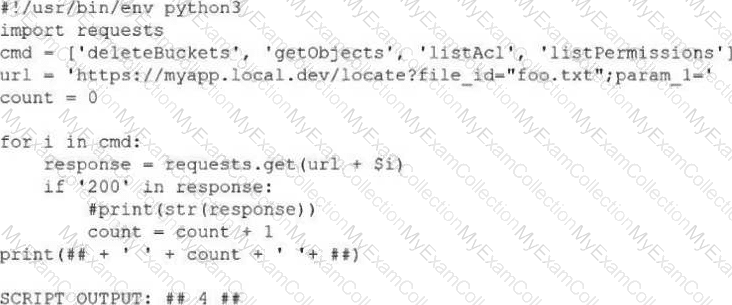
Which of the following is the best control to prevent abuse of the system?
A.
Implementing custom detection rules for anomalous model behavior
B.
Segmenting the workload into a separate virtual private cloud (VPC)
C.
Adding a large language model (LLM) guardrails library to the application code
D.
Reducing the privilege scope of the service account
Full Access
Answer:
D
Explanation:
Basic Concept: AI systems that access file systems or databases use service accounts to authenticate. Applying the principle of least privilege to these service accounts limits the damage that can result from prompt injection or other attacks that cause the AI to perform unauthorized file access. CompTIA SecAI+ Study Guide covers least privilege as a core AI security control.
Why D is Correct: Reducing the privilege scope of the service account implements the least privilege principle, ensuring the AI system can only access files it legitimately needs for its intended function. If an attacker uses prompt injection to abuse the file search capability, the service account ' s limited permissions prevent access to sensitive files outside the defined scope, containing the blast radius of any exploitation.
Why A is Wrong: Custom detection rules identify anomalous behavior after it occurs. They are detective controls, not preventive controls. They do not stop an attacker from successfully abusing the system; they only alert after abuse has occurred.
Why B is Wrong: VPC segmentation isolates the workload at the network level, limiting lateral movement. However, it does not restrict what files the AI ' s service account can access within its own environment, so file abuse attacks within the segment are still possible.
Why C is Wrong: LLM guardrails filter prompt inputs and outputs for policy violations. While useful, they can potentially be bypassed through sophisticated prompt injection. Reducing service account privileges provides a defense-in-depth layer that limits damage even if guardrails are bypassed.
Question # 14
A security administrator must provide access controls for AI systems to list tables.
Which of the following should the administrator implement?
A.
Agentic AI access
B.
Network access control list (NACL)
C.
Model access
D.
Data access
Full Access
Answer:
D
Explanation:
Basic Concept: AI systems interact with different resource layers including models, data stores, and infrastructure. Controlling what data an AI system can access requires implementing access controls at the data layer. CompTIA SecAI+ Study Guide differentiates between model access, data access, and network access controls for AI systems.
Why D is Correct: Data access controls govern what data resources an AI system can interact with, including which databases, tables, and records it can read or modify. To control an AI system ' s ability to list database tables, the administrator must implement data access controls that define precisely which tables the AI can enumerate and query, following the principle of least privilege for data interactions.
Why A is Wrong: Agentic AI access refers to permissions granted to autonomous AI agents to perform actions and use tools. It is a broader concept about what an AI agent can do operationally rather than a specific data-layer access control mechanism.
Why B is Wrong: A Network Access Control List controls network traffic at the IP and port level, determining which hosts can communicate with which network resources. It operates at the network layer and cannot enforce fine-grained control over which database tables an AI system is allowed to list.
Why C is Wrong: Model access controls govern who and what can interact with the AI model itself — who can query it, update it, or access its parameters. This is distinct from data access, which controls what the model can read from data stores during operation.
Question # 15
During a model validation procedure, an engineer notices that a model performs well during training but poorly during testing.
Which of the following best describes the reason?
A.
Fine-tuning
B.
Overfitting
C.
Regularization
D.
Inference
Full Access
Answer:
B
Explanation:
Basic Concept: The gap between training performance and test performance is a classic indicator of a specific model quality problem. Understanding this phenomenon and its causes is fundamental to AI model development. CompTIA SecAI+ Study Guide covers overfitting under basic AI concepts and model quality.
Why B is Correct: Overfitting occurs when a model learns the training data too specifically — memorizing noise, outliers, and specific patterns in the training set rather than learning generalizable underlying patterns. The model achieves high accuracy on training data but fails to generalize to new, unseen test data. This produces exactly the scenario described: excellent training performance combined with poor test performance. Overfitting is the quintessential cause of this training-testing performance gap.
Why A is Wrong: Fine-tuning is a training technique that adapts a pre-trained model to a new task or domain using additional training data. It is a deliberate training process, not a description of why a model ' s performance degrades from training to testing.
Why C is Wrong: Regularization is a training technique specifically used to prevent overfitting by adding penalties to large model weights, encouraging the model to learn simpler, more generalizable patterns. It is the solution to overfitting, not its cause.
Why D is Wrong: Inference is the process of using a trained model to make predictions on new data. It describes the operational use of a model, not a quality characteristic that explains why performance differs between training and testing phases.
Question # 16
Which of the following is the best example of an AI model that is trained to identify multiple points from input using a neural network to provide output for authentication?
A.
Facial recognition
B.
Encryption key
C.
Open Authorization (OAuth)
D.
Bounding box
Full Access
Answer:
A
Explanation:
Basic Concept: Neural networks can be trained to identify and match complex multi-point patterns in data. For biometric authentication, facial recognition uses deep neural networks to extract and compare dozens to hundreds of facial feature points from an input image. CompTIA SecAI+ covers neural network-based authentication under basic AI concepts.
Why A is Correct: Facial recognition systems use neural networks specifically trained to identify multiple facial landmarks and feature points such as eye distance, nose shape, and jawline contour from input images. These extracted feature vectors are compared against stored templates to authenticate individuals, making this the ideal example of multi-point neural network-based authentication output.
Why B is Wrong: An encryption key is a cryptographic artifact, not an AI model output. Encryption keys are generated mathematically, not through neural network training or multi-point feature identification from biometric inputs.
Why C is Wrong: OAuth is an open authorization protocol framework that handles delegated access and permission grants between services. It is an authentication delegation standard, not an AI model that processes input through neural networks.
Why D is Wrong: A bounding box is an output of object detection models that draws a rectangular box around detected objects in an image. While it uses neural networks, it identifies object location rather than multiple feature points for authentication purposes.
Question # 17
Security analysts want to track potential user behavior anomalies over time. Which of the following is the most comprehensive approach?
A.
Using an AI-enabled scanner to compare user permissions to other users in the department
B.
Using an agentic large language model (LLM) to search for multiple instances of a username in logs
C.
Leveraging browser plug-ins that monitor for uncommon sites visited by a user
D.
Running automated playbooks that monitor standard deviations from a user baseline
Full Access
Answer:
D
Explanation:
Option D is correct because behavioral anomaly detection requires a persistent baseline of normal user activity and a repeatable method for measuring departures from that baseline. Automated playbooks can continuously collect authentication, endpoint, network, and application events, calculate deviations such as unusual login times, abnormal resource access, or atypical transaction volume, and escalate activity that exceeds defined thresholds. Standard-deviation-based comparison is broader and more defensible than searching for a username or checking a single data source. Option A provides only a permissions comparison at one point in time; it does not establish how the user normally behaves. Option B searches log occurrences but lacks behavioral context, trend analysis, and reliable anomaly scoring. Option C observes only browser activity and therefore misses anomalies in identity, host, cloud, and business systems. A mature implementation should tune baselines, account for role and seasonality, and retain analyst review so legitimate changes are not treated as malicious. This aligns with AI-assisted security concepts involving user and entity behavior analytics, automated enrichment, and risk-based triage.
================
Question # 18
A cyberthreat intelligence (CTI) analyst conducts research about a threat during a recent attack. The analyst uses an AI threat-modeling resource to find the relevant risks and utilizes causal and domain taxonomies. Which of the following best describes which resource the analyst is using?
A.
Massachusetts Institute of Technology (MIT) AI Risk Repository
B.
MITRE Adversarial Threat Landscape for Artificial-Intelligence Systems (ATLAS)
C.
Common Vulnerabilities and Exposures (CVE) AI Working Group
D.
Open Worldwide Application Security Project (OWASP) Machine Learning Security Top 10
Full Access
Answer:
A
Explanation:
The MIT AI Risk Repository is specifically characterized by its use of both a Causal Taxonomy and a Domain Taxonomy. The repository consolidates AI risks from numerous frameworks and allows practitioners to classify and research risks according to how, when, and why they occur as well as the domain of harm involved. MIT states that its Causal Taxonomy addresses factors such as the responsible entity, intent, and timing, while its Domain Taxonomy categorizes risks into broader domains and subdomains. This terminology directly matches the scenario. CompTIA SecAI+ includes the MIT AI Risk Repository among the threat-modeling resources candidates must understand. MITRE ATLAS instead organizes adversarial AI activity into tactics, techniques, procedures, and case studies. The CVE AI Working Group focuses on vulnerabilities and related vulnerability-management concerns rather than causal/domain risk taxonomies. OWASP ' s Machine Learning Security Top 10 concentrates on prominent ML security risks and defensive awareness. Because the question explicitly identifies causal and domain taxonomies, the MIT AI Risk Repository is the precise resource being described.
================
Question # 19
A team of data scientists is ready to release a model for enterprise use. The team wants to protect the model from unintentional changes or tampering.
Which of the following is the most appropriate action?
A.
Change the model to a large language model (LLM) for interactive features with guardrails.
B.
Provide secure copies of the model for local runtime usage.
C.
Restrict access to only IT professionals in the organization.
D.
Integrate an application programming interface (API) with identity and access management (IAM) roles to interact with the model.
Full Access
Answer:
D
Explanation:
Basic Concept: Protecting a released AI model from unauthorized modification requires controlling who can interact with it and at what privilege level. IAM-integrated API access provides granular, auditable control over model interactions. CompTIA SecAI+ Study Guide covers model protection through identity and access management integration.
Why D is Correct: Integrating an API with IAM roles ensures that all interactions with the model are authenticated and authorized according to precisely defined permissions. IAM roles enforce the principle of least privilege, ensuring users can query the model only within authorized scope and cannot modify model parameters, weights, or configuration. API-level access provides an abstraction layer that protects the underlying model from direct access while enabling controlled, auditable interactions.
Why A is Wrong: Changing to an LLM with guardrails addresses model behavior safety but does not protect the model artifacts themselves from tampering or unauthorized modification. It changes the model type rather than implementing access controls.
Why B is Wrong: Providing secure copies for local runtime distributes model copies to multiple endpoints, significantly increasing the attack surface for tampering. Each local copy represents a potential point of unauthorized modification.
Why C is Wrong: Restricting access to IT professionals is overly broad and vague. IT professionals may still need varying levels of access for different purposes, and generic role-based access without IAM integration and API mediation provides insufficient granularity to prevent unintentional modification.
Question # 20
Which of the following responsible AI standards refers to a principle that clearly states the reasons behind the decisions for a particular conclusion?
A.
Accountability
B.
Auditability
C.
Transparency
D.
Explainability
Full Access
Answer:
D
Explanation:
Basic Concept: Responsible AI encompasses several key principles governing how AI systems should behave to be trustworthy and ethical. These principles are distinct but related. Understanding their precise definitions is essential for CompTIA SecAI+ Domain 4 governance questions.
Why D is Correct: Explainability in responsible AI means the AI system can clearly articulate the specific reasons, factors, and logic that led to a particular decision or output. It answers the question " why did the AI make this specific decision? " For example, an explainable credit scoring AI would not only give a score but also explain which factors such as payment history or credit utilization contributed most to that specific score. This directly matches the question ' s description of " clearly stating reasons behind decisions. "
Why A is Wrong: Accountability refers to the ability to identify who is responsible for AI system decisions and their consequences. It addresses ownership and responsibility assignment rather than explaining the reasoning behind specific decisions.
Why B is Wrong: Auditability refers to the ability to examine and verify an AI system ' s decisions, processes, and outputs through systematic review. It enables after-the-fact verification but does not mean the system itself explains its reasoning.
Why C is Wrong: Transparency refers to openness about how an AI system works at a general level, including its purpose, capabilities, limitations, and the data it was trained on. It is broader than explainability and does not specifically address articulating reasons for individual decisions.
Question # 21
An employee wants a consulting company to procure a data set that contains age, ethnicity, and diabetes status. During development, the employer wants to ensure the integrity of the data.
Which of the following is the best strategy to accomplish this task?
A.
Implementing checksums
B.
Conducting human evaluation
C.
Querying the model
D.
Enabling log monitoring
Full Access
Answer:
A
Explanation:
Basic Concept: Data integrity ensures that data has not been tampered with, corrupted, or modified during storage or transmission. For AI training data that is procured from external sources, cryptographic integrity verification is essential to confirm the data arrived unmodified. CompTIA SecAI+ Study Guide covers data integrity controls for AI data pipelines.
Why A is Correct: Implementing checksums provides cryptographic verification of data integrity. A checksum or hash value such as SHA-256 is computed from the dataset at the source. The receiver computes the same hash and compares it to the provided value. Any modification to the data during transit or storage will produce a different hash, immediately detecting tampering or corruption. This is the most reliable, automated, and scalable strategy for ensuring the integrity of procured training data.
Why B is Wrong: Human evaluation can verify data quality and relevance but is impractical for verifying integrity across large datasets of medical records. Human reviewers cannot detect subtle bit-level corruption or intentional small modifications, and the process is not scalable.
Why C is Wrong: Querying the model tests model performance rather than verifying the integrity of the underlying training data. The model cannot tell you whether its training data was modified after collection or during procurement.
Why D is Wrong: Log monitoring tracks system activities and events over time. While useful for auditing access to data, it cannot retroactively confirm that data content has not been modified and does not provide cryptographic integrity guarantees.
Question # 22
A cybersecurity administrator needs a security mechanism that can validate input.
Which of the following controls should the administrator use?
A.
Prompt firewall
B.
Rate limits
C.
Token limits
D.
Input quantity
Full Access
Answer:
A
Explanation:
Basic Concept: Input validation is a fundamental security principle that checks incoming data against expected criteria before processing it. For AI systems, this requires a mechanism capable of inspecting the semantic content and structure of inputs — not just their volume or format. CompTIA SecAI+ Study Guide identifies prompt firewalls as the primary input validation control for AI systems.
Why A is Correct: A prompt firewall validates incoming inputs by inspecting their content against security policies, detecting malicious patterns such as injection strings or jailbreaking attempts, enforcing structural rules, and blocking non-compliant inputs before they reach the AI model. Unlike network firewalls that operate on packet headers, a prompt firewall understands the semantic content of AI prompts, making it the appropriate input validation mechanism for AI systems.
Why B is Wrong: Rate limits control how frequently inputs are submitted, not what those inputs contain. A malicious prompt submitted within rate limits will not be detected or blocked — rate limiting does not validate the content or intent of individual inputs.
Why C is Wrong: Token limits cap the maximum length of inputs and outputs in terms of tokens. While this can prevent excessively long inputs from being processed, it does not inspect input content for malicious patterns or validate that inputs conform to policy requirements.
Why D is Wrong: Input quantity is a generic term that might refer to limiting the number or size of inputs. Like token limits and rate limits, quantity controls do not validate the content of inputs for security compliance or detect malicious prompt patterns.
Question # 23
A cybersecurity analyst must use pattern recognition on a data set containing unstructured data.
Which of the following models is the best for this task?
A.
Long short-term memory
B.
Convolutional neural network
C.
Decision tree
D.
Logistic regression
Full Access
Answer:
B
Explanation:
Basic Concept: Different ML model architectures are optimized for different data types and tasks. Unstructured data such as images, raw network packet captures, and visual content requires models capable of automatically extracting hierarchical spatial features. CompTIA SecAI+ covers ML model selection for security tasks under basic AI concepts.
Why B is Correct: Convolutional Neural Networks (CNNs) are specifically designed for pattern recognition in unstructured data, particularly image and grid-structured data. CNNs use convolutional layers to automatically extract local and hierarchical features without requiring manual feature engineering. They excel at recognizing patterns in raw, unstructured inputs, making them the optimal choice for pattern recognition on unstructured datasets in cybersecurity contexts such as image-based malware analysis or visual traffic pattern recognition.
Why A is Wrong: Long Short-Term Memory (LSTM) networks are recurrent neural networks optimized for sequential and time-series data such as network traffic flows over time or log sequences. While they handle unstructured sequential data, they are not specifically designed for spatial pattern recognition in general unstructured data.
Why C is Wrong: Decision trees work on structured, tabular data with defined features. They require feature extraction and engineering before processing unstructured data and are not designed for raw pattern recognition in unstructured inputs.
Why D is Wrong: Logistic regression is a linear classification algorithm that requires structured, numerical input features. It cannot directly process unstructured data and requires extensive preprocessing and feature extraction, making it unsuitable for pattern recognition on raw unstructured datasets.
Question # 24
Which of the following is the first step before using an online data set?
A.
A review by the legal team
B.
A feasibility study by the business
C.
A model design review by the architect
D.
A third-party risk management assessment
Full Access
Answer:
D
Explanation:
A third-party risk management assessment is the best first step because an externally obtained online dataset introduces risks concerning source trustworthiness, provenance, licensing, privacy, integrity, security, and regulatory compliance. CompTIA SecAI+ requires candidates to understand third-party compliance evaluations as part of AI governance and also emphasizes trustworthiness and authenticity during the AI lifecycle ' s data-collection stage. Before incorporating an externally sourced dataset into model development or training, the organization should determine who created or controls the data, whether its collection and distribution are legitimate, whether contractual or usage restrictions exist, and whether sensitive or malicious content could be present. A legal review may subsequently be required for licensing, copyright, privacy, and contractual issues, but third-party risk assessment provides the broader initial evaluation. A feasibility study addresses whether the proposed project is practical from a business perspective rather than whether the dataset is trustworthy. Model design review occurs later and focuses on architecture and implementation. Consequently, third-party risk management provides the most comprehensive initial gate before introducing an online dataset into the organization ' s AI lifecycle.
================
Question # 25
An organization is concerned with the exposure of sensitive data.
Which of the following is the most relevant security concern?
A.
Overfitting
B.
Model inversion
C.
Data normalization
D.
Hyperparameter tuning
Full Access
Answer:
B
Explanation:
Basic Concept: AI models can inadvertently memorize sensitive information from their training data. Certain attack techniques can exploit this memorization to extract private information from a deployed model, even without direct access to the training dataset. CompTIA SecAI+ Study Guide covers model inversion as an AI-specific data exposure attack vector.
Why B is Correct: Model inversion is an attack where an adversary queries a deployed AI model with carefully crafted inputs to reconstruct or infer sensitive training data. For example, an attacker could query a facial recognition model with optimized images to reconstruct faces of individuals from the training set, or query a medical diagnosis model to infer patient records used in training. This directly exposes sensitive data that was supposed to be protected.
Why A is Wrong: Overfitting is a model training quality issue where a model learns training data too specifically and performs poorly on new data. While it can indicate that sensitive data was memorized, overfitting itself is a performance concern rather than directly a data exposure attack vector.
Why C is Wrong: Data normalization is a preprocessing technique that scales numerical features to a common range to improve training performance. It is a data preparation step with no direct relevance to sensitive data exposure or privacy attacks.
Why D is Wrong: Hyperparameter tuning adjusts configuration parameters of a model to optimize its performance during training. It is an optimization technique with no relevance to protecting against sensitive data exposure attacks.
Question # 26
During the selection of a machine learning (ML)-based threat classification model, a cybersecurity administrator verifies that label distribution is highly unbalanced.
Which of the following processing techniques should the engineer use to balance the model?
A.
Data lineage
B.
Data augmentation
C.
Data provenance
D.
Data verification
Full Access
Answer:
B
Explanation:
Basic Concept: Class imbalance in training data — where some categories have significantly more examples than others — causes ML models to be biased toward the majority class, producing poor detection of minority class threats. Addressing this imbalance before training is critical for threat classification accuracy. CompTIA SecAI+ covers data preparation techniques under basic AI concepts.
Why B is Correct: Data augmentation addresses class imbalance by artificially increasing the number of training samples in under-represented classes. Techniques include oversampling minority classes by creating synthetic examples using methods like SMOTE (Synthetic Minority Over-sampling Technique), or undersampling majority classes. This balances label distribution and enables the model to learn decision boundaries that accurately classify all threat categories, not just the dominant ones.
Why A is Wrong: Data lineage documents the origin, movement, and transformation of data throughout its lifecycle. It provides traceability and auditability but does not address class imbalance in training data distribution.
Why C is Wrong: Data provenance records the history and context of data origins. Like lineage, it is a governance and tracking concept that does not alter data distribution for model training balance.
Why D is Wrong: Data verification confirms that data is correct and consistent with expected formats and values. It checks data quality and integrity but does not address the statistical distribution imbalance between threat classes in training datasets.
Question # 27
Developers introduce new features to their generative AI product in an effort to stand out from the competition and offer more value to customers.
Which of the following most accurately explains the risks when enabling more functionality?
A.
The risks remain the same as before the new features were added.
B.
The risks increase when new features are added.
C.
The risks are measured qualitatively.
D.
The risks are proportional to the model ' s capabilities.
Full Access
Answer:
D
Explanation:
Basic Concept: The relationship between AI system capabilities and security risk is a fundamental concept in AI governance. As AI models gain more functionality and capabilities, their potential for misuse, unintended consequences, and attack surface expansion grows proportionally. CompTIA SecAI+ Study Guide addresses capability-risk proportionality under AI governance.
Why D is Correct: The risks of a generative AI product are proportional to its capabilities. Each new feature expands what the model can do, which simultaneously expands what adversaries can manipulate it to do, what sensitive operations it can be directed to perform, and what unintended harm it can cause. A model that can generate text, images, execute code, and call external APIs has dramatically greater risk potential than one that can only generate text. Risk grows with capability scope.
Why A is Wrong: Risks do not remain constant when new features are added. New features introduce new attack vectors, expand the model ' s action space, and create new opportunities for misuse. Each addition fundamentally changes the system ' s risk profile.
Why B is Wrong: While risks do increase with new features, saying they simply increase does not capture the precise relationship. The increase is proportional to the nature and scope of the capabilities added, not a uniform increment for any feature addition.
Why C is Wrong: While risks can be measured qualitatively, stating that risks are measured qualitatively is a statement about measurement methodology rather than an explanation of how risks change when functionality is enabled. It does not accurately describe the relationship between capability and risk.
Question # 28
An organization recently developed an AI-powered product and discovers that it is vulnerable to attacks in which malicious actors can alter the input, causing the system to recommend inappropriate information.
Which of the following techniques is the most effective way to secure the system against manipulation attacks?
A.
Cross-validation
B.
Feature regularization
C.
Feature scaling
D.
Guardrails
Full Access
Answer:
D
Explanation:
Basic Concept: Input manipulation attacks — including adversarial examples and prompt injection — alter inputs to cause AI systems to produce unintended, harmful, or inappropriate outputs. Defending against these attacks requires mechanisms that validate and constrain both inputs and outputs at runtime. CompTIA SecAI+ Study Guide identifies guardrails as the primary defense against input manipulation in AI systems.
Why D is Correct: Guardrails implement real-time validation and filtering of both incoming inputs and outgoing recommendations. They detect manipulated inputs that deviate from expected patterns, enforce content policies on outputs, and prevent the system from producing inappropriate recommendations regardless of how cleverly the input was crafted. Guardrails provide the most comprehensive and directly applicable defense against the described manipulation attack scenario.
Why A is Wrong: Cross-validation is a model evaluation technique that assesses how well a model generalizes to independent datasets during training. It measures predictive performance but does not provide runtime protection against input manipulation attacks on a deployed system.
Why B is Wrong: Feature regularization is a training technique that adds penalties to model weights to prevent overfitting. It improves generalization during training but does not inspect or validate inputs at inference time to detect manipulation.
Why C is Wrong: Feature scaling normalizes input feature values to a standard range for training efficiency. Like regularization, it is a preprocessing and training step that has no effect on defending against runtime input manipulation attacks on deployed systems.
Question # 29
An organization develops a chatbot that does not provide harmful or explicit responses, must use clean and professional language, and ensures that responses are accurate.
Which of the following should the organization conduct after the chatbot is fully developed but before a customer-facing deployment?
A.
Data labeling and classification
B.
Model auditing and evaluation
C.
Guardrail testing and validation
D.
Regression modeling and minimization
Full Access
Answer:
C
Explanation:
Basic Concept: Before deploying an AI chatbot that has specific behavioral requirements — no harmful content, professional language, and accurate responses — organizations must verify that the controls designed to enforce these requirements actually work as intended. This pre-deployment verification is essential for customer-facing systems. CompTIA SecAI+ Study Guide covers guardrail testing as a required pre-deployment activity.
Why C is Correct: Guardrail testing and validation specifically verifies that the content filtering, safety controls, and behavioral constraints implemented in the chatbot function correctly before customer exposure. This involves systematically testing with edge cases, adversarial prompts, and boundary conditions to confirm that harmful content is blocked, language remains professional, and responses are accurate. This directly validates the three requirements stated in the question.
Why A is Wrong: Data labeling and classification is a data preparation activity performed during model training and development. By the time the chatbot is fully developed, this work should already be complete.
Why B is Wrong: Model auditing and evaluation assesses overall model performance, accuracy, and compliance at a broader level. While important, it does not specifically verify that the guardrails enforcing the three behavioral requirements work correctly for the specific failure modes customers might trigger.
Why D is Wrong: Regression modeling and minimization refers to statistical techniques for continuous outcome prediction. This is not a relevant pre-deployment activity for a conversational chatbot requiring behavioral safety validation.
Question # 30
A financial services company is being sued for using AI in the loan underwriting process. The lawsuit reveals that the AI model used biased sources to disproportionately deny loans to residents in certain postal codes. Which of the following employees is the most qualified to remove these biased sources from the model?
A.
Platform engineer
B.
Data scientist
C.
Cybersecurity analyst
D.
AI architect
Full Access
Answer:
B
Explanation:
The data scientist is the most appropriate role because correcting biased source data requires examining the datasets used to develop, train, validate, or refine the model and then modifying the data preparation or model-development process. Data scientists work directly with training data, feature selection, statistical distributions, model development, and evaluation, which places them in the strongest position to identify biased inputs and retrain or adjust the model using more representative information. CompTIA SecAI+ includes the data scientist as a formal AI governance role and separately identifies fairness, introduction of bias, accuracy, and model performance as key responsible-AI risks. A platform engineer primarily manages the infrastructure supporting AI workloads. A cybersecurity analyst focuses on security threats, monitoring, and defensive controls rather than correcting discriminatory training data. An AI architect designs the broader architecture and integration of AI solutions but normally does not perform the detailed dataset preparation and model-training work required here. Because the problem originates in biased data sources, the data scientist is the role closest to the underlying cause.
================
Question # 31
A healthcare organization plans to deploy a chatbot for appointment scheduling and patient records.
Which of the following is the first step a security administrator should take?
A.
Implement prompt firewalls.
B.
Enable role-based access management
C.
Conduct a risk assessment.
D.
Use a secure data communication channel for chat.
Full Access
Answer:
C
Explanation:
Basic Concept: Before implementing any security controls for an AI system, especially in a highly regulated sector such as healthcare, a risk assessment must first be conducted to understand the specific threats, vulnerabilities, regulatory obligations, and compliance requirements. CompTIA SecAI+ Study Guide emphasizes risk assessment as the foundational first step in any AI security program.
Why C is Correct: A risk assessment identifies what assets need protection, what threats exist, what regulations apply such as HIPAA for healthcare AI, and what the potential impact of various failure modes would be. In healthcare, this is especially critical given the sensitivity of patient records and strict regulatory requirements. The risk assessment results then inform and prioritize all subsequent security control implementations.
Why A is Wrong: Implementing prompt firewalls is a technical security control appropriate after risks have been identified and prioritized. Deploying controls before conducting a risk assessment may address the wrong threats or miss critical vulnerabilities.
Why B is Wrong: Role-based access management is a security control that should be designed based on identified roles and access requirements discovered during risk assessment. It is an implementation step, not the first step.
Why D is Wrong: Using a secure communication channel is a specific technical control for data in transit. While important, it addresses only one specific risk and should be implemented as part of a comprehensive security strategy informed by a prior risk assessment.
Question # 32
A recent release of an AI software update exposes confidential customer information due to storage misconfiguration.
Which of the following data security controls will help maintain confidentiality despite the data leak?
A.
Model encryption
B.
Encryption in transit
C.
Encryption in use
D.
Encryption at rest
Full Access
Answer:
D
Explanation:
Basic Concept: When a storage misconfiguration leads to data exposure, the question is which encryption type would have protected the confidentiality of data stored in that misconfigured storage. The three states of data — at rest, in transit, and in use — each require different encryption mechanisms. CompTIA SecAI+ Study Guide covers encryption states and their applicability to AI data protection.
Why D is Correct: Encryption at rest protects data stored in databases, file systems, and storage media by encrypting it so that even if unauthorized parties gain access to the storage through a misconfiguration, the data remains unreadable without the decryption key. Since the exposure resulted from a storage misconfiguration that allowed access to stored data, encryption at rest would have maintained confidentiality of the customer information despite the misconfiguration granting storage access.
Why A is Wrong: Model encryption specifically protects AI model weights and parameters from unauthorized access. It does not protect customer data stored in databases or data stores associated with the AI system.
Why B is Wrong: Encryption in transit protects data moving between components over networks. It does not protect data stored at rest in misconfigured storage that is accessed directly rather than over a network connection.
Why C is Wrong: Encryption in use (homomorphic encryption or confidential computing) protects data while it is being actively processed in memory. It addresses runtime processing security, not the confidentiality of data stored in misconfigured storage that is not currently being processed.
Question # 33
A security administrator wants to prevent prompt injection attacks and ensure responses have sanitized output.
Which of the following provides a primary compensating control for these requirements?
A.
Least privilege
B.
Encryption
C.
A large language model (LLM) firewall
D.
Rate limiting
Full Access
Answer:
C
Explanation:
Basic Concept: Preventing prompt injection and ensuring output sanitization requires a control that can inspect both the semantic content of incoming prompts and the safety of outgoing responses. This requires an intelligent, context-aware filtering layer specifically designed for LLM traffic. CompTIA SecAI+ Study Guide identifies LLM firewalls as a primary control for prompt security and output safety.
Why C is Correct: An LLM firewall is specifically designed to inspect, filter, and sanitize both incoming prompts and outgoing AI responses. It can detect and block prompt injection attempts using pattern matching, semantic analysis, and behavioral heuristics, while also sanitizing output to remove sensitive data, harmful content, or policy violations before responses reach users. This dual capability makes it the primary control addressing both requirements simultaneously.
Why A is Wrong: Least privilege restricts what resources and actions users and systems can access. It reduces the potential impact of successful attacks but does not inspect prompt content for injection attempts or sanitize model outputs.
Why B is Wrong: Encryption protects data confidentiality in transit and at rest. It does not analyze prompt content for malicious patterns or filter AI-generated responses for unsafe content. Encrypted traffic can still carry prompt injection attacks.
Why D is Wrong: Rate limiting controls request frequency. While it can slow down automated injection attack campaigns, it does not inspect the content of individual prompts to detect injections, nor does it sanitize output responses. Malicious prompts can still succeed within rate limits.
Question # 34
Faculty members at a university are concerned about potential inherent bias and inconsistency in one department ' s AI plagiarism detection service.
Which of the following principles will most likely address their concerns?
A.
Transparency
B.
Explainability
C.
Consistency
D.
Accountability
Full Access
Answer:
C
Explanation:
Basic Concept: Responsible AI principles each address different aspects of trustworthy AI behavior. When stakeholders are concerned about both bias and inconsistency — specifically that the same or equivalent work might receive different treatment from the AI system — the principle of consistency is most directly relevant. CompTIA SecAI+ covers responsible AI principles under governance.
Why C is Correct: Consistency in AI systems means the model applies the same rules, standards, and decision criteria uniformly across all inputs and user groups without variation based on characteristics unrelated to the task. An AI plagiarism detection system that produces inconsistent results across different student submissions or demographic groups fails the consistency principle, which directly addresses both the bias concern (differential treatment) and inconsistency concern the faculty have raised.
Why A is Wrong: Transparency relates to openness about how the AI system works and what data it uses. While valuable for understanding the system, transparency alone does not ensure that the system applies its rules uniformly or consistently.
Why B is Wrong: Explainability means the system can articulate why it made a particular decision. While useful for understanding individual cases, it does not guarantee that decisions are made with equal consistency across different submissions or groups.
Why D is Wrong: Accountability identifies who is responsible for AI system decisions and outcomes. It is a governance principle about ownership and responsibility rather than about ensuring uniform application of evaluation criteria.
Question # 35
Before submitting code to the upstream code repository, a security administrator wants to implement the following:
• Comments describing the inputs, outputs, and purpose of code blocks
• Recommendations for code security
Which of the following should the administrator implement to address both requirements?
A.
Machine learning (ML)-based code checker
B.
Command-line interface (CLI)-based AI add-on
C.
AI-enabled integrated development environment (IDE) plug-in
D.
AI-assisted code repository runner
Full Access
Answer:
C
Explanation:
An AI-enabled IDE plug-in is the best choice because it operates directly in the developer ' s coding environment before code is submitted to the upstream repository. It can analyze source code while it is being created, generate or improve comments describing functions, inputs, outputs, and code-block purpose, and simultaneously provide security recommendations for potentially vulnerable or unsafe code. This directly addresses both requirements at the appropriate stage of the development workflow. CompTIA SecAI+ explicitly includes IDE plug-ins among AI-enabled tools and identifies code quality, linting, and vulnerability analysis as AI-assisted security use cases. A machine-learning code checker may identify defects but does not necessarily generate useful documentation. A CLI-based add-on could perform some analysis, but it is less naturally integrated into the developer ' s authoring workflow. A repository runner generally operates after code has reached a repository or pipeline. The IDE plug-in therefore provides the most immediate combination of documentation assistance and secure-coding guidance before submission.
================
Question # 36
Which of the following is the primary purpose of validating data for an AI system?
A.
To automate the process
B.
To reduce consumption of resources
C.
To optimize the storage databases
D.
To ensure bias-free outcomes
Full Access
Answer:
D
Explanation:
Basic Concept: Data validation is a critical step in the AI development pipeline that involves verifying that the data used for training and inference meets quality standards, is representative, and is free from systematic errors that could introduce bias. The quality of training data directly determines the quality and fairness of model outputs. CompTIA SecAI+ Study Guide covers data validation under AI development and responsible AI principles.
Why D is Correct: The primary purpose of data validation for an AI system is to ensure that the data is accurate, representative, and free from systematic errors that would cause the model to produce biased or discriminatory outcomes. Validating data checks for class imbalance, demographic underrepresentation, labeling errors, and corrupted values that could embed biases into the model. This ensures the AI system produces fair, accurate, and trustworthy outputs across all user groups.
Why A is Wrong: Automating the process is a benefit of using automated data validation tools but is not the primary purpose of validation itself. The automation serves the validation goal rather than being the reason validation is performed.
Why B is Wrong: Reducing resource consumption is an engineering optimization concern. Data validation may reduce resource waste by preventing training on poor-quality data, but this is a secondary benefit, not the primary purpose.
Why C is Wrong: Optimizing storage databases is a database engineering concern about performance and efficiency. Data validation examines data quality and representativeness for AI purposes, not database architecture optimization.
Question # 37
A security analyst receives an alert about an AI system and is investigating the following output:

Which of the following is the most appropriate control the analyst should recommend?
A.
Integrating data sanitization
B.
Implementing user input validation
C.
Monitoring logs for attack words from the system
D.
Hardening the Model Context Protocol server
Full Access
Answer:
B
Explanation:
Basic Concept: Suspicious or unexpected AI system outputs are often caused by malicious or malformed user inputs that exploit the AI ' s input processing. Validating and sanitizing user inputs before they reach the AI model prevents many classes of attacks including prompt injection, data exfiltration attempts, and input manipulation. CompTIA SecAI+ Study Guide emphasizes input validation as a foundational AI security control.
Why B is Correct: Implementing user input validation applies checks and constraints to all user-submitted content before it is processed by the AI system. Input validation can enforce length limits, detect injection patterns, filter disallowed characters or command structures, and ensure inputs conform to expected formats. By rejecting malicious or malformed inputs at the entry point, this control prevents them from reaching the model and causing the suspicious outputs observed.
Why A is Wrong: Data sanitization processes data to remove harmful elements and is closely related to validation. However, input validation is broader and more proactive, checking conformance to rules before processing, while sanitization typically operates during or after processing. Validation at the input boundary is the more appropriate first-line control.
Why C is Wrong: Monitoring logs for attack keywords is a detective control that identifies attacks after they have already affected the system. It does not prevent suspicious outputs from being generated in the first place.
Why D is Wrong: Hardening the Model Context Protocol server improves the security of the infrastructure hosting the AI components. While important for infrastructure security, it does not directly validate or inspect the content of user inputs that cause suspicious outputs.
Question # 38
A machine learning (ML) engineer is working with a security engineer to identify the best practices for securing a system with various AI models.
Which of the following actions should the engineers suggest?
A.
Conducting guardrail testing and security validation
B.
Following a secure model development life cycle (MDLC)
C.
Implementing comprehensive security architecture
D.
Using a secure software development life cycle (SDLC)
Full Access
Answer:
B
Explanation:
Basic Concept: Securing AI systems requires a structured, end-to-end approach that addresses security at every phase of the AI model ' s lifecycle from data collection through training, testing, deployment, and ongoing monitoring. CompTIA SecAI+ Study Guide identifies the Model Development Life Cycle as the foundational framework for AI system security.
Why B is Correct: A secure Model Development Life Cycle (MDLC) integrates security practices at every stage of AI model development specifically tailored to ML workflows. It encompasses secure data handling, training data validation, model testing for adversarial robustness, secure deployment practices, and ongoing monitoring. Unlike generic software development lifecycles, the MDLC addresses ML-specific risks such as data poisoning, model drift, and adversarial attacks.
Why A is Wrong: Guardrail testing and security validation are important components of the MDLC but represent only the testing phase. They do not encompass the full lifecycle of security practices needed from data acquisition through production monitoring.
Why C is Wrong: Implementing comprehensive security architecture is a broad statement that describes an outcome rather than a specific actionable practice. It does not provide the structured, ML-specific guidance of an MDLC.
Why D is Wrong: A secure SDLC is designed for traditional software development and covers code security, testing, and deployment. While relevant to AI application development, it does not specifically address ML model-specific risks such as training data security, model integrity, and inference-time attacks.
Question # 39
As a compliance requirement, a large language model (LLM) application requires setting up guardrails.
Which of the following resources is most appropriate to use?
A.
Retrieval-augmented generation (RAG)
B.
Open Worldwide Application Security Project (OWASP)
C.
LLM libraries
D.
Security incident and event management (SIEM)
Full Access
Answer:
B
Explanation:
Basic Concept: When implementing guardrails for compliance purposes, organizations need a recognized framework or standard that provides authoritative guidance on what guardrails should address and how to implement them. Compliance guardrails require industry-recognized standards as their basis. CompTIA SecAI+ Study Guide identifies OWASP as the primary reference for LLM application security controls including guardrails.
Why B is Correct: OWASP provides the OWASP Top 10 for Large Language Model Applications, which is a recognized industry resource defining the most critical vulnerabilities in LLM applications and the guardrails needed to mitigate them. Using OWASP as the reference for compliance-required guardrails provides a defensible, industry-standard basis for the security controls implemented, satisfying compliance requirements with authoritative guidance on what guardrails should prevent and how they should function.
Why A is Wrong: RAG is an AI architecture that enhances LLM responses with retrieved external context. It is a capability enhancement technique, not a framework for defining or implementing security guardrails for compliance purposes.
Why C is Wrong: LLM libraries are software development toolkits that provide functions for working with language models. While they may include built-in guardrail features, they are implementation tools, not the governance resource or standard that compliance guardrail requirements should be based upon.
Why D is Wrong: A SIEM is a security monitoring and alerting platform that aggregates and analyzes log data. It is a detection and monitoring tool, not a framework that defines what guardrails are required for LLM application compliance.
Question # 40
For which of the following situations would a human-in-the-loop be most recommended?
A.
A large language model (LLM) that summarizes large blocks of text
B.
A generative model that creates graphics for websites
C.
A chatbot that provides answers based on frequently asked questions
D.
Agentic AI that automates system patching for an organization
Full Access
Answer:
D
Explanation:
Agentic AI that can automatically patch organizational systems represents the highest-impact and highest-risk scenario, making human-in-the-loop control the most appropriate. CompTIA SecAI+ identifies human-in-the-loop, human oversight, and human validation as human-centric AI design principles. Agentic systems differ from passive AI because they can take actions through tools, APIs, scripts, or other integrated systems. Automated patching can modify production hosts, restart services, introduce incompatibilities, cause outages, or affect business-critical applications. Requiring human authorization before consequential actions provides an important control point for validating the recommendation, affected assets, timing, dependencies, and rollback plan. A summarization model normally produces content for review without directly modifying systems. A graphics-generation model likewise creates content rather than performing privileged infrastructure changes. An FAQ chatbot is generally constrained to answering questions and typically has limited operational impact. Human oversight can still be valuable in all three situations, but the potential operational consequences are considerably greater when autonomous AI can change production systems. Therefore, agentic AI performing patching is the scenario where human-in-the-loop governance is most strongly warranted.
================
Question # 41
A SOC team has an AI agent that performs web searches and calls to the SOAR solution. The team is concerned about enterprise uptime and case resolution time.
Which of the following is the most appropriate use of the AI agent?
A.
To analyze and contain offending users or hosts using SOAR playbooks
B.
To perform research using open-source intelligence to enrich the alerts
C.
To aggregate SOC metrics and generate reports for the leadership team
D.
To create tabletop exercises so the team can increase its incident response speed
Full Access
Answer:
A
Explanation:
Basic Concept: AI agents in SOC environments can automate repetitive, rules-based response actions that previously required human intervention. When the primary concerns are enterprise uptime and case resolution time, the AI agent ' s ability to autonomously execute containment actions through SOAR is the most impactful application. CompTIA SecAI+ Study Guide covers AI agent use cases in security operations.
Why A is Correct: Using the AI agent to analyze incidents and execute containment actions through SOAR playbooks directly addresses both uptime and resolution time concerns. The agent can immediately analyze alert details, determine the appropriate playbook, and execute containment actions such as isolating compromised hosts or disabling compromised accounts autonomously, without waiting for human intervention. This dramatically reduces mean time to contain threats, improving both uptime and resolution speed.
Why B is Wrong: Enriching alerts with open-source intelligence improves analyst context but is a preparatory step rather than a response action. While valuable, it does not directly reduce resolution time by taking containment actions to stop ongoing threats.
Why C is Wrong: Aggregating metrics and generating leadership reports is an administrative function that consumes agent capacity for non-operational purposes. It improves visibility but does not directly improve uptime or case resolution time for active incidents.
Why D is Wrong: Creating tabletop exercises improves team preparedness over time through training scenarios. While beneficial for long-term capability development, it does not directly address the immediate concerns of enterprise uptime and active case resolution time.
Question # 42
Which of the following International Organization for Standardization (ISO) standards contains compliance requirements for building an AI management system?
A.
20000
B.
27001
C.
27018
D.
42001
Full Access
Answer:
D
Explanation:
Basic Concept: ISO develops management system standards for various organizational domains. For organizations building and managing AI systems in a structured, compliant manner, the appropriate ISO standard must specifically address the unique requirements of AI management systems including risk governance, lifecycle management, and accountability. CompTIA SecAI+ Exam Objectives cover ISO standards applicable to AI governance.
Why D is Correct: ISO 42001 (Artificial Intelligence Management System — AIMS) is the international standard specifically designed for building and managing AI management systems. It provides compliance requirements and guidance for establishing, implementing, maintaining, and continually improving an organization ' s AI management system, addressing AI-specific concerns including risk management, AI system governance, accountability, transparency, and continuous improvement for AI applications.
Why A is Wrong: ISO 20000 is the Information Technology Service Management (ITSM) standard covering IT service delivery processes, SLAs, incident management, and change management. It is not an AI management standard and does not address AI-specific governance requirements.
Why B is Wrong: ISO 27001 is the Information Security Management System (ISMS) standard addressing organizational information security risk management through controls and policies. While relevant to data security in AI systems, it does not contain requirements specifically for building an AI management system.
Why C is Wrong: ISO 27018 is a code of practice for protection of personally identifiable information (PII) in public cloud computing environments, extending ISO 27001 for cloud privacy. It addresses cloud PII protection rather than AI system management compliance requirements.
Question # 43
An engineer is analyzing findings from a penetration test that indicate insufficient data encryption. The report also indicates that additional controls must be placed on the data. To protect against loss of intellectual property, the engineer must implement data security.
Part 1: Use drop-down menu to select the most appropriate protocol or cipher for each system component.
Part 2: Use the drop-down menu to select the most appropriate technique to apply to the modified data.
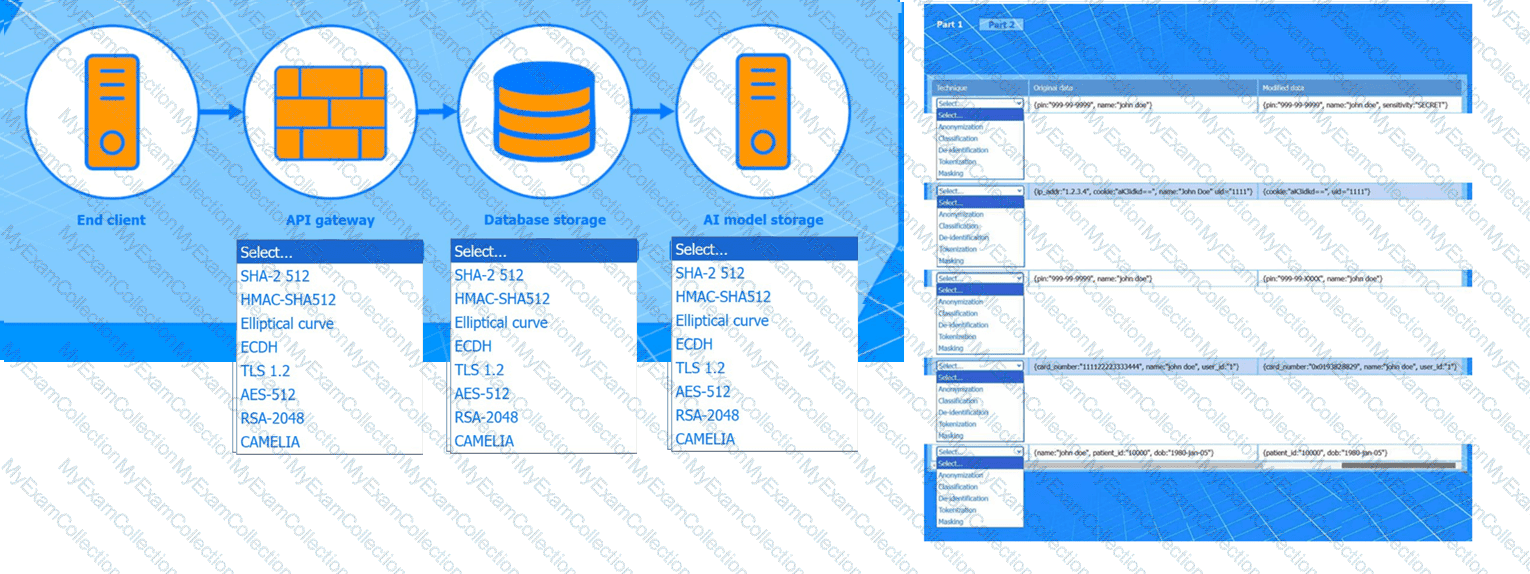
Full Access
Answer:
Answer: 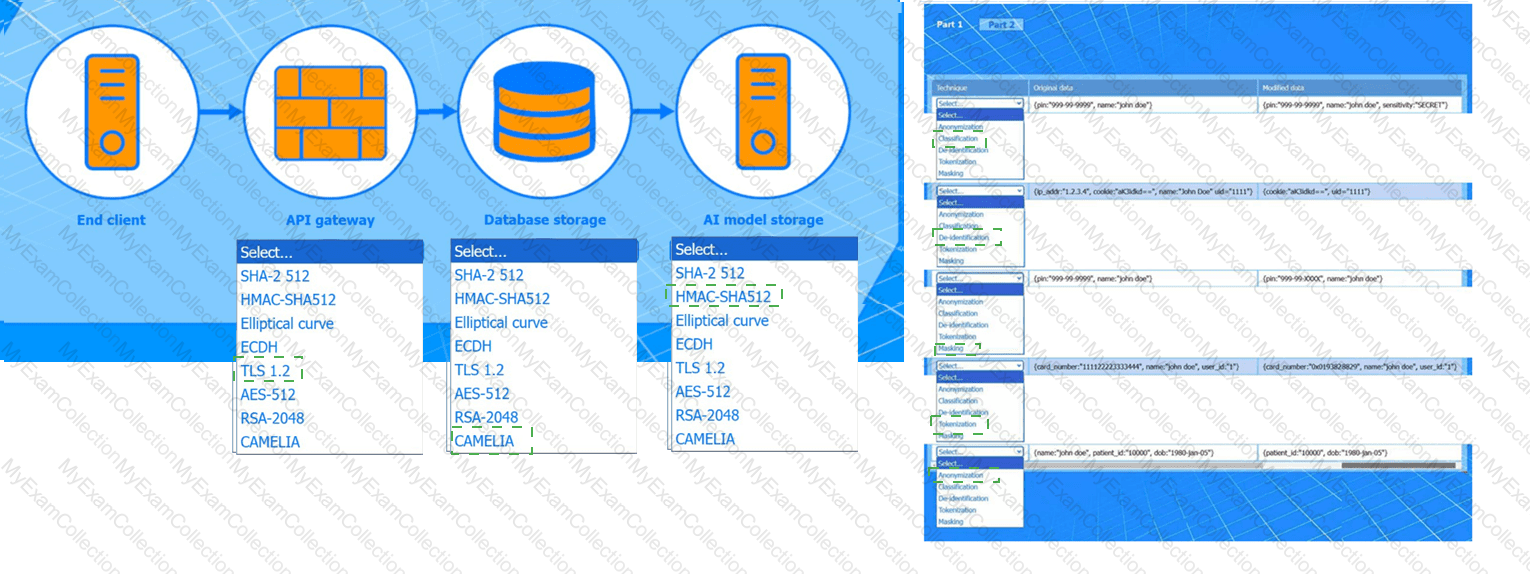
Explanation:
Part 1 — Select the protocol or cipher
System component
Select
API gateway
TLS 1.2
Database storage
CAMELLIA
AI model storage
HMAC-SHA512
Part 2 — Select the data-protection technique
Enter the techniques from the first row to the fifth row in this exact order:
Row Data modification Select
1 The name field is removed, while patient_id and dob remain De-identification
2 ip_addr and name are removed, leaving cookie and uid Anonymization
3 The card number is replaced by 0x0193828829 Tokenization
4 sensitivity: " SECRET " is added Classification
5 Part of the PIN is replaced by XXXX Masking
See Explanation
Why these are the intended answers
API gateway → TLS 1.2
The API gateway handles data moving between the client and backend systems. TLS is the only listed transport-security protocol and therefore protects the data in transit . OWASP recommends encrypting sensitive data in transit by using TLS with secure parameters.
Database storage → CAMELLIA
CAMELLIA is a symmetric block cipher suitable for encrypting substantial quantities of stored data. It is therefore the valid storage-encryption choice among the listed options.
Do not select AES-512 . AES-512 is not a standardized AES variant. NIST defines only AES-128, AES-192, and AES-256 .
AI model storage → HMAC-SHA512
The scenario separately emphasizes protection against loss or modification of intellectual property. HMAC-SHA512 supplies message authentication and integrity verification, allowing unauthorized modification of the AI model to be detected. HMAC is not confidentiality encryption, but it is the most appropriate listed additional control for protecting model integrity. OWASP specifically identifies HMACs as cryptographic controls for stored-data integrity.
Why the other options are not selected
SHA-2 512: Hashing only; no secret key and no encryption.
Elliptical curve: A family of cryptographic techniques, not a specific storage or transport protocol.
ECDH: Used for key agreement, not direct bulk-data encryption.
AES-512: Invalid AES key size.
RSA-2048: Primarily used for asymmetric encryption, signatures, or key transport; inefficient for bulk database or model encryption.
CAMELLIA: Appropriate symmetric encryption for stored data.
HMAC-SHA512: Integrity and authenticity, not confidentiality.
Final Part 2 order
De-identification
Anonymization
Tokenization
Classification
Masking
Explanation
De-identification removes an explicitly identifying field—in this case, the person’s name—while retaining other fields needed for processing. The remaining patient ID and date of birth could potentially permit re-identification when combined with other information, so this is de-identification rather than complete anonymization. OWASP describes de-identification as deleting, scrambling, or pseudonymizing direct and indirect identifiers.
Anonymization removes identifying attributes so that the displayed record is not directly tied to the named individual. Here, both the name and IP address are removed.
Tokenization substitutes a sensitive value with a non-sensitive representative token. The original payment-card number is replaced with the hexadecimal-style value 0x0193828829. OWASP recognizes tokenization as a method for reducing exposure of stored sensitive data.
Classification labels information according to sensitivity. Adding sensitivity: " SECRET " does not conceal or transform the PIN; it categorizes the record so appropriate controls can be applied. OWASP recommends classifying processed, stored, and transmitted data and applying controls based on that classification.
Masking obscures only part of a sensitive value while preserving its general format. Changing 999-99-9999 to 999-99-XXXX is partial masking.
Question # 44
A cybersecurity administrator must examine the cost of AI and implement controls so the research environment operates within a specified budget.
Which of the following controls is best for this situation?
A.
Prompt firewalls
B.
Application programming interface (API) access
C.
Model guardrails
D.
Token limits
Full Access
Answer:
D
Explanation:
Basic Concept: Operating AI systems within a budget requires direct control over the primary cost driver of LLM usage. For research environments where users may run extensive queries, token consumption management is the most effective budget control mechanism. CompTIA SecAI+ Study Guide covers token limits as the key cost management control for AI environments.
Why D is Correct: Token limits set hard caps on the maximum tokens consumed per request and per session, directly controlling the per-interaction cost of LLM API usage. In a research environment where users may submit complex, multi-part queries generating long responses, token limits prevent any single interaction from consuming disproportionate budget and enable the administrator to enforce aggregate budget constraints across all users and research activities.
Why A is Wrong: Prompt firewalls inspect and filter prompt content for security and policy compliance. They are security controls designed to prevent malicious or policy-violating prompts, not financial controls for managing token consumption or enforcing budget limits.
Why B is Wrong: API access controls manage authentication and authorization for API interactions, governing who can connect to the AI API. While restricting API access could limit who uses the system, it does not control how much budget individual authorized users consume through their research queries.
Why C is Wrong: Model guardrails enforce content policy and behavioral constraints on model inputs and outputs. They ensure safe and appropriate responses but do not limit the computational resources or tokens consumed by interactions, making them unsuitable as budget enforcement controls.
Question # 45
Which of the following risks most often occurs when developing an internal chatbot?
A.
Prompt injection
B.
Model theft
C.
Data leakage
D.
Unauthorized access
Full Access
Answer:
C
Explanation:
Data leakage is the most applicable risk because an internal chatbot commonly interacts with organizational information that may include confidential documents, customer information, employee records, credentials, intellectual property, and other sensitive content. CompTIA SecAI+ specifically identifies accidental data leakage as an AI risk and sensitive information disclosure as an attack or failure condition affecting AI systems. Internal chatbots can expose information when retrieval permissions are too broad, conversation context crosses security boundaries, prompts contain confidential material, or model responses reproduce information that the requesting user should not receive. Prompt injection is an important chatbot attack vector, but it describes deliberate manipulation of model instructions rather than the broader organizational risk emphasized here. Model theft concerns unauthorized acquisition or reproduction of a model. Unauthorized access concerns gaining access to resources without proper authorization and is generally addressed through model, data, agent, network, and API access controls. In contrast, information leakage can occur even when legitimate employees are using the chatbot normally. Protecting sensitive data through access controls, minimization, masking, classification, and monitoring is therefore fundamental to internal chatbot security.
================
Question # 46
Instructions: Use the drop-down menus to define two appropriate security controls for each component of the AI system. Each control may be used only once.
An engineer is deploying a new AI system and wants to integrate it into the core system through an API.
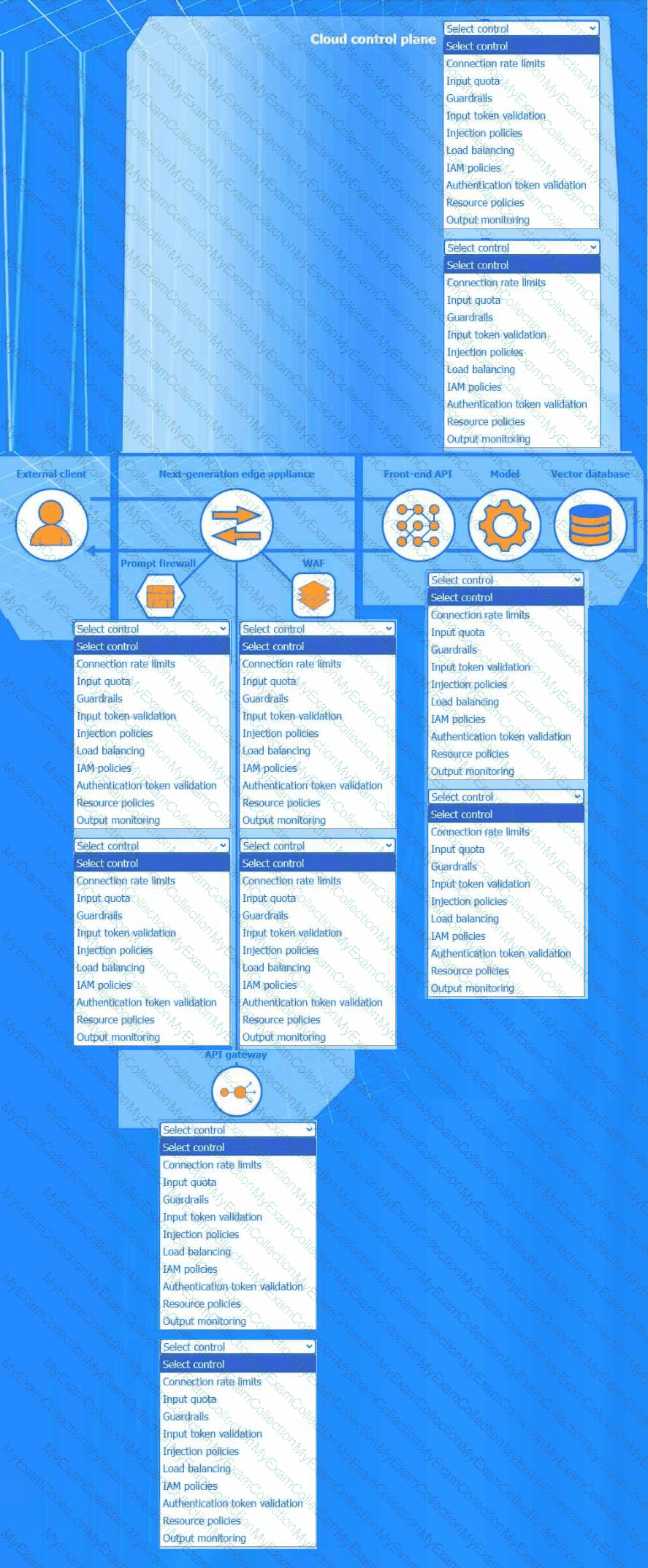
Full Access
Answer:
Answer: 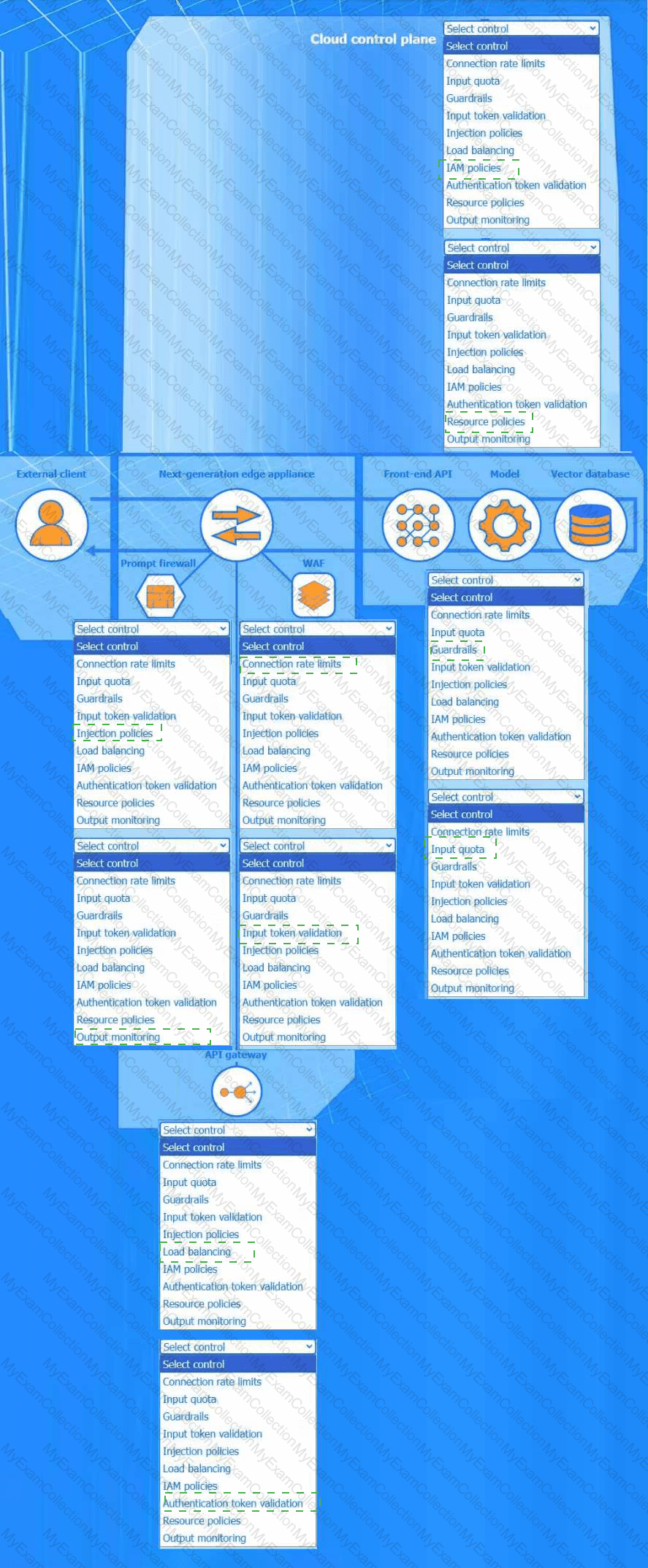
Explanation:
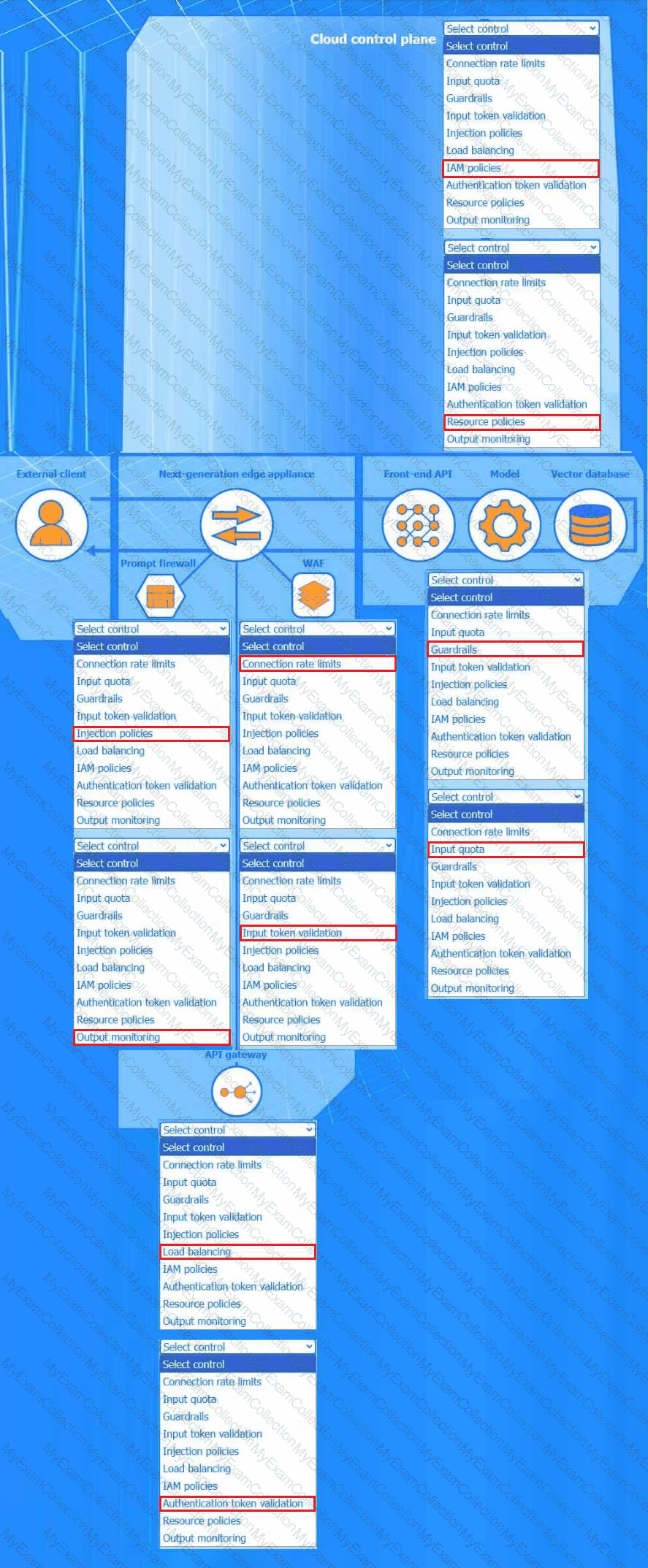
Basic Concept: This is a Performance-Based Question (PBQ) — a HOTSPOT/simulation item requiring interactive selection in the actual exam. It tests the candidate ' s ability to map appropriate security controls to AI system components such as API gateway, model endpoint, data layer, and authentication layer.
Key Concept — Appropriate Controls by Component: For an API gateway connecting an AI system, typical controls include API key authentication, rate limiting, TLS encryption, and input validation. For the model endpoint, controls include IAM role-based access, audit logging, and guardrails. For data access components, encryption at rest and data masking are appropriate. For the authentication layer, MFA and expiring session tokens are relevant.
Why This Matters: The CompTIA SecAI+ Study Guide emphasizes defense-in-depth for AI system integration, ensuring each architectural layer has dedicated, appropriate security controls. The principle of least privilege should guide access control assignments at each component, while availability controls such as rate limiting protect against abuse.
[Reference: CompTIA SecAI+ Exam Objectives Domain 2 (Securing AI Systems) covers AI system component security controls. Candidates should study the mapping of controls to infrastructure components including API gateways, model serving endpoints, data stores, and identity management layers. In the live exam, select the most specific and directly relevant control for each component based on the component's function and risk profile., ]
Question # 47
After the latest software update, a developer receives reports that the system no longer requires reauthentication to display account balances because this issue was present in a previous release. Which of the following should the developer do to best mitigate the risk of recurrence?
A.
Ensure that AI approvals are required to push changes into production.
B.
Implement AI regression testing into the continuous integration/continuous deployment (CI/CD) pipeline.
C.
Deploy an AI-assisted change management system to schedule and track feature releases.
D.
Use code commit automation to perform AI-assisted static application security testing (SAST) scans.
Full Access
Answer:
B
Explanation:
Option B is correct because the defect is a regression: a security behavior that should require reauthentication was previously corrected but reappeared after a software update. Automated AI-assisted regression testing in the CI/CD pipeline can repeatedly verify that protected account-balance functions still demand reauthentication before a release is promoted. The test should reproduce the prior defect, fail the build when authentication is bypassed, and preserve the case as a permanent security test. Option A adds an approval step, but an approver may not detect the reintroduced behavior without an executable test. Option C improves release scheduling and traceability but does not prove that security controls still function. Option D uses SAST to inspect source code for known weakness patterns; it may identify some authentication flaws, but it does not reliably validate the end-to-end runtime behavior described here. Regression testing is the direct control for preventing recurrence. The NIST AI Risk Management Framework emphasizes testing AI systems before deployment and regularly during operation, supporting automated security validation within the delivery pipeline.
================