Question # 4
You are working on a project to build an application that will handle insurance claims. The main requirements for the system are that it shall:
• Allow users to enter details of claims that have been submitted by insured customers.
• Take each claim through a workflow that will allow an assessor to approve the request, reject it or request clarification from the claimant.
• Send approved requests to the accounts payable system for payment.
The solution is being developed according to the company’s standard V-model methodology. The requirements are clearly documented and include a business process model. Operational profiles have been created to guide performance testing.
A risk-based approach to testing is used; frequency of use and role of the user are major factors in feature risk assessment.
System testing has almost finished but a major change to the approval workflow is just about to be delivered. A standard regression test pack has not yet been established, but ad-hoc regression testing has already been performed on earlier builds.
As a TA, you have updated the list of product risks and must now decide the scope of the regression testing. Which pair of techniques will be MOST effective for selecting the regression tests?
a) History-based, driven by the results of the regression tests run so far
b) Risk-based, driven by the updated list of product risks and its traceability to the tests
c) Operational profile-based, driven by the likely patterns of use of the relevant transactions
d) Requirement traceability matrix-based, driven by the links from affected requirements to related tests
e) Impact analysis, driven by consultation with technical stakeholders to identify what might be affected.
Question # 5
You are working on a project to build a purchasing system. The main requirements for the system are that it shall:
1. Allow users to enter details of items that they would like to purchase and, from these details, create a purchase request.
2. Take each purchase request through a workflow that will allow the requestor’s line manager to approve the request, reject it, or return it for clarification / modification.
3. Forward approved requests to the Purchasing Department.
4. Allow purchasers to find the best available supplier for each approved request and place the request on that supplier as a purchase order.
The system is being developed following an Agile SDLC. Risk-based testing is practiced informally, discussion about what testing each user story will need being done in a risk-driven way during story refinement, but there is no central product risk register. Testing is exploratory, except for the acceptance tests for each story’s acceptance tests. Operational profiles have been created to guide performance testing.
Regression test automation started late. The team want to automate all acceptance tests for every user story, but the test automation engineers are still playing catch up. They started with the tests that were easiest to automate, so the functional and non-functional coverage of the regression test pack is incomplete and random.
The current iteration is delivering a major change to the approval workflow and you, as a Test Analyst, have been tasked with defining the regression testing.
Which techniques would be MOST effective for selecting regression tests?
a) History-based, driven by the results of the regression tests run so far
b) Risk-based, driven by the product risks and their traceability to the tests
c) Operational profile-based, driven by the likely patterns of use of the relevant transactions
d) Coverage-based, driven by the coverage obtained from use of relevant test techniques
e) Impact analysis, driven by consultation with technical stakeholders to identify what might be affected.
Question # 6
The following table shows the software areas covered by the test cases.
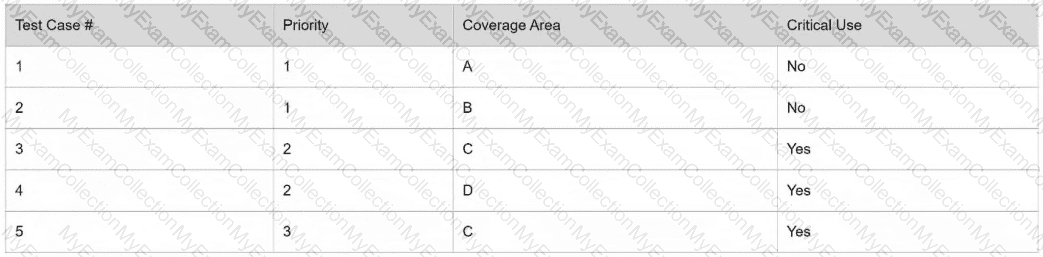
You want to use impact analysis to focus testing. Research shows that areas A, C, and D were affected by this change. Based on this information, which test cases should be run, and in what order?
Question # 7
You are assigned to an Agile team as a Test Analyst. In most ways, the team seems to be working well. Iteration planning goes smoothly because the user stories are good quality. Most defects that are found by testing are fixed in the same iteration and those that do go live are not causing significant dissatisfaction amongst stakeholders. However, the team is unhappy because the Defect Removal Efficiency rate, measured for each iteration, is less than 80%.
What would be the MOST effective contribution by you as a TA, to improve the situation?
Question # 8
BeRich is preparing to launch a mobile application to manage personal finances. The app is expected eventually to attract a broad range of users, from young people through adults to retirees. It provides various functions, including budgeting, expense analysis, saving, and financial advice. The project team includes specialists from different departments: marketing, product development, testing, UX, and system architecture. To ensure consistent performance and positive reception of the application, the team will review the functional documentation before entering the intensive implementation phase.
Each department views the app through the lens of its own goals and expertise. For marketing, it is essential that the application offers unique market-differentiating features that are intuitive for users. The system architecture team concentrates on scalability, security, and protection of user data. Testers, on the other hand, focus on making sure that every function is easy to test and on anticipating scenarios that could create user problems. In contrast, UX specialists focus on the application’s accessibility for a wide range of users.
Which type of review applied to the functional documentation would be the BEST solution in this scenario?
Question # 9
You intend to test a computer game across several configurations. A configuration includes:
operating system (2 possible values: Windows 10, Windows 11)
browser (3 possible values: Edge, Chrome, Firefox)
RAM type (3 possible values: 16 GB, 32 GB, 64 GB)
You apply pairwise testing. So far, you have designed these test cases:
TC1: Windows 10, Edge, 64 GB -
TC2: Windows 11, Chrome, 32 GB -
TC3: Windows 10, Firefox, 64 GB -
TC4: Windows 10, Firefox, 16 GB -
TC5: Windows 11, Chrome, 64 GB -
TC6: Windows 11, Edge, 32 GB -
What is the MINIMUM number of test cases that must be added to the existing six test cases so that the resulting test set attains 100% pairwise coverage?
Question # 10
You are designing test cases from the following state-transition diagram.
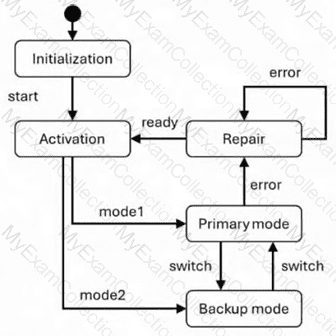
So far, the only test case designed is:
TC1: start, mode1, error, error, ready, mode1, switch, switch, switch, switch.
You use the ROUND-TRIP coverage approach. What round-trip coverage is achieved by this test case?
Question # 11
Your company, which specializes in medical software, has designed an application for use on smartphones and tablets, that calculates a person’s BMI (Body Mass Index). How can a test analyst BEST contribute to adaptability testing for this application?
Question # 12
A particular test case was executed as follows:
Create customer record “John Smithâ€; result: record created.
Modify customer record “John Smithâ€; result: data modified correctly.
Delete customer record “John Smithâ€; result: record deleted correctly.
Which test technique was used to design this test case?
Question # 13
You are working on a project to build a purchasing system. The main requirements for the system are that it shall:
1. Allow users to enter details of items that they wish to have purchased and, from these details, create a purchase request.
2. Take each purchase request through a workflow that will allow the requestor’s line manager to approve the request, reject it or return it for clarification / modification.
3. Forward approved requests to the Purchasing Department.
4. Allow purchasers to find the best available supplier for each approved request and place the request on that supplier as a purchase order.
The solution is being developed according to the company’s traditional V-model methodology. The requirements are clearly documented and include a business process model.
System testing has finished and the test manager has asked you, the senior TA, to identify any parts of the product that should be focused on during acceptance testing. The results of this may be used to adjust the acceptance test plan.
You are using defect cluster analysis, only counting defects with severity levels 1 to 3, ignoring low severity levels 4 and 5. Function point analysis was used for estimating, so you have used function points as the unit of size for the various functional areas of the product. No numeric estimates of expected defect quantities were made for them individually but, as a result of product risk analysis, these functional areas have been ranked according to the amount of product risk that was predicted in them, with risk ranking 1 being the highest and 5 the lowest; the thoroughness of the testing performed so far has been proportional to that. The results are presented in the table below.
Functional area
Total function points
Product risk ranking
Defects found
Purchase Request entry
2000
2
30
Purchase Request workflow
1500
4
15
Purchase Request authorisation
1000
5
25
Supplier identification
2000
1
30
Purchase Order creation
1000
3
30
Which functional areas would you recommend for more test focus in acceptance testing?
a) Purchase Request entry
b) Purchase Request workflow
c) Purchase Request authorization
d) Supplier Identification
e) Purchase Order creation
Question # 14
You are testing a beverage vending machine. The beverage costs $1. The machine accepts 25c, 50c, and $1 coins. When the total value of inserted coins is equal to or greater than the beverage price, the system dispenses the beverage and returns any change. However, if it cannot dispense change because it lacks coins, or if the user presses Cancel, the system does not dispense the beverage and returns the inserted coins.
You use a keyword-based approach and have the following keywords available.
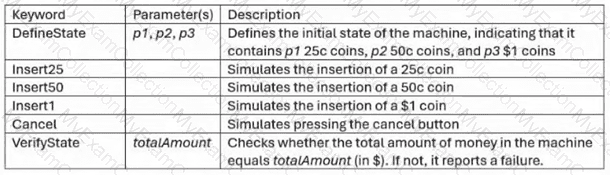
Consider this keyword-based test script used to execute a particular test scenario.
DefineState(1,1,1)
Insert25
Cancel
Insert50
Insert50
Which keyword should end this test script?
Question # 15
A simple drinks machine is described in the following state transition diagram:
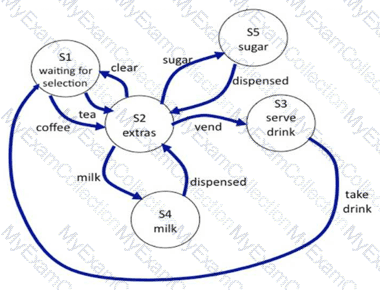
How many test cases will be needed for Chow’s 1-switch coverage?
Question # 16
Which of the following is an example of a test-environment requirement for an online store?
Question # 17
What is a common problem associated with using a pseudo-oracle in testing?
Question # 18
You are evaluating an image-recognition system based on a deep neural network. The system receives as input a 1000×1000-pixel image of a geometric figure—a triangle, square, or circle. The figure has one color and appears on a solid background of a different color. The figure may be any size and may be positioned anywhere in the image. The system classifies the output figure as a triangle, square, or circle. If it receives an image that does not satisfy the preceding requirements, it returns “unrecognized shape.â€
You want to test the correctness of this system using metamorphic testing.
Which of the following is NOT a valid metamorphic relation for this scenario?
Question # 19
You are testing a program which calculates the best airspeed for optimal fuel economy of a new type of aero engine. The result depends on atmospheric pressure at the airplane ' s current height, the air temperature at the airplane ' s current height, and on the airplane ' s current fuel load. The best airspeed:
• decreases by 4 knots (nautical miles per hour) for every 5mb (millibar) decrease in atmospheric pressure,
• increases by 6 knots for every 1°C decrease in air temperature,
• increases by 1 knot for every 1,000kg decrease in fuel load.
You have a test case which predicts that at an atmospheric pressure of 1,000 mb, an air temperature of 10°C and a fuel load of 400,000kg, the optimal airspeed for an Airbus A380 is 600 knots.
Which test case would verify the metamorphic relation described in the three bullet points above?
Question # 20
Your project is developing an application to generate quotes for motor insurance. The calculation requires a wide range of input data and a reliable model of it has been built in a spreadsheet. There will not be enough time to get adequate functional correctness coverage from the base choice or pairwise techniques, so you have decided to do some random testing based on a probability distribution of variable values that is weighted towards their business criticality.
Which limitation of random testing should you be MOST concerned about?
Question # 21
You are testing the functional correctness of an application which generates quotes for motor insurance. The amount of the quote is governed by a combination of the following factors:
• Type of Cover (can be: comprehensive, third party damage only, or third party damage + fire and theft)
• Vehicle Engine Size (can be: < 1500cc, < 2000cc, < 2500cc, = > 2500cc)
• Driving Licence Type (can be: fully qualified, or student driver)
• Vehicle Storage Type (can be: locked garage, or unlocked private place, or public place)
• Time Since Last Claim (can be: < 1year, < 2yrs, < 3yrs, = > 3yrs)
In order to achieve full PAIRWISE coverage, how many combinations must be tested?
Question # 22
Consider the following use case steps that make up the main scenario for an airline check-in application:
1. Login
2. Select flight
3. Select Passenger
4. Confirm check-in
5. Request boarding pass
6. Print boarding pass
7. Select to check-in luggage
8. Print luggage tags
9. Exit
You need to create extension and exception sequences based on this main scenario. Which of the following is a valid extension from this scenario?
Question # 23
A pricing system for determining the postage cost of a company’s letters examines two input variables, representing the length (L) of the envelope in centimeters and the weight (W) of the letter in grams. Envelopes can only have three lengths, 15cm (Small), 20cm (Standard) and 25cm (Large).
For standard length envelopes (20 cm), a premium postage rate is applied if the weight is equal or greater than 50 grams. This is represented as:
IF L = 20 AND W > 50 then RETURN Cost ‘Premium rate’
Which set of test points (each represented as variables L, W) achieves 100% SIMPLIFIED domain coverage for the Standard letter postage cost domain?
Question # 24
Consider the following state diagram for a simple ATM.
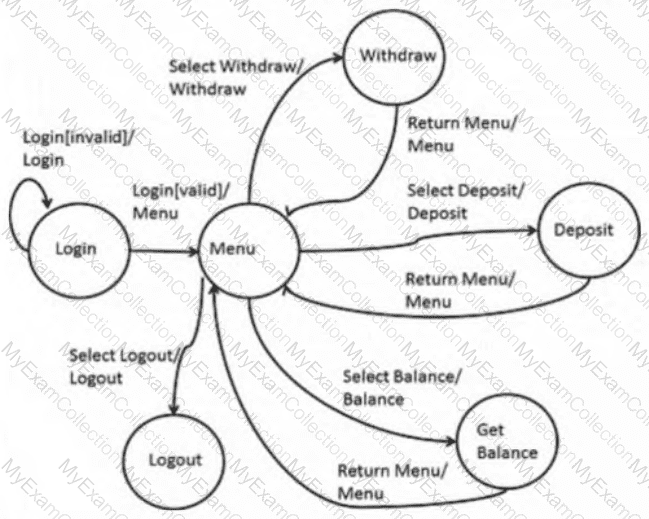
The decision has been made to add the following capabilities:
Allow the customer to move from Get Balance to Deposit, Withdrawal, or Menu.
Allow the customer to move from Deposit to Withdrawal, Get Balance, or Menu.
From Withdrawal, the customer will still be able to go only to Menu.
How many test cases are required to achieve 100% 0-switch coverage of both the new and existing capabilities?
Question # 25
You are testing an online banking application. The following features have been implemented and are ready to be tested:
Funds transfer: lets you transfer funds between accounts at the bank.
Transaction history: shows a list of the last 10 transactions.
Account balance: shows the current balance for each account.
Your task, as a test analyst, is to create a test charter for a 2-hour session to assess the functionality of the funds transfer function, with a focus on basic scenarios and usability aspects.
Your test charter currently appears as follows:
> Test the correctness of transfers
> Using the data: account number, account balance, transfer amount
> To discover a potential violation of the rules of correct transfer
> Scope of testing: ...
What would be MOST useful to include as part of the test scope in this test charter?
Question # 26
You are using a lightweight test charter form to describe a testing session for testing an ATM application. What information is missing from the following charter statement:
" Explore the account balance functionality to discover if the data is accurate "
Question # 27
The following decision table shows the rules for sending a package. Same day delivery will not be provided for big packages. All combinations of same day delivery and international destination have been removed as they are infeasible.
Id
Conditions
1
2
3
4
5
6
7
8
9
10
11
12
Infeasible
C1
Size, Small / Average / Big
S
S
S
S
A
A
A
A
B
B
B
B
-
C2
High value. Yes / No
y
y
n
n
y
y
n
n
y
y
n
n
-
C3
Same Day wanted. Yes / No
Y
N
Y
N
Y
N
Y
N
N/A
N/A
N/A
N/A
Y
C4
International, Yes / No
N
N
N
N
N
N
N
N
N
N
N
N
Y
Actions
A1
Charge Extra %
0
0
0
0
10
10
10
10
20
20
20
20
A2
Provide insurance
X
X
X
X
X
X
X
X
A3
Deliver Same Day
X
X
X
X
How many columns will the table have after all possible minimization has been performed?
Question # 28
Which category of tools provides traceability between test cases and test-basis elements?
Question # 29
A credit risk scoring system accepts two integer inputs, L and E, representing credit scores calculated by two independent systems. The system assesses credit risk using the following business logic:
IF L > = 50 OR E > = 50 THEN the risk is high
IF L < = 49 AND E < = 49 THEN the risk is low
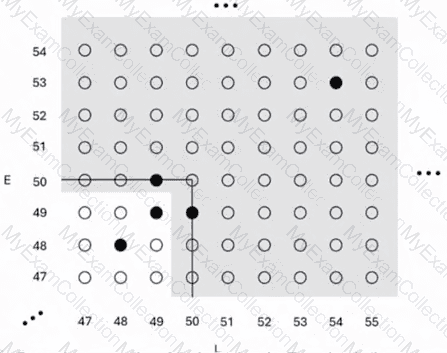
The figure displays a section of the input domain. Points in the gray area are part of the “high risk†equivalence partition, and points outside it are part of the “low risk†equivalence partition. The lines indicate the closed boundary of the “high risk†equivalence partition.
You use domain-based testing to verify the correct implementation of the above requirement. The test set contains the five black points in the figure: (L=48, E=48), (L=49, E=49), (L=49, E=50), (L=50, E=49), and (L=54, E=53).
What level of RELIABLE domain coverage does this set of test points achieve?
Question # 30
You have been appointed to be a TA in the development of a road traffic control application, which will be installed at busy road junctions to control the operation of traffic signal lights according to sensors that detect traffic volume on the various approaches to the junction. The project is still in the early stages of test planning, but it is already clear that despite a tight schedule its safety-critical nature demands careful and thorough testing.
You have been asked to decide whether automated test design would deliver benefits. Which characteristic of automated test design is MOST important for the development of this system?
Question # 31
A simple DVD player is described in the following state transition diagram:
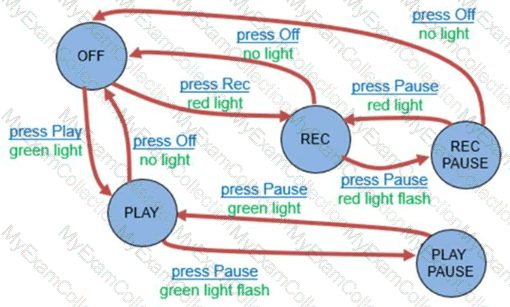
All round trips are feasible, even those that do not start at OFF. How many test cases will be needed for complete round-trip coverage?
Question # 32
Which activity involves a test analyst creating the schedule for test execution and preparing the test environments and test data?
Question # 33
Your organization has been conducting requirements reviews. Participation has been good, but many participants tend to report the same defects. You are concerned that some parts of the requirements are receiving good review coverage while other parts are being missed. Which of the following is a good way to broaden the viewpoints of the reviewers?
Question # 34
You are applying simplified coverage for domain testing. The equation under test is as follows:
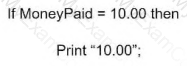
Which set of values for x must be tested to obtain 100% simplified coverage?
Question # 35
You are testing an application that has a large combination of conditions to be tested. The conditions should not interact, but the various combinations still need to be tested. Unfortunately, you are significantly time constrained and will not have time to test all combinations. What testing technique would be useful in this situation?
Question # 36
You are developing tests for a bank ATM system. You want to define the keywords that will be used for the following user story: " As a bank customer, I want to withdraw cash so that I can buy a nice dinner. "
Assuming this is a standard ATM with standard functions, which of the following is the most likely set of keywords needed to test this story?
Question # 37
Which of the following is a way to ensure your synthetic data is reflective of production data?
Question # 39
Which statement accurately characterizes high-level and low-level test cases?