Question # 4
Based solely on the information above, which ONE of the following statements is your manager most likely to make?
Question # 5
As a security testing specialist, you support test management in monitoring and controlling the testing process. During development of the test strategy, scenarios are assessed to identify possible responses to particular circumstances. In particular, the team you work with considers which circumstances should, or should not, lead to revising the exit, acceptance, and completion criteria from the security-test perspective.
Which ONE of the following situations should NOT lead to a revision of acceptance criteria from a security perspective?
Question # 6
An organizational security policy permits the definition of a guest network that lets guests connect to the internet but prevents access to the internal network.
Which ONE of the following options is a correct example of the implemented security policy?
Question # 7
Which ONE of the following situations is MOST LIKELY to occur when the security testing goal and objectives are not aligned with the organization’s overall security policy?
Question # 8
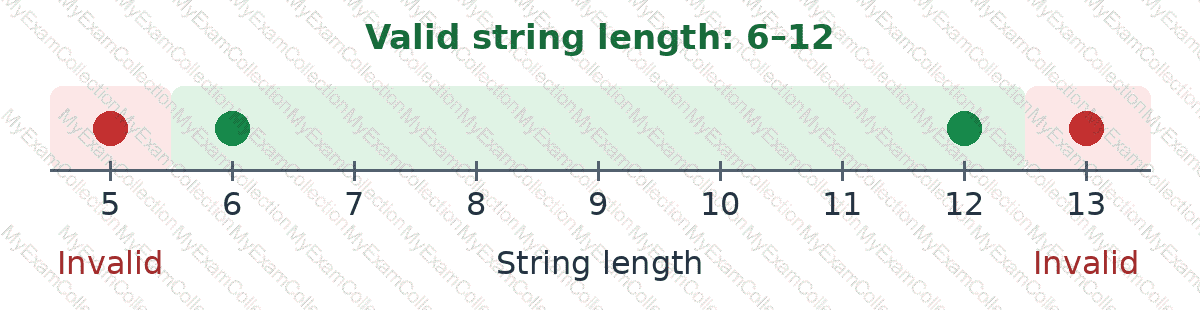
Which ONE of the following input-value sets provides 100% coverage of two boundary values for the string length?
Question # 9
Recovered scenario: A registration-based web application supporting mobile devices offers free and paid services. Its security manager proposes incorporating CAPTCHA into registration to differentiate legitimate human users from automated bots.
Which ONE of the following security-test objectives for this feature is CORRECT?
Question # 10
George is a security tester using a suite of tools for different tasks, including network inventory, managing service-upgrade schedules, and monitoring host or service uptime. He wants to identify the hosts available on the network, the services and OS versions they run, the types of packet filters and/or firewalls in use, and create a list of string parameters such as ‘ or “, -- or #, /*…*/, +, ||, %, PRINT.
Which TWO of the following types of testing is George performing?
Choose two.
Question # 11
As a security tester, you are ensuring that source code and/or sensitive data is protected from copy/paste through network packet capture.
Which ONE of the following techniques BEST describes your work?
Question # 12
Max is attempting to collect as much information as possible about a specific target. He wants to identify the technology used by its website, IP addresses, employee details, and similar information.
Using the information collected, he will choose the tools and techniques to hack the target.
Which TWO of the following tools can help him perform this task passively, without actually connecting to the target system?
Choose two.
Question # 13
An organization is establishing its security test approach for a web-based application developed with various server-side and client-side technologies. Both software development and testing are carried out in-house. It has decided to conduct code reviews and use tools for static analysis of security vulnerabilities. All risks identified in the earlier security risk assessment are also being addressed. Additionally, it has decided to test for encryption of transmitted data, buffer overflow vulnerability, and any language-specific vulnerabilities.
Which ONE of the following statements about the security testing approach is CORRECT in this case?