Question # 4
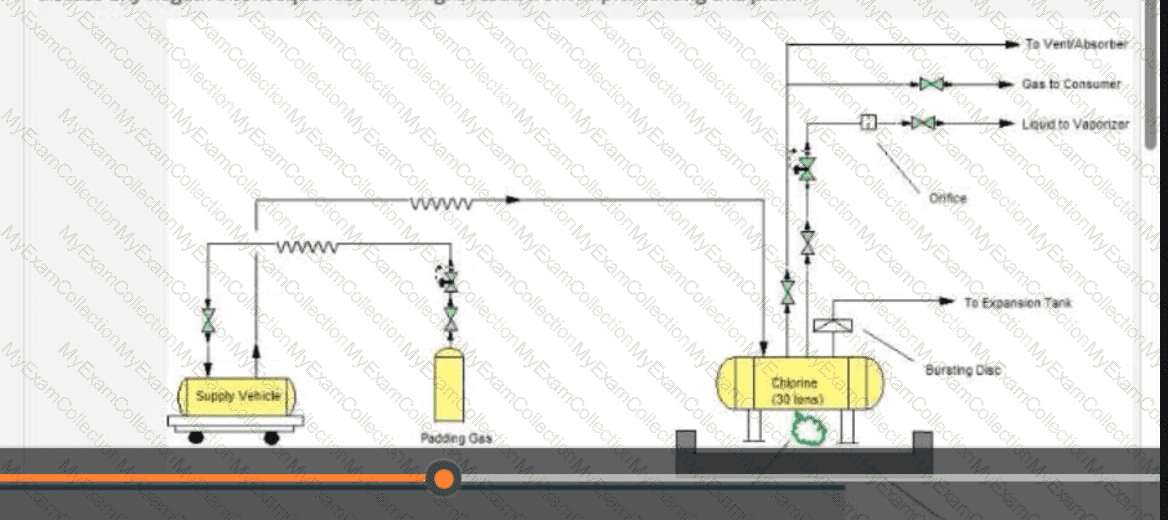
A chemical processor has a chlorine unloading facility shown in the sketch. The area has an ambient chlorine detector with audible alarm and a chemical operator is continually in attendance during the unloading operation. In the event of a leak, the action plan is to spray water on the leak and the contained spill to effect some dilution. Identify and discuss any negative consequences that might result from implementing this plan.
A.
Water spray always neutralizes chlorine safely with no risks
B.
Water spray may increase hazard by forming toxic/corrosive byproducts, spreading contamination, and increasing exposure risk
C.
The plan eliminates the need for detection systems
D.
There are no significant consequences if an operator is present
Full Access
Answer:
B
Explanation:
The correct answer is B because, according to CCPS hazard evaluation principles, response strategies must consider secondary hazards and unintended consequences . While water spray is sometimes used for vapor knockdown, applying it directly to a chlorine release can create additional risks.
Chlorine reacts with water to form hydrochloric acid (HCl) and hypochlorous acid (HOCl) , both of which are highly corrosive and toxic , potentially increasing harm to personnel and damaging equipment. Additionally, water can spread contamination , creating contaminated runoff that may extend the affected area and introduce environmental hazards.
From a Hazard Identification and Risk Assessment (HIRA) perspective, this response may also increase operator exposure , especially if personnel must approach the leak to apply water. The reliance on a single operator and manual intervention reduces the effectiveness of independent protection layers.
Furthermore, water spray may reduce visibility , complicate emergency response, and give a false sense of mitigation while not effectively stopping the release source. CCPS emphasizes that effective safeguards should prioritize containment, isolation, and remote mitigation , rather than relying on manual intervention in hazardous zones.
This scenario highlights the importance of thoroughly evaluating emergency actions to ensure they do not escalate the hazard or introduce new risks .
Question # 5
Which of the following is generally a disadvantage of a rupture disc vs a relief valve?
A.
Reduced fugitive emissions – no simmering or leakage prior to bursting
B.
Protect against rapid pressure rise caused by heat exchanger tube ruptures or internal deflagrations
C.
Is relatively more susceptible to damage during installation
D.
Less expensive way to achieve corrosion resistance
Full Access
Answer:
C
Explanation:
The correct answer is C because rupture discs are generally more fragile and susceptible to damage during installation and handling compared to relief valves, which is a recognized disadvantage in CCPS guidance on pressure relief systems within Mechanical Integrity.
Rupture discs are thin membranes designed to burst at a specific pressure. Because of their delicate construction, improper installation (e.g., incorrect torque, misalignment, or physical handling damage) can alter their burst pressure or cause premature failure. This sensitivity requires strict installation procedures, trained personnel, and careful inspection practices.
Option A is actually an advantage of rupture discs. They provide tight sealing with zero leakage , preventing fugitive emissions and eliminating simmering that can occur in relief valves.
Option B is also an advantage. Rupture discs respond very rapidly to sudden pressure spikes , making them suitable for scenarios like deflagrations or tube ruptures.
Option D is generally considered an advantage as well, since rupture discs can be made from corrosion-resistant materials or coated, often at lower cost than equivalent corrosion-resistant relief valves.
CCPS emphasizes selecting pressure relief devices based on service conditions, reliability, response characteristics, and maintenance considerations, including installation sensitivity.
Question # 6
A vessel has a rupture disc and pressure relief valve in series to protect against high pressure in the vessel. There is a pressure gauge on the pipe between the rupture disc and the relief valve. The gauge normally reads zero. As part of regular maintenance inspections, these pressure gauges are supposed to be routinely checked.
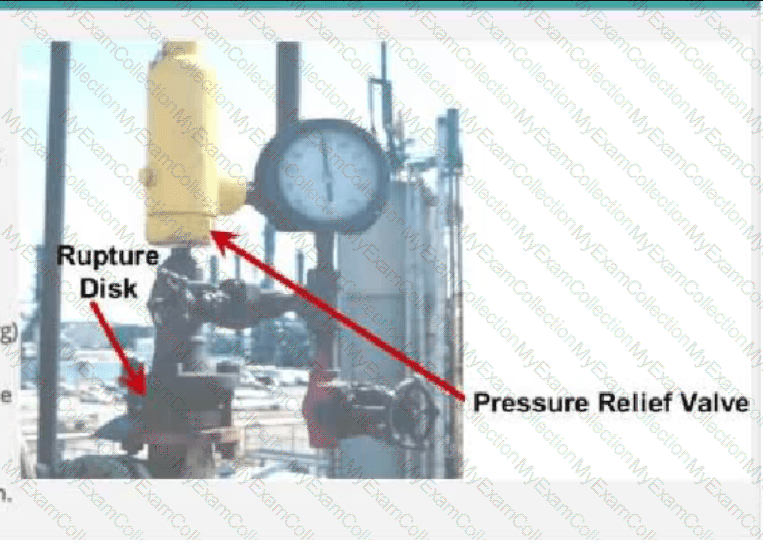
Today, a pressure of nearly 50 psig (~3.5 barg) was observed by an operator. There is a significant hazard now. Identify the hazard and discuss which elements of Risk-Based Process Safety could have been involved in the development of this situation.
A.
No hazard exists because the relief valve will always protect the system
B.
The rupture disc may have failed or leaked, compromising the relief system and creating overpressure risk
C.
The pressure gauge is faulty and can be ignored
D.
The system is operating normally under transient conditions
Full Access
Answer:
B
Explanation:
The correct answer is B because a pressure reading between the rupture disc and relief valve—where it should normally be zero—indicates that the rupture disc has likely failed or is leaking . This creates a serious hazard because the pressure relief valve (PRV) may no longer function as intended , especially if backpressure builds up or if the system configuration compromises its ability to relieve safely. This condition can lead to loss of overpressure protection , increasing the risk of vessel rupture or explosion.
From a CCPS RBPS perspective, several elements are implicated. Mechanical Integrity is central, as the rupture disc may not have been properly inspected, maintained, or replaced. Operating Procedures and Training and Performance Assurance are also relevant, as operators must recognize abnormal readings and respond appropriately. Hazard Identification and Risk Analysis (HIRA) should have considered failure modes such as rupture disc leakage and its impact on relief system performance. Additionally, Management of Change (MOC) could be involved if modifications or replacements were made without proper review.
This scenario highlights how degradation or failure of protective devices, combined with gaps in multiple RBPS elements, can undermine critical safety layers and lead to potentially catastrophic consequences.
Question # 7
A common design safety factor typically used for pressure vessels is:
A.
10 times the MAWP
B.
1.5 times the MAWP
C.
4 times the MAWP
D.
1 times the MAWP (Maximum Allowable Working Pressure)
Full Access
Answer:
B
Explanation:
The correct answer is B (1.5 times the MAWP) because pressure vessels are typically designed and tested with a safety margin above their Maximum Allowable Working Pressure (MAWP) to ensure structural integrity under operating and upset conditions.
According to CCPS and widely accepted engineering codes such as ASME, pressure vessels are often hydrostatically tested at approximately 1.3 to 1.5 times the MAWP . This provides a safety factor to account for uncertainties such as material imperfections, corrosion, fatigue, and unexpected pressure surges.
The MAWP represents the maximum pressure at which the vessel is allowed to operate safely under normal conditions. Designing and testing above this limit ensures that the vessel can withstand occasional excursions without failure.
Option A (10 times) and C (4 times) are unrealistically high and not practical for engineering design. Option D (1 times MAWP) would provide no safety margin, which is unacceptable in pressure vessel design.
CCPS emphasizes the importance of design margins and conservative engineering practices to prevent catastrophic failures, ensuring that equipment can safely handle both normal and abnormal operating conditions.
Question # 8
Which of the following are characteristics of a good Process Safety Culture (check all that apply)?
A.
Using production-capable process equipment
B.
Management approval required for emergency shutdown
C.
Operations and Maintenance personnel are involved in process decisions
D.
Having a high awareness of process hazards
E.
Leading and lagging indicators are tracked to monitor process safety performance
F.
Visible leadership
Full Access
Answer:
C, D, E, F
Explanation:
The correct answers are C, D, E, and F because these align directly with CCPS-defined attributes of a strong process safety culture , which emphasizes leadership, engagement, awareness, and performance monitoring.
C (involvement of operations and maintenance personnel) reflects workforce engagement, a key CCPS principle. Frontline personnel bring practical knowledge and should actively participate in safety-related decisions.
D (high awareness of process hazards) is fundamental. A strong culture ensures that all personnel understand hazards, risks, and controls associated with their work.
E (tracking leading and lagging indicators) demonstrates a commitment to measuring and improving performance. CCPS stresses the importance of both proactive (leading) and reactive (lagging) metrics to manage risk effectively.
F (visible leadership) is critical. Leadership must actively demonstrate commitment to process safety through actions, communication, and resource allocation.
Option A is not a cultural characteristic—it relates to equipment capability. B is incorrect because requiring management approval for emergency shutdowns can delay critical safety actions , contradicting CCPS principles that empower personnel to act immediately in unsafe situations.
Overall, CCPS highlights that a strong process safety culture is built on leadership commitment, workforce involvement, hazard awareness, and continuous performance monitoring .
Question # 9
A rupture pin relief device operates when:
A.
A special spiral spring called a “pin spring†pushes against the valve seat - the valve opens when the pressure against the seat is high enough
B.
An electric solenoid operates a pin, allowing the valve seat to open
C.
A rod buckles at a specific pressure allowing the seat to open
D.
This is a special type of spring relief with a very small seat, called a pin seat
Full Access
Answer:
C
Explanation:
The correct answer is C because a rupture pin relief device operates based on the mechanical buckling of a calibrated pin (or rod) at a predetermined pressure.
According to CCPS and industry practice, rupture pin devices are a type of non-reclosing pressure relief device that rely on structural instability (buckling) rather than spring force or membrane rupture. The pin is designed to fail (buckle) at a specific load corresponding to a set pressure. When this occurs, the valve mechanism is released, allowing the system to relieve pressure.
This design provides high accuracy and reliability , especially in applications where precise set pressure is required and where traditional spring-loaded relief valves may be affected by corrosion, vibration, or backpressure.
Option A is incorrect because it describes a spring-loaded relief valve , not a rupture pin device. Option B is incorrect because rupture pin devices are mechanical, not electrically actuated . Option D is incorrect because there is no such concept as a “pin seat†type of relief valve.
CCPS highlights rupture pin devices as an alternative to rupture discs and spring valves, particularly where tight tolerances and resistance to process conditions are needed.
Question # 10
As the temperature increases, the upper and lower flammability limits change in the following fashion:
A.
The upper limit increases and the lower limit increases
B.
The upper limit decreases and the lower limit decreases
C.
The upper limit increases and the lower limit decreases
D.
The upper limit decreases and the lower limit increases
Full Access
Answer:
C
Explanation:
Comprehensive Explanation (CCPS-based):
As temperature increases, the flammability range of a vapor widens , meaning it becomes easier for combustion to occur over a broader concentration range. This happens because higher temperatures provide additional energy to support combustion reactions.
The Lower Flammability Limit (LFL) decreases with increasing temperature. This means that less fuel is required to sustain combustion , making mixtures that were previously too lean now flammable.
At the same time, the Upper Flammability Limit (UFL) increases. This means that richer mixtures (higher fuel concentrations) can still support combustion because elevated temperatures improve reaction kinetics and reduce quenching effects.
Together, these changes expand the flammable range, increasing hazard potential. This is a critical concept emphasized by CCPS, particularly in evaluating process upsets, heated systems, and confined spaces , where elevated temperatures can significantly increase explosion risk.
Therefore, the correct answer is C: the upper limit increases and the lower limit decreases , indicating a widening of the flammable range.
Question # 11
Which of the following statements apply to the purpose of an incident investigation procedure? Select all that apply.
A.
To promote uniform and accurate reporting and documentation of incidents
B.
To share the company’s incident investigation practices with external stakeholders
C.
To define the training requirements for all incident investigation team members
D.
To promote thorough and timely incident investigations
E.
To provide guidance for the incident investigation team composition
Full Access
Answer:
A, C, D, E
Explanation:
The correct answers are A, C, D, and E because these reflect the core purposes of a structured incident investigation procedure as defined in CCPS Risk-Based Process Safety.
A (uniform and accurate reporting) is essential to ensure consistency in how incidents are documented, enabling effective analysis, trending, and organizational learning.
C (defining training requirements) ensures that investigation team members are competent in methodologies such as root cause analysis, interviewing techniques, and evidence collection. CCPS emphasizes that trained investigators are critical for high-quality investigations.
D (promoting thorough and timely investigations) is a key objective. Investigations must be conducted promptly to preserve evidence and ensure accurate findings, while also being sufficiently thorough to identify root and systemic causes.
E (guidance on team composition) ensures that investigations are conducted by a multidisciplinary team with appropriate expertise and independence, which improves the quality and credibility of results.
Option B is not a primary purpose of an internal investigation procedure. While sharing lessons learned may occur, the procedure itself is designed for internal consistency, rigor, and effectiveness , not external communication.
CCPS stresses that well-defined procedures are essential to ensure investigations consistently lead to actionable insights and prevention of future incidents.
Question # 12
The workforce involvement element: (Select all that apply)
A.
Reinforces process safety culture
B.
Defines roles and responsibilities of all involved
C.
Establishes mechanisms to facilitate participation
D.
Allows veto authority for employee representatives
Full Access
Answer:
A, B, C
Explanation:
The correct answers are A, B, and C because the Workforce Involvement element in CCPS RBPS is focused on actively engaging employees in process safety activities and decision-making.
Option A is correct because workforce involvement plays a key role in reinforcing a strong process safety culture . When employees participate in hazard identification, incident investigations, and safety discussions, they develop ownership and commitment to safe operations.
Option B is also correct because effective workforce involvement requires clearly defined roles and responsibilities . Employees at all levels must understand their responsibilities in maintaining process safety, which improves accountability and consistency.
Option C is correct as CCPS emphasizes the need to establish formal mechanisms for participation , such as safety committees, feedback systems, and involvement in HAZOPs or risk assessments. These mechanisms ensure that workforce knowledge and experience are effectively utilized.
Option D is incorrect because CCPS does not require or define veto authority for employee representatives . While employee input is critical, decision-making authority remains structured within the organization’s management systems.
Overall, workforce involvement strengthens process safety by leveraging frontline knowledge, improving communication, and fostering shared responsibility .
Question # 13
The control of the status of systems and equipment is part of:
A.
Incident Investigation
B.
Operational Readiness
C.
Conduct of Operations
D.
Hazard Identification and Risk Analysis
Full Access
Answer:
C
Explanation:
The correct answer is C. Conduct of Operations because this RBPS element specifically addresses the day-to-day management and control of process conditions, equipment status, and operational discipline .
CCPS defines Conduct of Operations as the framework that ensures systems and equipment are operated in a safe, consistent, and well-controlled manner . A key component of this element is maintaining clear knowledge of equipment status , such as whether systems are in service, out of service, under maintenance, isolated, or in standby mode. This includes practices like valve line-up control, tagging, shift handover communication, and status logging.
Option B (Operational Readiness) focuses on ensuring systems are ready for startup or restart, including pre-startup safety reviews, but it does not govern ongoing status control during routine operations. Option A (Incident Investigation) is concerned with learning from past events, not managing current equipment status. Option D (Hazard Identification and Risk Analysis) focuses on identifying and evaluating hazards, not controlling operational conditions.
CCPS emphasizes that poor control of equipment status can lead to serious incidents, such as incorrect line-ups or unintended releases. Therefore, strict operational discipline under Conduct of Operations is essential for maintaining process safety.
Question # 14
The following groups may provide information required for the Process Knowledge Management element (select all that apply)
A.
Process equipment vendors
B.
External engineering firms
C.
Corporate research and development function
D.
Local emergency responders
Full Access
Answer:
A, B, C
Explanation:
The correct answers are A, B, and C because Process Knowledge Management (PKM) requires collecting and maintaining accurate technical information from all relevant and credible sources involved in process design, operation, and development.
Process equipment vendors (A) are a key source of detailed equipment design data, operating limits, materials of construction, and performance specifications. This information is essential for safe operation and maintenance.
External engineering firms (B) contribute critical knowledge related to process design, system integration, hazard considerations, and technical calculations. They often develop PFDs, P & IDs, and design basis documents, all of which are core PKM components.
Corporate research and development (C) provides essential data on chemical properties, reaction kinetics, hazards, and scale-up considerations. This information is particularly important for understanding process chemistry and potential risks.
Option D (Local emergency responders) is incorrect because, while they play an important role in Emergency Management , they are not a primary source of process knowledge such as chemical, design, or engineering data required under PKM.
CCPS emphasizes that PKM must integrate information from multiple technical sources to ensure completeness, accuracy, and accessibility, forming the foundation for hazard analysis, safe operations, and risk management.
Question # 15
Which of the following is not essential to Conduct of Operations:
A.
A strong process safety culture
B.
Widely understood but unwritten ways the work is accomplished
C.
Defining roles and responsibilities
D.
Establishing standards for performance
Full Access
Answer:
B
Explanation:
Comprehensive Explanation (CCPS-based):
The correct answer is B because Conduct of Operations (CoO) strongly emphasizes formalization, clarity, and consistency , not informal or unwritten practices. Relying on “widely understood but unwritten ways†introduces variability, ambiguity, and increased risk of error—key contributors to process safety incidents.
CCPS highlights that effective Conduct of Operations requires documented procedures, clear expectations, and disciplined execution . Informal knowledge (“tribal knowledgeâ€) can lead to inconsistent practices, especially during shift changes, training of new personnel, or abnormal situations.
Option A is essential because a strong process safety culture supports adherence to procedures and operational discipline.
Option C is essential because clearly defined roles and responsibilities ensure accountability and proper execution of tasks.
Option D is essential because establishing performance standards provides measurable expectations for safe and reliable operations.
In summary, Conduct of Operations aims to eliminate reliance on informal practices and instead promote structured, written, and standardized approaches to ensure safe, consistent, and reliable plant operation.
Question # 16
What minimum size is normally used for laboratory test apparatus to determine dust explosion severity?
A.
5 liters
B.
1 cubic meter
C.
20 liters
D.
50 liters
Full Access
Answer:
C
Explanation:
The correct answer is C (20 liters) because the 20-liter sphere apparatus is the widely accepted standard for determining dust explosion severity parameters , including Kst (deflagration index) and Pmax (maximum explosion pressure) .
According to CCPS and industry standards (such as ASTM and ISO methods), the 20-liter test chamber provides a controlled, repeatable environment for evaluating the explosibility characteristics of combustible dusts. It represents a balance between laboratory practicality and representative explosion behavior , making it suitable for routine testing.
Smaller volumes such as 5 liters (A) are generally not sufficient to accurately capture explosion dynamics and may produce less reliable results. Larger vessels such as 1 cubic meter (B) are sometimes used for more detailed or confirmatory testing, but they are not typically considered the minimum standard due to cost and complexity. Option D (50 liters) is not a recognized standard for this purpose.
CCPS emphasizes that understanding dust explosibility is essential for hazard identification, equipment design, and mitigation strategies , including explosion venting, suppression, and isolation systems. The 20-liter sphere has become the industry benchmark for generating reliable and comparable dust explosion data.
Question # 17
Which of the following are best used to verify that an operator adequately understands training? (Select all that apply)
A.
An attendance sheet from the training course
B.
Documentation from the trainer that the operator demonstrated understanding
C.
A written quiz or test that must be passed upon completion
D.
A form signed by the operator indicating that the training was completed
Full Access
Answer:
B, C
Explanation:
The correct answers are B and C because CCPS emphasizes that training effectiveness must be verified through demonstrated competence , not just participation or acknowledgment.
Option B is correct because trainer verification of demonstrated understanding reflects performance-based assessment. This may include practical demonstrations, simulations, or observed task execution, which are strong indicators that the operator can apply the knowledge safely in real situations.
Option C is also correct because written quizzes or tests are commonly used to assess knowledge retention and comprehension. When properly designed, they ensure that operators understand critical safety concepts, operating limits, and emergency actions.
Option A is incorrect because attendance alone does not confirm understanding—it only proves participation. Similarly, D is insufficient because a signed form merely indicates completion, not competence.
CCPS highlights that effective training programs must include assessment and verification methods to confirm that personnel are capable of performing their duties safely. This is part of Training and Performance Assurance , where the focus is on ensuring that workers not only receive training but also demonstrate the ability to apply it correctly in practice .
Question # 18
A facility’s process safety staff does consequence modeling for releases of various toxic substances that the facility handles. Which elements of Risk Based Process Safety would be most likely to use the results of this modeling? (Select all that apply)
A.
Operational Readiness
B.
Measurement and Metrics
C.
Stakeholder Outreach
D.
Hazard Identification and Risk Analysis
E.
Emergency Management
Full Access
Answer:
C, D, E
Explanation:
The correct answers are C (Stakeholder Outreach), D (Hazard Identification and Risk Analysis), and E (Emergency Management) because consequence modeling is fundamentally used to understand the potential impact of hazardous material releases and to support risk-informed decision-making across these RBPS elements.
Within Hazard Identification and Risk Analysis (HIRA) , consequence modeling is a core analytical tool used in studies such as HAZOP, LOPA, and quantitative risk assessments (QRA). It helps estimate the severity of potential release scenarios, including toxic dispersion, which directly supports risk evaluation and safeguards selection.
For Emergency Management , modeling results are essential to plan effective response strategies. They define hazard zones, evacuation distances, shelter-in-place decisions, and emergency resource allocation. CCPS emphasizes that credible worst-case and alternative release scenarios should guide emergency preparedness planning.
In Stakeholder Outreach , consequence modeling provides critical information for communicating risks to external parties such as local communities, regulators, and emergency responders. This aligns with CCPS guidance on transparency and community awareness, ensuring stakeholders understand potential offsite consequences.
Operational Readiness (A) focuses on startup and system preparedness, not consequence modeling outputs. Measurement and Metrics (B) deals with performance indicators rather than predictive hazard analysis. Therefore, they are less directly connected to the use of consequence modeling results.
Question # 19
Workforce involvement metrics can involve (select all that apply):
A.
Number of Loss of Primary Containment Incidents
B.
Number of safety suggestions submitted
C.
Number of comments submitted on the content and frequency of refresher training
D.
Nuisance alarm rate
E.
Number of Past Due PHA action items
Full Access
Answer:
B, C
Explanation:
The correct answers are B and C because workforce involvement metrics in CCPS RBPS focus on active participation, engagement, and feedback from personnel in process safety activities.
B (number of safety suggestions submitted) is a direct indicator of workforce engagement. A high number of suggestions reflects a proactive safety culture where employees are encouraged to identify hazards and propose improvements. CCPS highlights employee participation as a key contributor to strong process safety performance.
C (comments on training content and refresher frequency) is also a valid workforce involvement metric. It reflects how actively employees engage with training programs and provide feedback to improve their effectiveness. This aligns with CCPS emphasis on continuous learning and workforce input.
Options A (loss of containment incidents) and E (past due PHA action items) are lagging or compliance metrics , not direct measures of workforce involvement. D (nuisance alarm rate) relates to alarm management and system performance rather than employee participation.
CCPS distinguishes between participation metrics (leading indicators of engagement) and outcome metrics (incident-based or system performance). Workforce involvement metrics specifically track how well personnel are contributing to and engaging with process safety systems, which is critical for sustaining a strong safety culture.
Question # 20
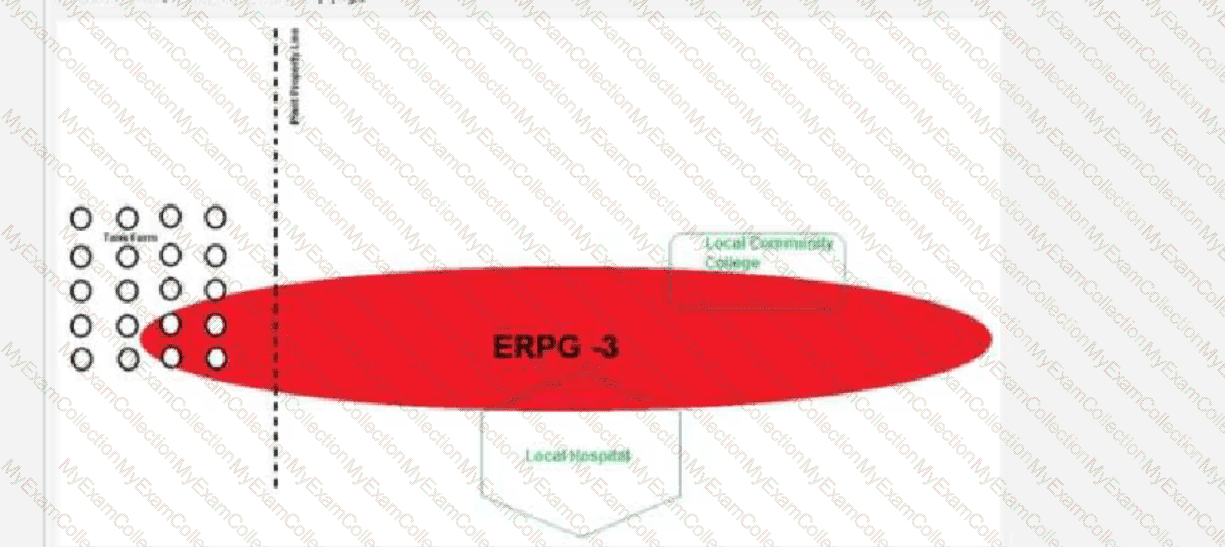
Consider the information shown on the diagram. Which Risk Based Process Safety elements are most relevant to this situation? (select all that apply)
A.
Auditing
B.
Hazard Identification and Risk Analysis
C.
Emergency Management
D.
Contractor Management
E.
Stakeholder Outreach
F.
Safe Work Practices
Full Access
Answer:
B, C, E
Explanation:
The correct answers are B, C, and E because the diagram shows an ERPG-3 toxic release plume extending offsite , impacting public receptors such as a local community, college, and hospital . This scenario directly relates to hazard analysis, emergency planning, and external communication.
Option B (Hazard Identification and Risk Analysis) is critical because determining the extent and severity of the toxic plume (e.g., ERPG levels) is a key outcome of consequence modeling and risk analysis. This element identifies potential offsite impacts and supports decision-making for safeguards.
Option C (Emergency Management) is essential because such a release requires prepared emergency response plans , including evacuation, shelter-in-place strategies, and coordination with local responders.
Option E (Stakeholder Outreach) is also highly relevant because offsite consequences require communication and coordination with external stakeholders , including the public, hospitals, and emergency services. This ensures awareness and preparedness beyond the facility boundary.
Options A, D, and F are less directly relevant to the scenario presented, as they focus on internal systems rather than offsite consequence management and response .
CCPS emphasizes that when hazards extend beyond the facility, organizations must integrate risk analysis, emergency planning, and community engagement to effectively manage potential impacts.
Question # 21
Austenitic stainless steels are typically susceptible to which of the following corrosion mechanisms specifically attributed to chloride exposure? (Select all that apply)
A.
Stress corrosion cracking
B.
Galvanic corrosion
C.
Pitting corrosion
D.
Uniform corrosion
Full Access
Answer:
A, C
Explanation:
The correct answers are A (Stress Corrosion Cracking) and C (Pitting Corrosion) because both are well-known chloride-induced damage mechanisms affecting austenitic stainless steels, as emphasized in CCPS Mechanical Integrity guidance. Chloride ions are particularly aggressive toward the passive oxide layer that protects stainless steel. When this protective film is locally broken down, pitting corrosion occurs, leading to highly localized attack that can penetrate deeply while leaving most of the surface intact. This makes detection difficult and increases the likelihood of sudden failure.
Additionally, chloride stress corrosion cracking (SCC) occurs when tensile stress (residual or applied), a susceptible material (such as austenitic stainless steel), and a corrosive chloride environment are present simultaneously. This mechanism can lead to brittle, catastrophic cracking with little prior warning, which is why CCPS highlights it as a critical degradation mechanism in process equipment.
Galvanic corrosion (B) requires two dissimilar metals electrically connected in an electrolyte and is not specifically caused by chloride exposure alone. Uniform corrosion (D) is a general material loss across the surface and is not the primary concern for stainless steels in chloride environments, where localized attack dominates.
Proper Mechanical Integrity programs per CCPS require identification of such damage mechanisms, material selection, inspection strategies, and monitoring to prevent unexpected failures.
Question # 22
During a Risk Based Process Safety audit, one operator states that refresher training should be provided more frequently. What actions should the auditor take? (Select all that apply)
A.
The auditor should classify this as a finding. No additional information is required
B.
The auditor should record this input, but not classify this as a finding based on a single observation
C.
The auditor should not classify this as a finding because the operator should not have been interviewed
D.
The auditor should interview additional operators before deciding whether to classify the observation as a finding
Full Access
Answer:
B, D
Explanation:
The correct answers are B and D because CCPS emphasizes that audit findings must be based on sufficient, corroborated evidence , not isolated observations.
Option B is correct because the auditor should capture and document all relevant input , including operator concerns. However, a single statement is not enough to justify a formal finding. It should be treated as potential evidence requiring further evaluation .
Option D is also correct because auditors are expected to seek additional information and validate observations . Interviewing more operators, reviewing training records, and examining performance data helps determine whether the concern represents a systemic issue or an isolated opinion .
Option A is incorrect because immediately classifying a finding without verification contradicts the CCPS principle of evidence-based auditing . Option C is incorrect because operator interviews are a critical part of audits , providing insight into how systems function in practice.
CCPS highlights that effective audits rely on triangulation of evidence —combining interviews, documentation, and observations—to ensure findings are accurate, objective, and meaningful for continuous improvement.
Question # 23
For flashing liquids:
A.
the fraction flashed is always less than 10% of the total mass
B.
the fraction flashed is always more than 50% of the total mass
C.
the energy for the flashing comes from the enthalpy of the liquid
D.
flashing will never occur if the liquid is stored above its normal boiling point
Full Access
Answer:
C
Explanation:
The correct answer is C because flashing of liquids is fundamentally an energy-driven thermodynamic process , as described in CCPS consequence analysis and dispersion modeling guidance. When a pressurized liquid is suddenly released to a lower pressure, a portion of the liquid rapidly vaporizes (flashes). The energy required for this phase change comes from the internal energy (enthalpy) of the liquid itself , not from an external heat source.
As the liquid flashes, it cools because energy is consumed in vaporization. The fraction that flashes depends on factors such as initial temperature, pressure, heat capacity, and latent heat of vaporization—not fixed percentages.
Option A and B are incorrect because the fraction flashed is not constant ; it can vary widely depending on thermodynamic conditions.
Option D is incorrect because flashing is actually more likely when a liquid is above its normal boiling point under pressure . When pressure is suddenly reduced, the liquid is in a superheated state and can rapidly flash.
CCPS emphasizes understanding flashing behavior in hazard analysis because it significantly affects release rates, vapor cloud formation, and potential consequences such as toxic exposure or vapor cloud explosions.
Question # 24
Which of the following sets of inputs should be considered when developing Operating Procedures?
A.
Six Sigma, Lean Manufacturing, Product Pricing
B.
Geographical Location, Research and Development, Stakeholder Outreach
C.
Utility Costs, Process Safety Management Reviews, Union Contract
D.
Equipment Manufacturer recommendation, Process Design Basis, Lessons Learned
Full Access
Answer:
D
Explanation:
The correct answer is D because CCPS emphasizes that operating procedures must be developed using accurate technical, design, and experiential inputs that directly affect safe operation of the process.
Equipment manufacturer recommendations provide critical information on safe operating limits, startup/shutdown requirements, maintenance constraints, and potential failure modes. These are essential to ensure equipment is operated within safe boundaries.
The process design basis defines the intended operating conditions, including temperature, pressure, flow, and chemical characteristics. CCPS highlights that procedures must align with these design parameters to prevent deviations that could lead to loss of containment or unsafe conditions.
Lessons learned from past incidents, near misses, and operating experience are also vital inputs. Incorporating these insights helps prevent recurrence of known issues and improves procedural robustness.
Options A, B, and C include factors that may be relevant to business or administrative decisions but are not directly related to safe process operation . CCPS clearly distinguishes that operating procedures must be grounded in process safety information, engineering design, and operational experience .
Therefore, using technical design data, vendor guidance, and historical learning ensures procedures are accurate, practical, and aligned with safe operation requirements.
Question # 25
Which of the following conditions could indicate performance problems in a plant’s Asset Integrity program? (select all that apply)
A.
An operator can identify each piece of equipment on the maintenance schedule and explain what is planned
B.
The metrics report related to Asset Integrity performance is 9 months out of date
C.
The rotating equipment is vibrating excessively
D.
Piping handling hazardous material within a containment area is not on the inspection list
Full Access
Answer:
B, C, D
Explanation:
The correct answers are B, C, and D because they represent clear indicators of deficiencies in the Mechanical Integrity (Asset Integrity) program , as defined by CCPS.
Option B is correct because outdated metrics (9 months old) indicate poor performance monitoring and lack of timely oversight . CCPS stresses that asset integrity programs must use current, accurate data to track inspection, testing, and maintenance effectiveness.
Option C is also correct because excessive vibration in rotating equipment is a well-known sign of potential mechanical failure, such as imbalance, misalignment, or bearing issues. This suggests inadequate condition monitoring or maintenance practices.
Option D is critical because piping containing hazardous materials that is not included in inspection programs represents a serious gap. CCPS requires that all critical equipment be identified, risk-ranked, and included in inspection and maintenance plans . Missing such equipment indicates a breakdown in the integrity management system.
Option A reflects good practice, showing operator awareness and effective communication, not a problem.
Overall, CCPS emphasizes that effective asset integrity programs require accurate tracking, proactive monitoring, and comprehensive equipment coverage to prevent loss of containment.
Question # 26
For a vapor explosion in an unconfined and uncongested area, the amount of thermodynamic energy that ends up in the overpressure is approximately:
A.
100%
B.
50–75%
C.
10–15%
D.
2–5%
E.
0%
Full Access
Answer:
D
Explanation:
The correct answer is D (2–5%) because, according to CCPS guidance on vapor cloud explosions (VCEs) , only a small fraction of the total thermodynamic energy released during combustion is converted into blast overpressure in unconfined and uncongested conditions.
In such scenarios, the combustion process occurs relatively slowly (deflagration rather than detonation), and much of the energy is dissipated as heat, light, and expansion of gases , rather than contributing to pressure waves. As a result, only about 2–5% of the total energy is typically available to generate damaging overpressure effects.
Higher energy conversion efficiencies (such as 10% or more) are generally associated with congested or confined environments , where obstacles (pipes, equipment, structures) promote turbulence and flame acceleration, significantly increasing overpressure. In contrast, an open and uncongested area limits turbulence, reducing explosion severity.
Options A , B , and C significantly overestimate the fraction of energy contributing to blast effects, while E (0%) is incorrect because some overpressure is always generated.
CCPS emphasizes understanding explosion efficiency when performing consequence analysis, as it is a key factor in predicting blast damage and designing appropriate safeguards.
Question # 27
The Accident Pyramid indicates:
A.
That for every accident fatality there are many “near missesâ€
B.
How Murphy’s law operates
C.
That for every minor accident there are many accidents of greater consequences
D.
A graphical illustration of major incidents
Full Access
Answer:
A
Explanation:
The correct answer is A because the Accident Pyramid (also known as Heinrich’s Pyramid or the Safety Triangle) illustrates the relationship between near misses, minor incidents, and major accidents . According to CCPS and traditional safety theory, for every serious or fatal accident, there are many more low-consequence events and near misses that occur but do not result in harm.
This concept is fundamental to process safety metrics and learning systems , as it emphasizes that organizations should not only focus on major incidents but also actively track and investigate near misses and minor events . These lower-level events provide valuable insight into system weaknesses and potential failure pathways before a catastrophic incident occurs.
Option B is incorrect because Murphy’s law is unrelated to structured safety analysis. Option C reverses the logic of the pyramid—minor incidents are far more frequent than major ones, not the other way around. Option D is incorrect because the pyramid represents a range of incident severities , not just major incidents.
CCPS uses this concept to promote proactive safety management , encouraging organizations to learn from small failures and near misses to prevent escalation into severe process safety events.
Question # 28
A facility has several processes that need to be audited. There are 120 P & IDs (Piping and Instrumentation Diagrams) for the processes to be audited. The auditor responsible for Process Knowledge Management should:
A.
Only review P & IDs from the processes with the highest process safety risk
B.
Request assistance from the lead auditor to distribute the load
C.
Plan to extend the time required to do the audit
D.
Review a representative sampling of P & IDs from all processes
Full Access
Answer:
D
Explanation:
Comprehensive Explanation (CCPS-based):
The correct answer is D because CCPS auditing guidance emphasizes the use of representative sampling when the volume of information is large. Reviewing all 120 P & IDs is typically impractical and unnecessary for an audit, while reviewing only high-risk processes (Option A) could overlook systemic issues in lower-risk areas.
A representative sample ensures that the auditor evaluates consistency, completeness, and quality of process knowledge management across the entire facility , not just selected areas. This approach allows identification of systemic weaknesses , such as outdated drawings, missing information, or inconsistencies between documents and actual installations.
Option B may help logistically but does not address the audit methodology , which is the focus of the question. Option C is inefficient and not aligned with standard audit practices, which prioritize effectiveness and practicality .
CCPS promotes audits that are risk-informed, efficient, and evidence-based , using sampling techniques to draw valid conclusions about the overall health of a system without reviewing every single document.
Question # 29
A facility is selecting an inerting procedure for one of its large reactors. Which inerting method would be expected to require the greatest nitrogen consumption?
A.
Vacuum purging
B.
Pressure purging
C.
Sweep through purging
D.
Vacuum/pressure purging
E.
Siphon purging
Full Access
Answer:
C
Explanation:
The correct answer is C (Sweep through purging) because it is the least efficient inerting method in terms of inert gas consumption , as described in CCPS guidance on inerting and purging practices.
In sweep through purging , nitrogen is continuously introduced into the vessel while the existing gas mixture is displaced and vented. This method relies on dilution rather than compression or evacuation, meaning that large volumes of nitrogen are required to achieve the desired reduction in oxygen concentration. The inefficiency arises because complete mixing is assumed, and multiple vessel volume exchanges are needed.
In contrast, pressure purging (B) and vacuum purging (A) are significantly more efficient. Pressure purging uses repeated pressurization and venting cycles to reduce oxygen concentration, while vacuum purging removes gases before backfilling with nitrogen. The most efficient method is typically combined vacuum/pressure purging (D) , which minimizes nitrogen usage by leveraging both techniques.
Siphon purging (E) is not a commonly recognized CCPS inerting method for gas-phase systems.
CCPS emphasizes selecting inerting methods based on vessel design, pressure capability, safety requirements, and gas consumption efficiency. For large vessels, minimizing nitrogen usage is often important for both cost and operational practicality.
Question # 30
It is considered good Risk Based Process Safety practice to periodically review operating procedures, and this review must be done by the person who wrote the procedure.
True or False?
A.
True
B.
False
Full Access
Answer:
B
Explanation:
The correct answer is B (False) because, while CCPS strongly emphasizes the importance of periodic review of operating procedures , it does not require that the review be performed by the original author . In fact, CCPS Risk-Based Process Safety encourages independent, multidisciplinary review to improve effectiveness and identify gaps.
Operating procedures should be reviewed regularly to ensure they remain accurate, current, and aligned with actual plant conditions , especially after changes managed through MOC. However, limiting the review to the original author can introduce bias and reduce the likelihood of identifying errors or outdated information.
CCPS promotes involving operators, engineers, supervisors, and subject matter experts in the review process. Operators, in particular, provide valuable practical insights into how procedures are used in real operations. Independent reviewers are more likely to challenge assumptions and detect inconsistencies.
Additionally, procedure reviews should verify consistency with process safety information, training materials, and field practices . This supports safe and reliable operations and reduces the risk of human error.
Therefore, while periodic review is essential, requiring the original author to perform the review is not considered good RBPS practice , and broader participation is preferred.
Question # 31
A worker appears to be improvising instead of following procedures. A review indicates that the procedures provide the correct instructions. The worker says “I don’t understand the procedure, can you explain?†You explain the procedure, and then this worker performs consistently well. Then you give the worker a new procedure to follow and this worker begins to improvise on the new procedure. After a verbal explanation the performance improves. What is the most likely explanation for this situation?
A.
Worker does not understand what can go wrong if procedures are not followed
B.
Worker did not study new procedures before using them
C.
Worker may have a reading disability
Full Access
Answer:
C
Explanation:
The correct answer is C because the scenario strongly indicates a human factors issue related to comprehension of written information , rather than motivation or discipline.
The key observation is that the worker performs well after verbal explanation but struggles when relying solely on written procedures. This pattern repeats with new procedures, suggesting a consistent difficulty in understanding written content. CCPS highlights that human performance can be affected by factors such as literacy, language barriers, cognitive limitations, or learning styles , all of which must be considered in process safety systems.
Option A is unlikely because the worker improves immediately after explanation, indicating willingness to follow procedures once understood. Option B is also less likely because the repeated pattern suggests a systemic issue , not a one-time lack of effort.
CCPS emphasizes that procedures must be clear, accessible, and usable by the intended workforce , and organizations should account for human variability. This may include using visual aids, simplified language, hands-on training, or verbal reinforcement .
This scenario demonstrates the importance of integrating human factors engineering into process safety to ensure procedures are truly effective for all users.
Question # 32
Which of the following can be considered applicable inspection methods as part of an Inspection/Testing/Preventive Maintenance program under the Asset Integrity and Reliability Element? (Select all that apply)
A.
Ultrasonic Thickness Measurements
B.
Work Orders
C.
Ultrasonic Leak Detection
D.
Positive Material Identification
Full Access
Answer:
A, C, D
Explanation:
The correct answers are A (Ultrasonic Thickness Measurements), C (Ultrasonic Leak Detection), and D (Positive Material Identification) because these are recognized inspection and testing techniques within CCPS’s Asset Integrity and Reliability element of RBPS. This element ensures that critical equipment is designed, fabricated, installed, and maintained to perform reliably throughout its lifecycle.
Ultrasonic Thickness Measurement (UT) is a widely used non-destructive examination (NDE) method to monitor wall loss due to corrosion or erosion. It provides quantitative data that supports fitness-for-service evaluations and remaining life assessments.
Ultrasonic Leak Detection is another diagnostic tool used to identify leaks in pressurized systems, valves, and fittings. It supports early detection of loss of containment, which is critical for preventing process safety incidents.
Positive Material Identification (PMI) verifies that the correct alloy materials are installed, helping prevent failures due to incorrect material selection—especially important in environments prone to corrosion, high temperature, or hydrogen damage.
Work Orders (B) , while essential for maintenance management, are administrative controls rather than inspection or testing methods. CCPS distinguishes between execution systems (like work orders) and actual inspection techniques used to assess equipment condition.
These inspection methods collectively support proactive identification of degradation mechanisms and ensure equipment integrity is maintained.
Question # 33
Which of the following are Hazard Identification and Risk Analysis methods? (Select all that apply)
A.
Root Cause Analysis
B.
Layer of Protection Analysis
C.
Bow-Tie Analysis
D.
What-If
E.
Fish Bone Analysis
F.
FMEA
Full Access
Answer:
B, C, D, F
Explanation:
The correct answers are B (Layer of Protection Analysis), C (Bow-Tie Analysis), D (What-If), and F (FMEA) because these are recognized Hazard Identification and Risk Analysis (HIRA) methodologies within CCPS Risk-Based Process Safety.
What-If analysis is a qualitative method used to systematically evaluate deviations from intended operation by asking structured “what if†questions. FMEA (Failure Modes and Effects Analysis) is a structured technique that identifies potential failure modes, their causes, and consequences, often used during design and early lifecycle stages.
Layer of Protection Analysis (LOPA) is a semi-quantitative method that evaluates risk by analyzing initiating events and independent protection layers, determining whether risk reduction is sufficient. Bow-Tie analysis visually integrates fault trees (causes) and event trees (consequences), helping to identify preventive and mitigative barriers.
Root Cause Analysis (A) and Fishbone Analysis (E) are not HIRA methods; instead, they are incident investigation tools used after an event to determine underlying causes. CCPS clearly distinguishes between proactive hazard analysis (HIRA) and reactive learning methods (incident investigation and root cause analysis).
These HIRA tools are essential for identifying hazards, evaluating risks, and ensuring appropriate safeguards are in place to prevent major process safety incidents.