Weekend Special - 75% Discount Offer - Ends in 0d 00h 00m 00s - Coupon code: my75ex

Home > Anthropic > Claude Certified Architect > CCAR-P

CCAR-P Claude Certified Architect - Professional Question and Answers

Question # 4

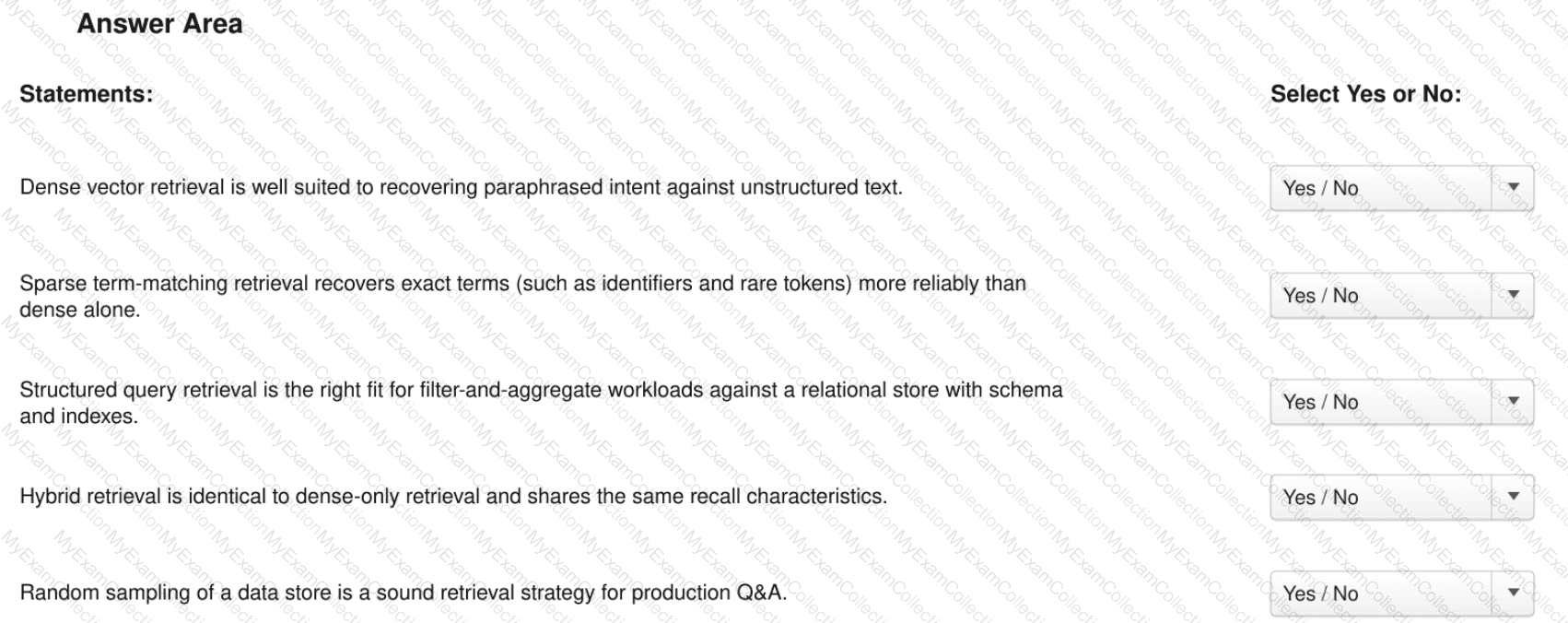
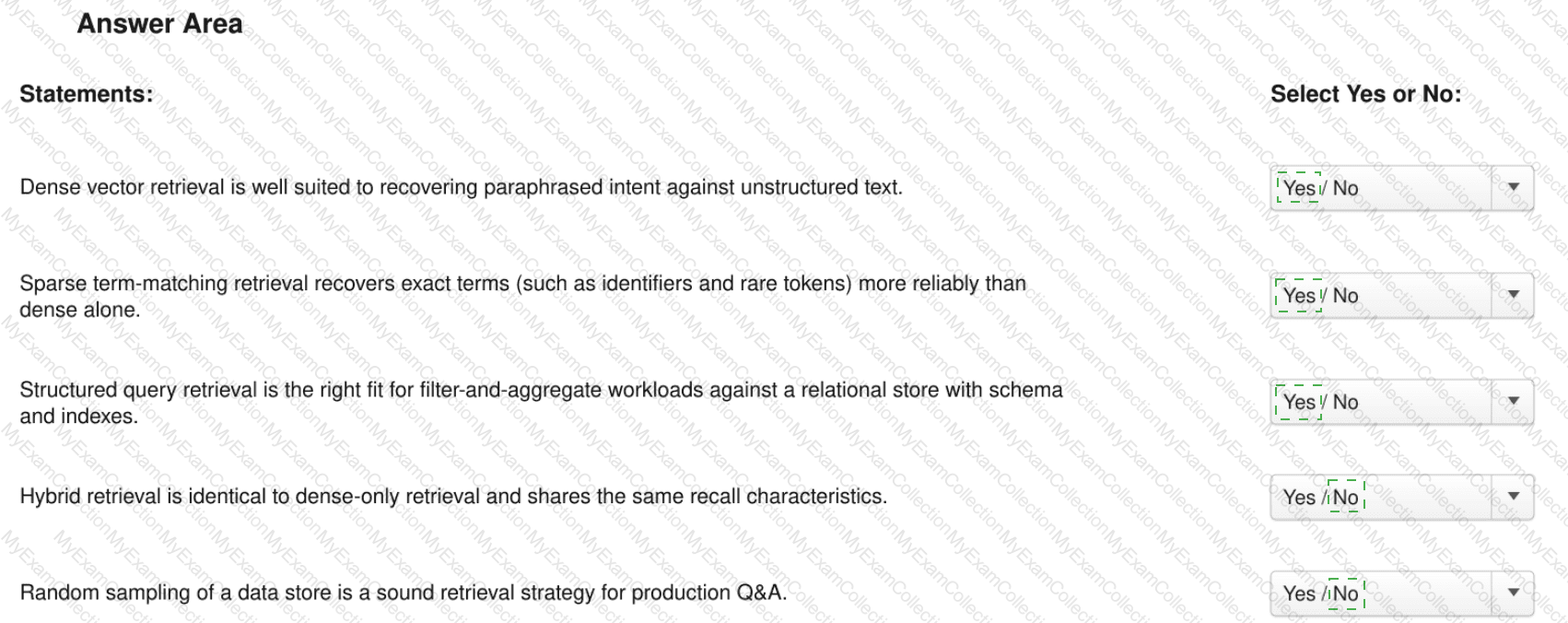
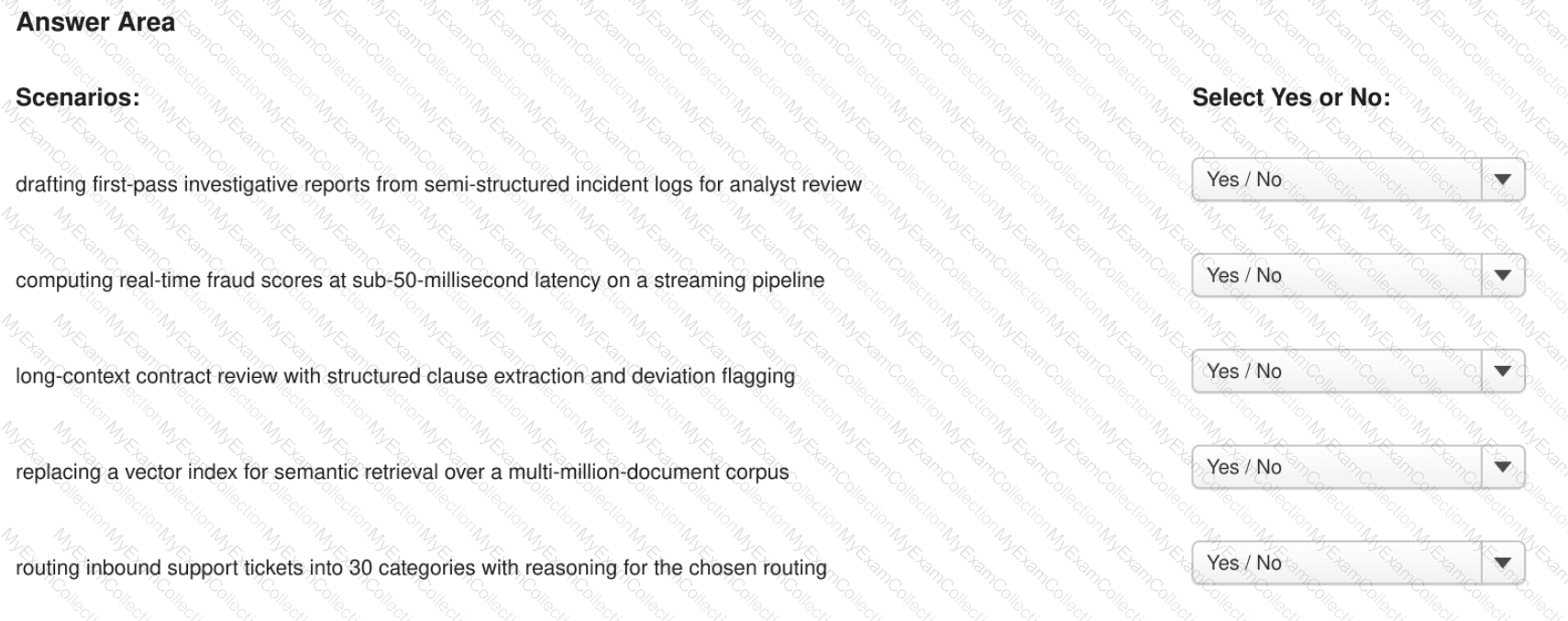
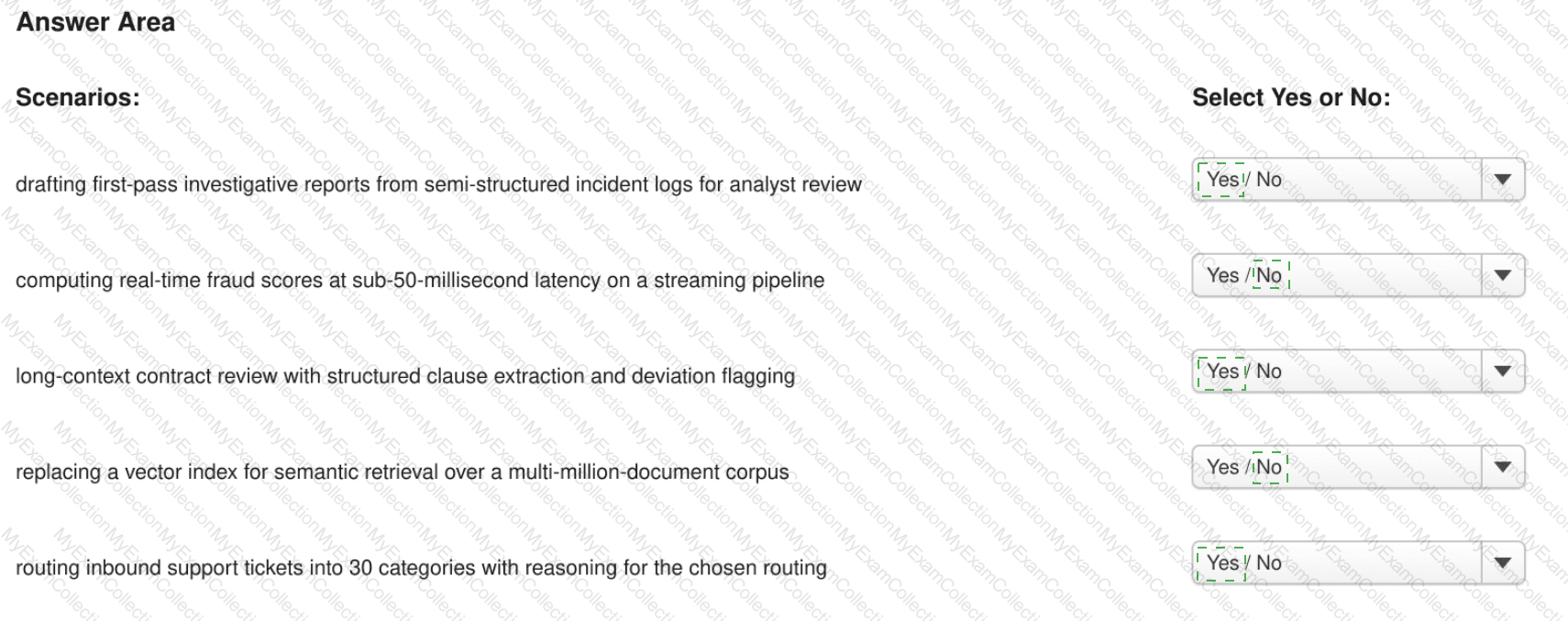
You are a solution architect evaluating candidate use cases for a Claude-based program.

For each scenario, select Yes if Claude is appropriate as the primary solution at the architectural level. Otherwise, select No.
Full Access
Question # 5

A senior architect is managing stakeholder expectations for a Claude-based reporting assistant midway through development. Stakeholders have escalating concerns about response latency.

Which two actions most directly address stakeholder expectation alignment in this situation? (Select two.)

A.

Present measured p50 and p95 latency baselines against the agreed SLA thresholds so stakeholders have accurate data.

B.

Pause all development and reallocate engineering resources entirely to latency optimization.

C.

Communicate that latency concerns are a known LLM limitation and outside the architecture team’s control.

D.

Replace the current Claude model with a third-party model that may offer lower latency without evaluation.

E.

Revise the SLA definition collaboratively with stakeholders if current targets are not achievable given production constraints.

Full Access
Question # 6

You are reviewing a peer’s Claude Code permission rules for an enterprise rollout. The rules grant unrestricted Bash access to all projects across all developers.

Which response is most appropriate?

A.

Add unrestricted access to additional tool categories as well, so that Bash is not asymmetrically more permissive than other tools, expanding the attack surface further in the name of consistency.

B.

Approve the unrestricted Bash access as written on the grounds that narrowing the rules would add configuration complexity, accepting the full attack surface for all engineers across all projects.

C.

Replace unrestricted Bash with narrowly scoped tool patterns that allow only the specific commands the workflows require, and add explicit deny rules for sensitive operations.

D.

Disable all permission rules for the enterprise rollout so every command across every project runs without any tool-pattern scoping or explicit deny rules for sensitive operations.

Full Access
Question # 7

You must present an architectural recommendation to deploy a Claude-based contract review assistant to a steering committee that includes the CFO, the general counsel, and the CIO. Each stakeholder cares about different aspects of the decision.

How should you structure the recommendation document?

A.

Lead with the technical architecture diagram and the full component list before any other section.

B.

Lead with detailed cost projections across the full multi-year horizon before the rationale section.

C.

Present the same dense narrative throughout with no stakeholder differentiation in any section.

D.

Lead with the architectural decision, then address each stakeholder’s primary concerns directly.

Full Access
Question # 8

A Claude architect needs to ensure that a security-hardening flag cannot be disabled by any individual engineer after it is set.

Which configuration scope correctly enforces this requirement?

A.

User scope (~/.claude/settings.json) on each engineer’s machine

B.

Environment variable defined in the CI/CD pipeline only

C.

Managed configuration applied centrally and marked as non-overridable

D.

Project scope (.claude/settings.json) committed to the repository

Full Access
Question # 9

During an architectural review, the security team identifies a risk that adversarial content injected into retrieved documents could manipulate the model’s behavior.

Which mitigation most directly addresses this threat?

A.

Treat all retrieved content as untrusted input and apply input classifiers with output validation.

B.

Require citations for each claim and constrain responses to source-supported content.

C.

Restrict outbound tool calls to an approved destination allow-list.

D.

Score outputs against a stable adversarial evaluation set on each model-version change.

Full Access
Question # 10

You are running a risk assessment on a planned Claude-based deployment and must complete the inventory steps before assessing threats against assets.

Which two steps must be completed BEFORE assessing threats against assets to estimate likelihood and impact? (Select two.)

Each correct answer presents part of the solution.

A.

Document the assessment outcome with risks, mitigations, residual risk, and acceptance owners.

B.

Recommend mitigations and residual-risk acceptance for the risks that remain after analysis.

C.

Identify the assets that the deployment touches, along with the sensitivity of each asset.

D.

Recommend mitigations and residual-risk acceptance for risks that remain.

E.

Enumerate the threat actors and attack vectors relevant to the deployment.

Full Access
Question # 11

A revenue projection assistant has missed its monthly cost target by 38 percent. Profiling shows three contributors: a 6,000-token policy preamble repeated on every call (45 percent of cost), retrieval of historical sales chunks averaging 3,000 tokens per call (30 percent), and inference on a flagship-tier model (25 percent). Stakeholders require that projection accuracy remain unchanged.

Which two optimizations should you sequence first to reduce cost without affecting accuracy? (Select two.)

Each correct answer presents part of the solution.

A.

Reduce the number of historical sales chunks retrieved across each query run.

B.

Truncate the policy preamble to remove non-essential clauses from the prompt.

C.

Enable prompt caching on the static policy preamble across the recurring calls.

D.

Switch the workload to a smaller, faster Claude model tier across all queries.

E.

Cache common retrieved sales chunks accessed across many of the daily queries.

Full Access
Question # 12

A team manager wants all engineers working on the same repository to share identical MCP server definitions without manual synchronization.

Which configuration approach satisfies this requirement?

A.

managed configuration pushed to all endpoints by the administrator

B.

environment variables set at the operating-system level on each workstation

C.

project-scope .claude/settings.json and .mcp.json files committed to the repository

D.

each engineer maintains a personal ~/.claude/settings.json with the shared definitions

Full Access
Question # 13

You are compiling continuity practices that span the deployment lifecycle.

Which two practices belong on the list? (Select two.)

Each correct answer presents a complete solution.

A.

Maintain a stakeholder register and notify the listed parties at every phase transition event.

B.

Carry the evaluation framework and reference set forward across iterations rather than rebuilding each time.

C.

Archive every phase deliverable in long-term storage to preserve a record of what was produced.

D.

Capture lessons learned at the end of each phase and surface them as inputs to the next phase.

E.

Lock decisions made in early phases to prevent revisiting them as later phases begin.

Full Access
Question # 14

You are a solution architect designing a Claude-based assistant with access to 60 internal tools across multiple business domains. Loading every tool definition on every request increases token usage and time to first response.

Which design pattern best addresses this issue without sacrificing capability breadth?

A.

Apply progressive tool discovery so a curated initial subset is exposed and additional tools are loaded on demand based on the task.

B.

Use a separate model call to summarize all 60 tool definitions before each user turn.

C.

Increase the maximum context length and load all 60 tool definitions on every request, accepting the higher token cost and latency as necessary for full capability.

D.

Hard-code a fixed set of five tools per request to reduce token usage, regardless of whether those tools are relevant to the current task.

Full Access
Question # 15

You are integrating human review into a high-volume classification pipeline where reviewing every output is infeasible.

Which sampling strategy best balances throughput with quality oversight?

A.

No sampling, relying entirely on user complaints to reveal quality and safety problems after they affect users.

B.

Risk-stratified sampling that reviews all low-confidence and high-impact outputs and a smaller random sample of high-confidence routine outputs.

C.

Inverse sampling that reviews only high-confidence routine outputs and skips low-confidence and high-impact outputs.

D.

Universal review of every output regardless of confidence or throughput impact.

Full Access
Question # 16

A Claude architect is implementing safety controls for a customer-facing advice assistant that must never provide regulated investment recommendations.

Which two guardrail implementations most directly enforce this constraint? (Select two.)

A.

Increase response temperature to introduce variability that reduces the likelihood of specific recommendations.

B.

Add an output classifier that detects and blocks responses containing regulated investment-recommendation language.

C.

Limit session length to reduce the volume of queries processed per user per day.

D.

Log all user queries to a SIEM for post-hoc compliance review.

E.

Define explicit out-of-scope categories in the system prompt with fixed refusal phrasing for investment advice requests.

Full Access
Question # 17

You are integrating Claude Code into a workflow that runs against a production database.

Which guardrail design most directly preserves safety on data-modifying operations?

A.

Allow Claude Code to write directly to the production database without subagent scoping, read-only credential defaults, or human confirmation gates on data-modifying operations.

B.

Configure the database MCP server with a fully privileged credential that can perform any read or write operation, and allow all operations to proceed without explicit human confirmation.

C.

Disable all logging and auditing on database operations through the MCP server to reduce alert noise, removing the observability needed to detect unintended data modifications.

D.

Configure the database MCP server with a read-only credential by default, restrict the subagent’s tool list to read-only operations, and require explicit human confirmation on any operation that would modify data.

Full Access
Question # 18

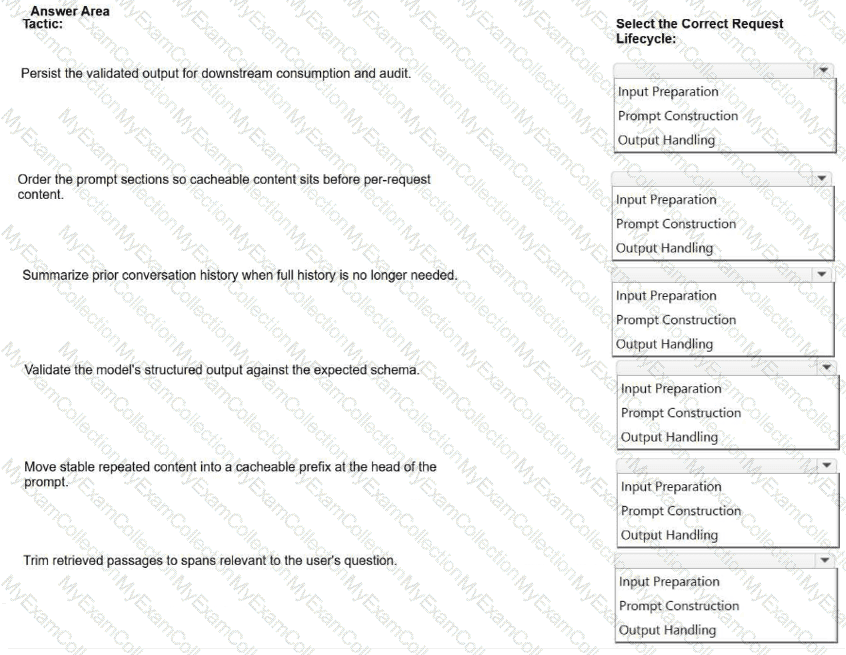
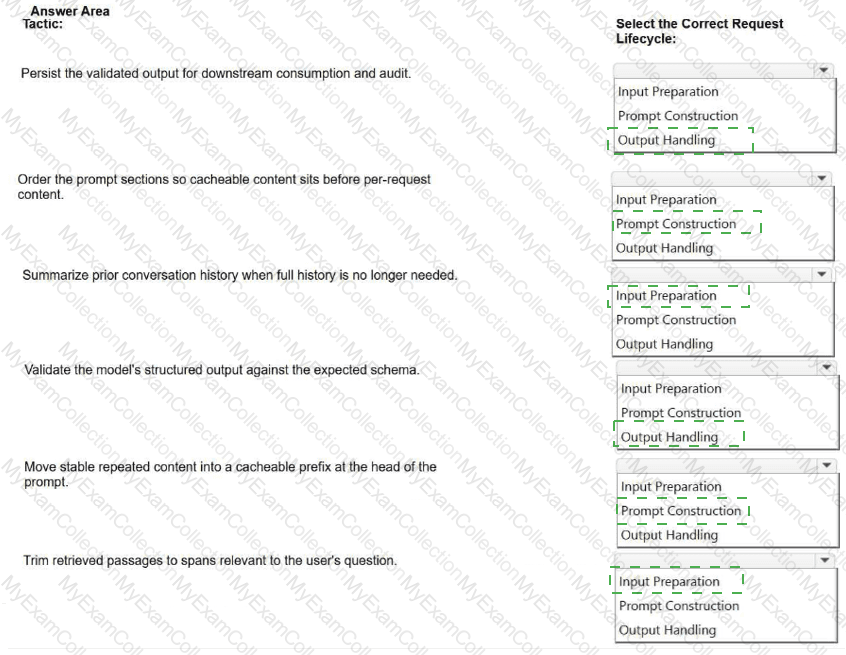
You are evaluating prompting claims in a peer’s design document.

For each claim, select yes if the claim reflects sound practice. Otherwise, select no.

Full Access
Question # 19

After a prompt-template update, several previously passing test cases now produce unexpected outputs.

Which test type is specifically designed to detect this category of failure?

A.

Integration tests that validate cross-component pipeline behavior.

B.

Adversarial tests that probe for prompt-injection vulnerabilities.

C.

Regression tests scored against a stable reference set of known-good behavior.

D.

Smoke tests that confirm high-level system availability after the change.

Full Access
Question # 20

The compliance team at a firm has approved a Claude Skill that generates client-facing investment summaries. The Skill includes the firm’s required disclaimers and prohibited-language list. A product manager has asked whether additional guardrails are needed at the application layer or whether the Skill alone is sufficient.

Which two guardrail responsibilities should remain at the application layer rather than the Skill? (Select two.)

Each correct answer presents part of the solution.

A.

Log every generated summary to the firm’s compliance audit trail for retention.

B.

Verify the requesting user is authorized to generate investment summaries at all.

C.

Format output sections according to the firm’s standardized house style guidelines.

D.

Apply the disclaimer template that the compliance team has standardized firm-wide.

E.

Apply the prohibited-language list that the compliance team maintains and updates.

Full Access
Question # 21

You are building an evaluation pipeline for a Claude-based deployment and must complete the specification steps before running the deployment against the dataset.

Which two steps must be completed BEFORE running the deployment against the evaluation dataset? (Select two.)

Each correct answer presents part of the solution.

A.

Publish the aggregated metrics to a dashboard and gate releases on threshold checks.

B.

Curate and label the evaluation dataset to match the defined slices.

C.

Review failure cases with subject matter experts to refine the scoring rubric.

D.

Define the metrics and slices the framework will report across representative, edge, and adversarial cases.

E.

Score the deployment outputs against the reference labels and aggregate the metrics.

Full Access
Question # 22

You are transitioning a Claude-based deployment from design into implementation.

Which handoff package most directly supports a clean transition?

A.

The most recent set of design presentation slides without component-level diagrams, interface contracts, an evaluation framework with a reference set, runbooks, or a known-limitations register.

B.

A verbal walkthrough conducted on the day of handoff with no written architecture overview, ADRs, component contracts, evaluation framework, runbooks, playbook, or known limitations.

C.

Architecture overview, ADRs, component contracts, evaluation framework with reference set, runbooks, on-call playbook, and known limitations.

D.

Source code alone with no integrating architecture overview, ADRs, component contracts, evaluation framework, runbooks, on-call playbook, or known-limitations register to support the delivery team.

Full Access
Question # 23

You are rolling out a standardized Claude Code configuration to an engineering team and must complete the planning steps before piloting the configuration.

Which two steps must be completed BEFORE piloting the configuration with a small group of engineers? (Select two.)

Each correct answer presents part of the solution.

A.

Define the project-scope baseline covering Model Context Protocol (MCP) servers, permission rules, and subagents.

B.

Onboard every engineer in the organization to the new configuration through mandatory training sessions.

C.

Roll out the stabilized configuration to additional teams with documentation and a defined support channel.

D.

Identify the team workflows, security boundaries, and which decisions belong to managed configuration versus project scope.

E.

Iterate the configuration based on the pilot findings and stabilize the baseline before broader rollout.

Full Access
Question # 24

You are reviewing an integration specification for security gaps.

Which two findings constitute valid security gaps in the specification? (Select two.)

Each correct answer presents a complete solution.

A.

Tool calls execute server-side under a least-privilege service principal scoped to the requested action.

B.

Service credentials are placed in the prompt context, where they can leak into logs and traces.

C.

Role-based access control is enforced only at the response-rendering layer after the model accesses restricted data.

D.

Per-user OAuth tokens are exchanged with scope-restricted permissions and refreshed within the active session.

E.

Tool inputs and outputs are encrypted in transit using transport-layer security between services.

Full Access
Question # 25

You are responding to a stakeholder request that adds significant scope to a deployment already in flight.

Which response best aligns expectations while respecting the stakeholder’s underlying need?

A.

Hide the scope-addition request from the broader delivery team to avoid a difficult conversation, allowing the change to proceed without team awareness of its timeline implications.

B.

Decline the request outright without acknowledging the stakeholder’s underlying need or offering alternatives such as deferral, descoping, or timeline extension.

C.

Acknowledge the request, describe the scope and timeline implications transparently, and propose options—defer it, descope something else, or extend the timeline—for the stakeholder to choose.

D.

Accept the additional scope into the current release without describing the timeline or descoping implications, allowing the delivery plan to absorb unacknowledged changes until they surface as delays.

Full Access
Question # 26

You are running a controlled experiment to compare two prompts and must complete the design steps before executing the experiment.

Which two steps must be completed BEFORE running the experiment with random assignment? (Select two.)

Each correct answer presents part of the solution.

A.

Determine the minimum detectable effect size and the sample size needed for power.

B.

Decide whether to promote, reject, or iterate the candidate based on the analysis.

C.

Define the hypothesis and the primary success metric for the comparison.

D.

Analyze the results against the predefined success metric and significance threshold.

E.

Document the recommendation, the trade-offs accepted, and the alternatives considered.

Full Access
Question # 27

You are selecting a protocol for a single low-latency stateless tool call from a Claude-based assistant to an internal pricing service that already exposes a stable HTTP API.

Which integration mechanism is the most appropriate?

A.

A direct API call to the existing endpoint with the appropriate scoped credentials.

B.

A long-lived stateful session protocol for a stateless single-call interaction.

C.

A bespoke streaming protocol layered over an unrelated asynchronous message bus.

D.

An agent-to-agent handoff that introduces another Claude-based agent in front of the pricing service.

Full Access
Question # 28

You are reviewing a peer’s draft system prompt that contains contradictory instructions: one section says never to speculate beyond the supplied source, while another says to confidently fill in any gaps.

Which response is most appropriate?

A.

Add a priority instruction directing the model to evaluate all instructions and apply whichever appears most contextually appropriate on each request.

B.

Remove or rewrite the gap-filling instruction so the prompt consistently constrains the model to source-supported content.

C.

Increase temperature so output randomness masks the contradiction.

D.

Keep both instructions and rely on the model to decide which one to follow on each request.

Full Access
Question # 29

You are compiling team-setup practices for a Claude Code rollout across an engineering organization.

Which two practices belong on the list? (Select two.)

Each correct answer presents a complete solution.

A.

Use project scope for team-shared Model Context Protocol (MCP) servers and permission rules under version control.

B.

Apply managed configuration centrally for security-critical settings that must not be overridden by individual engineers.

C.

Use local scope for security-critical permission rules so each engineer can adapt them to ongoing work.

D.

Use user scope for team-shared MCP servers so every engineer on the team has consistent access.

E.

Use project scope for personal editor preferences so the preferences apply consistently within the project.

Full Access
Question # 30

You are distinguishing functional from non-functional requirements during discovery.

Which item is a non-functional requirement?

A.

The system must extract a defined set of specific fields from invoice attachments and populate a downstream data record.

B.

The system must produce a draft response that a human reviewer can edit before sending.

C.

The system must classify inbound tickets into a defined set of categories.

D.

The system must respond at p95 latency under 800 milliseconds at the expected request volume.

Full Access
Question # 31

You are integrating AI-assisted tooling into the team’s documentation workflow. The team wants generated documentation that stays grounded in the actual code.

Which integration approach best fits this requirement?

A.

Generate documentation from the model’s training-data recall without reading any of the actual repository code, accepting that the output will not reflect the current implementation.

B.

Have the subagents publish generated documentation directly to the public-facing site without passing through the team’s normal review workflow or any human approval step.

C.

Configure subagents that read the relevant code files via filesystem and code-search tools, generate the documentation, and emit changes through the team’s normal review workflow.

D.

Disable all filesystem and code-search tools so the subagents cannot read any repository code, accepting that documentation generation will be entirely disconnected from the actual implementation.

Full Access
Question # 32

You are defining escalation criteria for ambiguous cases in an automated workflow.

Which set of criteria best supports consistent escalation?

A.

No escalation criteria; the model decides independently on every turn whether to escalate, without explicit confidence thresholds, impact categories, or classifier-based ambiguity flags.

B.

Escalation only after an affected customer has contacted support to complain, after the automated workflow has already completed without human review.

C.

Escalation at the discretion of whoever is available when the team’s on-call engineer has spare capacity, without a defined threshold, category, or ambiguity criterion.

D.

A confidence score below a defined threshold, presence of high-impact decision categories, ambiguity flags raised by content classifiers, and the user’s explicit request for review.

Full Access
Question # 33

You are identifying the highest-impact optimization for a deployment whose token cost is dominated by a long, repeated system prompt and a large retrieved context per request.

Which optimization most directly targets the dominant cost driver?

A.

Increase retrieval depth on every request to maximize recall, worsening the dominant cost driver by adding more retrieved tokens per request rather than reducing them.

B.

Add additional repeated content to the system prompt to give the model more guidance.

C.

Move the long, repeated system prompt into a cacheable prefix and trim retrieved context to the spans relevant to each query.

D.

Switch every request to the heaviest available model to maximize output quality, accepting that higher per-request inference cost compounds rather than addresses the dominant cost driver.

Full Access
Question # 34

A business sponsor has requested an AI solution to “improve customer experience.” The sponsor cannot articulate which customer journey is failing, which metric reflects the failure, or which decisions the AI should support. The sponsor is asking you to begin design work next week.

Which delegation-competency action should you take first?

A.

Recommend that the sponsor revise the request and resubmit it later for evaluation.

B.

Begin prototyping a generic assistant against the broad request before the next deadline.

C.

Propose a fixed scope that you commit to by default based on your own assumptions.

D.

Facilitate a structured discovery to define the failing decision and the target metric.

Full Access