Question # 4
An administrator has noticed that an application running in WebSphere Application Server ND on Linux in the production environment becomes unresponsive every 2 days. After reviewing SystemOut.log, they found several hung threads. On the advice of IBM Support, they ran the linperf script.
Which two statements about the linperf script are true?
Choose two
A.
It gathers verboseGC data.
B.
It generates heapdumps.
C.
It should be executed as the root user.
D.
It runs for 4 minutes by default.
E.
It takes the server name as a parameter.
Full Access
Answer:
C, D
Explanation:
The linperf script is part of the IBM MustGather for performance and hang problems on Linux. Its job is to collect operating system data and diagnostic data from the Java process while the problem is occurring: it takes periodic samples of CPU, memory, and process information and signals the JVM to produce javacores, which show the threads and their stacks. Two statements about it are true. It must be executed as the root user, because several of the commands it runs, such as those capturing system-wide statistics and signalling processes owned by other accounts, need elevated privileges. And it runs for four minutes by default, sampling at regular intervals so that a sequence of snapshots shows how the problem develops. Options C and D are correct.
The remaining statements are wrong. Option A is wrong because verbose GC data is not gathered by the script; it must be enabled in the JVM beforehand if it is wanted. Option B is wrong because linperf generates javacores, not heap dumps, and heap dumps have their own collection steps. Option E is wrong because the script takes the process identifier of the JVM, and not the server name.
When using it for a hang that recurs, the administrator should start the script as soon as symptoms appear, and send the resulting archive and the SystemOut.log to IBM Support.
[Reference: MustGather: Performance, hang, or high CPU issues on Linux; linperf.sh; Javacore analysis.]
Question # 5
What are two legitimate reasons to modernize an application and move it to a cloud environment?
Choose two
A.
Make source code simpler
B.
Speed in-market delivery
C.
Make application faster
D.
Reduce complexity and costs
E.
Better user experience
Full Access
Answer:
B, D
Explanation:
Modernisation is justified by business and operational outcomes, and two of the listed reasons are legitimate. Speeding in-market delivery is a central motive: moving an application to a cloud environment, and often packaging it in containers, lets teams use automated build and release pipelines, provision environments on demand, and deliver changes more often. Reducing complexity and costs is the second: consolidating infrastructure, using pay-as-you-go capacity, and retiring ageing platforms lower the burden of operating the estate. Options B and D are correct.
The remaining statements describe side effects or goals that are not reasons in themselves. Making source code simpler, option A, may occur if an application is refactored, but a move to the cloud does not simplify code, and rewriting for that purpose is an expensive end in itself. Making the application faster, option C, is not a dependable result, because performance depends on design, and an application that is moved without change usually performs much as before. A better user experience, option E, relates to the application's interface and functionality, which modernisation of the platform does not by itself change.
Transformation Advisor helps to prioritise by estimating the effort per application, so the organisation can begin with the candidates that have the best ratio of benefit to work.
[Reference: Modernization to the cloud; Transformation Advisor; Benefits of modernizing applications.]
Question # 6
Which cloud providers does IBM support for running WebSphere Application Server ND?
A.
IBM Cloud, Google, and AWS ECS Fargate.
B.
IBM Cloud, Microsoft Azure, AWS ECS Fargate.
C.
IBM Cloud, Microsoft Azure, and Google.
D.
Only IBM Cloud is supported.
Full Access
Answer:
B
Explanation:
IBM supports WebSphere Application Server in several public cloud environments, and the arrangements differ in how much IBM provides. On IBM Cloud, the product is offered through virtual server instance deployments that can be provisioned from the catalog. On Microsoft Azure, IBM publishes marketplace offerings for the traditional product, covering both a single instance and a cluster. On Amazon Web Services, the product is supported in containers running on Elastic Container Service with the Fargate launch type, with the Network Deployment licence used for the container deployment. Those three are the environments listed in option B.
The other options either add a provider that is not on that list or remove one that is. Google Cloud, which appears in options A and C, is not among the providers for which IBM publishes a supported offering for the traditional product in this documentation, though the product could be installed on virtual machines in other clouds under the general policy for eligible public clouds. Option D, that only IBM Cloud is supported, is incorrect because the Azure and AWS arrangements exist.
Administrators who plan a cloud deployment should check the Passport Advantage policy on eligible public clouds, which governs the licence entitlements for running the product on third-party infrastructure, and the specific prerequisites for each offering.
[Reference: WebSphere Application Server on cloud: IBM Cloud, Microsoft Azure, and AWS ECS Fargate; Passport Advantage eligible public cloud BYOSL policy.]
Question # 7
Which statement is correct about upgrading a WebSphere Application Server cell, installed by using a VSI tile in IBM Cloud, to the newest fix pack level?
A.
The latest WebSphere Application Server fix pack will be applied automatically.
B.
The administrator must open a support ticket to get the fix pack applied.
C.
The administrator can use the catalog tile to update the existing installation.
D.
The administrator has to manage and upgrade the installation on their own.
Full Access
Answer:
D
Explanation:
IBM's offering for running WebSphere Application Server on IBM Cloud virtual server instances is delivered as a catalog tile that provisions virtual machines with the product installed. The tile automates the initial deployment, creating the instances and installing the software at the version it offers. After that point, the environment behaves as an ordinary installation on virtual servers that the customer owns and operates. The service is not a managed platform that patches itself, so operations such as applying fix packs, updating the operating system, and managing the cell remain the customer's duty. This corresponds to option D.
Option A is incorrect because fix packs are not applied automatically. Option B is incorrect because no support ticket is needed, and IBM support does not apply fixes on the customer's behalf. Option C is incorrect because the tile is used for provisioning and is not an update mechanism for an existing installation.
The administrator therefore patches the cell with the usual tools, using Installation Manager to apply the fix pack to the product installation on each virtual server, taking care to follow the supported order for the deployment manager and nodes, and backing up the configuration beforehand. The documentation for the offering describes the shared responsibility between the platform and the customer.
[Reference: WebSphere Application Server for IBM Cloud VSI: getting started; Updating the product with Installation Manager; Applying fix packs to a cell.]
Question # 8
An administrator has set up a high-availability deployment manager (HA dmgr) with two dmgr nodes and two ODR nodes. What is the minimum role needed to view the HA dmgr configuration?
A.
Deployer
B.
Configurator
C.
Administrator
D.
ISC Administrator
Full Access
Answer:
B
Explanation:
A high availability deployment manager configuration provides more than one deployment manager in a cell, with one active and the others on standby, supported by shared file-system access to the master configuration. Intelligent Management, through the on demand routers, takes part in the environment. Reading the configuration of that setup is a read-oriented administrative task, which makes the question one of choosing the least-privileged administrative role that is sufficient.
WebSphere administrative roles form a hierarchy of increasing authority: Monitor, Configurator, Operator, Deployer, Administrator, and so on. Monitor grants read-only access, but it is not offered here. Among the choices given, Configurator is the lowest role that can view the configuration, since it can read and also change configuration, though it cannot perform runtime operations such as starting servers. The Deployer role is limited to application deployment functions, and Administrator is the highest role and therefore exceeds the minimum. ISC Administrator relates to the Integrated Solutions Console, which is the console application itself and is not the role required to inspect the HA deployment manager configuration, so option B is correct.
Granting the smallest sufficient role follows the principle of least privilege, which limits the harm that a compromised or mistaken account can cause.
[Reference: High availability for the deployment manager; Administrative roles and privileges; Assigning users to administrative roles.]
Question # 9
An administrator has created and configured a managed node for a non-IBM web server. Which two statements are true about this configuration?
Choose two
A.
The administrator can propagate the web server plugin-cfg.xml using the administrator console.
B.
The administrator can view web server logs using the administrator console.
C.
The administrator can generate plug-in configurations using the administrator console.
D.
The administrator can enable web server plug-in trace using the administrator console.
E.
The administrator can start and stop the web server using the administrator console.
Full Access
Answer:
A, C
Explanation:
When a non-IBM web server is represented in the cell as a managed node, a node agent for the web server is set up, which gives the deployment manager a route for managing certain aspects of it. Two capabilities hold for such a node. The administrator can generate the plug-in configuration with the console, and can propagate the resulting plugin-cfg.xml file to the web server through the node. Options A and C are correct. Managed web server nodes are the means by which the console keeps the plug-in configuration current as applications and clusters change.
The other capabilities are not available for non-IBM web servers. Viewing the web server's logs through the console, enabling the plug-in trace, and starting or stopping the server rely on the IBM HTTP Server administration server, which is provided for IBM HTTP Server and is not available for other web servers. For a non-IBM server, these actions would have to be done directly on the web server host with its own tools. This explains why options B, D, and E are incorrect.
The administrator should therefore treat the console as responsible for plug-in generation and propagation, and manage the lifecycle, logging, and tracing of a non-IBM web server with the vendor's own mechanisms. The plug-in's own log, whose location is set in the plug-in configuration, can be read directly on the host.
[Reference: Web server definitions: managed, unmanaged, and IBM HTTP Server nodes; Plug-in configuration generation and propagation; Web server plug-ins.]
Question # 10
Which two statements are correct about the clone migration feature?
Choose two
A.
Clone migrations follow the standard migration procedures, except the -clone parameter is specified when WASPostUpgrade is run.
B.
Cloned configurations must use the same port numbers as the original profiles.
C.
If a deployment manager is cloned, its federated nodes must also be cloned.
D.
Clone migrations follow the standard migration procedures, except the -clone parameter is specified when WASPreUparade is run.
E.
The cloning request must be made via a properties file parameter to WASPreUpgrade.
Full Access
Answer:
A, C
Explanation:
Clone migration is a feature that lets an administrator migrate a configuration to a new installation while the original environment continues to run, so the source remains available as a fallback. The procedure follows the standard migration sequence of running the pre-upgrade tool against the source and the post-upgrade tool on the target, with one distinction: the -clone parameter is specified when WASPostUpgrade is run. Option A is correct, while option D wrongly attributes the parameter to the pre-upgrade step, and option E likewise places a cloning request in a properties file for WASPreUpgrade.
A further rule concerns topology. When a deployment manager is cloned, its federated nodes must be cloned as well, so that the cell remains consistent, which makes option C correct. A cloned deployment manager that continues to manage the original nodes would conflict with the existing cell.
Option B is incorrect. Because the cloned and original environments may coexist, they cannot use the same port numbers when they run on the same system; the migration assigns new, non-conflicting ports, so ports are not required to match.
Administrators typically choose clone migration where a rollback path, parallel validation, or a short cut-over window is required, as running both environments reduces risk compared with an in-place upgrade.
[Reference: Migrating to the next version: clone migration; WASPreUpgrade and WASPostUpgrade commands; Migrating a deployment manager and federated nodes.]
Question # 11
During profile creation, which repository is set up as the active user registry?
A.
LDAP (Lightweight Directory Access Protocol)
B.
Stand-alone custom
C.
Federated Repository
D.
File-based federated
Full Access
Answer:
D
Explanation:
When a profile is created with default settings and administrative security is turned on, the product has to have a user registry in place so that the administrative user can authenticate. It configures the file-based federated repository as the active registry. That repository stores the administrative user and group definitions in a file in the profile's configuration, and it is a federated repositories realm that contains a single file-based repository. Option D is correct. The administrator can later add LDAP or other repositories to the realm, or switch the active registry to a stand-alone LDAP registry or a custom registry, once the profile is running.
The other options name registry types that are possible choices after creation, but are not what the profile creation sets up. A stand-alone LDAP registry, option A, and a stand-alone custom registry, option B, are alternative configurations that an administrator selects deliberately. The term Federated Repository in option C names the realm technology in general and does not identify the repository that actually holds the identities at creation time.
The practical implication is that a freshly created profile with security enabled can be used at once, with the administrator ID and password supplied during creation. For production, organisations usually point the realm to a corporate LDAP directory, and they take care to keep the administrative identity defined in a repository that stays available.
[Reference: Federated repositories; File-based federated repository (default registry); Configuring the active user registry; Profile creation and administrative security.]
Question # 12
An administrator must enable a Java 2 Security policy for an enterprise application installed in a horizontally clustered distributed environment. Which dynamic policy must they configure?
A.
was.policy
B.
app.policy
C.
java.policy
D.
server.policy
Full Access
Answer:
A
Explanation:
Java 2 security restricts the resources that application code can reach, and permissions are granted through policy files at different levels. Some of the policies are static and are read when the server starts, and others are dynamic and are attached to a particular application. The application-specific policy is the was.policy file, which is packaged within the application's META-INF directory and which the product reads when the application is started. Because it belongs to the application and travels with the archive, it is applied on every cluster member to which the application is deployed, with no separate per-server edit, which is what a horizontally clustered environment needs. Option A is correct.
The other files are outside that model. The server.policy file, option D, applies to all applications on the server and has to be maintained on each node. The java.policy file, option C, is the JVM's own policy and applies to every program that runs under that Java runtime. The app.policy file, option B, is not used as a name for an application policy file in this product.
Administrators should enable Java 2 security in the global security settings, grant only the permissions the application needs, and restart the servers. Where permissions are missing, AccessControlException messages in the logs name the permission that is required.
[Reference: Java 2 security; was.policy dynamic policy for applications; Configuring Java 2 security policy files.]
Question # 13
What information does the Technology Evaluation Summary section of an application migration report provide?
A.
List of all the required features for the application in the Liberty server.xml configuration file.
B.
High-level view of the content and structure of the application.
C.
Detailed migration analysis with file names and line numbers where rule infractions were detected.
D.
Which IBM platforms are a good fit with the technologies used by the application.
Full Access
Answer:
D
Explanation:
An application migration report is organised into sections, each with a different level of detail and a different audience. The Technology Evaluation Summary section sits at the top, and it answers a strategic question: given the technologies the application uses, which IBM runtime platforms suit it best. The analysis examines the application's use of specifications and APIs, and then indicates the fit with the platforms the report evaluates, such as traditional WebSphere Application Server, Liberty, and options for containers, so that a decision-maker can see where the application could run with the least rework. Option D is correct.
The other descriptions belong to different parts of the report. A list of the features needed in the Liberty server.xml file, option A, is the kind of information given in the Liberty-related recommendations, where features are mapped to the technologies used. A high-level view of the content and structure of the application, option B, is given by the application inventory or summary of its modules. A detailed analysis with file names and line numbers for infractions, option C, is the content of the detailed results, which identify the individual rule violations that a developer must fix.
Reading the report in order from summary to detail is the efficient approach: use the technology evaluation to choose a target, then the detailed section to estimate and plan the changes.
[Reference: Application migration reports: Technology Evaluation Summary; Migration analysis and detailed results; Transformation Advisor.]
Question # 14
An administrator is carrying out a silent installation of WebSphere Application Server by using a response file. Which options can they use to create the response file?
Choose two
A.
imcl –skipInstall
B.
imcl generateResponseFile
C.
IBMIM –skipInstall
D.
imcl createResponseFile
E.
IBMIM generateResponseFile
Full Access
Answer:
B, C
Explanation:
A response file for a silent Installation Manager run can be authored by hand, but the more dependable approach is to record one, so that every option the interactive wizard offered is captured in the correct syntax. Two methods are available. The first is the IBMIM executable, the graphical Installation Manager, started with the -record option and the -skipInstall option and a path for the data location. The administrator walks through the installation wizard, and Installation Manager writes the selections to a response file without performing the installation. That is option C. The second uses the command line tool, whose generateResponseFile command builds a response file from an existing installation, and this is option B.
Option A is wrong because the imcl tool does not use the -skipInstall option in that way; the record function belongs to the graphical IBMIM. Options D and E use command names that do not exist, namely createResponseFile on imcl and generateResponseFile on IBMIM.
A recorded response file ought to be reviewed before it is reused, since it contains the installation location, repository paths, and, if specified, encrypted passwords. Typical edits include changing the profile identifier and install location for other machines. The silent run is started with imcl input followed by the response file name.
[Reference: Installation Manager response files; Recording a response file (IBMIM -record -skipInstall); imcl generateResponseFile; Silent installation.]
Question # 15
Which statement is accurate about an on-demand router (ODR) in WebSphere Application Server ND?
A.
It cannot be run in a virtualized environment.
B.
It requires a dedicated node.
C.
It should be run in the DMZ.
D.
It is a gateway through which HTTP requests and SIP messages flow to back-end application servers.
Full Access
Answer:
D
Explanation:
The on demand router is a component of Intelligent Management that sits in front of the application servers and routes incoming traffic to them. It is a Java-based proxy that receives HTTP requests and SIP messages and forwards them to the back-end application servers, selecting a target according to workload information, routing rules, and service policies. It also takes part in dynamic operations such as queueing and prioritising requests and routing around unhealthy servers. Option D describes it accurately.
The other statements are not correct. Option A says the router cannot be run in a virtualised environment, but it runs as an ordinary server process on a node and can be virtualised in the same way as other servers. Option B says that it requires a dedicated node, whereas it can share a node with other servers, although a dedicated node is a common practice for performance and isolation. Option C says it should be run in the DMZ, but the security guidance for the product places it inside the internal network behind the web server in the DMZ, in the same way as the application servers. The product also supports configurations in which the router replaces the web server plug-in for request distribution.
Administrators typically deploy at least two routers for availability, and use the dynamic workload management data to keep routing decisions consistent between them.
[Reference: Intelligent Management: On demand router (ODR); Routing HTTP and SIP requests; Dynamic workload management.]
Question # 16
Which statement about WebSphere Application Server nodes is true?
A.
Node agents must be created manually after federation.
B.
Application servers must reside on managed nodes.
C.
Nodes can span a single or multiple virtual machines.
D.
A cell can contain managed and unmanaged nodes.
Full Access
Answer:
D
Explanation:
A node in WebSphere Application Server is a logical grouping of server processes that share a configuration and a host system. A cell can contain two kinds. Managed nodes have a node agent and are federated into the cell, so the deployment manager can administer them and synchronise their configuration. Unmanaged nodes have no node agent; they are used to represent resources that the cell must know about but cannot fully administer, such as a web server. A cell can therefore hold both managed and unmanaged nodes, which is option D.
The other statements are incorrect. Node agents do not need manual creation after federation, option A, since the addNode command creates and starts the node agent as part of federating the node. Application servers do not have to be on managed nodes, option B, because a stand-alone application server is a valid configuration, though it lacks central administration. Option C, that nodes can span a single or multiple virtual machines, conflicts with the definition of a node as associated with one host; a physical or virtual machine may host several nodes, but a single node does not extend across machines.
When planning topology, administrators generally place one node per machine for each profile, and add an unmanaged node when a web server must be included in the cell so that the plug-in configuration can be generated and propagated.
[Reference: Nodes and node agents; Managed and unmanaged nodes; Cell topology.]
Question # 17
Which statement is accurate about configuring a new Java EE application that uses JAX-WS web services?
A.
The use of the webservices.xml deployment descriptor is required.
B.
Any information defined in the webservices.xml deployment descriptor overrides any corresponding information that is specified by annotations,
C.
Use wsdeploy to add WebSphere product-specific deployment classes to a web services-compatible enterprise application enterprise archive (EAR) file.
D.
The web services application requires adding additional bindings and deployment descriptors for application deployment.
Full Access
Answer:
B
Explanation:
A Java EE application that exposes or consumes JAX-WS services can define its web service metadata in two ways, through annotations in the code and through the webservices.xml deployment descriptor. The descriptor is optional in this model, because annotations alone are sufficient, so it is not required, which rules out option A. The JAX-WS specification, together with the web services metadata specification it builds on, establishes a precedence rule: where both sources define the same item, the information given in the deployment descriptor overrides what the annotations specify. That is the position described in option B, and it lets an administrator or assembler adjust values such as port component names without changing the source code.
Option C is incorrect because wsdeploy is associated with the older JAX-RPC model and does not apply to JAX-WS applications in this release; JAX-WS annotated classes are discovered and prepared automatically when the application is installed. Option D is also incorrect because JAX-WS applications do not require additional product-specific bindings or deployment descriptors for ordinary deployment, since the runtime assembles the endpoint from the annotations.
When a service behaves differently from the annotations, the first check should therefore be whether a webservices.xml file in the module is overriding them. Policy sets and bindings can then be attached separately for qualities of service such as security and reliable messaging.
[Reference: Developing JAX-WS web services; webservices.xml deployment descriptor; Deploying and administering web services applications.]
Question # 18
When installing a new enterprise application, which option does not offer resource binding during deployment?
A.
wsadmin scripts
B.
Monitored directory
C.
Rapid deployment tools
D.
Administrative console installation wizard
Full Access
Answer:
B
Explanation:
Resource bindings connect the resource references declared in an application, such as data sources, EJB references, and message destinations, to actual resources defined in the server's JNDI namespace. During installation the application must receive those bindings, and the different installation paths vary in how much control they give over them. The administrative console installation wizard presents binding panels for each module and reference. The wsadmin scripting interface, using AdminApp.install, accepts binding options and binding files, so bindings can be supplied programmatically. Rapid deployment tools, through their annotation-driven approach, can generate bindings as part of the deployment package, which supports resource binding in those packages.
The monitored directory is the exception. When an application archive is copied into the monitored directory, the server installs it automatically, applying default bindings and without presenting any opportunity to adjust them. Because the deployment happens unattended, the administrator cannot specify the resource bindings at that time, and any adjustment has to be made afterward through the console or wsadmin. Option B is therefore the one that does not offer resource binding.
This limitation makes the monitored directory best suited to development and test environments, in which defaults are acceptable. For production releases, an installation method that permits explicit bindings is preferable because it avoids a corrective step after deployment and reduces the risk of an application starting against a wrong resource.
[Reference: Installing enterprise applications; Monitored directory application installation; Resource bindings and AdminApp.install options.]
Question # 19
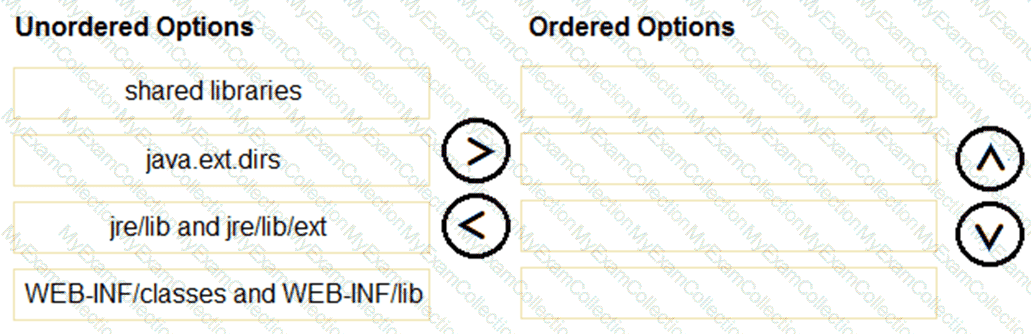
What is the load order of classes for an application when using the parent first class-loader mode for WebSphere Application Server ND? (Choose all that apply.)
Full Access
Answer:
Answer: 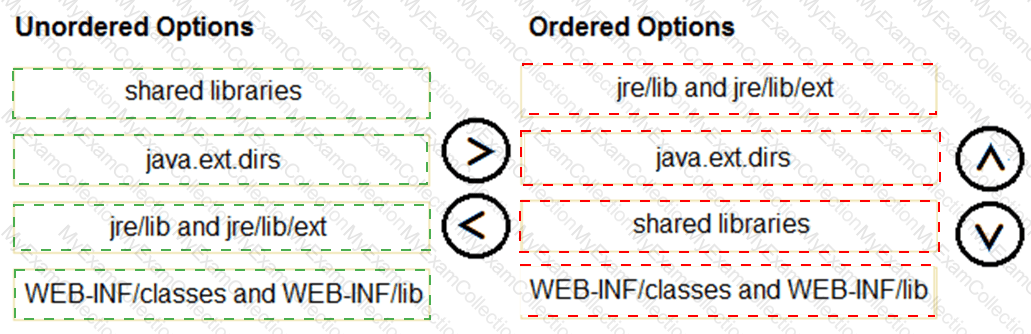
Explanation:
1. jre/lib and jre/lib/ext
2. java.ext.dirs
3. shared libraries
4. WEB-INF/classes and WEB-INF/lib
With the parent first class loader mode, a class loader asks its parent to load a class before it tries to load the class itself, so lookup proceeds from the broadest scope to the narrowest. The order for an application therefore runs as follows. First, the Java virtual machine's own class path is searched, which includes the jre/lib and jre/lib/ext directories. Second, the directories listed in the java.ext.dirs system property are consulted, which carries the WebSphere extensions and runtime classes. Third, the shared libraries associated with the application are searched. Fourth, and last, the application's own classes are loaded from WEB-INF/classes and WEB-INF/lib.
Placing the application's classes last means that any class available higher in the hierarchy takes precedence over a class of the same name that the application packages. That behaviour protects the integrity of the server runtime and provides consistent versions, but it also means an application that bundles a different version of a library supplied by the server will see the server's copy. Applications that must use their own versions should be set to parent last, in which case the application's classes are checked ahead of the parent's.
Class loader conflicts can be diagnosed with the class loader viewer in the administrative console, which displays the loaders and their search paths.
[Reference: Class loaders; Class loading mode: parent first and parent last; Class loader viewer.]
Question # 20
What is the proper sequence for setting up LTPA SSO between two WebSphere cells?
A.
Export the LTPA key from CellA and then import the LTPA key to CellB
B.
Export the LTPA key and then import the LTPA key to a text file.
C.
Generate the LTPA key from CellA, export CellB, and then import the LTPA key to CellA.
D.
Export the LTPA key from CellB and then export the LTPA key from CellA.
Full Access
Answer:
A
Explanation:
Lightweight Third Party Authentication tokens are encrypted and signed with keys held in each cell's configuration. A token generated in one cell can only be accepted by another cell if both cells share the same LTPA keys, along with the same password and a compatible realm configuration. Single sign-on between two cells is therefore set up by taking the keys from one cell and placing them in the other. The sequence is to export the LTPA key from the first cell to a file, using the console's LTPA page or the exportLTPAKeys wsadmin task, and then to import that file into the second cell. Option A describes this: export from Cell A and import to Cell B.
The other sequences are not workable. Option B proposes importing the key to a text file, which is not an import into a cell and so does not share the key. Option C generates a key in Cell A, exports from Cell B, and imports to Cell A, which mixes the cells' roles and ends with Cell B's key unchanged, so the cells do not end up holding the same key. Option D exports from both cells, and neither cell receives the other's key.
After importing, the administrator saves the configuration, and generally restarts servers so that the new keys take effect. The user registries of the cells should resolve users to the same identities, and the domain name for the SSO cookie should be common to both.
[Reference: LTPA key export and import; Configuring single sign-on across cells; LTPA authentication mechanism.]
Question # 21
An administrator has deployed a multi-module application to a WebSphere Application Server ND cell. Which statement is true about changing the modules’ mappings to servers?
A.
Modules can be mapped to the same application server or distributed among several application servers.
B.
The only way to change the mapping is to uninstall and then reinstall the application with the correct mapping.
C.
Ensure that each module entry is mapped to one and only one target identified under Server.
D.
The applications must be manually restarted after saving the configuration changes for the changes to take effect.
Full Access
Answer:
A
Explanation:
An enterprise application containing several modules, such as web modules and EJB modules, is deployed with a mapping of each module to one or more targets. The administrative console's Manage Modules page, and the wsadmin equivalents, let an administrator change that mapping after the installation. Modules may be placed on the same application server, or distributed among several application servers or clusters in the cell, according to capacity and availability needs. Option A is correct.
Option B is wrong because reinstalling is not the only route; the mappings can be edited directly in the application's configuration. Option C is incorrect as stated: a module may be mapped to more than one target, for example to multiple cluster members or to a cluster together with a web server for plug-in generation, so there is no rule that each entry maps to one and only one target. Option D is wrong because the changes do not require manual restart of the application in every case; the product applies the configuration after it is saved and synchronised, restarting the affected application as necessary.
Administrators should map modules that have a strong dependency, such as a web module and the EJB module it calls, thoughtfully, since placing them on separate servers introduces remote calls. Web server targets should also be included so the plug-in configuration lists the application's URLs.
[Reference: Managing module mappings to servers; Application deployment targets; Mapping modules to servers in the administrative console.]
Question # 22
To periodically purge FFDC files, which file or files must be updated to change the value of the ExceptionFileMaximumAge property?
A.
ffdcStart properties only
B.
ffdcStart.properties and ffdcStop.properties only
C.
ffdcRun.properties.ffdcStart.properties and ffdcStop.properties
D.
ffdcRun.properties only
Full Access
Answer:
C
Explanation:
First failure data capture (FFDC) writes exception summaries and incident files to the profile's ffdc directory. Retention of those files is controlled by the ExceptionFileMaximumAge property, which sets how long an FFDC file may remain before it becomes eligible for purging. The product reads FFDC settings from three separate property files, and each file is consulted at a different point in the server lifecycle. ffdcRun.properties applies while the server is running, ffdcStart.properties applies during startup processing, and ffdcStop.properties applies during shutdown. For the purge policy to behave identically in all three phases, ExceptionFileMaximumAge has to carry the same value in every one of them, which is the position stated in option C.
Options A, B, and D each leave out at least one of the files. Updating only ffdcRun.properties, for example, would change the retention age for a running server but leave startup and shutdown purges operating on the previous value, so files could be removed on an inconsistent schedule or accumulate longer than intended. Option A also refers to "ffdcStart properties" without the .properties extension and names a single file, so it fails on both counts.
The practical rule for administrators is to treat the three files as one logical configuration and edit them together whenever FFDC retention is tuned.
[Reference: First failure data capture (FFDC) property files: ffdcRun.properties, ffdcStart.properties, ffdcStop.properties; Managing FFDC output.]
Question # 23
An administrator has configured High Performance Extensible Logging (HPEL) in a WebSphere cell. Which option lets them access logs throughout the cell?
A.
HPELControlService and HPELLogDataService
B.
HPELLogDataService and HPEL API
C.
HPELTraceDataService and HPEL API
D.
HPELControlService and HPEL API
Full Access
Answer:
D
Explanation:
High Performance Extensible Logging stores log and trace records in a binary repository, and it exposes that content through services and an API. Two management interfaces matter. The HPELControlService is the MBean used to configure the logging service, for example to change repository settings, and the HPEL API, which provides programmatic access for reading and filtering repository data. Where logs must be reached across the whole cell, the control service lets the administrator manage HPEL behaviour for servers in every node, and the API lets a program read records from multiple servers' repositories. This pairing is what option D lists.
The other options mix the services in ways that fall short. HPELLogDataService is a service for retrieving log records from a single server, which makes it narrower than the cell-wide requirement. HPELTraceDataService concerns trace records and, with the same limitation, offers retrieval for a particular server and not cell-wide access.
For day-to-day work, the LogViewer command line tool, which reads HPEL repositories, is the most common method of seeing the content in a readable form, and it can be used with filters on time, thread, logger, or message level. Administrators can also view logs from the administrative console's log viewer when HPEL is the active log framework.
[Reference: High Performance Extensible Logging (HPEL); HPELControlService and HPEL API; LogViewer command.]
Question # 24
Which command generates a list of every installed package, including its features, installed fixes, and rollback version?
A.
imcl listInstalledPackages –verbose
B.
imcl listInstalledPackages –long
C.
imcl listInstalledPackages –features –long
D.
imcl listInstalledPackages –verbose –features
Full Access
Answer:
A
Explanation:
Installation Manager's imcl tool can report on what is installed, and the options determine how much detail is returned. Running imcl listInstalledPackages with no options returns the package identifiers and versions. Adding -verbose expands the output to list every installed package along with its features, installed fixes, and the rollback version, which is the full inventory the question describes. Option A is correct.
The other forms are not valid or do not provide the same output. The -long option in options B and C is not accepted by the listInstalledPackages command, so those commands would fail with an error. Option D combines -verbose with a -features switch, but features are already part of the verbose output, and the additional switch is not a recognised option for this command.
This listing is useful in several scenarios. Before applying a fix pack, an administrator can record the current level and the rollback target. After an installation by response file, it confirms that the packages and optional features were applied. Where a problem is reported to IBM Support, the verbose listing is typically requested, since it shows precisely which fixes are present. The output should be generated by the user account that performed the installation, because Installation Manager keeps separate registries for root and non-root installations.
[Reference: Installation Manager command line (imcl); listInstalledPackages options; Installed package and fix inventory.]
Question # 25
How can multiple base WebSphere Application Servers, running in different operating-system environments, be managed by a WebSphere ND cell?
A.
Create a deployment manager and then federate the nodes with the application server profiles into the cell.
B.
Create a deployment manager and new nodes for the applications.
C.
A Job Manager can be configured to manage the deployment manager and the federated nodes since they are on different operating systems.
D.
Heterogeneous cells with different operating systems are not supported.
Full Access
Answer:
A
Explanation:
A Network Deployment cell is built around a deployment manager, which holds the master configuration, and nodes that are federated into it. Each node runs a node agent that communicates with the deployment manager, and the operating system of each node is independent of the others. Because the communication between the cell's processes uses platform-neutral protocols, a cell may contain nodes running on different operating systems, which is called a heterogeneous cell. To bring base application servers on several platforms under central management, the administrator creates a deployment manager and then federates each application server profile into the cell with the addNode command. Option A states that procedure.
Option B, creating new nodes for the applications, would discard the existing servers' configuration instead of bringing them under management. Option C misapplies the job manager. The job manager coordinates administrative jobs across multiple deployment managers and administrative agents, and it is a way of managing groups of separate environments, but it does not replace federation for placing nodes in a cell. Option D is incorrect because heterogeneous cells are supported, subject to the product's requirements for compatible versions.
Before federating, the administrator should check that the node's product version is no higher than the deployment manager's, since a node at a later release cannot join. Time synchronisation and name resolution between hosts must also work reliably.
[Reference: Cell topology and heterogeneous cells; Federating nodes with addNode; Job manager overview.]
Question # 26
When security is enabled in WebSphere Application Server ND, which two administrative commands may be used without providing a user name and password?
Choose two
A.
serverStatus
B.
stopServer
C.
stopManager
D.
startServer
E.
startManager
Full Access
Answer:
D, E
Explanation:
When administrative security is enabled, most administrative commands authenticate to the server before acting on it, so they need a user ID and password supplied as arguments or through a properties file. Commands that stop servers or query their status communicate with a running process and are therefore subject to authentication. The commands that start a server are different, because the start commands launch a local operating-system process on the machine where they are run; they do not connect to an existing server's administrative service and therefore need no credentials. startServer and startManager are the two commands that can be run without a user name and password, so options D and E are correct.
serverStatus, option A, queries a running server through the administrative connector, so it requires credentials with at least the monitor role when security is enabled. stopServer, option B, and stopManager, option C, send a stop request to a running server, which calls for the operator or administrator role and thus needs authentication.
The practical rule is that anything operating on a live process requires credentials, while launching a process requires only operating-system privileges to run the script. Administrators who dislike passing credentials on the command line can place them in the soap.client.props file, ideally with the password encoded.
[Reference: Starting and stopping servers; Administrative security and command authentication; soap.client.props credentials.]
Question # 27
Which supported client type supplies the support required by full-function Java SE client applications for object resolution, security, reliability, availability, and serviceability (RAS), but does not support a client container that offers easy access to these services?
A.
ActiveX to Enterprise JavaBeans Bridge
B.
Applet client
C.
Java thin client
D.
Java EE client
Full Access
Answer:
C
Explanation:
The Java thin client is a standalone Java SE application that uses the WebSphere thin client runtime libraries to reach services in the application server. That runtime provides the support a full-function Java SE client needs: resolving objects, including JNDI lookups and remote references; security operations such as authentication to the server; and the facilities for reliability, availability, and serviceability, abbreviated RAS, which cover logging and diagnostic behaviour. What it does not provide is an application client container. Without the container, the client has to handle initialisation and service access in its own code rather than relying on declarative references and container-managed startup. That matches the wording of the question, so the correct answer is C.
The Java EE client differs on exactly this point, because it runs in the application client container, which gives easy access to those services. The applet client runs within a browser's Java plug-in and has its own limitations on what the browser permits. The ActiveX to EnterpriseJavaBeans Bridge serves non-Java ActiveX clients rather than full-function Java SE applications.
Selecting among client types is largely a question of how much container support the application needs. For a lightweight Java SE tool that only needs to call enterprise beans, the thin client is adequate; for more involved clients, the Java EE client is preferred.
[Reference: Client types and client container; Java thin client for EJB applications; Java EE application client.]
Question # 28
When updating an application, if changes are made to classes that add, remove, or modify class hierarchies in the application and affect annotated classes, what action must be performed to ensure the updates are reflected?
A.
Reinstall the application.
B.
Restart the application.
C.
Modify the annotations manually.
D.
Modify applications.xml on the server config directory.
Full Access
Answer:
A
Explanation:
The product can reflect many changes to a deployed application without a full redeployment, either through dynamic reloading, which applies to changes in classes and related files, or through fine-grained update operations in which individual files are added, replaced, or removed. Annotated classes are a special case. During application installation, the product scans the application's classes for annotations and uses the results to build metadata, so, for instance, servlets or web services declared by annotation are discovered at that time. When a change affects the class hierarchy of annotated classes, by adding, removing, or modifying superclasses or interfaces, the scan results can no longer be assumed accurate, and the metadata derived at installation must be regenerated.
The only action that regenerates it is a fresh installation of the application, which makes option A the correct answer. A simple restart, option B, reloads the code but reuses the stored metadata. Editing annotations manually, option C, does not apply because annotations live in the source code compiled into the archive. Modifying applications.xml, option D, would risk corrupting the deployment configuration and does not trigger a scan.
After such a change, administrators should uninstall or reinstall the updated archive, and confirm afterwards that the expected components and endpoints appear, reviewing the application's start-up messages for scan-related warnings.
[Reference: Updating enterprise applications; Dynamic reloading and fine-grained updates; Annotation scanning during application installation.]
Question # 29
Which two commands can be used to modify configurations in WebSphere Application Server ND?
Choose two
A.
ws_ant.sh
B.
wasadmin.sh
C.
manageprofiles.sh
D.
WsAnt.sh
E.
wsadmin.sh
Full Access
Answer:
A, E
Explanation:
Configuration of a Network Deployment cell is modified through the administrative interfaces, and two of the listed commands can do it. wsadmin.sh is the scripting client. It connects to the deployment manager and, through objects such as AdminConfig, AdminTask, and AdminApp, creates, changes, and removes configuration documents, which is the primary scripted method for configuration changes. ws_ant.sh starts Apache Ant with the WebSphere-supplied environment and tasks. The product ships Ant tasks, including the wsadmin task, that run administrative scripts, install applications, and start or stop servers, so a build script launched with ws_ant.sh can change cell configuration in an automated manner. The correct selections are A and E.
The other options do not fit. manageprofiles.sh manages the lifecycle of profiles: creating, deleting, augmenting, backing up, and restoring them. It operates on profile structure on the local machine and is not the tool used to change configuration of servers, resources, or applications in a running cell. WsAnt.sh is not a script shipped with the product, and "wasadmin.sh" is a misspelling of the scripting client and does not exist.
When automation is required, administrators typically choose wsadmin with Jython for fine-grained control and ws_ant.sh when administrative steps must be embedded in a larger build or deployment pipeline.
[Reference: wsadmin scripting client; ws_ant command and Ant tasks; manageprofiles command.]
Question # 30
After installing the PerfServiet to retrieve performance data for their WebSphere Application Server Domain, an administrator observes consistently high response times across all nodes at all times. Which two factors can contribute to this responsiveness?
Choose two
A.
Number of PMI counters
B.
Numbers of application servers that exist in the cell
C.
Number of monitoring agents
D.
Number of users
E.
Number of resources configured in the cell
Full Access
Answer:
B, E
Explanation:
PerfServlet exposes PMI data from the application server in XML form so that external tools can collect it. It runs as an application inside the server it monitors and gathers data on request, so its cost grows with the amount of data it has to assemble. Two of the listed factors increase that amount directly. The number of application servers in the cell matters because data must be collected from each server, and the number of resources that are configured, such as data sources, thread pools, and queues, matters because each resource has its own counters to read and report. Options B and E are correct.
The number of PMI counters is a closely related factor, but a given PMI statistic set size is configured separately, and the question's emphasis on consistently high response times across all nodes points to the scale of the topology and its resources. The number of monitoring agents, option C, does not add to the cost within the server itself, since the polling frequency is controlled by the client. The number of users, option D, affects application load but does not determine the size of the PerfServlet response.
To limit the overhead, administrators can lower the PMI statistic set to Basic, request data for specific modules instead of the whole cell, and lengthen the polling interval.
[Reference: Performance Monitoring Infrastructure (PMI); PerfServlet; PMI statistic sets and counter selection.]
Question # 31
When modifying descriptors in Java EE 6 applications that use annotations, what is one method to ensure the changes take effect?
A.
Update the files through the administrative console.
B.
Restart the application.
C.
Reinstall the application.
D.
Update server.xml for the application server.
Full Access
Answer:
C
Explanation:
A Java EE 6 application can describe its components through annotations in the code, through deployment descriptors, or through both. At installation time the product scans the application's classes, reads the annotations, and merges that information with whatever the deployment descriptors state, producing the metadata it uses at run time. That metadata is stored with the installed application, so a change to a descriptor, or to any element that changes how annotations are interpreted, is not picked up simply by changing a file in place or by restarting the application, because the stored result of the earlier scan remains in effect. To make the product repeat the scan and rebuild the metadata, the administrator reinstalls the application, which is option C.
Option A, updating files through the administrative console, is a way of delivering changed files, but it does not by itself guarantee a rescan of annotated classes. Option B, restarting, reloads the code but reuses the existing metadata. Option D, editing server.xml, targets the server configuration, and the file does not hold the application's deployment descriptor or its annotation metadata.
After reinstalling, administrators should confirm the intended components were discovered, for example by checking the module and servlet listings in the console, and should preserve bindings and mappings by supplying them again or using a saved binding file. In clustered environments the new version is synchronised to every node before the application starts.
[Reference: Updating enterprise applications; Annotation scanning and metadata-complete deployment descriptors; Installing enterprise applications.]
Question # 32
Which two exceptions can be thrown when class-loading problems occur?
Choose two
A.
NoClassFoundLibraryException
B.
GeneralClassError
C.
DuplicatedClassException
D.
UnsatisfiedLinkError
E.
ClassCastException
Full Access
Answer:
D, E
Explanation:
Class-loading faults in WebSphere Application Server surface as standard Java throwables, and two from the list are genuine. ClassCastException occurs when code casts an object to a type of which it is not an instance. In class-loader terms, it is a classic symptom of the same class name being loaded by two different class loaders: the two Class objects are distinct to the JVM, so an object created from one fails a cast to the other. This commonly appears when a library exists in both an application and a shared library, or when parent-first and parent-last settings produce duplicate copies.
UnsatisfiedLinkError is thrown when the JVM cannot link a native method, typically because the native library cannot be found or, importantly in application servers, because a native library has already been loaded by a different class loader. A JVM allows a given native library to be bound to only one class loader, so redeployment or multiple loaders in the same server can trigger the error.
The remaining choices, NoClassFoundLibraryException, GeneralClassError, and DuplicatedClassException, are not exceptions in the Java platform or WebSphere runtime. Administrators looking for real class-loading evidence should also watch for ClassNotFoundException and NoClassDefFoundError, which were not offered here. The correct selections are therefore D and E.
[Reference: Class loaders; Troubleshooting class loaders; Class loader viewer.]
Question # 33
Which two of the following are valid options for the syncNode command?
Choose two
A.
forceStop
B.
stopservers
C.
restart
D.
silentMode
E.
verbose
Full Access
Answer:
B, C
Explanation:
The syncNode command is run on a node to synchronise its configuration with the deployment manager's master repository without needing the node agent, which is useful when the node agent cannot start because its local configuration is out of date. The command takes the deployment manager's host name and SOAP port, optionally followed by options that adjust its behaviour. Two of them are in the list. The -stopservers option stops all of the node's servers before synchronising, so that files are not replaced under running processes, and the -restart option restarts the node agent after synchronisation completes. Options B and C are correct.
The other names are not options for the command. forceStop in option A is not recognised. silentMode, option D, is not an option for syncNode. verbose, option E, is not a syncNode option either, although other commands accept similar flags; for diagnostic output the command writes to a log file, which can be named with the -logfile option, and the -trace option increases the detail.
A typical recovery proceeds as follows: stop the node's servers, run syncNode with the deployment manager's host and port, and start the node agent. If the command is used with security enabled, the credentials for the deployment manager must be supplied with -user and -password. The resulting synchronisation log is the first place to check when the run fails.
[Reference: syncNode command; Synchronizing node configuration with the deployment manager; Node agent recovery.]