Summer Sale Special - Limited Time 70% Discount Offer - Ends in 0d 00h 00m 00s - Coupon code: mxmas70

Home > Appian > Associate Developer > ACD101

ACD101 Appian Associate Developer Question and Answers

Question # 4

What are the three parts of a test case in Appian? (Choose three.)

A.

Assertion

B.

SQL Scripts

C.

Test inputs

D.

Context Data

E.

Test Outputs

Full Access
Question # 5

You are running a process instance and an error occurs on an unattended node.

What happens to your process when this error occurs?

A.

• The process is not paused.

• Parallel paths in the process continue to proceed.

• An alert is sent to the appropriate recipients (usually admins).

• These nodes are not included in the num_problem_tasks process metric in process reports.

B.

• The process is paused.

• Parallel paths in the process are stopped.

• No alerts are sent.

• These nodes are included in the num_problem_tasks process metric in process reports.

C.

• The process is paused.

• Parallel paths in the process are stopped.

• An alert Is sent to the process initiator.

• These nodes are included in the num_problem_tasks process metric in process reports.

Full Access
Question # 6

You built a grid field with the data source as a query entity.

You want to add a search box to the grid using Appian’s out-of-the-box functionality. You set the parameter of showSearchBox to “True”, but the search box is still not appearing.

Why is the search box NOT appearing?

A.

The search box only appears when data is populated in the grid.

B.

The grid is on an interface that needs to be placed within a report object.

C.

The showSearchBox parameter only applies when a record type is used as the source in the data.

Full Access
Question # 7

You are troubleshooting an error on an interface.

How should you begin your investigation?

A.

View the recent error messages found in the Performance tab.

B.

Look for the error message in a large banner across the top of the screen.

C.

Use the a!finderror() function in expression mode.

Full Access
Question # 8

You write an expression that checks the validity of an email address.

Which three scenarios should you configure as test cases? (Choose three.)

A.

An invalid email address that is missing the @-character: " john.doeexample.com " .

B.

An invalid email address: null.

C.

A valid email address: " jane.doe@example.com " .

D.

The mail server is unavailable.

Full Access
Question # 9

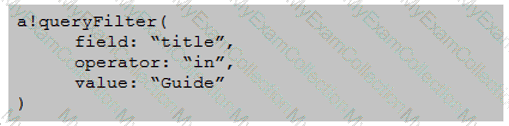
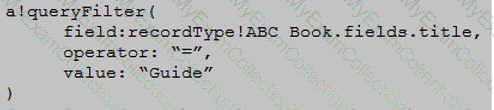
You have a Custom Data Type (CDT), ABC_book, with a constant that refers to its data store entity, ABC_DSE_BOOK.

You need to write a query filter for all ABC_book items whose title contains “Guide”.

Which code snippet accomplishes this goal?

A)
B)

C)
A.

Option A

B.

Option B

C.

Option C

Full Access
Question # 10

What is the Production environment used for?

A.

Allowing business users to test the application.

B.

Allowing developers to make updates to the application.

C.

Allowing business users to use the final version of the application.

Full Access
Question # 11

Which statement about editing interfaces and expression rules is true?

A.

Once created, both expression rules and interfaces cannot be renamed.

B.

Expression rules containing more than 4,000 characters should be converted to interfaces.

C.

When editing an expression rule, interface components do not render for display.

Full Access
Question # 12

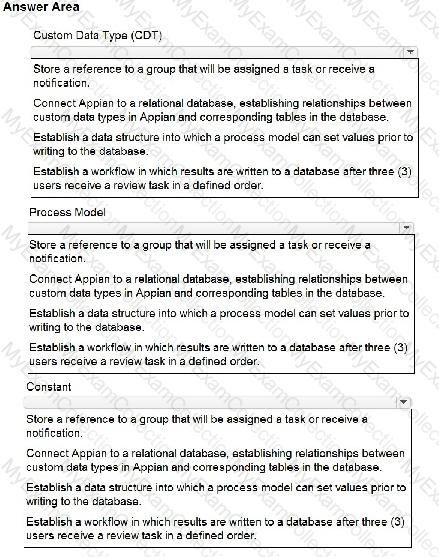
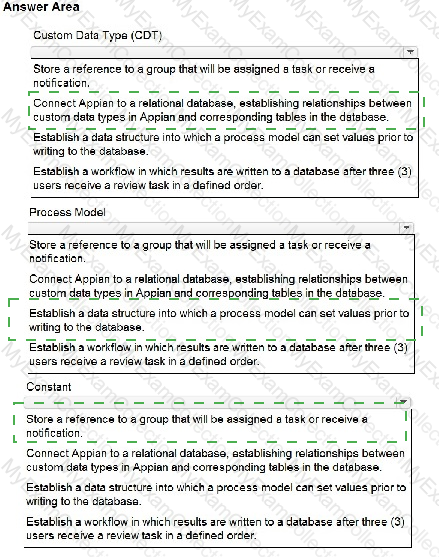
Match each Appian Design Object name to the most applicable use case.

Note: Each use case will be used once or not at all. To change your responses, you may deselect your response by clicking the blank space at the top of the selection list.
Full Access
Question # 13

Which variable type is used to store data used within a single node of a process model?

A.

Rule Inputs

B.

Process Variables

C.

Activity Class Parameters

Full Access
Question # 14

You need to remove an unused field from an existing record type Product, which has data sync enabled and is backed by a database table.

What should you do?

A.

Delete the field from the record type and optionally delete the column from the database table.

B.

Delete the field from the product Custom Data Type (CDT) and perform a full resync of the record type.

C.

Delete the column from the database table and perform a full resync of the record type.

Full Access
Question # 15

Review the following interface definition:
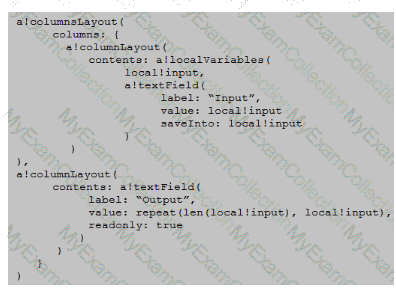
The interface does not display, and you get an error message.

What is the cause of the error?

A.

localinput needs to be configured with a!refreshVariable().

B.

len() is not a valid function and length() should be used instead.

C.

localinput is being referenced outside the scope it is defined in.

Full Access
Question # 16

You are creating a form used to order a pizza. You use a radio button component for the selection.

The pizza selection labels include a list of toppings. You do not want the selection labels to be truncated.

Which layout should you choose?

A.

Compact

B.

Grid

C.

Stacked

Full Access
Question # 17

You receive the following error message after creating a dropdown field:

What could be the problem?

A.

The choiceLabels and choiceValues datatypes do not match.

B.

The choiceValues has too few values.

C.

The choiceLabels have too few labels.

Full Access
Question # 18

You need to view a record type relationship diagram.

Where should you look in the record type?

A.

List

B.

Views

C.

Data model

Full Access
Question # 19

Your customer wants to change the name of a field of an existing Custom Data Type (CDT) to match a renamed database field.

The CDT is backed by a database entity, whose data store has the Automatically Update Database Schema option disabled. The old column name was BIRTHDATE and the new column name is DATE_OF_BIRTH.

How should you proceed?

A.

Download the CDT as XSD, make the appropriate changes, and re-upload the XSD. Verify and publish the data store.

B.

Rename the field in the record type in Appian to automatically update the CDT field.

C.

Rename the field in the CDT in Appian. Verify and publish the data store.

Full Access
Question # 20

You need to create a record type of only active Products using an existing database table: PRODUCT.

The PRODUCT table consists of the following columns:

• ID(INT(11))

• NAME (VARCHAR(255))

• DESCRIPTION (VARCHAR(1000))

• IS_ACTIVE (BIT)

• CREATED_BY (VARCHAR(255))

• CREATED_ON (TIMESTAMP)

• MODIFIED_BY (VARCHAR(255))

• MODIFIED_ON (TIMESTAMP)

What is a valid way to create this record type?

A.

Create a record type with data sync enabled using the PRODUCT table, and apply a source filter on IS_ACTIVE to filter out inactive products.

B.

Create a record type with data sync enabled using the PRODUCT table, and create a user filter using IS_ACTIVE.

C.

Create a record type without data sync enabled using the PRODUCT table, and apply record-level security to filter out inactive products.

Full Access
Question # 21

Which statement regarding the use of rule inputs for expression rules is true?

A.

Only basic data types should be used for rule inputs. Custom Data Types (CDTs) or records should always be queried within the expression rule rather than passed in via rule input.

B.

The data type for rule inputs should be set only for Custom Data Types (CDTs).

C.

If the value passed in via rule input may be a list of numbers, the rule input must be configured as an “Array”.

Full Access
Question # 22

You are creating a large, complex interface

Which statement describes a best practice for strategizing code organization?

A.

Create individual interface objects for each chunk of code that is logically grouped, especially for those that may be reused in other areas of the application.

B.

Create only one interface object per developer assigned to the feature. This balances the performance cost of calling additional interface objects with the need to prevent developers from overwriting each other.

C.

Since the components are related, all code should be centralized in a single interface object. This minimizes the performance cost incurred by Appian calling multiple interface objects.

Full Access
Question # 23

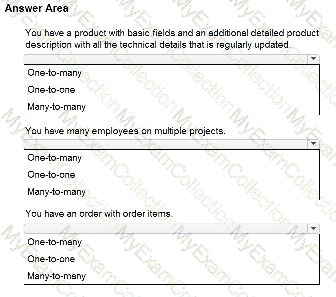
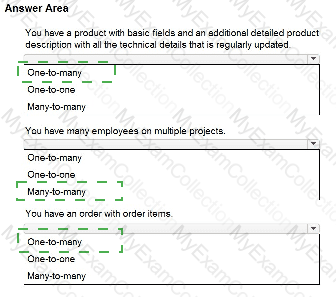
Match each scenario to the correct relationship type in your data model design.

Note: Each relationship type will be used once. To change your responses, you may deselect your response by clicking the blank space at the top of the selection list.
Full Access
Question # 24

How do you refer to metadata of a process model object within process model expressions? For example: the creator, name, or description.

A.

Process Properties, referred to in process model expressions using the pp! domain.

B.

Process Variables, referred to in process model expressions using the pv! domain.

C.

Process Model Properties, referred to in process model expressions using the pm! domain.

Full Access
Question # 25

You select the " Generate groups and folders to secure and organize objects " option while creating a new application, Acme, with the prefix ACM.

By default, which two groups are generated by Appian? (Choose two.)

A.

ACM Administrators

B.

ACM Designers

C.

ACM Viewers

D.

ACM Users

Full Access
Question # 26

You want to prevent a user from submitting a form when an invalid value is entered.

What should you do?

A.

Wrap the Text field in an if statement and display a red card layout when the value is not valid.

B.

Use a rich text display field with “STRONG” style and “NEGATIVE” color when the value is not valid.

C.

In the validations parameter, use an if statement that returns a text string when the value is not valid.

Full Access
Question # 27

You are working on an existing process model with three process variables:

1. pv!vehicleID (integer)

2. pv!vehicle(Custom Data Type (CDT)

3. pv!dealershipName (text)

You have a script task with an output variable, defined as rule!VIM_getVehicle(vehicleID: pv!vehicleID). The result is saved to pv!vehicle.

The rule VIM_getDealershipName() accepts the dealership ID, which is a field on the vehicle CDT, and returns the dealership name.

What should you update in the process model to set the value for pv!dealershipName?

A.

Move the existing output variable to the inputs tab, and name it “vehicle”. Add output variable defined as rule!VIM_getDealershipName(ac!vehicle.dealershipId) and save that value to pv!dealershipName.

B.

Add another output variable defined as rule!VIM_getDealershipName(pv!vehicle.dealershipId) and save that value to pv!dealershipName.

C.

Add a new script task, and add an input variable defined as rule!VIM_getDealershipName(ac!vehicle.dealershipName) that saves into pv!dealershipName.

Full Access
Question # 28

Review the following expression rule:

union(ri!fruit, ri!vegetables)

The rule inputs are configured as text arrays.

What is the expected output?

A.

All items in ri!fruit followed by items in ri!vegetables, including duplicate values.

B.

Only items that are in both ri!fruit and ri!vegetables.

C.

All items in ri!fruit and ri!vegetables combined, with duplicates removed.

Full Access
Question # 29

How can you prevent users from accessing Tempo?

A.

Remove the users from the Tempo Users system group.

B.

Change the default User Start Page.

C.

Ensure the user is in the Application Users group, which by default does not have access to Tempo.

Full Access
Question # 30

What are three ways to start a process from an interface? (Choose three.)

A.

Subprocesses

B.

a!startProcessLink()

C.

a!recordLink()

D.

a!startProcess()

E.

Record Actions

Full Access
Question # 31

You are working on a process model " VIM Update Vehicle. "

You want to call another process " VIM Get Service Date " that accepts pv!vehicleId as a process parameter and sets a value for pv!serviceDate. The next node in VIM Update Vehicle depends on the value of pv!serviceDate.

Which node should you use to execute " VIM Get Service Date " from VIM Update Vehicle?

A.

Start Process smart service

B.

Asynchronous subprocess with activity chaining

C.

Synchronous subprocess with input and output variables configured

Full Access
Question # 32

Where can an Appian Developer connect with and share their expertise with other Appian Developers?

A.

Appian Learning Paths via Appian Academy

B.

Appian Knowledge Base

C.

Appian Community discussions

Full Access
Question # 33

An interface references an expression rule.

What are the relationships between these objects?

A.

Dependents and Reliants

B.

Dependents and Precedents

C.

Inheritance and Association

Full Access
Question # 34

Which statement about local variables is valid?

A.

The data type of a local variable is determined by its value.

B.

Local variables can only store primitive data types, such as numbers and strings.

C.

Local variables must have an initial value set when defining them.

Full Access
Question # 35

Which three of the following are valid page types in a site? (Choose three.)

A.

Record List

B.

Tempo

C.

News Feed

D.

Interface

E.

Action

Full Access
Question # 36

What is an Appian best practice for calling interface rules on your interface?

A.

Call the interface rule on a rule input.

B.

Use keyword syntax.

C.

Always use consistent ordering of rule parameters.

Full Access
Question # 37

Which set of out-of-the-box features is only available when data sync is enabled on a record type?


A.

Generate record actions

Define record type object security

Add custom record fields

B.

Define record type relationships

Add custom record fields

Configure record-level security

C.

Define record type relationships

Add hidden record fields

Configure record-level security

Full Access