Question # 4
An administrator is tasked to install Istio service mesh for the vSphere Kubernetes Service (VKS). What command installs Istio?
Question # 5
An administrator has been tasked with enabling backup for a vSphere Kubernetes cluster. How does the administrator configure a backup?
Question # 7
What two configurations must be applied to a vSphere cluster to support a Supervisor deployment? (Choose two.)
Question # 8
The DevOps engineer deployed a new application to a vSphere Kubernetes Service (VKS) cluster in a vSphere Namespace and then determined that a newer Kubernetes version was required. The vSphere administrator verified compatibility between the Supervisor and all running VKS clusters and successfully updated the vSphere Supervisor to the latest version. After the Supervisor update, the DevOps engineer still could not get the application to work.
What caused the application to fail?
Question # 9
An organization has standardized on the following configurations:
vSphere Kubernetes Services upgrade is separate from vCenter upgrades.
A private registry will be utilized.
What is the recommended solution to adhere to these standards?
Question # 10
What is the function ofContourin a VMware vSphere Kubernetes Service (VKS) cluster?
Question # 12
A cloud platform team is deploying multiple Supervisors in a VMware Cloud Foundation (VCF) environment to support a multi-tenant VKS architecture. Each Supervisor will host a distinct set of namespaces mapped to different organizational tenants such as Finance, Public Services, and R & D, where each tenant consumes resources from dedicated workload domains.
What is the purpose of the vcf context create command?
Question # 13
An administrator enabled cluster scaling by running kubectl edit deployment and updating the number of replicas from 5 to 10. When the cluster was redeployed with the number of replicas set to 5, what was the result?
Question # 14
An administrator is building a secure, multi-tenant container registry strategy for their vSphere Kubernetes Services deployment running on VMware Cloud Foundation. Each workload domain hosts a Supervisor Cluster, and multiple development teams require private repositories to store and distribute container images for Kubernetes clusters. The organization enforces strict image security posture due to compliance requirements. The operations team deploys Harbor as an add-on service through the Supervisor control plane, and developers push/pull images from Harbor through Kubernetes manifests.
What requirement describes the role and purpose of Harbor?
Question # 15
An administrator is deploying vSphere Kubernetes Service (VKS) to support containerized workloads across multiple regions. Each region hosts a dedicated Workload Domain with Supervisor instances deployed on vSphere Distributed Switch (VDS) networking. The organization’s security policy requires that pod-to-pod and pod-to-service communications be fully observable and controllable at the Kubernetes layer, without introducing additional licensing or overlay complexity.
When deploying a Supervisor, which CNI should the administrator select as the default supported option?
Question # 16
Which four capabilities are provided by a VMware Kubernetes Service (VKS) cluster?
Question # 17
A VMware Administrator is tasked with implementing a backup and restore strategy using Velero and external object storage for the namespace ' myapp1. Arrange the steps In the correct order of operations to enable Vetero.
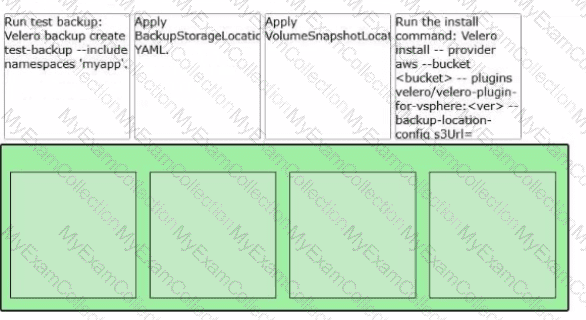
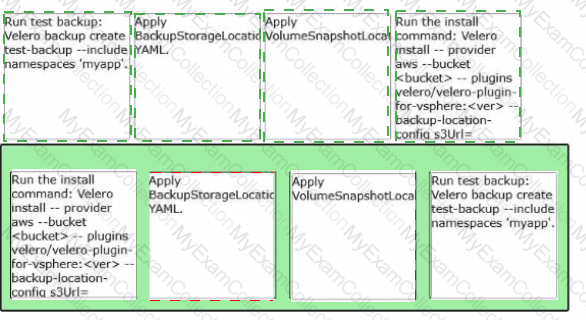
Question # 18
What role does Contour play in a VMware vSphere Kubernetes Service (VKS) architecture?
Question # 19
A cloud operations team is managing multiple Supervisor Clusters across two regions. Each region hosts its own vSphere Kubernetes clusters, integrated through a federated service mesh to enable consistent service connectivity and policy enforcement across environments.
The application team wants to expose a multi-tier microservice named “GovAppâ€, which includes front-end, API, and database services distributed between the two regions. Uniform traffic routing, identity, and security policies are also needed for these workloads regardless of the cluster or region in which they are deployed.
To meet these requirements, the architects decide to create a Global Namespace that spans both Supervisor Clusters.
Which two statements describe the requirements for a Global Namespace in a vSphere Kubernetes Service Mesh deployment? (Choose two.)
Question # 20
Which protocols are supported for use as an external identity provider for VMware vSphere Kubernetes Service (VKS) clusters?
Question # 21
A remote site has a requirement for VMware vSphere Kubernetes Service (VKS). The environment has minimal storage available. Which action ensures the Content Library does not consume all available space on the datastore?
Question # 22
An administrator must assign a storage policy to a VMware vSphere Kubernetes Service (VKS) Cluster. Which step satisfies the requirement?
Question # 23
An administrator set the following value: ENABLE_AUDIT_LOGGING=true during cluster deployment. Which statement explains the benefit of this setting?
Question # 24
An administrator is upgrading to VKS 3.4 and encounters the following error during cluster creation using workload, yami:

How should the administrator resolve this issue to successfully complete the upgrade " ?