Question # 4
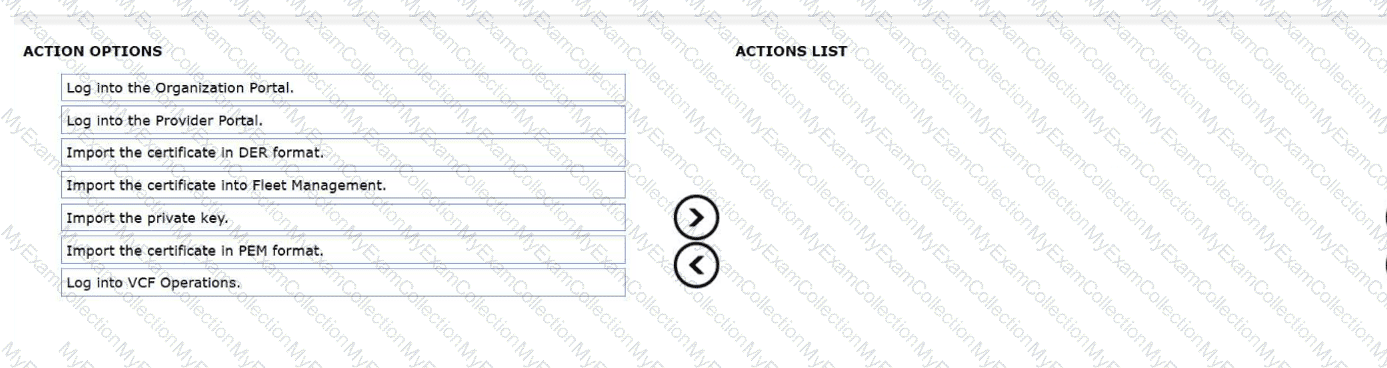
An organization administrator has been tasked with adding a certificate to their organization in VCF Automation. What three actions are required? (Choose three.)

Question # 5
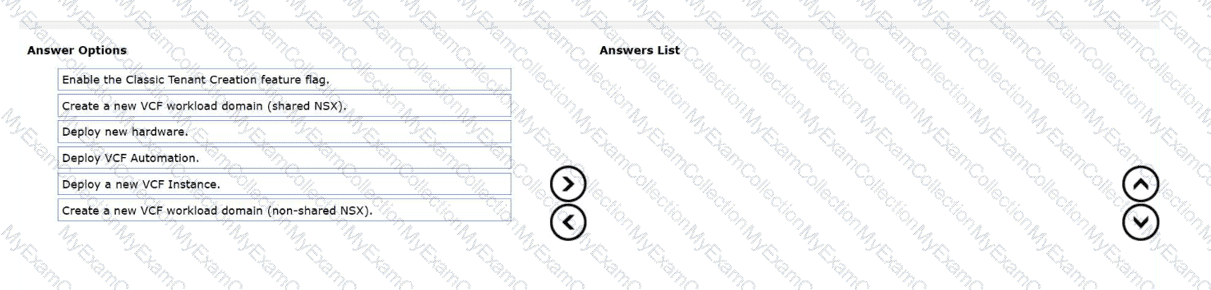
An administrator has been tasked with creating a new organization for VM Apps within an existing VMware Cloud Foundation (VCF) Fleet with minimal operational overhead.
The existing VCF fleet already has an organization for All Apps configured.
Drag and drop the three actions from the Answer Options to the Answers List, in any order, that the administrator needs to perform to complete the objective (Choose three.)

Question # 6
The product development team is rolling out several new application stacks and require a self-service option to deploy their applications quickly and consistently. The requirements are:
• Present only approved application configurations.
• No manual configuration within a blueprint.
Which VMware Cloud Foundation (VCF) Automation approach meets these requirements?
Question # 7
An administrator has been tasked to provide workload storage that remains available even if one zone in a three-zone Supervisor cluster fails. Which action must the VMware Cloud Foundation (VCF) Automation administrator take to meet this requirement?
Question # 8
An administrator must initiate the deployment of a new 3-tier application architecture using the VMware Cloud Foundation (VCF) Automation portal. This application includes:
• A web tier (stateless).
• A business logic tier (some local caching).
• A database tier (stateful, PostgreSQL).
• An NSX load balancer fronting the web tier.
• ~99.9% uptime requirement.
• Moderate performance requirements.
Which requirement represents a risk inherent to single-zone deployments?
Question # 9
An administrator is designing a VCF Automation service catalog item that enables development teams from multiple business units to deploy standardized environments for microservices applications. The solution must support consistent configuration, minimize environment sprawl, and enforce automated decommissioning policies. Which three capabilities of VMware Cloud Foundation (VCF) Automation can be used to meet these requirements? (Choose three.)
Question # 11
An administrator has been tasked with deploying an AllApps Organization within VMware Cloud Foundation (VCF) Automation.
During the regional networking creation step, which three NSX constructs will automatically be configured? (Choose three.)
Question # 12
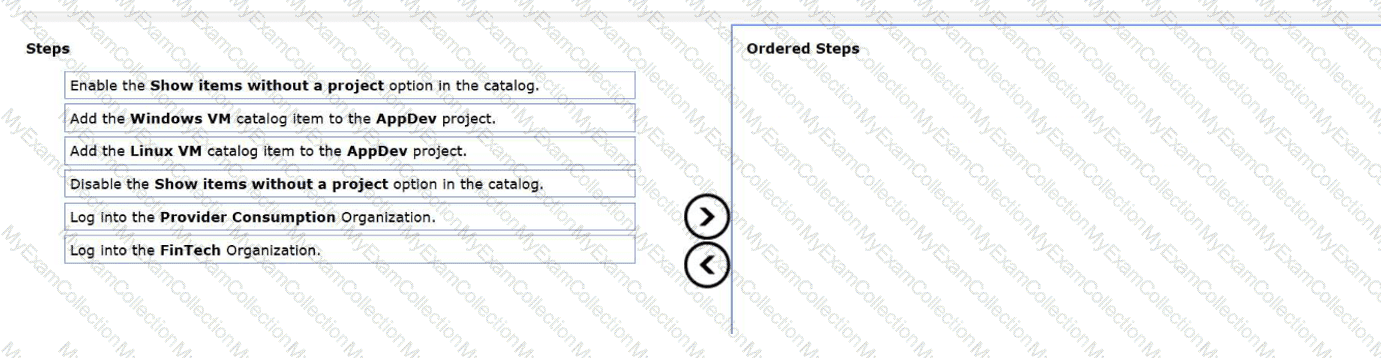
An administrator has been tasked with sharing a catalog item from the VMware Cloud Foundation (VCF) Automation Provider Consumption Org (PCO) to the FinTech
organization.
The following information has been provided:
The are two catalog items, Linux VM and Windows VM
The Linux VM catalog item should be shared project called AppDev.
Drag and drop three steps from the Steps list to the Ordered Steps list on the right to complete the objective. (Choose three.)

Question # 13
An organization uses a centralized external Configuration Management Database (CMDB) to track all infrastructure assets. Currently, when a new virtual machine (VM) is provisioned through VMware Cloud Foundation (VCF) Automation, operations teams are required to manually input associated metadata into the CMDB.
An administrator is tasked with reducing the manual effort and increasing efficiency of this process using VCF Automation.
Which three of the following can VCF Automation perform? (Choose three.)
Question # 14
An administrator is responsible for managing a VMware Cloud Foundation (VCF) fleet and the administrator has been tasked with the following:
• Create DNS records before each virtual machine (VM) is deployed using VCF Automation.
The administrator has already completed the following tasks:
• Created two VCF Operations Orchestrator Workflows with corresponding Event Subscriptions:
Create DNS Record
Delete DNS Record
• Created a new blueprint to deploy a VM:
Added two string inputs, hostname and domainName
Added hostname: '${input.hostname}' as a custom property of the Virtual Machine resource.
Added domainName: '${input.domainName}' as a custom property of the Virtual Machine resource.
What should the administrator configure within the Event subscription to ensure that the DNS record is only created when the hostname is provided?
Question # 15
An organization is experiencing rapid growth, and the VMware Cloud Foundation (VCF) administrator needs to ensure that the "Development" organization does not consume all available physical resources in the "West" region, which is shared with the "Production" organization.
What should the administrator configure to limit the total CPU and Memory consumption for the Development organization?
Question # 16
An administrator has been tasked with creating a region to provide resources to an Organization in VMware Cloud Foundation (VCF) Automation.
The following information has been provided to the administrator for this task:
• Two workload domains are configured and will integrate with the region.
• All workload domains are configured to share a VMware NSX Manager.
• All workload domains are configured with VMware vSAN storage.
• All workload domain VMware vCenter instances have a Supervisor enabled.
Before creating the region, what two additional configurations should the administrator validate? (Choose two.)
Question # 17
An administrator clicks on Orchestrator to create a workflow in a VMApps organization as shown in the image. Where would the administrator go next to enable Orchestrator?
Question # 18
A customer needs to deploy Kubernetes-based workloads in a newly created VMware Cloud Foundation (VCF) workload domain.
Which two prerequisites must be met before creating an AllApps Organization in VMware Cloud Foundation (VCF) Automation? (Choose two.)